Push for clean energy and electrification a key focus at COP31 in Turkey推动清洁能源和电气化是土耳其COP31气候大会的重点议题。
Turkey is proposing is to increase the share of electricity in global energy demand from 20% currently to 35% by 2035. Read more at straitstimes.com.
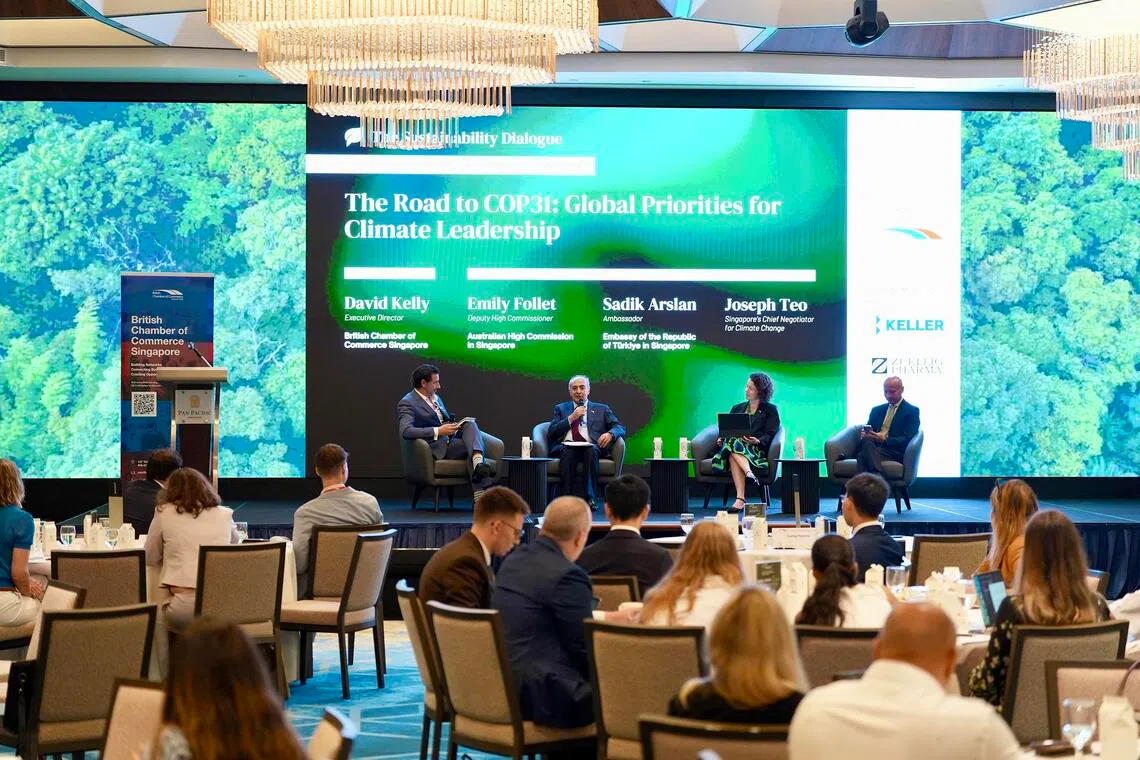
The panellists were speaking at a panel at the Sustainability Dialogue 2026 organised by the British Chamber of Commerce Singapore on Sept 3.
PHOTO: BRITISH CHAMBER OF COMMERCE SINGAPORE
Published Sep 03, 2026, 08:25 PM
Updated Sep 03, 2026, 08:25 PM
SINGAPORE – Getting countries to accelerate their transition from fossil fuels to cleaner energy options will be a key focus at the upcoming UN climate conference COP31 held in Turkey in November.
This round of the annual summit, hosted by Turkey with Australia leading the negotiations, will have a “strong focus” on electrification and clean energy investment, said Emily Follet, deputy high commissioner at Australian High Commission in Singapore.
She was speaking on Sept 3 during a panel at the Sustainability Dialogue 2026 organised by the British Chamber of Commerce Singapore.
One of the main targets Turkey is proposing is to increase the share of electricity in global energy demand from 20 per cent currently to 35 per cent by 2035 through electrification.
Electrification helps to reduce carbon emissions by replacing fossil fuels with electricity power from low-carbon sources – such as the switch from cars with internal combustion engine to electric cars. This replaces fossil fuel combustion in a car with a battery that can be charged up with green sources.
Follet said that energy security vulnerabilities as highlighted by the recent global energy shocks could help to fuel interest in more financing for renewable energy.
“More clean energy and greater electrification can, of course, reduce exposure to volatile fuel markets… they strengthen energy security, and they reduce emissions at the same time, so it really is a win-win,” she said.
The other panellists are Sadik Arslan, Turkey’s ambassador in Singapore , and Joseph Teo, Singapore’s chief negotiator for climate change.
Arslan said Turkey has been investing in renewable energy. More than 50 per cent of the country’s electricity is generated by renewables, mainly from hydroelectric, solar and wind power, he added.
On how the success of the climate summit should be measured , he said that negotiations deliver balanced progress on mitigation, adaptation and means of implementation . Tangible action should also be visible beyond the negotiating rooms, in energy systems, among others.
“For Turkey, an implementation COP means linking multilateral consensus to practical delivery,” he said.
Teo said the target to raise electricity’s share of global energy demand to 35 per cent by 2035 is one that Singapore is keen about.
“We really need to talk about practical ways of getting countries to retire coal early and then to phase in renewable energy,” he said.
Investments in energy grids is also an issue that interests the Republic.
Singapore can play the role of a connector, Teo said, such as by way of rallying public-private partnerships.
An example is Singapore’s Financing Asia’s Transition Partnership (FAST-P). This climate financing initiative makes use of blended finance – which involves a mix of public, private and philanthropic money – to fund projects such as those pushing for cleaner sources of electricity to replace coal.
The blended finance approach uses public or philanthropic capital to attract risk-averse private capital, which holds most of the world’s wealth, to kick-start investment in sustainable projects.
“Singapore came in putting in some first-loss instrument and then trying to structure innovatively how to get in place the pieces, the secret, sweet sauce that can then crowd in private sector,” said Teo.
First-loss guarantees refer to a financial mechanism where a public or philanthropic investor agrees to absorb the initial losses in a portfolio of investments, protecting commercial lenders and institutional investors.
Besides investing in clean energy, more investment is also needed in helping countries to adapt to the intensifying impacts of climate change, Pollet said.
Adaptation measures include making a place more flood-proof, strengthening food security, and making infrastructure more climate-resilient.
Other priorities Australia has at COP31 are mobilising finance and investment, growing green industries, and elevating the needs and priorities of the Pacific nations, which are the most vulnerable to the impacts of climate change, said Pollet.
Teo said Singapore hopes the upcoming summit will build on the outcomes achieved at COP30 in Belem, Brazil, and give a “very strong” support for multilateralism to engineer the actions needed in a geopolitically fraught time.
The summit should be not be dismissed as a “talk shop”, he added.
Each COP sends signals of a government’s intentions to reach a certain target, through instruments like nationally determined contributions – or national climate targets – and national adaptation plans.
“Those signals are important for the private sector, and those (in) private sector should use those signals to know where they should be putting their money,” he said.
Chin Hui Shan is a journalist covering the environment beat at The Straits Times.
Environmental issues
Climate change conference/COP
小组成员于 9 月 3 日在新加坡英国商会举办的 2026 年可持续发展对话小组会议上发表了讲话。
图片来源:新加坡英国商会
发布于 2026 年 9 月 3 日晚上 8:25
更新于2026年9月3日晚上8:25
新加坡——促使各国加快从化石燃料向更清洁能源转型将是即将于11月在土耳其举行的联合国气候变化大会(COP31)的一个重点议题。
澳大利亚驻新加坡高级专员公署副高级专员艾米丽·福莱特表示,本轮由土耳其主办、澳大利亚牵头谈判的年度峰会将“重点关注”电气化和清洁能源投资。
9月3日,她在新加坡英国商会举办的2026年可持续发展对话小组讨论会上发表了讲话。
土耳其提出的主要目标之一是通过电气化,到 2035 年将电力在全球能源需求中的份额从目前的 20% 提高到 35%。
电气化通过用低碳能源发电替代化石燃料发电,有助于减少碳排放——例如,用电动汽车取代内燃机汽车。这用可使用绿色能源充电的电池取代了汽车中的化石燃料燃烧。
福莱特表示,近期全球能源冲击凸显了能源安全方面的脆弱性,这可能会激发人们对可再生能源融资的兴趣。
“当然,更多的清洁能源和更高的电气化水平可以减少对波动性燃料市场的风险敞口……它们既能增强能源安全,又能同时减少排放,所以这真的是双赢,”她说。
其他小组成员包括土耳其驻新加坡大使萨迪克·阿尔斯兰和新加坡气候变化首席谈判代表约瑟夫·张。
阿尔斯兰表示,土耳其一直在投资可再生能源。他补充说,该国超过50%的电力来自可再生能源,主要包括水力发电、太阳能发电和风能发电。
关于如何衡量气候峰会的成功,他表示,谈判应在减缓、适应和实施手段方面取得平衡进展。切实行动也应体现在谈判之外,例如在能源系统等领域。
他说:“对土耳其而言,执行型缔约方大会意味着将多边共识与实际执行联系起来。”
张先生表示,新加坡非常希望实现到 2035 年将电力在全球能源需求中的份额提高到 35%。
他说:“我们真的需要讨论一些切实可行的方法,让各国尽早淘汰煤炭,然后逐步引入可再生能源。”
对能源网络的投资也是共和国关注的问题之一。
张先生表示,新加坡可以发挥连接者的作用,例如通过促成公私合作。
例如新加坡的“亚洲转型融资伙伴关系”(FAST-P)。这项气候融资倡议利用混合融资——即公共资金、私人资金和慈善资金的组合——为诸如推动清洁能源替代煤炭等项目提供资金。
混合融资方式利用公共或慈善资本来吸引规避风险的私人资本(私人资本掌握着世界上大部分财富),从而启动对可持续发展项目的投资。
“新加坡先是投入了一些首损工具,然后尝试以创新的方式构建如何将各个环节、秘诀和甜头整合起来,从而吸引私营部门参与,”张先生说。
首损担保是指一种金融机制,其中公共或慈善投资者同意承担投资组合中的初始损失,从而保护商业贷款人和机构投资者。
波莱特表示,除了投资清洁能源外,还需要加大投资,帮助各国适应日益加剧的气候变化的影响。
适应措施包括提高防洪能力、加强粮食安全以及提高基础设施的气候适应能力。
波莱特表示,澳大利亚在COP31上的其他优先事项包括调动资金和投资、发展绿色产业,以及提升太平洋岛国的需求和优先事项,因为这些国家最容易受到气候变化的影响。
张先生表示,新加坡希望即将举行的峰会能够巩固在巴西贝伦举行的第30届联合国气候变化大会(COP30)所取得的成果,并为多边主义提供“非常强有力的”支持,以在当前地缘政治局势紧张的时期制定必要的行动。
他补充说,不应将此次峰会视为“空谈会”。
每次缔约方大会都会通过国家自主贡献(或国家气候目标)和国家适应计划等手段,发出政府实现特定目标的意图信号。
他说:“这些信号对私营部门很重要,私营部门的人员应该利用这些信号来了解应该把钱投向哪里。”
Chin Hui Shan是《海峡时报》负责环境报道的记者。
环境问题
气候变化大会/COP