Beyond prototypes: Army readies operational NGC2 tech for I Corps超越原型:陆军为第一军准备投入作战使用的NGC2技术
As the Army begins fielding NGC2 to I Corps, software tools will be critical to enable interoperability and getting new capabilities to units faster.
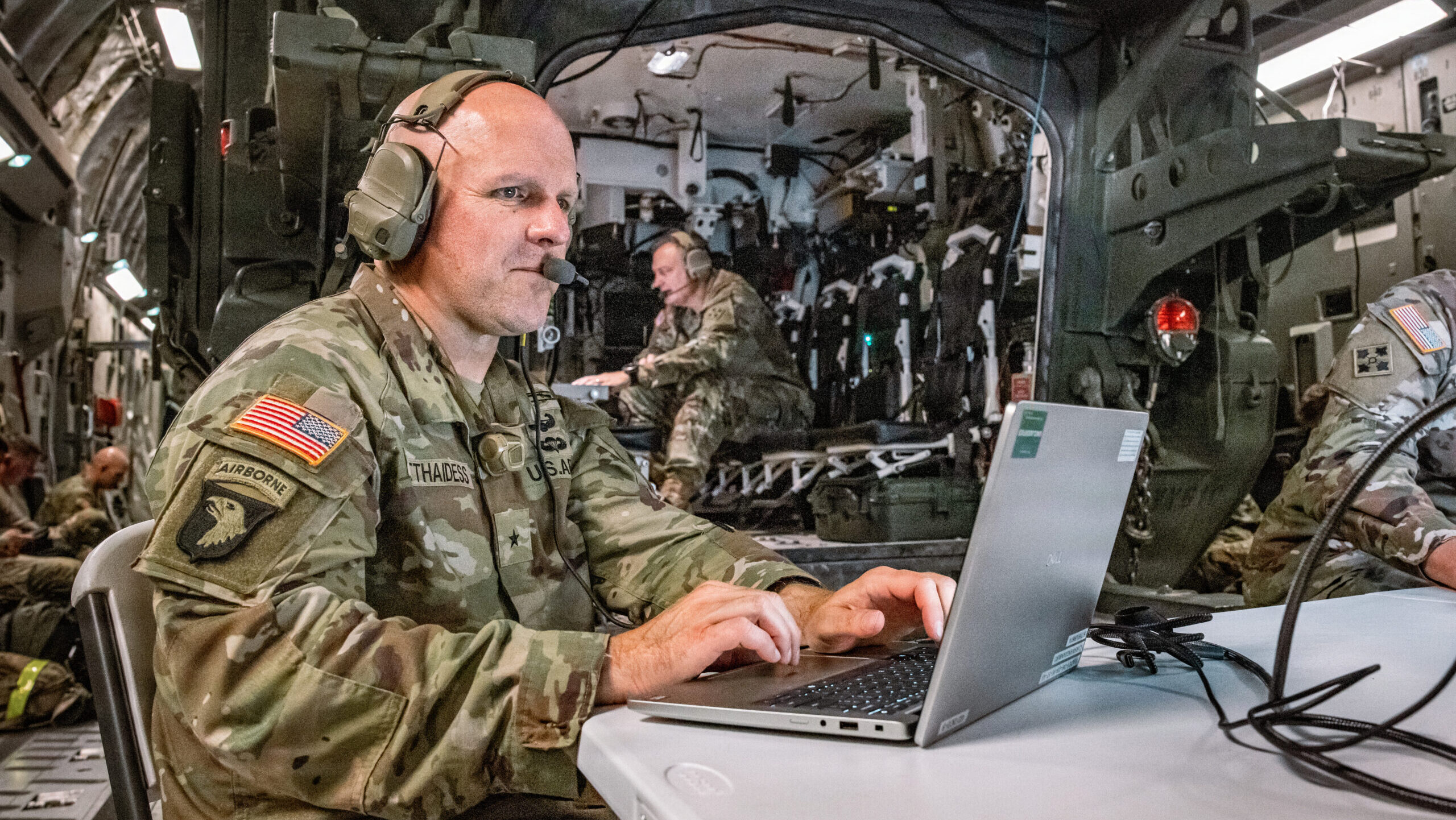
Brig. Gen. Edwin Matthaidess III, the deputy commanding general for maneuver of the 4th Infantry Division, utilizes Next-Generation Command and Control communication capabilities aboard a U.S. Air Force C-17 Globemaster III over the Pacific Ocean while en route to Indonesia for Super Garuda Shield 2026, Aug. 24, 2026. (U.S. Army photo by Spc. Jonathan Reyes)
WASHINGTON — After more than a year of experimentation, the Army is on track to provide the first operational version of its ambitious Next Generation Command and Control hardware and software to the I Corps, starting with choosing which software applications to move forward.
“The reality is, some of the principal apps of Next Generation Command and Control, we’ve already incorporated into our operations as we provided some C2 oversight for both 4th Infantry Division and 25th,” I Corps commander Lt. Gen. Matthew McFarlane told Breaking Defense.
The 4th and 25th ID have been the principal testers for NGC2 prototypes for months, culminating in NGC2 experiments at the Army’s Project Convergence Capstone 6 event, which began in late July.
I Corps will be the first to receive what Army officials described as the locked-in architecture: a combination of new, commercial gear as well as reggeized, bespoke military systems. NGC2, billed by senior leaders as a ground up rebuild of communications networks to enable everything from passing and receiving data to intelligence information, is planned to eventually be fielded to the entire service.
But going from the division level to the corps level is expected to come with its own challenges, McFarlane said in the Aug. 24 interview. In this case, the I Corps is made up of several Army units, to include four divisions — typically between 12,000-16,000 people — across the massive Pacific theater.
“Corps echelons do not fight localized tactical engagements. My job, the Corps’ job, is to shape operational battlespaces, allocate theater-level resources, and orchestrate complex multi-domain campaigns across vast maritime distances,” he said.
Before the tech gets to I Corps, the first order of business, NGC2 program officials said, is slimming down the software footprint. The 4ID had 45 apps during Project Convergence in July, but the final baseline will be significantly less than that, broken down into core and common services. Common services are things like map capabilities while core apps serve particular warfighting functions such as airspace deconfliction, sustainment and spectrum management. While not specifying exactly what those applications are, McFarlane said they include logistics.
The defense intelligence community’s AI and cyber view forward
From AI adoption and agentic systems to Zero Trust and cyber resilience, Breaking Defense’s latest eBook brings together key reporting from DoDIIS 2026 on the technologies and strategies shaping the future of defense intelligence.
Army program officials explained the biggest requirement in shifting the NGC2 architecture to the corps level is ensuring interoperability with other joint and multinational partners.
“In the Pacific, I Corps acts as a joint multinational data router. By scaling [NGC2’s] open architecture, we are securely federating real-time sensor-shooter data from joint services and our partners and allies to achieve true decision dominance. We’re nesting this transition directly with our active training tempo starting in earnest with a software rollout in October, followed by upcoming exercises,” McFarlane said.
To that end, the Army is making big bets on how that software flexibility will enable “fight tonight” capabilities, tools McFarlane can employ immediately into battle, if needed, as a senior operational commander in the Pacific.
Joseph Welch, portfolio acquisition executive for command and control and counter-command and control, told Breaking Defense at the TechNet conference in Augusta, Ga., “that’s really where my focus is going to be as we move into I Corps. We want to be able to get them to achieve fight tonight capability with these new tools as quickly as possible.”
“The fight tonight challenge … is we need to be able to get this capability to the point where we can do that handoff, we can make that transition from the legacy C2 system that the modern software based capability we’re providing as part of NGC2 is able to pick that up and go,” he said.
Those apps and features have to integrate with others across the board.
“Key is … interoperability with our joint partners and allies as we’re equipping with these new systems and these apps, making sure we can connect with everybody on the battlefield, even if they have historical or their host nation systems, but we can connect with them and have the ability to gain the decision dominance,” McFarlane said.
To test that kind of interoperability among the US services, 4ID is currently participating in Garuda Shield with the Indonesian Army using its NGC2 architecture for planning enroute to the region aboard joint platforms and as part of the exercise.
For that exercise, Brig. Gen Edwin Matthaidess, deputy commanding general for maneuver for 4ID, told Breaking Defense the command picked two “stretch goals.”
“We said we wanted to do enroute mission command while flying. And then when we got out here, we know there’s some naval components to Super Garuda Shield, [so] we said, hey, we want to put it on a boat,” Matthaidess said in an interview. “We’re going to be operating in in the littorals. We’re going to be operating in the archipelagic region, how do we get it afloat?”
Enroute communications, he said, allow for battle planning, updating air tasking orders, targeting and overall command and control before even touching on the ground. He said he was able to take all his normal meetings he had at home in his Stryker 30,000 feet in the air abord a C-17 on the way to Indonesia.
But it required C2 links between services to keep the info flowing back and forth — in this case the Army used new proliferated-Low Earth Orbit-equipped C-17s from the Air National Guard that allowed high transport bandwidth.
When it comes to afloat capabilities, Matthaidess said they know they’re going to be part of a joint plan and that will most likely involve operations on ships and waterways.
The destroyer that the Navy had in the region they planned to plug into was pulled away, he said, but 4th ID was able to integrate two different NGC2 kits to Coast Guard fast response cutters, courtesy of Pacific Fleet, to try two different forms of integration.
It’s “not truly plug and play yet, but easily integrated and in a matter of minutes, we’re up and running on comms, talking … [while] we’re sitting in Jakarta on another island across the strait on a vessel that we hadn’t seen 24 hours before,” he said.
Moving down the ladder, the corps is responsible for coordinating the capabilities of all its subordinate units and divisions.
“As we apply the [NGC2] ecosystem to my command and control the fight, I’ll enable subordinate divisions and brigades freedom of action through decentralized mission command-driven data architecture,” McFarlane said.
He added that, in his view, the architecture provides a significant amount of tailorability for each subordinate unit to customize as they need to fit their unique requirements.
“The tailorable aspect is key, [and] especially will be important at the operation level for some of considerations that I have across the theater and wherever I’m operating, versus what a division has that’s focused on a smaller area for their tactical operations,” he said.
And even though I Corps will be getting an operational NGC2 architecture, the service plans to keep adapting the tech.
James Craven, Program Manager for NGC2 for Anduril, which was recently selected to lead the common data layer baseline , said in an early August interview that over the next six months, industry and the Army will be working to figure out what can be incorporated from existing architectures and what changes need to be made to the data layer to get the right information to the right place without overloading units.
2026年8月24日,美国陆军第四步兵师机动副司令埃德温·马泰德斯三世准将乘坐美国空军C-17“环球霸王III”运输机飞越太平洋,前往印度尼西亚参加“超级迦楼罗之盾2026”联合军演。在飞行途中,他使用了新一代指挥控制通信技术。(美国陆军下士乔纳森·雷耶斯摄)
华盛顿——经过一年多的试验,陆军正按计划向第一军提供其雄心勃勃的下一代指挥控制硬件和软件的第一个可运行版本,首先要选择哪些软件应用程序要继续推进。
“事实上,下一代指挥与控制的一些主要应用程序,我们已经将其纳入到我们的行动中,因为我们为第4步兵师和第25步兵师提供了一些指挥控制监督,”第一军军长马修·麦克法兰中将告诉《防务新闻》。
几个月来,第 4 和第 25 步兵师一直是 NGC2 原型机的主要测试部队,最终在 7 月下旬开始的陆军“融合项目顶石 6”活动中进行了 NGC2 实验。
第一军将率先接收陆军官员所称的“锁定架构”:该架构融合了新型商用设备和定制化的军用系统。高级领导人称,NGC2是对通信网络的彻底重建,旨在实现从数据传输到情报信息传递的全面功能,最终计划部署到整个陆军。
但麦克法兰在8月24日的采访中表示,从师级到军级的升级预计会带来自身的挑战。就此而言,第一军由多个陆军单位组成,包括四个师——通常在12000至16000人之间——遍布广袤的太平洋战区。
“军级单位不参与局部战术交战。我的职责,军级单位的职责,是塑造作战空间,分配战区级资源,并协调跨越广阔海域的复杂多域作战行动,”他说。
NGC2项目官员表示,在技术部署到第一军之前,首要任务是精简软件数量。第四步兵师在7月份的“融合项目”中安装了45个应用程序,但最终的基线版本将大幅减少,并分为核心服务和通用服务。通用服务包括地图功能等,而核心应用程序则服务于特定的作战功能,例如空域冲突协调、后勤保障和频谱管理。麦克法兰并未具体说明这些应用程序是什么,但他表示其中也包括后勤保障。
国防情报界对人工智能和网络安全的未来展望
从人工智能应用和智能体系统到零信任和网络弹性,《Breaking Defense》最新电子书汇集了 DoDIIS 2026 的重要报告,内容涉及塑造国防情报未来的技术和战略。
陆军项目官员解释说,将 NGC2 架构转移到军级的最大要求是确保与其他联合和多国伙伴的互操作性。
“在太平洋地区,第一军扮演着联合多国数据路由器的角色。通过扩展[NGC2]的开放式架构,我们正在安全地联合来自联合部队、伙伴和盟友的实时传感器-射击数据,以实现真正的决策优势。我们将这一过渡与积极的训练节奏紧密结合,从10月份正式推出软件开始,随后将举行一系列演习,”麦克法兰说道。
为此,陆军正在大力押注这种软件灵活性将如何实现“今晚开战”的能力,麦克法兰作为太平洋地区的高级作战指挥官,如果需要,可以立即将这些工具投入战斗。
负责指挥控制和反指挥控制的投资组合采购主管约瑟夫·韦尔奇在佐治亚州奥古斯塔举行的 TechNet 会议上告诉 Breaking Defense,“随着我们进入第一军,这确实是我关注的重点。我们希望能够尽快让他们利用这些新工具实现今晚就能开战的能力。”
他说:“今晚的挑战在于……我们需要将这种能力提升到可以进行交接的程度,我们可以从传统的 C2 系统过渡到我们作为 NGC2 的一部分提供的基于现代软件的能力,使其能够接管并继续运行。”
这些应用和功能必须与其他应用和功能全面集成。
麦克法兰说:“关键在于……与我们的联合伙伴和盟友的互操作性,因为我们正在为这些新系统和应用程序配备设备,确保我们能够与战场上的每个人连接,即使他们拥有的是历史遗留系统或东道国系统,但我们仍然可以与他们连接,并有能力获得决策优势。”
为了测试美国各军种之间的这种互操作性,第4步兵师目前正在与印尼陆军一起参加“迦楼罗之盾”演习,在前往该地区的途中,他们使用联合平台和其NGC2架构进行规划。
4ID机动部队副司令埃德温·马泰德斯准将告诉《防务新闻》,为了这次演习,指挥部选择了两个“挑战目标”。
“我们当时就想在飞行过程中进行航程任务指挥。但到了这里之后,我们发现‘超级迦楼罗之盾’系统包含一些海军组件,所以我们就说,嘿,我们想把它装到船上,”马泰德斯在一次采访中说道。“我们将在近岸海域和群岛地区执行任务,我们该如何让它漂浮起来呢?”
他表示,飞行途中的通信使得作战计划、更新空中任务指令、目标定位以及整体指挥控制能够在飞机着陆前完成。他还说,他能够在飞往印度尼西亚的C-17运输机上,在3万英尺的高空,完成所有他平时在“斯特瑞克”装甲车内进行的会议。
但这需要各军种之间的 C2 连接来保持信息来回流动——在这种情况下,陆军使用了来自空中国民警卫队的新型、已扩散的低地球轨道装备的 C-17 运输机,这些运输机具有高传输带宽。
马泰德斯表示,就海上作战能力而言,他们知道自己将参与一项联合计划,而该计划很可能涉及在船舶和水道上的行动。
他说,海军在该地区计划接入的驱逐舰被调走了,但第四步兵师在太平洋舰队的帮助下,将两套不同的 NGC2 套件集成到海岸警卫队的快速反应巡逻艇上,以尝试两种不同的集成方式。
他说:“虽然还不能真正做到即插即用,但它很容易集成,几分钟之内,我们就能开始通信,进行通话……(而我们当时正坐在雅加达,在海峡对岸的另一个岛上,在一艘我们24小时前都没见过的船上。”
再往下看,军团负责协调其所有下属单位和师的能力。
麦克法兰说:“随着我们将 [NGC2] 生态系统应用于我的指挥和控制作战,我将通过去中心化的任务指挥驱动的数据架构,使下属师和旅拥有行动自由。”
他还补充说,在他看来,这种架构为每个下属单位提供了相当大的可定制性,可以根据自身独特的需求进行定制。
他说:“可定制性是关键,尤其是在作战层面,因为我需要考虑整个战区以及我作战的任何地点的情况,这与专注于较小区域进行战术作战的师级单位的情况截然不同。”
尽管第一军将获得可运行的 NGC2 架构,但该军种计划不断改进这项技术。
最近被选中领导通用数据层基线的 Anduril 的 NGC2 项目经理 James Craven 在 8 月初的一次采访中表示,在接下来的六个月里,业界和陆军将努力弄清楚可以从现有架构中整合哪些内容,以及需要对数据层进行哪些更改,以便在不使部队过载的情况下将正确的信息传递到正确的位置。