US Air Force seeks ‘rapidly deployable’ drone swarms for base security美国空军寻求“可快速部署”的无人机群以加强基地安全
The U.S. Air Force is looking to use "rapidly deployable" swarms of AI-controlled drones for base security.
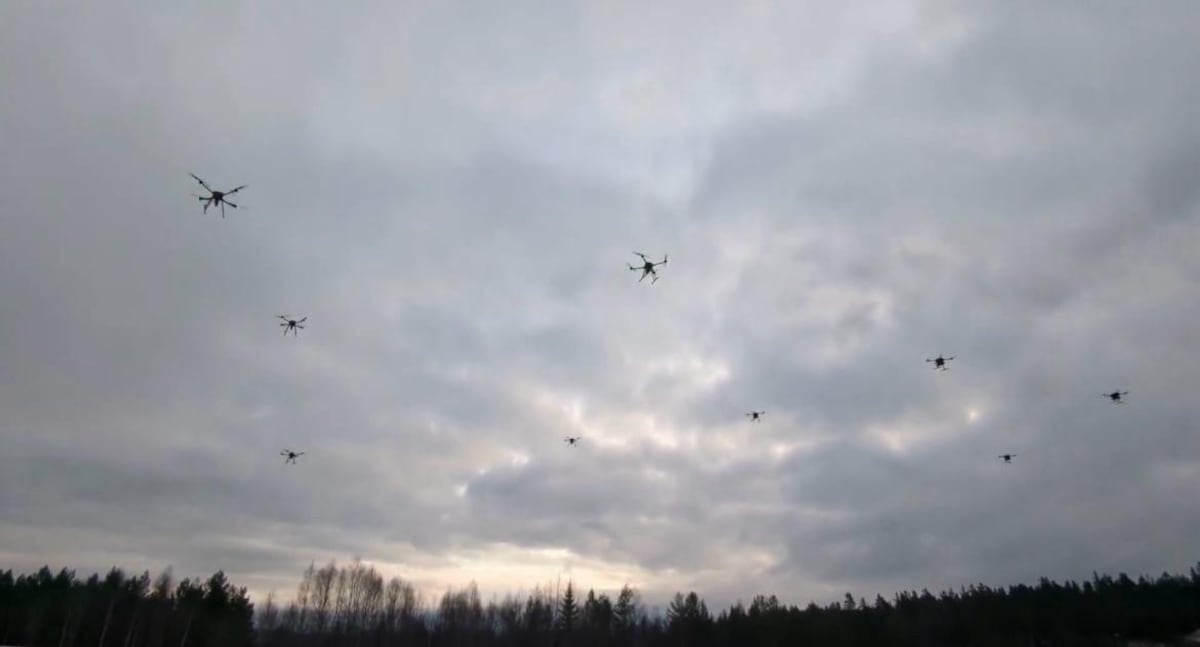
The U.S. Air Force is looking to turn its cargo planes into launch platforms for drone swarms.
Or more specifically, the service would like transport aircraft and their retinue of drones to deploy to Air Force bases. Once there, this swarm of AI-controlled drones would autonomously defend the bases — and any aircraft parked there — from attack.
The goal is to transform cargo planes into “adaptive, force-multiplying launch platforms” that provide “a rapidly deployable swarm for base security,” according to an Air Force Small Business Innovation Research solicitation. The deadline is Oct. 21.
The Air Force is looking for a 3-for-1 deal. One mission is to provide transport aircraft with onboard intelligence, surveillance and reconnaissance capabilities by enabling them to become high-altitude drone motherships, as the Defense Advanced Research Projects Agency demonstrated in 2021 when a C-130 recovered an X-61 Gremlin in mid-air.
An X-61 Gremlin Air Vehicle drone and a C-130 during a flight test conducted by DARPA at Dugway Proving Ground, Utah, on Oct. 29, 2021. During the flight test, DARPA said it successfully recovered a Gremlin in midair for the first time. (DARPA)
A footnote in the SBIR also cites discussion by Air Mobility Command of using KC-135 tankers as launch platforms.
Another mission is “self-protection for Mobility Air Forces operating in contested airspace.” Such a capability would have been welcome in the Iran war, during which Iranian strikes destroyed or damaged American tankers and airborne warning and control system aircraft parked at Persian Gulf airbases.
Meanwhile, drone swarms would protect forward bases from which the transports and other aircraft operate.
Transport planes can be “significantly augmented with enhanced organic self-protection and intelligence, surveillance, and reconnaissance capabilities to maintain operational overmatch,” explained the SBIR. “Similarly, forward operating bases can bolster their security posture by leveraging rapidly deployable, autonomous perimeter defense networks.”
In a sign of how far drone and AI technology has advanced, the project is skipping the customary Phase I of an SBIR and going straight to Phase II.
“The fundamental scientific and technical merit of coordinating multiple uncrewed aerial systems via artificial intelligence has already been established by the private sector,” the Air Force noted.
Phase II involves contractors demonstrating how cargo planes can deploy drone swarms “at operational altitudes to simulate operational Mobility Air Forces scenarios.” As for the drones, companies should show “the swarm’s ability to autonomously monitor and defend a designated perimeter using onboard visual and thermal sensors.”
The Air Force wants the same AI drone software to handle both missions. This means “the artificial intelligence software should be adapted to seamlessly transition from aerial deployment into a coordinated flight pattern and autonomously execute a perimeter defense monitoring route.”
Another key is keeping the drones from being hacked. The Air Force is looking for “secure, encrypted military communications, replacing readily available data links to ensure secure command and control that aligns with Department of the Air Force standards.”
The SBIR also offers potential Phase III dual-use applications, including domestic missions by the National Guard.
“By rapidly deploying a high-altitude drone swarm from mobility launch platforms, rescue units gain an instant, wide-area sensor net to expedite the location of survivors during natural disasters, while ground units can deploy the swarm for persistent, autonomous border surveillance,” the Air Force suggested.
Other potential uses include National Oceanic and Atmospheric Administration drone swarms flying into hurricanes.
Commercially, the ruggedized, secure swarm capability could be expanded for advanced disaster response, large-scale search-and-rescue, and commercial aviation monitoring, the Air Force said.
Michael Peck is a correspondent for Defense News and a columnist for the Center for European Policy Analysis. He holds an M.A. in political science from Rutgers University. Find him at theuncommondefense.com. His email is mikedefense1@gmail.com.
美国空军正计划将运输机改装成无人机群的发射平台。
更具体地说,空军希望运输机及其搭载的无人机群部署到空军基地。抵达基地后,这群由人工智能控制的无人机将自主防御基地及其停放的任何飞机,使其免受攻击。
根据美国空军小型企业创新研究机构(SBIR)的一份招标书,该项目的目标是将货运飞机改造为“适应性强、能倍增作战能力的发射平台”,从而为基地安全提供“可快速部署的集群”。截止日期为10月21日。
空军正在寻求三合一的解决方案。其中一项任务是使运输机具备机载情报、监视和侦察能力,使其能够成为高空无人机母舰,正如国防高级研究计划局在2021年展示的那样,当时一架C-130运输机在空中回收了一架X-61“小精灵”无人机。
2021年10月29日,美国国防高级研究计划局(DARPA)在犹他州达格威试验场进行飞行测试时,一架X-61“小精灵”无人机和一架C-130运输机正在飞行。DARPA表示,在这次飞行测试中,他们首次成功地在空中回收了“小精灵”无人机。(DARPA)
SBIR 中的一个脚注还引用了空军机动司令部关于使用 KC-135 加油机作为发射平台的讨论。
另一项任务是“为在争议空域作战的机动空军提供自卫保护”。这种能力在伊朗战争期间会非常受欢迎,当时伊朗的袭击摧毁或损坏了停放在波斯湾空军基地的美国加油机和空中预警与控制系统飞机。
与此同时,无人机群将保护运输机和其他飞机起降的前沿基地。
小型企业创新研究计划(SBIR)解释说,运输机可以“显著增强自身防御能力以及情报、监视和侦察能力,以保持作战优势”。“同样,前沿作战基地也可以利用快速部署的自主周界防御网络来加强其安全态势。”
从无人机和人工智能技术发展到如今的程度来看,该项目跳过了 SBIR 计划通常的第一阶段,直接进入第二阶段。
空军指出:“私营部门已经证实,通过人工智能协调多个无人空中系统的基本科学和技术价值已经得到证明。”
第二阶段要求承包商演示货运飞机如何在“作战高度”部署无人机群,以“模拟机动空军的作战场景”。至于无人机本身,各公司应展示“无人机群利用机载视觉和热成像传感器自主监控和防御指定区域的能力”。
空军希望使用同一款人工智能无人机软件来执行这两项任务。这意味着“人工智能软件应该能够无缝地从空中部署过渡到协调飞行模式,并自主执行周界防御监视路线。”
另一个关键是防止无人机被黑客攻击。空军正在寻求“安全、加密的军事通信方式,以取代现有的数据链路,从而确保符合空军部标准的安全指挥和控制”。
SBIR 还提供了潜在的第三阶段两用应用,包括国民警卫队的国内任务。
美国空军建议:“通过从机动发射平台快速部署高空无人机群,救援部队可以立即获得大范围的传感器网络,从而在自然灾害期间加快定位幸存者;同时,地面部队可以部署该无人机群进行持续的自主边境监视。”
其他潜在用途包括美国国家海洋和大气管理局的无人机群飞入飓风中。
美国空军表示,从商业角度来看,这种坚固耐用、安全的集群能力可以扩展到高级灾害响应、大规模搜救和商业航空监控等领域。
迈克尔·佩克是《防务新闻》的通讯员,也是欧洲政策分析中心的专栏作家。他拥有罗格斯大学政治学硕士学位。您可以在theuncommondefense.com找到他。他的邮箱是mikedefense1@gmail.com。