A less contentious debate on ministerial pay gives PAP more room to focus on leadership renewal部长薪酬问题的争议减少,使人民行动党有更多精力集中于领导层更新。
Read more at straitstimes.com.
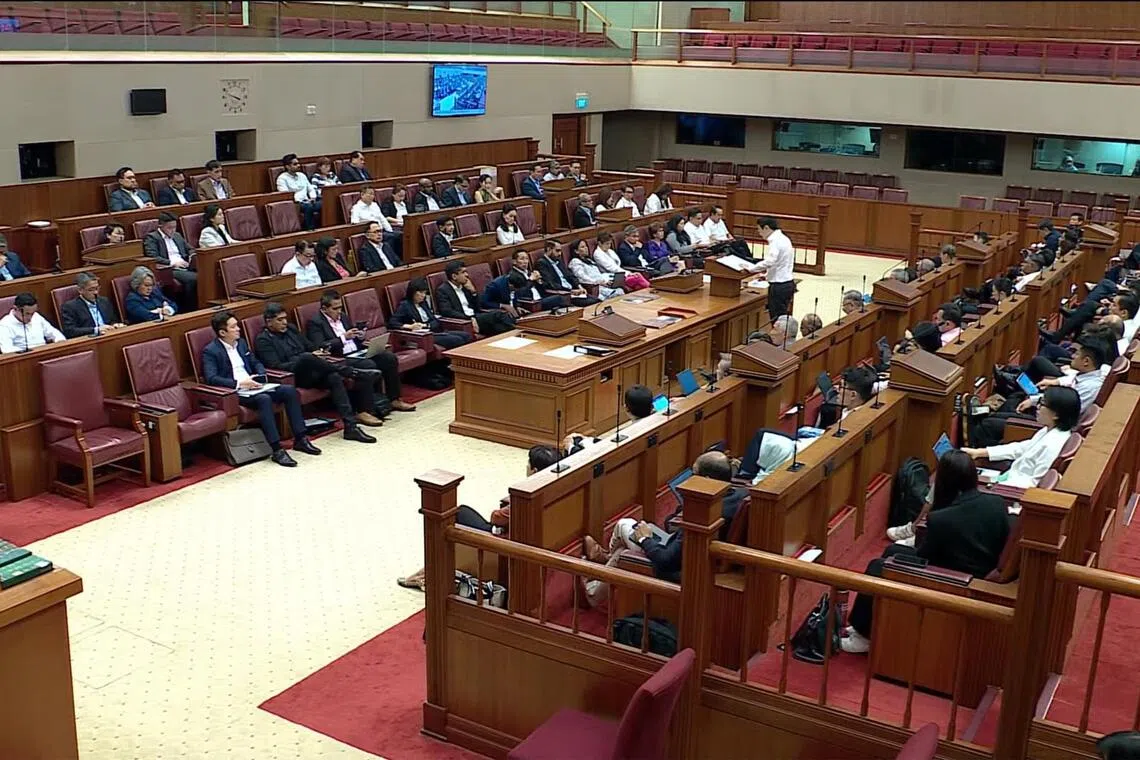
Parliament debated changes to political salaries on Sept 10.
Published Sep 11, 2026, 10:09 PM
Updated Sep 11, 2026, 10:09 PM
SINGAPORE – Those anticipating a heated debate on ministerial pay in Parliament this week would have come away somewhat disappointed.
The debate on this emotive topic, as both parties in the House characterised it, was shorter than observers expected and less combative than in 2012, when MPs discussed at length a new framework for political salaries.
Those who had followed the debate would probably also agree that the PAP and WP appear to have found more common ground than before.
This augurs well for the ruling party on what could have been a contentious topic.
It also puts PM Wong on firmer ground to focus on his priorities of leadership renewal and recruitment going forward, having no protracted back-and-forth with the WP casting a shadow beyond the debate in Parliament.
In 2012, then Deputy Prime Minister Teo Chee Hean framed the debate as both sides of the House taking a “major step forward to bridge the once-wide gap” on the issue of ministerial pay.
That 2012 debate, which spanned 2½ days and had 29 MPs speaking including eight from the WP, saw several drawn-out exchanges between the PAP and the WP on the formula used to calculate the pay and the reference pool that the benchmark pay is pegged to.
But clashes aside, both parties affirmed the three basic principles that the new salary framework had used to determine how much ministers should be paid.
These are: that salaries should take reference from the market to attract individuals of the right calibre to lead the country; that a discount should be included to reflect the ethos of political service; and that pay should be transparent and linked to individual performance and national outcomes.
In 2026, it seems the House – which spent just over four hours on Sept 10 debating the issue – has further converged. Thirteen MPs made speeches – four PAP backbenchers, five Nominated MPs, three ministers, and WP chief Pritam Singh. He was the sole MP from the opposition party who spoke.
Both political parties still agree on the three basic principles but crucially, the WP also agreed with PM Wong’s decision to increase ministerial salaries by up to 9 per cent.
The Prime Minister had said he would give ministers a one-off adjustment, subject to performance, rather than immediately take on the review committee’s proposed increase in benchmark pay from $1.1 million to $1.8 million for the entry-level MR4 grade.
Tacit in the WP’s agreement is that since ministerial pay has remained stagnant over the last 15 years, it should be raised, though the opposition party did not agree with the new benchmark pay.
It preferred a more modest increment, derived from its pay formula proposed in 2012, which the party continued to stand by. This formula would have come up with a benchmark pay of $1.08 million in 2026, the WP said.
Despite this, it seems the PAP and WP are closer in their stances, compared with other opposition parties outside the House that criticised the overall pay package and objected to having any increment at all.
While observers might have also expected the parties to continue to cross swords in Parliament over differences in the pay formula, Singh did not push the Government further on taking up his party’s suggested formula beyond his initial speech during the debate.
Neither PM Wong nor Coordinating Minister for Public Services Chan Chun Sing rebutted Singh on its formula, and there were no further clarifications from either side on this.
Instead, there was stronger pushback from several Nominated MPs, who questioned the continued usage of the top 1,000 Singaporean earners as a salary benchmark and proposed alternative models. Businessman Azhar Othman even mooted a larger variable component in the overall salary package.
On Singh’s part, much of his clarifications centred on having more public information on the pay package ministers receive – in line with the WP’s continued advocacy for transparency and accountability that it ties to its role as a check on the Government.
He pressed the ministers for more information on the actual remuneration figures, citing bonus ranges that had been provided for 2013 to 2017 but were not similarly made available for 2018 to 2024 when requested.
To this, PM Wong said he would consider disclosing more information on the distribution of salaries and range of individual bonuses while cautioning against a public popularity contest.
The other topics raised by Singh in his speech lay outside the core of the salary framework – he questioned the continued relevance of the role of mayors and asked for a review of allowances for legislative and secretarial assistants.
Overall, the tone of the debate was more restrained than in 2012, with less partisan discourse.
With little pushback from the WP to manage on the formula itself, PM Wong could then use his time on the floor to convince the broader House and the watching public of why he chose to move on political salaries now, and in this manner.
On these two issues, he circled back to his priorities of leadership renewal and recruitment, which he had made clear in his Sept 8 statement.
He identified then the succession gaps in his Cabinet that he hoped to fill and continued to underscore the pressing need to bring in strong members to shore up his team – a message he had emphasised ahead of the 2025 General Election and at the two subsequent Cabinet reshuffles.
He highlighted four key ministries – Trade and Industry, Home Affairs, Foreign Affairs and Finance – helmed by experienced and senior members of his team and himself, that have no clear replacements.
The Prime Minister also stressed the difficulty in attracting someone of ministerial calibre from the private sector, echoing what his predecessors have said.
But while previous prime ministers have found it difficult to recruit from the private sector, there were still success stories such as current ministers K. Shanmugam and Vivian Balakrishnan, former minister Ng Eng Hen and more who were cited by MPs during the debate.
Since the 2011 election, Tan See Leng is the only PAP candidate from the private sector who is a minister.
The benefits of having someone like Tan - who is Minister for Trade and Industry (Energy and Industry) - on the team are underscored by his involvement in two recent debates.
This week, he weighed in on the debate on pay, pointing out that no realistic amount of ministerial salary could have matched what he was earning before politics. During a WP motion on the future of Singapore’s economy last month, he provided the dual perspective of a successful entrepreneur in Singapore and a minister involved in shaping economic policy.
There may be no “politically convenient” time to move on ministerial pay, as PM Wong said, but by moving now, he has also given himself a longer runway possible to recruit new faces, who can play a similar role as Tan, with an updated remuneration figure.
While the higher benchmark is not meant to incentivise prospective candidates, his hope is that it will remove a hurdle that would have deterred some of them.
Ministerial pay will remain a prickly issue that the PAP has to contend with even as the debate in the House has concluded. The party will have to continue defending its decision to Singaporeans, some of whom will continue to use the million-dollar figure as a retort when policies go wrong. The issue will also rear its head again in future reviews, which PM Wong has promised.
In the next few years, Singaporeans will also be watching how PM Wong fills the gaps he has identified, and come GE 2030, the candidates that he puts forward will show whether this move has borne the party any fruit.
Goh Yan Han is assistant news editor at The Straits Times, where she oversees coverage of political news. She writes Unpacked, a weekly newsletter on Singapore politics and policy.
Singapore Parliament
9月10日,议会就政治人物薪酬改革进行了辩论。
发布于 2026 年 9 月 11 日晚上 10:09
更新于2026年9月11日晚上10:09
新加坡——那些期待本周国会就部长薪酬问题展开激烈辩论的人可能会有些失望。
正如议会两党所言,这场关于这个情绪化话题的辩论比观察人士预期的要短,而且对抗性也不如 2012 年那么强。当时,议员们就政治薪酬的新框架进行了长时间的讨论。
那些关注过这场辩论的人可能也会同意,人民行动党和工人党似乎比以前找到了更多的共同点。
这对执政党来说是个好兆头,因为原本这可能是一个颇具争议的话题。
这也让黄英贤总理能够更稳固地专注于他未来的领导层更新和招募工作,避免与工人党之间旷日持久的争论在国会辩论之外蒙上阴影。
2012 年,时任副总理张志贤将这场辩论定性为国会两院在部长薪酬问题上“迈出了弥合曾经巨大分歧的一大步”。
2012 年的那场辩论持续了两天半,共有 29 名议员发言,其中包括 8 名工人党议员。人民行动党和工人党就计算工资的公式以及基准工资所依据的参考池进行了多次长时间的交流。
但撇开冲突不谈,双方都肯定了新薪酬框架用于确定部长薪酬的三项基本原则。
这些原则包括:薪酬应参考市场水平,以吸引有能力的人才来领导国家;应包含折扣,以体现政治服务的精神;薪酬应透明,并与个人绩效和国家成果挂钩。
2026年,国会似乎在议题上进一步达成共识。9月10日,国会就此议题进行了四个多小时的辩论。共有13名议员发言,其中包括4名人民行动党后座议员、5名委任议员、3名部长以及工人党主席毕丹星。毕丹星是唯一一位发言的反对党议员。
两个政党仍然在三个基本原则上达成一致,但至关重要的是,工人党也同意黄英贤总理将部长薪金提高至多 9% 的决定。
总理曾表示,他将根据部长们的绩效情况给予他们一次性的薪酬调整,而不是立即接受审查委员会提出的将入门级 MR4 级别的基准薪酬从 110 万美元提高到 180 万美元的建议。
工人党的默许之处在于,由于部长级薪酬在过去 15 年里一直停滞不前,因此应该提高薪酬,尽管反对党并不同意新的基准薪酬。
工人党倾向于更为温和的增幅,该增幅源自其2012年提出的薪酬方案,该党一直坚持这一方案。工人党表示,按照该方案计算,到2026年,基准薪酬将达到108万新元。
尽管如此,与国会外的其他反对党相比,人民行动党和工人党的立场似乎更加接近。其他反对党批评了整体薪酬方案,并反对任何形式的加薪。
尽管观察人士可能也预料到各党派会在议会中继续就薪酬计算公式的分歧展开争论,但辛格在辩论中的首次发言之后,并没有进一步敦促政府采纳他所在政党提出的公式。
黄英贤总理和公共服务统筹部长陈振声都没有反驳辛格提出的方案,双方也没有就此作出进一步的澄清。
然而,几位官委议员对此提出了更强烈的反对意见,他们质疑继续以新加坡收入最高的1000名员工作为薪酬基准的做法,并提出了其他方案。商人阿兹哈尔·奥斯曼甚至提议在整体薪酬方案中增加浮动部分。
辛格方面,他的许多澄清都集中在要公开部长们的薪酬待遇信息上——这与工人党一贯倡导的透明度和问责制相一致,工人党认为这是其作为政府监督者的角色。
他敦促部长们提供更多关于实际薪酬数字的信息,并指出2013年至2017年的奖金范围已公布,但当他提出要求时,2018年至2024年的相关奖金范围却没有公布。
对此,黄循财总理表示,他会考虑披露更多关于薪金分配和个人奖金范围的信息,但同时告诫不要搞公开的人气竞赛。
辛格在演讲中提出的其他话题都与薪酬框架的核心无关——他质疑市长这一角色的持续相关性,并要求审查立法助理和秘书助理的津贴。
总体而言,辩论的基调比 2012 年更加克制,党派之争也较少。
由于工人党对方案本身几乎没有反对意见,黄英贤总理就可以利用他在议会的时间,向更广泛的国会议员和旁听的公众解释他为什么选择现在以这种方式解决政治薪酬问题。
在这两个问题上,他再次强调了领导层更新和招聘的优先事项,这在他 9 月 8 日的声明中已经明确阐述过。
他当时指出了内阁中存在的继任空缺,并希望填补这些空缺。他还继续强调迫切需要引入强有力的成员来巩固他的团队——他在 2025 年大选前以及随后的两次内阁改组中都强调了这一信息。
他重点介绍了由他本人及其团队中经验丰富的高级成员领导的四个关键部门——贸易和工业部、内政部、外交部和财政部,这些部门目前还没有明确的继任者。
首相还强调了从私营部门吸引部长级人才的难度,这与他的前任们的说法不谋而合。
虽然以往的总理都发现很难从私营部门招募人才,但仍然有一些成功的例子,例如现任部长尚穆根和维文·巴拉克里希南、前部长黄永宏等等,这些例子在辩论中被议员们提及。
自 2011 年大选以来,陈世龙是人民行动党唯一一位来自私营部门的部长级候选人。
谭先生是贸易及工业部(能源及工业)部长,他参与了最近的两场辩论,这凸显了团队中有像他这样的人加入的好处。
本周,他参与了薪酬辩论,指出任何部长级薪酬都不可能与他从政前的收入相提并论。上个月,在工人党就新加坡经济未来问题提出的动议中,他以新加坡成功企业家和参与制定经济政策的部长的双重身份,阐述了自己的观点。
正如黄循财总理所说,现在可能没有“政治上合适的”时机来解决部长薪酬问题,但通过现在采取行动,他也为自己争取了更长的时间来招募新人,让他们能够像陈庆炎一样发挥类似的作用,并制定更新的薪酬标准。
虽然提高门槛并不是为了激励潜在的候选人,但他希望这能消除一些原本会阻碍他们的障碍。
即使国会辩论已经结束,部长薪酬问题仍将是人民行动党必须面对的棘手难题。该党必须继续向新加坡民众解释其决定,因为一些民众仍会在政策失误时以百万美元的薪酬数字作为反驳的论据。此外,这个问题在未来的薪酬审查中还会再次出现,而黄循财总理已承诺会进行审查。
在接下来的几年里,新加坡人也将关注黄循财总理如何填补他所发现的空白,而到了 2030 年大选,他推出的候选人将表明这一举措是否给该党带来了任何成果。
吴燕涵是《海峡时报》的助理新闻编辑,负责政治新闻报道。她撰写每周通讯《Unpacked》,内容涵盖新加坡政治和政策。
新加坡国会