France Accelerates Rafale F5 Upgrade After Collapse Of FCAS Next-Gen Fighter Project法国在未来空中作战系统(FCAS)下一代战斗机项目失败后,加快阵风F5战斗机的升级进程
France is investing in a new Rafale configuration, along with drone wingmen, that aim to carry French tactical aviation deep into the 2030s. France is investing in a Rafale configuration designed to carry French combat aviation deep into the 2030s.
新闻视频
Published Sep 11, 2026 1:13 PM EDT
Dassault Aviation – C. Cosmao
France is accelerating work on the Rafale F5 standard, bringing forward development of a major new configuration of its combat aircraft at a time when the country’s planned next-generation fighter with Germany has effectively collapsed in its original form . The contracts cover the equipment judged to have the highest technical risk , ahead of the overall development contract for the F5 standard, expected for the end of this year.
The French defense procurement agency, the Direction générale de l’armement (DGA), ordered the first upstream development work for F5 from Dassault Aviation, Thales, MBDA, and Safran. The contracts cover key areas including navigation, datalinks, radar, electronic warfare, and propulsion, laying the groundwork for the next configuration of the Rafale, which is planned to enter service with the French Air and Space Force and the French Navy starting around 2033.
#Commande | Rafale F5 La DGA commande les 1ers travaux en amont du prochain lancement en réalisation du standard F5 du Rafale Ils concernent notamment : ➡️la centrale inertielle ➡️le moteur ➡️le radar ➡️la suite d’autoprotection de l’avion ⤵️ pic.twitter.com/n3uhBYqIvi — Direction générale de l'armement 🇫🇷 (@DGA) September 9, 2026
#Commande | Rafale F5 La DGA commande les 1ers travaux en amont du prochain lancement en réalisation du standard F5 du Rafale Ils concernent notamment : ➡️la centrale inertielle ➡️le moteur ➡️le radar ➡️la suite d’autoprotection de l’avion ⤵️ pic.twitter.com/n3uhBYqIvi
The most extensive modernization of the Rafale yet, the F5 standard was originally part of a longer transition toward France’s next-generation combat-air capability. But with the Franco-German New Generation Fighter (NGF) effort now effectively dead in its original configuration, the accelerated F5 program is taking on a much larger strategic role.
Concept artwork of the NGF future fighter. Dassault Aviation
Rather than simply keeping the Rafale relevant until NGF arrives, France is now developing a version of the aircraft that is set to carry much of the country’s high-end combat-air capability well into the 2030s and potentially beyond.
The increasingly capable F5 could, in turn, reduce the urgency of finding a replacement for the Rafale — while potentially adding to the fighter’s export appeal. After a slow start, Dassault has recorded export sales of 299 new-build Rafales to eight nations.
The DGA’s contracts engage four of France’s principal combat-aircraft industrial players. Dassault Aviation remains responsible for the aircraft and its overall integration; Thales is involved in major sensor, electronic warfare, and communications capabilities; MBDA is responsible for much of the weapons system; and Safran is responsible for propulsion.
The Rafale assembly line at the Dassault Aviation facility in Mérignac, France. Dassault Aviation – V. Almansa ALMANSA
Previous Rafale standards have largely consisted of incremental upgrades, focusing on software and other improvements to the existing aircraft configuration. F5 is notably more extensive, addressing many of the critical systems that determine how the aircraft senses the battlespace, communicates with other platforms, conducts electronic warfare, and generates the power needed to operate increasingly demanding equipment.
The DGA has specifically identified the Thales RBE2-XG radar as one of the major technological advances associated with F5.
The RBE2-XG is expected to feature gallium nitride (GaN) semiconductors. Compared with previous technology, GaN generates less heat and has the capacity to operate at higher voltages, meaning that output power can be increased, while component size can be reduced. Overall, using GaN should help to get more power out of the radar without increasing its size.
According to the DGA, “This new radar will benefit from a substantial increase in power, and consequently in detection range, as well as improvements in the identification of targets with an extremely low radar cross-section (RCS). Its computing capabilities will also be enhanced to facilitate the integration of artificial intelligence.”
The RBE2-XG will also be “designed with collaborative combat in mind, featuring sensors capable of working together without the need for pilot intervention.” It is also planned to have enhanced resilience, including against cyber threats.
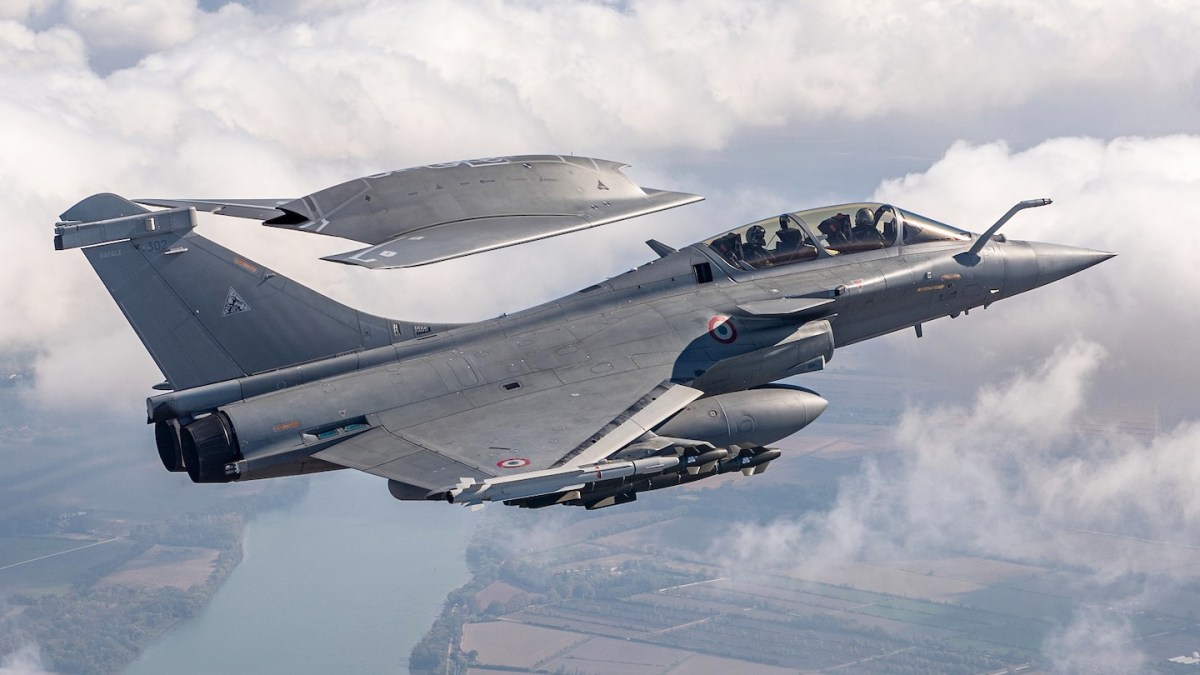
France is already working on the concept of a combat drone to accompany the Rafale, with the future F5 standard providing the crewed aircraft around which those systems can operate.
A Rafale during a test mission with a Dassault nEUROn combat drone demonstrator. Dassault Aviation – A. Pecchi
The new radar will be combined with more capable electronic warfare equipment, improved communications and datalinks, expanded processing capacity, and a more capable propulsion system.
To be developed by MBDA and Thales, the forthcoming F5 version of the SPECTRA self-protection suite is intended to significantly improve detection and jamming capabilities, the DGA says, “through a fully digital approach, enabling a complete overhaul of the core electronic warfare system to counter the increasing density and broadening of the threat spectrum, as well as the growing complexity of threat waveforms, expected by 2035.”
Thales will also be respinsible for the new Inter-Vehicle Data Link (IVDL) system, decribed as a “stealthy and resilient datalink.”The DGA says the new datalink will expand connectivity “thanks to a new high-speed, discreet, and jamming-resistant waveform. IVDL will allow the Rafale to penetrate hostile areas where jammers are widespread, while maintaining optimal quality of communication and dialogue between aircraft.”
Safran will begin preliminary design work on the M88 T-Rex engine, which is planned to increase the turbofan’s thrust from around 16,500 pounds to nearly 19,850 pounds, an increase of roughly 20 percent.
In terms of armament, the contract announcement mentions the ASN4G missile, set to be introduced to service by 2035, which will allow the Rafale F5 to continue to serve as the airborne nuclear component. The munition remains in the early stages of development, but it will be capable of hypersonic speeds — defined as speeds greater than Mach 5 — with a range in excess of 1,000 kilometers (621 miles).
Other likely new missiles include a beyond-visual-range air-to-air missile to succeed the current Meteor . As you can read about here , France’s Comet program, apparently led by the French side of MBDA, is already looking into this requirement, with an apparent plan to introduce the weapon around 2030.
An older video from MBDA showing some of the company’s weapons integrated on earlier versions of the Rafale:
For France, the original logic behind the pan-European FCAS program was that Rafale would eventually give way to the NGF as its principal crewed combat aircraft, operating from land bases and aircraft carriers.
With the collapse of the Franco-German effort, France cannot simply wait for a next-generation fighter program whose industrial and political future is uncertain. Instead, the Rafale has to remain capable against rapidly evolving threats throughout the 2030s and beyond.
With the F5 standard, however, France is looking to incorporate some of the concepts envisaged for NGF. These include distributed architectures in which crewed fighters, uncrewed aircraft , remote carriers , missiles, and offboard sensors cooperate across a battlespace.
The nEUROn drone and a Rafale M in flight over the aircraft carrier Charles de Gaulle , during tests to investigate the use of a UCAV in a naval context. Dassault Aviation – A. Pecchi
A highly upgraded Rafale operating as the crewed controller of uncrewed combat aircraft and remote weapons could perform some of the missions that France originally expected from NGF.
For now, F5 also sidesteps the central problem in the now-defunct Franco-German effort: whether the two countries could agree on the requirements, industrial structure, and workshare behind a new-generation combat aircraft.
Despite its advances, the F5 airframe remains derived from a design dating back to the 1980s, which first entered French service in the early 2000s. In particular, it falls well short of fifth-generation designs — let alone sixth-generation ones — in terms of low observability. This is one area where collaborative drones could potentially help compensate for the Rafale’s inherent limitations.
The current standard F4 Rafale with a full weapons load. Dassault Aviation – C. Cosmao © Dassault Aviation – C. Cosmao / © Dassault Aviation – C. Cosmao
France has therefore bought itself some time with the F5 program. But it may eventually decide that it needs a future high-end crewed fighter to provide capabilities that an upgraded fourth-generation airframe cannot fully replicate, particularly in terms of survivability against advanced integrated air-defense systems, signature reduction, internal weapons carriage, and operations deep inside heavily contested airspace.
On an industrial level, F5 is also significant because it brings together the same French industrial heavyweights that would have formed the backbone of its FCAS effort. Dassault Aviation, Thales, Safran, and MBDA are now well-positioned to work together on whatever comes after F5, whether that is a crewed combat aircraft, uncrewed CCA-type platforms , or a combination of both. Based on its experience with the nEUROn program, France would be well placed to develop a UCAV that can work cooporatively as well as independently, taking over the deeper-penetrating fighter mission set, and potentially skipping a sixth-generation fighter altogether.
Meanwhile, success with F5 — and, in particular, with the wider combat ecosystem planned around it — could put France in an even stronger position when it comes to any future European fighter project.
For the time being, Britain, Italy, and Japan are pursuing the GCAP/Tempest pathway toward a new combat aircraft. Germany and Spain remain tied to the wider FCAS architecture , even as the original Franco-German NGF arrangement has fractured. Sweden’s position is less clear , with indications that it could collaborate with either France or Germany .
France, for its part, is now investing heavily in an increasingly sophisticated Rafale architecture while maintaining its own sovereign industrial base.
In terms of acqusition, France is expected to pursue a mixed approach, buying new-build Rafales while upgrading suitable aircraft already in service to the F5 standard. The oldest jets are unlikely to receive the full F5 treatment, however.
The irony is that the failure of the NGF effort may ultimately make Rafale F5 more important — and potentially more capable — than it was ever expected to be.
Contact the author: thomas@thewarzone.com
Comments couldn’t be loaded. Please refresh the page.
发布于美国东部时间2026年9月11日下午1:13
达索航空 – C. Cosmao
法国正在加快“阵风”F5标准的研发工作,提前开发其战斗机的一项重大新配置。与此同时,法国与德国合作的下一代战斗机项目原计划已基本搁浅。这些合同涵盖了被认为技术风险最高的设备,先于预计将于今年年底签署的F5标准整体研发合同。
法国国防采购局(DGA)已向达索航空、泰雷兹、MBDA和赛峰集团订购了F5战斗机的首批上游研发工作。这些合同涵盖导航、数据链、雷达、电子战和推进系统等关键领域,为下一代阵风战斗机奠定了基础。下一代阵风战斗机计划于2033年左右开始在法国空军、航天部队和海军服役。
#指挥官|阵风 F5 La DGA 命令 1ers travaux en amont du prochain lancement en réalification du standard F5 du Rafale Ils 相关注释:➡️lacentrale inertielle ➡️lemoteur➡️lerada➡️la suite d'autoprotection de l'avion ⤵️ pic.twitter.com/n3uhBYqIvi —武装总局🇫🇷 (@DGA) 2026 年 9 月 9 日
#指挥官|阵风 F5 La DGA 命令 1ers travaux en amont du prochain lancement en réalising du standard F5 du Rafale Ils 相关注释:➡️中央惯性➡️发动机➡️雷达➡️航空自动防护套件⤵️ pic.twitter.com/n3uhBYqIvi
作为迄今为止阵风战斗机最全面的现代化升级,F5标准最初是法国向下一代空中作战能力过渡计划的一部分。但随着法德新一代战斗机(NGF)项目最初方案的终止,加速推进的F5项目承担了更为重要的战略角色。
NGF未来战斗机的概念图。达索航空
法国不再只是让“阵风”战斗机保持竞争力直到下一代战斗机(NGF)到来,而是正在开发一种新型战机,旨在将该国的高端空中作战能力延续到 2030 年代甚至更久。
性能日益提升的F5战机或许会降低寻找“阵风”战机替代者的紧迫性,同时还有可能提升该战机的出口吸引力。尽管初期进展缓慢,但达索公司目前已向八个国家出口了299架全新“阵风”战机。
法国国防采购局(DGA)的合同涉及法国四家主要的战斗机工业企业。达索航空公司负责飞机及其整体集成;泰雷兹公司负责主要的传感器、电子战和通信能力;MBDA公司负责大部分武器系统;赛峰集团负责推进系统。
法国梅利尼亚克达索航空公司的阵风战斗机装配线。达索航空公司 – V. Almansa ALMANSA
以往的阵风战斗机标准主要以渐进式升级为主,侧重于软件和其他方面的改进。而F5标准则更为全面,涵盖了许多关键系统,这些系统决定了飞机如何感知战场环境、与其他平台通信、进行电子战以及为日益复杂的设备提供运行所需的电力。
DGA 已明确指出泰雷兹 RBE2-XG 雷达是与 F5 相关的主要技术进步之一。
RBE2-XG预计将采用氮化镓(GaN)半导体。与以往技术相比,GaN发热量更低,且可在更高电压下工作,这意味着在提高输出功率的同时,还能缩小元件尺寸。总而言之,使用GaN有助于在不增加雷达尺寸的情况下提升其功率输出。
据德国国防装备总局(DGA)称,“这款新型雷达的功率将大幅提升,探测距离也将相应扩大,同时对雷达反射截面(RCS)极低的目标的识别能力也将得到提高。其计算能力也将得到增强,以便更好地集成人工智能技术。”
RBE2-XG的设计也将“充分考虑协同作战,其传感器无需飞行员干预即可协同工作”。此外,它还计划增强抵御网络威胁的能力。
法国已经在着手研发与“阵风”战斗机配套的作战无人机,未来的F5标准将提供有人驾驶飞机,这些系统可以围绕其运行。
一架阵风战斗机正在与达索公司的 nEUROn 战斗无人机演示机执行测试任务。达索航空 – A. Pecchi
新型雷达将与功能更强大的电子战设备、改进的通信和数据链、更大的处理能力以及功能更强大的推进系统相结合。
据国防采购局 (DGA) 称,即将推出的 SPECTRA 自卫套件 F5 版本将由 MBDA 和泰雷兹公司共同开发,旨在通过“全数字化方法”显著提高探测和干扰能力,“从而彻底改造核心电子战系统,以应对预计到 2035 年日益增长的威胁频谱密度和范围扩大,以及威胁波形日益复杂的局面。”
泰雷兹公司还将负责新型车辆间数据链(IVDL)系统,该系统被描述为“隐蔽且可靠的数据链”。德国国防采购局(DGA)表示,新型数据链将“借助一种新型高速、隐蔽且抗干扰的波形”扩展连接性。IVDL将使“阵风”战斗机能够在干扰器广泛分布的敌对区域内飞行,同时保持飞机间最佳的通信和对话质量。
赛峰集团将开始对 M88 T-Rex 发动机进行初步设计工作,该发动机计划将涡扇发动机的推力从大约 16,500 磅增加到近 19,850 磅,增幅约为 20%。
在武器装备方面,合同公告中提到了ASN4G导弹,该导弹计划于2035年服役,届时“阵风”F5战斗机将继续作为其机载核打击力量。该导弹目前仍处于早期研发阶段,但其飞行速度将超过5马赫,射程超过1000公里(621英里),并具备高超音速飞行能力。
其他可能的新型导弹包括一种超视距空空导弹,用于取代现役的“流星”导弹。正如您在此处所读到的,法国的“彗星”计划(显然由MBDA的法国方面主导)已经在研究这一需求,并计划在2030年左右推出该武器。
MBDA公司早期发布的一段视频展示了该公司的一些武器系统,这些武器系统被集成到早期版本的阵风战斗机上:
对于法国而言,泛欧FCAS计划背后的最初逻辑是,阵风战斗机最终将让位于NGF,成为其主要的有人驾驶战斗机,从陆地基地和航空母舰上作战。
随着法德联合研制计划的失败,法国不能仅仅等待下一代战斗机项目,因为该项目的工业和政治前景尚不明朗。相反,阵风战斗机必须在整个2030年代及以后保持应对快速演变的威胁的能力。
然而,法国希望通过F5标准融入一些为下一代战斗机(NGF)设想的概念。这些概念包括分布式架构,在这种架构中,有人驾驶战斗机、无人驾驶飞机、远程载体、导弹和外部传感器可以在战场上协同作战。
在测试中,nEUROn无人机和一架阵风M战斗机飞越“戴高乐”号航空母舰,以研究无人作战飞行器在海军环境中的应用。达索航空 – A. Pecchi
经过高度升级的“阵风”战斗机可以作为无人作战飞机和遥控武器的有人操控者,执行法国最初期望NGF执行的一些任务。
目前,F5 也回避了已经终止的法德合作计划的核心问题:两国能否就新一代战斗机的需求、工业结构和工作分工达成一致。
尽管取得了进步,但F5战机的机身设计仍然源自上世纪80年代,并于21世纪初首次在法国服役。尤其是在低可探测性方面,它远逊于第五代战机,更不用说第六代战机了。而协同无人机或许能够弥补“阵风”战机的固有缺陷。
目前标准的F4“阵风”战斗机,配备全套武器。达索航空 – C. Cosmao © 达索航空 – C. Cosmao / © 达索航空 – C. Cosmao
因此,法国通过F5项目为自己争取了一些时间。但它最终可能会认为,它需要一种未来的高端有人驾驶战斗机,以提供升级后的第四代战机无法完全复制的能力,尤其是在对抗先进的综合防空系统、降低特征信号、内置武器挂载以及在高度敌对空域纵深作战等方面。
从工业层面来看,F5项目意义重大,因为它汇集了原本构成法国未来空中作战系统(FCAS)核心力量的几家法国工业巨头。达索航空、泰雷兹、赛峰集团和MBDA公司如今已做好充分准备,在F5项目之后的任何项目中展开合作,无论是有人驾驶战斗机、无人作战飞机平台,还是两者的结合。凭借在“神经元”(nEUROn)项目上的经验,法国完全有能力开发出既能协同作战又能独立作战的无人作战飞机(UCAV),从而承担更深入敌后的战斗机任务,甚至有可能完全跳过第六代战斗机阶段。
与此同时,F5的成功——尤其是围绕它规划的更广泛的作战生态系统的成功——可能会使法国在未来的任何欧洲战斗机项目中处于更有利的地位。
目前,英国、意大利和日本正沿着GCAP/Tempest路线研发新型战斗机。德国和西班牙仍然坚持更广泛的FCAS架构,尽管最初的法德下一代战斗机联队(NGF)协议已经破裂。瑞典的立场尚不明朗,有迹象表明它可能与法国或德国合作。
法国方面,目前正在大力投资研发日益先进的阵风战斗机架构,同时保持其自身的自主工业基础。
在采购方面,预计法国将采取混合策略,既购买全新制造的“阵风”战斗机,又将现役的合适机型升级到F5标准。不过,最老的几架战机不太可能获得完整的F5升级。
具有讽刺意味的是,NGF 项目的失败最终可能会使阵风 F5 比预期的更加重要,也可能更加强大。
联系作者:thomas@thewarzone.com
评论加载失败,请刷新页面。