Here’s a look at the military firepower the US is providing to Israel以下是美国向以色列提供的军事火力概览。
The buildup reflects U.S. concern that the deadly fighting between Hamas and Israel could escalate into a more dangerous regional conflict.
Editor’s note: This story was updated on Oct. 15 at 9:55 a.m. EST with additional information.
Within hours of the horrific attack by Hamas , the U.S. began moving warships and aircraft to the region to be ready to provide Israel with whatever it needs to respond.
A second U.S. carrier strike group departs from Norfolk, Virginia, on Friday. Scores of aircraft are heading to U.S. military bases around the Middle East. Special operations forces are now assisting Israel’s military in planning and intelligence. The first shipment of additional munitions has already arrived.
[ Israel-Hamas war misinformation flourishes on X as platform struggles ]
More is expected, soon. Defense Secretary Lloyd Austin will arrive in Israel Friday to meet with Israeli leaders to discuss what else the U.S. can provide.
For now, the buildup reflects U.S. concern that the deadly fighting between Hamas and Israel could escalate into a more dangerous regional conflict. So the primary mission for those ships and warplanes is to establish a force presence that deters Hezbollah, Iran or others from taking advantage of the situation. But the forces the U.S. sends are capable of more than that.
A look at what weapons and options the U.S. military could provide:
Missiles for Iron Dome
The U.S. is providing some personnel and much-needed munitions to Israel. Defense Secretary Lloyd Austin announced that a small special operations cell was now assisting Israel with intelligence and planning, and providing advice and consultations to the Israeli Defense Forces on hostage recovery efforts. However those forces have not been tasked with hostage rescue, which would put them on the ground fighting in the conflict. That’s something the Biden administration has not approved and White House spokesman John Kirby has said the Israelis do not want.
The U.S. is also getting U.S. defense companies to expedite weapons orders by Israel that were already on the books. Chief among those are munitions for Israel’s Iron Dome air defense system.
An Iron Dome system launches a missile. (Courtesy of Rafael).
“We’re surging additional military assistance, including ammunition and interceptors to replenish Iron Dome,” President Joe Biden said Tuesday. “We’re going to make sure that Israel does not run out of these critical assets to defend its cities and its citizens.”
Iron Dome’s missiles target rockets that approach its cities. According to Raytheon, Israel has 10 such systems in place. Beginning with Saturday’s attack, Hamas has fired more than 5,000 rockets at Israel, most of which the system has been able to intercept, according to the Israel Defense Forces.
Raytheon produces most of the missile components for Iron Dome in the U.S., and the Army has two systems in its stockpile.
The Iron Dome munitions the U.S. provides to Israel will likely be above and beyond what Israel has ordered and will be part of ongoing military assistance packages. Those packages will also include small diameter bombs and JDAM kits — essentially a tail fin and navigation kit that turns a “dumb” bomb into a “smart” bomb and enables troops to guide the munition to a target, rather than simply dropping it.
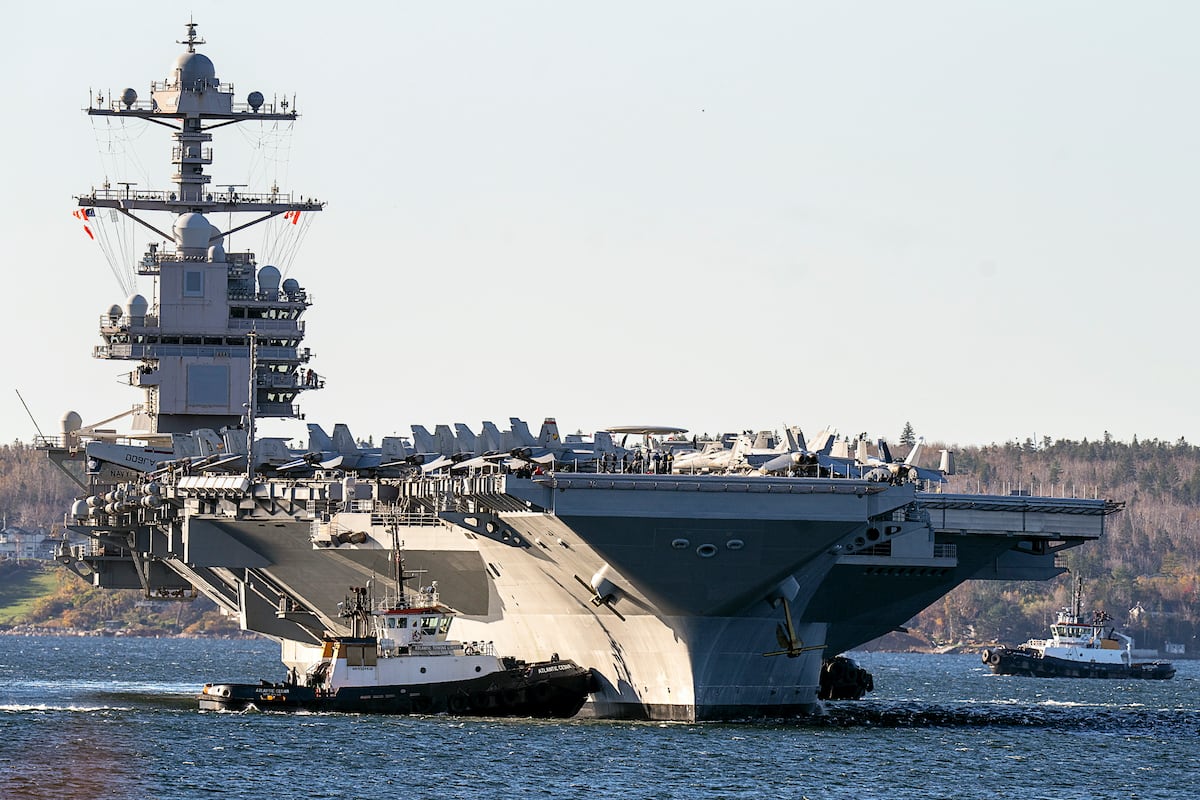
One of the most visible examples of the U.S. response was the announcement Sunday by the Pentagon to redirect the Gerald R. Ford carrier strike group to sail toward Israel. The carrier had just completed an exercise with the Italian Navy when the ship and its crew of about 5,000 were ordered to quickly sail to the Eastern Mediterranean.
One week after the attacks, as Israel positioned for a major ground offensive into Gaza City, Austin announced a second carrier group would be sailing toward Israel, as he ordered the USS Dwight D. Eisenhower carrier strike group to join the Ford in the Eastern Mediterranean. In a statement announcing the move, Austin said he was sending the Eisenhower too “as part of our effort to deter hostile actions against Israel or any efforts toward widening this war following Hamas’s attack on Israel.”
The carriers provide a host of options. They serve as primary command and control operations centers and can conduct information warfare. They can launch and recover E2-Hawkeye surveillance planes, recognizable by their 24-foot (7-meter) diameter disc-shaped radars. The planes provide early warnings on missile launches, conduct surveillance and manage the airspace, not only detecting enemy aircraft but also directing U.S. movements.
160413-N-KK394-083 An E2-C Hawkeye assigned to the Screwtops of Airborne Early Warning Squadron (VAW) 123 takes off from the flight deck of the aircraft carrier USS Dwight D. Eisenhower (CVN 69), the flagship of the Eisenhower Carrier Strike Group. (U.S. Navy photo by Mass Communication Specialist 3rd Class Anderson W. Branch/Released)
They also serve as a floating airbase for F-18 fighter jets that can fly intercepts or strike targets. And the carriers can flex to provide significant capabilities for humanitarian work, including onboard hospitals with ICUs, emergency rooms, medics, surgeons and doctors. They also sail with helicopters that can be used to airlift critical supplies in or victims out.
The Eisenhower had already been scheduled to deploy to the Mediterranean on a regular rotation, and the Ford is near the end of its scheduled deployment. But the Biden administration for now has decided to have both carriers there.
The Pentagon has also ordered additional warplanes to bolster existing squadrons of A-10, F-15 and F-16 squadrons at bases throughout the Middle East and is ready to add more if needed.
Air Force Secretary Frank Kendall said Tuesday at an Atlantic Council event that the service was doubling up by directing units that were about to come home to remain in place and stay there along with their replacements.
A U.S. Air Force MQ-9 Reaper. (Senior Airman Haley Stevens/U.S. Air Force)
The U.S. Air Force already has significant airpower in the region to conduct manned and unmanned operations, most notably in Syria where an Air Force F-16 last week was ordered to shoot down a Turkish drone that was posing a threat to U.S. ground forces operating there.
Kendall also said U.S. Air Force C-17s have landed in and departed from Israel since the attacks. The transport planes were picking up U.S. military personnel who were there for a military exercise that hadn’t started yet when the attacks began, the Air Force said in a statement.
Neither the Air Force nor Central Command would comment on what additional missions U.S. airpower might take on in response to the conflict.
Associated Press writer Colleen Long contributed to this report.
Tara Copp is a Pentagon correspondent for the Associated Press. She was previously Pentagon bureau chief for Sightline Media Group.
编者按:本文于美国东部时间 10 月 15 日上午 9:55 更新,添加了更多信息。
在哈马斯发动恐怖袭击后的几个小时内,美国就开始向该地区调集军舰和飞机,随时准备向以色列提供其所需的任何援助以进行应对。
周五,第二个美国航母打击群从弗吉尼亚州诺福克出发。数十架飞机正飞往中东各地的美军基地。特种作战部队目前正在协助以色列军方进行计划和情报工作。首批增援弹药已经抵达。
[以色列与哈马斯战争的虚假信息在X平台上泛滥,平台运营举步维艰]
预计很快会有更多进展。美国国防部长劳埃德·奥斯汀将于周五抵达以色列,与以色列领导人会晤,讨论美国还能提供哪些帮助。
目前来看,美国的军事集结反映了其担忧,即哈马斯和以色列之间的致命冲突可能升级为更危险的地区冲突。因此,这些舰艇和战机的首要任务是建立武力存在,以阻止真主党、伊朗或其他势力利用当前局势。但美国派遣的部队的能力远不止于此。
让我们来看看美军可能提供的武器和选项:
铁穹导弹
美国正在向以色列提供一些人员和急需的弹药。国防部长劳埃德·奥斯汀宣布,一个小型特种作战小组目前正在协助以色列进行情报和计划制定,并就人质营救行动向以色列国防军提供建议和咨询。然而,这些部队并未被赋予营救人质的任务,这意味着他们不会直接参与冲突。拜登政府尚未批准这样做,白宫发言人约翰·柯比也表示以色列方面不希望如此。
美国还在敦促美国国防企业加快以色列此前已签订的武器订单的交付。其中最主要的是以色列“铁穹”防空系统的弹药。
铁穹系统发射导弹。(图片由拉斐尔公司提供)
“我们正在加大军事援助力度,包括提供弹药和拦截导弹,以补充‘铁穹’防御系统,”乔·拜登总统周二表示。“我们将确保以色列不会耗尽这些保卫其城市和公民的关键资产。”
“铁穹”导弹系统用于拦截接近以色列城市的火箭弹。据雷神公司称,以色列部署了10套此类系统。以色列国防军表示,自周六的袭击以来,哈马斯已向以色列发射了超过5000枚火箭弹,其中大部分已被该系统拦截。
雷神公司在美国生产“铁穹”导弹系统的大部分导弹部件,陆军的库存中有两套该系统。
美国向以色列提供的“铁穹”导弹系统弹药很可能超出以色列的订单数量,并将作为持续军事援助计划的一部分。这些援助计划还将包括小直径炸弹和联合直接攻击弹药(JDAM)套件——JDAM本质上是一个尾翼和导航套件,可以将“普通”炸弹改装成“智能”炸弹,使部队能够引导弹药击中目标,而不是简单地投掷。
美国应对措施中最引人注目的例子之一是五角大楼周日宣布将“杰拉尔德·R·福特”号航母打击群调往以色列方向。这艘航母刚刚与意大利海军完成联合演习,就接到命令,迅速驶往东地中海。该舰及其约5000名船员也立即被调往东地中海。
袭击发生一周后,正值以色列准备对加沙城发动大规模地面进攻之际,奥斯汀宣布第二个航母战斗群将驶向以色列,他命令“德怀特·D·艾森豪威尔”号航母打击群加入在东地中海的“福特”号航母战斗群。奥斯汀在一份声明中宣布了这一行动,称他派遣“艾森豪威尔”号也是为了“阻止针对以色列的敌对行动,或阻止任何在哈马斯袭击以色列后扩大战争的企图”。
航母提供了多种选择。它们是主要的指挥控制作战中心,并能开展信息战。它们可以起降E-2“鹰眼”侦察机,这种飞机最显著的特征是其直径7米(24英尺)的碟形雷达。这些飞机能够对导弹发射进行预警,执行监视任务并管理空域,不仅能探测敌机,还能引导美军的行动。
160413-N-KK394-083 隶属于第123空中预警中队(VAW-123)“螺丝钉”的E2C“鹰眼”预警机从“艾森豪威尔”号航空母舰(CVN 69)的飞行甲板上起飞,该航母是“艾森豪威尔”号航母打击群的旗舰。(美国海军三级大众传播专家安德森·W·布兰奇拍摄/发布)
它们还可作为F-18战斗机的海上基地,用于拦截或打击目标。此外,这些航母还能灵活地提供重要的救援能力,包括配备重症监护室、急诊室、医护人员、外科医生和内科医生的舰载医院。它们还搭载直升机,用于空运关键物资或撤离伤员。
“艾森豪威尔”号航母原本就已按计划轮换部署到地中海,“福特”号航母的预定部署也接近尾声。但拜登政府目前决定让这两艘航母都驻扎在那里。
五角大楼还订购了更多战机,以加强驻扎在中东各地基地的现有 A-10、F-15 和 F-16 中队,并准备在需要时增加更多战机。
空军部长弗兰克·肯德尔周二在大西洋理事会的一次活动上表示,空军正在加倍部署兵力,指示即将回国的部队留在原地,与接替他们的部队一起驻扎。
美国空军MQ-9“死神”无人机。(高级空军士兵海莉·史蒂文斯/美国空军)
美国空军在该地区已经拥有强大的空中力量,可以进行有人和无人作战行动,最值得注意的是在叙利亚,上周一架空军 F-16 战斗机奉命击落一架对在那里作战的美国地面部队构成威胁的土耳其无人机。
肯德尔还表示,自袭击事件发生以来,美国空军的C-17运输机已多次在以色列起降。空军在一份声明中称,这些运输机当时正在接载美国军事人员,他们原本计划参加一项军事演习,但袭击发生时演习尚未开始。
美国空军和中央司令部均拒绝就美国空军可能为应对冲突而承担的额外任务发表评论。
美联社记者科琳·朗对本报道亦有贡献。
塔拉·科普是美联社驻五角大楼记者。她此前曾担任Sightline媒体集团驻五角大楼分社社长。