Russian forces test flying flamethrower to target Ukrainian firedrones俄罗斯军队测试飞行火焰喷射器,目标是乌克兰发射的无人机
The device is emblematic of an ever-faster cycle of ad-hoc fixes on the battlefield in Ukraine.
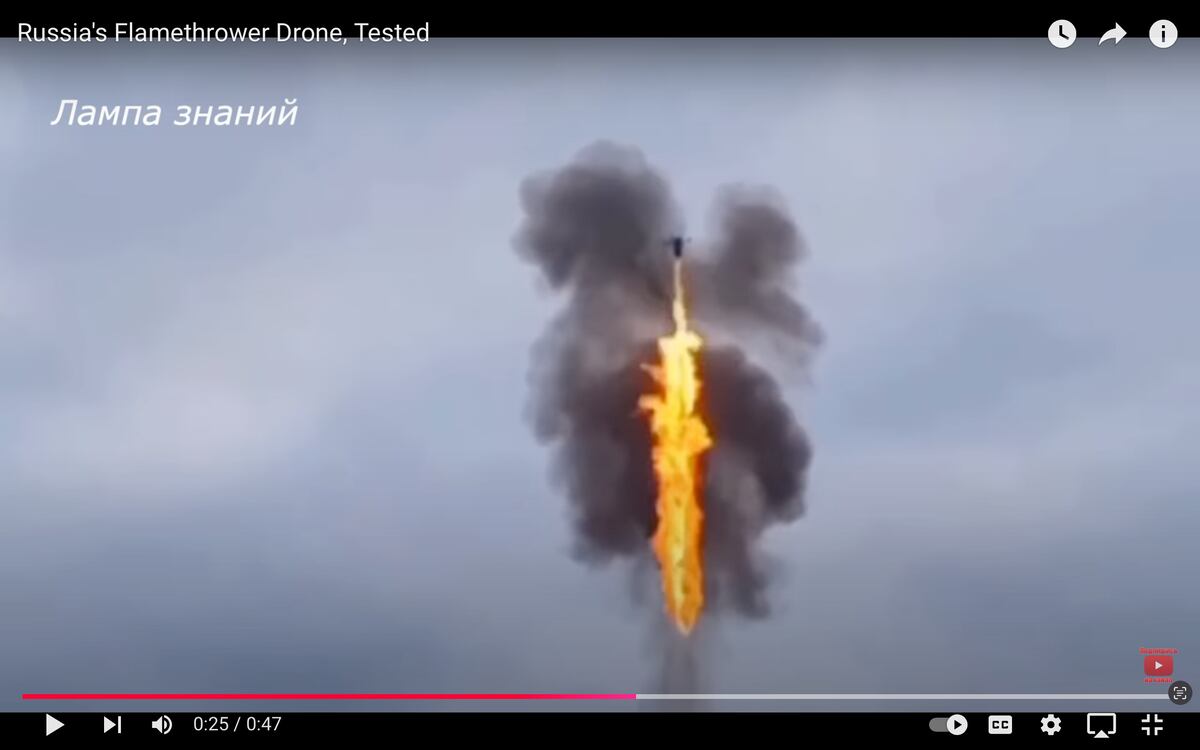
MILAN — Russian troops claim to have developed a flamethrower drone designed to counter Ukrainian first-person-view drones carrying an incendiary burning mixture, a tactic experts say will likely be ineffective against moving targets.
On Nov. 14, footage was published by Russian Telegram channels showing what appeared to be an unmanned aerial vehicle equipped with a flammable mixture which, once in the air, spluttered strong flames.
“It seems to be a commercial quadcopter-type drone carrying a small tank filled with a flammable substance, probably weighing around one or two pounds, which it can spray downward, creating a flamethrower effect with an effective range of two to three meters,” Federico Borsari, resident fellow at the U.S. Center for European Policy Analysis said of the video.
Experts said that the platform seems to have been specifically developed to target adversary drones. Samuel Bendett, advisor on Russian military technology at the Center for Naval Analyses, noted that in the video, an unidentified voice can be heard saying, “we essentially joined another UAV.”
This Russian countermeasure is likely a response to the Ukrainian military use of FPV drones to spray thermite over forested areas where enemy troops and equipment are suspected.
However, some analysts are skeptical about the effectiveness of the flamethrowers, as accurately steering the flame stream towards decently fast-moving Ukrainian drones dropping thermite would be tricky.
“If this type of [Russian] drone is to do that to another UAV, you have to get in position and be very precise – this may work against some that hover in place for observation, otherwise if the drone is moving, it will be very difficult to shoot this type of liquid at a moving target,” Bendett said.
Borsari noed that the limited amount of flammable solution the Russian drone can carry is another important limitation, which he estimates to be sufficient “barely” for a single sortie before needing to be refilled.
“As the drone exhausts the flammable liquid and the pressure of the spraying mechanism diminishes, the returning heat may damage the drone itself and make it crash if the operator keeps it hovering,” Borsari added.
In early September, when the first footage of Ukrainian fire-dropping FPVs emerged, analysts told Defense News that such systems, besides being a cheap alternative to expose enemy locations, are also psychological tools.
Elisabeth Gosselin-Malo was a Europe correspondent for Defense News. She covers a wide range of topics related to military procurement and international security, and specializes in reporting on the aviation sector. She is based in Milan, Italy.
米兰——俄罗斯军队声称已研制出一种火焰喷射无人机,旨在对抗乌克兰携带燃烧混合物的第一人称视角无人机。专家表示,这种战术对移动目标可能无效。
11 月 14 日,俄罗斯 Telegram 频道发布了一段视频,视频显示一架疑似无人机的飞行器装载着易燃混合物,升空后喷出强烈的火焰。
“这似乎是一款商用四旋翼无人机,携带一个装满易燃物质的小罐,可能重约一两磅,它可以向下喷射,产生火焰喷射器的效果,有效射程为两到三米,”美国欧洲政策分析中心常驻研究员费德里科·博尔萨里在谈到这段视频时说道。
专家表示,该平台似乎是专门为打击敌方无人机而开发的。海军分析中心俄罗斯军事技术顾问塞缪尔·本德特指出,视频中可以听到一个身份不明的声音说:“我们基本上加入了另一架无人机的行列。”
俄罗斯的这一反制措施很可能是对乌克兰军方使用FPV无人机向疑似敌军和装备所在的森林地区喷洒铝热剂的回应。
然而,一些分析人士对火焰喷射器的有效性持怀疑态度,因为要准确地将火焰流引导到速度相当快的、正在投放铝热剂的乌克兰无人机上,将会非常棘手。
“如果这种(俄罗斯)无人机要对另一架无人机进行这种攻击,你必须占据有利位置并非常精确——这可能对一些悬停在原地进行观察的无人机有效,否则,如果无人机在移动,就很难向移动目标发射这种液体,”本德特说。
博尔萨里指出,俄罗斯无人机可携带的可燃溶液数量有限,这是另一个重要的限制,他估计这些溶液“勉强”够一次飞行任务使用,之后就需要重新加注。
博尔萨里补充说:“随着无人机排出易燃液体,喷洒机构的压力减小,返回的热量可能会损坏无人机本身,如果操作员继续让无人机悬停,就会导致无人机坠毁。”
9 月初,当乌克兰投放火力点火飞行器的首批视频曝光时,分析人士告诉《防务新闻》,此类系统除了是暴露敌方位置的廉价替代方案外,也是心理战工具。
伊丽莎白·戈斯林-马洛曾任《防务新闻》欧洲通讯员。她的报道涵盖军事采购和国际安全等广泛领域,尤其擅长航空领域的报道。她常驻意大利米兰。