NATO artillery units link up their fires in Europe’s snowy north北约炮兵部队在欧洲白雪皑皑的北部地区进行火力联防。
Ideally, it’s a relay race of sensors and shooters across multiple nationalities, in the blink of an eye.
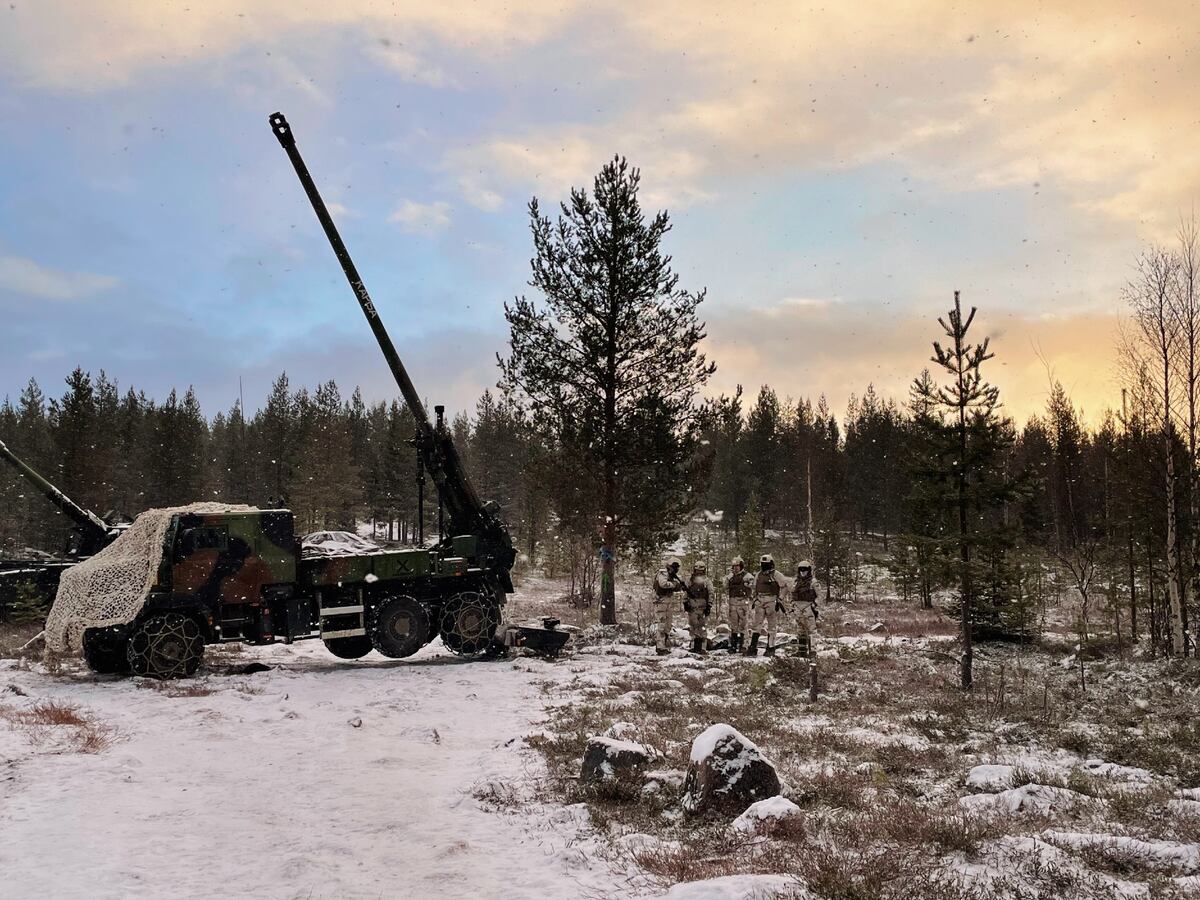
ROVAJÄRVI, Finland — Roughly 100 kilometers from the Finnish-Russian border, on a snowy November day, a soldier’s command rips through the frigid air: “Avfyra!” That’s the Swedish call to fire the Archer self-propelled howitzer system that sits camouflaged between a line of thin trees. The gun lets out a burst of two shots, the rounds clearing the barrel to strike a target called in by Finnish soldiers elsewhere on the range.
These are some of the hundreds of munitions that were fired here near the Arctic circle during Exercise Lightning Strike 24 (LS24), where five NATO artillery units – the French, British, Swedish, Finnish and Americans – practiced joint long-range fire capabilities.
LS24 is part of the Dynamic Front series, the alliance’s largest artillery exercise series ever conducted in Europe, taking place across five countries – Finland, Estonia, Germany, Romania and Poland.
A Swedish Archer artillery system fires two munitions during a NATO exercise in northern Finland on Nov. 20, 2024.(Elisabeth Gosselin-Malo/staff)
The name of the game here in Lapland, the northernmost region of Finland, was to have a call for fire made by one of the nations and the fires delivered by other ones to increase the interoperability of the different artillery systems. In total, this leg of the exercise included 130 pieces of artillery equipment, according to Finnish Col. Janne Makitalo, the event’s director.
The training was meant to rehearse the chain of forward observers finding simulated targets and sending their coordinates to the guns for “servicing,” as the jargon of artillerymen goes.
The information passed digitally all the way to the different platforms, including to the unit in charge of allocating the fire mission, the Allied Rapid Reaction Corps, or ARCC, a rapid reaction force maintained by NATO. Officials at that unit, alongside with supporting formations, determined where and which national artillery platform could best respond and would connect it with the assignment.
Ideally, it’s a relay race of sensors and shooters across multiple nationalities, in the blink of an eye.
A Swedish Archer artillery piece fires during a NATO exercise near the Arctic Circle in Finland on Nov. 20, 2024. (Elisabeth Gosselin-Malo/staff)
“When we speak of deciding of the best platform – whether it is Swedish, British, or French – the decision is not based upon the national unit [per say], it is based upon how we can get the best effect on the ground,” British Col. Alex Forbes, commander of the multinational field artillery brigade told reporters.
The specific system that connects all the pieces is ASCA, which stands for Artillery Systems Cooperation Activities, NATO’s digital language for putting “warheads on foreheads,” as another U.S. military adage goes. It’s an encrypted software suite that creates a unified network of communication, digitally linking artillery and command and control systems from different nations.
The software also allowed the sharing of real-time information about the simulated battlefield to other units in Estonia and Germany. While it was created in the 1980s, it gets refined every time it is used in exercises or other events, based on what worked and what did not in the evolving nature of combat, U.S. officers told Defense News.
Fifteen countries used ASCA throughout the event, the highest number ever integrated in a NATO exercise, which allowed to nullify language barriers and share all targeting data between users regardless of individual fire control systems.
Forbes explained that in terms of artillery, the types of operations practiced here, while complex, were necessary to help further the “deconfliction of fires across a battlefield,” something participants were now achieving in an advanced manner.
A Finnish K9 fires two rounds on Nov. 18, 2024, during a NATO exercise in northern Finland. (Elisabeth Gosselin-Malo/staff)
The exercise scenario featured a simulated near-peer enemy confined to a small “kill-box” – another military term of art that describes a geographic location from which it’s best to stay away – that allies had to neutralize by “massing multinational fires to enable freedom of movement for infantry and armor forces,” Maj. Nicholas Chopp, deputy media chief for US Army Europe and Africa said.
Artillery units used small drones, deployed from concealed sites, to secure the fire missions while vulnerable. Finnish F-18 Hornets were also in the air to help service targets.
Shortening the ‘kill chain’
An objective identified by the heads of the participating artillery units, inspired in part by Russian tactics in Ukraine, was to shorten the amount of time required between the identification of a target and the shot.
“The link between C2 [command and control], the drone and the launcher has to be shortened… We are trying to work on this here, accelerating the time between the target acquisition and the firing,” French Brig. Gen. Eric Lendroit said during a press conference here on Nov. 20.
A Finnish soldier sits inside one of the country’s K9 self-propelled howitzers on Nov. 20, 2024, during a NATO exercise in northern Finland. (Elisabeth Gosselin-Malo/staff)
Maj. Gen. Rafferty, the head of the U.S. 56th artillery regiment, added that Ukraine served as a reminder that the Russian Army “is built around the fires of war-fighting action,” that is long-range artillery protected by sophisticated air defenses.
The U.S. official said that if they were to “counter” such an advantage, then NATO countries have to keep on practicing as a “multinational fires and artillery team” to enable combined arms maneuvers.
Even in light of significant shortages of ammunition faced by several European countries, officials told Defense News that magazine depth – that is, not having sufficient rounds in combat – was not a constraint of the exercise.
While Rafferty and Brig. Gen. Takamaa, Finnish deputy chief of staff for Army operations, said they were unconcerned about munition scarcity, given that the U.S. and Finland both accelerated the production of 155mm shells, the French official shared a different perspective.
“We all know that in [almost] all the nations the stock of ammunition is a key issue – but at the tactical level, [one thing we do practice] is to have the best target acquisition and ammo to produce the greatest effect to minimize our consumption of munitions,” he said during the press conference.
Elisabeth Gosselin-Malo was a Europe correspondent for Defense News. She covers a wide range of topics related to military procurement and international security, and specializes in reporting on the aviation sector. She is based in Milan, Italy.
芬兰罗瓦耶尔维——在距离芬兰-俄罗斯边境约100公里处,一个十一月的雪天,一名士兵的命令划破了凛冽的寒风:“Avfyra!”这是瑞典人向伪装在一排稀疏树木间的“弓箭手”自行榴弹炮开火的口令。火炮齐射两发炮弹,炮弹飞出炮膛,击中了靶场上芬兰士兵指定的目标。
这是在北极圈附近举行的“闪电打击 24 (LS24)”演习中发射的数百枚弹药中的一部分。当时,来自法国、英国、瑞典、芬兰和美国的五个北约炮兵部队演练了联合远程火力作战能力。
LS24 是“动态前线”系列演习的一部分,这是联盟在欧洲举行的规模最大的炮兵演习系列,演习遍及芬兰、爱沙尼亚、德国、罗马尼亚和波兰五个国家。
2024年11月20日,在芬兰北部举行的北约演习中,一套瑞典“弓箭手”自行火炮系统发射了两枚炮弹。(伊丽莎白·戈斯林-马洛/工作人员摄)
在芬兰最北端的拉普兰地区,此次演习的目的是由一个国家发出火力请求,其他国家则进行火力支援,以提高不同火炮系统的协同作战能力。据演习负责人、芬兰上校扬内·马基塔洛介绍,此次演习共动用了130门火炮。
训练的目的是演练前线观察员寻找模拟目标并将坐标发送给火炮进行“维护”(用炮兵的行话来说)的流程。
信息以数字化方式传递至各个平台,包括负责分配火力任务的北约快速反应部队——盟军快速反应部队(ARCC)。该部队的官员与支援部队共同确定了最适合响应的各国炮兵平台的位置和部署方式,并将其与任务对接。
理想情况下,这是一场跨越多个国家的传感器和射手之间的接力赛,瞬间完成。
2024年11月20日,在芬兰北极圈附近举行的北约演习中,一门瑞典“弓箭手”自行火炮开火。(伊丽莎白·戈斯林-马洛/工作人员摄)
“当我们谈到决定最佳平台——无论是瑞典的、英国的还是法国的——时,这个决定并非基于国家单位本身,而是基于我们如何才能在地面上取得最佳效果,”多国野战炮兵旅指挥官、英国上校亚历克斯·福布斯告诉记者。
连接所有组件的特定系统是ASCA,即炮兵系统合作活动(Artillery Systems Cooperation Activities)的缩写,这是北约的数字化语言,用一句美国军方谚语来说,就是“把弹头装到额头上”。它是一套加密软件,能够创建一个统一的通信网络,将不同国家的炮兵和指挥控制系统进行数字化连接。
该软件还允许与爱沙尼亚和德国的其他部队共享模拟战场的实时信息。美国军官告诉《防务新闻》,虽然该软件创建于20世纪80年代,但每次在演习或其他活动中使用时,都会根据不断变化的作战形势,对哪些有效、哪些无效进行改进。
在整个演习过程中,共有 15 个国家使用了 ASCA,这是北约演习中采用 ASCA 的国家数量最多的一次,这使得用户能够消除语言障碍,并共享所有目标数据,而无需考虑个人的火控系统。
福布斯解释说,就炮兵而言,这里演练的作战类型虽然复杂,但对于进一步“消除战场上的火力冲突”是必要的,而参与者现在正以一种先进的方式实现这一点。
2024年11月18日,在芬兰北部举行的北约演习中,一只芬兰K9军犬发射了两发炮弹。(伊丽莎白·戈斯林-马洛/摄)
美国陆军欧洲和非洲副媒体主管尼古拉斯·乔普少校表示,演习场景模拟了一个势均力敌的敌人被限制在一个小型“杀伤区”(另一个军事术语,指的是最好远离的地理位置)内,盟军必须通过“集中多国火力来消灭该敌人,以确保步兵和装甲部队的行动自由”。
炮兵部队使用从隐蔽地点部署的小型无人机,在自身易受攻击的情况下保障火力支援任务。芬兰的F-18“大黄蜂”战斗机也升空支援目标打击。
缩短“杀戮链”
参战炮兵部队指挥官们确定的一个目标,部分灵感来源于俄罗斯在乌克兰的战术,就是缩短从发现目标到开火所需的时间。
“C2(指挥与控制)、无人机和发射器之间的联系必须缩短……我们正在努力缩短目标捕获和发射之间的时间,”法国准将埃里克·朗德罗伊特在11月20日于此地举行的新闻发布会上说。
2024年11月20日,在芬兰北部举行的北约演习期间,一名芬兰士兵坐在该国的K9型自行榴弹炮内。(伊丽莎白·戈斯林-马洛/摄)
美国第56炮兵团团长拉弗蒂少将补充说,乌克兰战争提醒人们,俄罗斯军队“是围绕着战争行动的火力而建立的”,即由先进的防空系统保护的远程火炮。
美国官员表示,如果要“对抗”这种优势,那么北约国家就必须继续以“多国火力炮兵小组”的形式进行训练,以实现联合兵种演习。
尽管一些欧洲国家面临严重的弹药短缺,但官员们告诉《防务新闻》,弹药库深度(即战斗中弹药不足)并不是此次演习的限制因素。
尽管拉弗蒂和芬兰陆军作战副参谋长塔卡马准将表示,鉴于美国和芬兰都加快了 155 毫米炮弹的生产,他们并不担心弹药短缺,但这位法国官员却持不同观点。
“我们都知道,在(几乎)所有国家,弹药储备都是一个关键问题——但在战术层面,(我们实践的一件事)是拥有最佳的目标获取和弹药,以产生最大的效果,从而最大限度地减少我们的弹药消耗,”他在新闻发布会上说。
伊丽莎白·戈斯林-马洛曾任《防务新闻》欧洲通讯员。她的报道涵盖军事采购和国际安全等广泛领域,尤其擅长航空领域的报道。她常驻意大利米兰。