Biden brokers new defense commitments between Japan, South Korea拜登促成日本和韩国之间达成新的防务协议
The U.S., Japan and South Korea agreed to instate annual military exercises, collaborate on missile defense and shore up supply chain security.
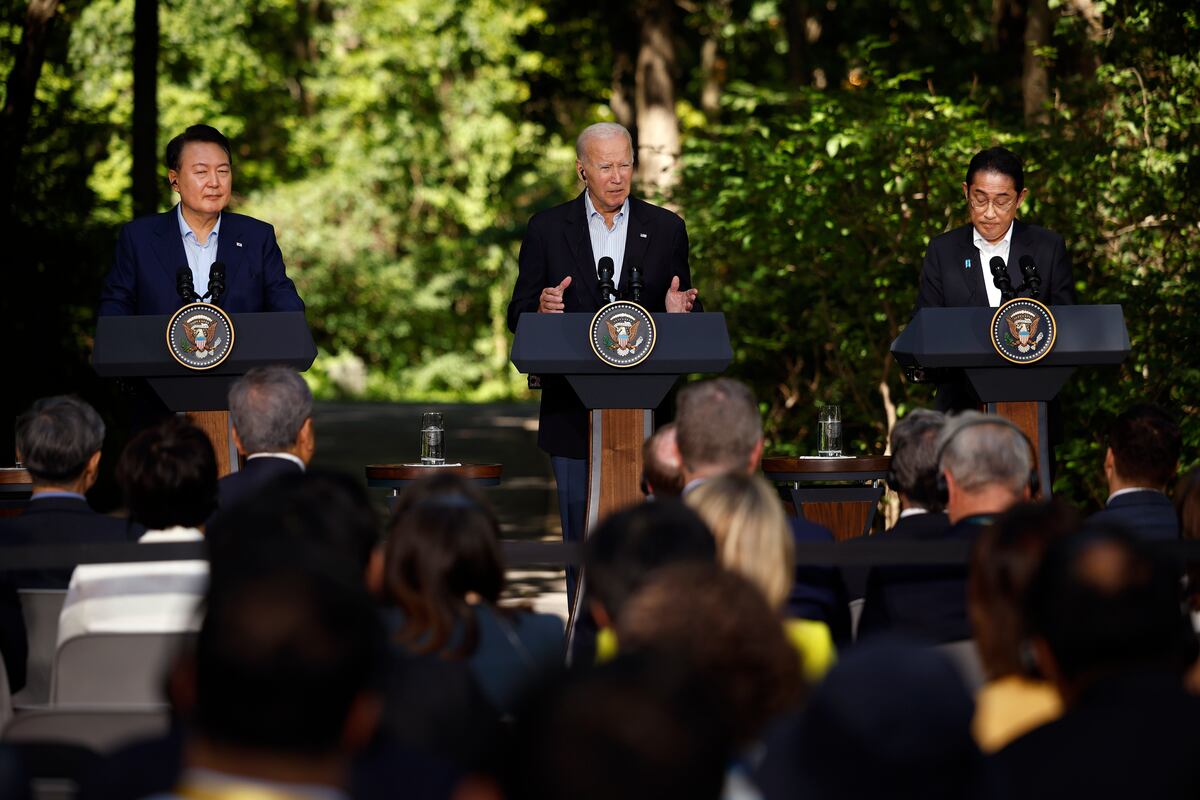
WASHINGTON ― U.S. President Joe Biden brokered a series of trilateral defense initiatives with Japanese Prime Minister Fumio Kishida and South Korean President Yoon Suk Yeol at Camp David on Friday as the two U.S. allies move past decades of strained relations .
The agreements between the three countries include annual trilateral military exercises, ballistic missile defense cooperation and shoring up the security of defense supply chains. The U.S. has worked to reconcile Japan and South Korea for well over a decade as it seeks to bolster its alliances in Asia to counter China and contain North Korea’s nuclear and ballistic missile programs.
“We’re elevating our trilateral defense collaboration to deliver in the Indo-Pacific region,” Biden said. “This is not about a day, a week or month. This is about decades and decades of relationships that we’re building.”
The leaders and some of their top cabinet officials agreed to meet at least once a year — in the hope that their commitments will outlast their time in office. The summit marked the first time Biden has hosted foreign leaders at the president’s country residence Camp David, intended to be a symbol of its importance. Indeed, the statement released — titled “The Spirit of Camp David” — calls this moment a “hinge point of history.”
Biden announced the three countries would establish a security hotline to consult with each other, and a joint statement announced “annual, named, multi-domain trilateral exercises on a regular basis.” This would include air, land, sea, undersea and cyber components.
The statement is full of the three countries’ future commitments, likely in response to the two U.S rivals it names. The first is China, whose maritime claims in the South China Sea it describes as “dangerous and aggressive.” China has increased its military drills around the island nation of Taiwan, which Beijing considers part of its territory. The statement calls for “peace and stability” in the Taiwan Strait.
The U.S. regularly conducts freedom of navigation operations in the South China Sea and has sought to deepen military cooperation with its Southeast Asian partners who have overlapping claims in the disputed region.
The second country invoked in the statement is North Korea, whose “unprecedented number of ballistic missile launches” continue to rattle its neighbor to the south and Japan. The three countries “remain committed to re-establishing dialogue” with Pyongyang with no preconditions, according to the statement. Thus far, North Korea has declined invitations for detente.
The U.S. reaffirmed its extended deterrence commitments to both countries, and the three allies vowed that by the end of the year they would begin sharing data regarding North Korean missile launches.
“We are committed to pursuing enhanced ballistic missile defense cooperation to counter [North Korean] nuclear and missile threats,” the statement read.
The three countries will also collaborate more closely on supply chain security, which includes several vulnerable areas of the defense-industrial base that are often contingent on Chinese-dominated markets . These include critical minerals, batteries, semiconductors, artificial intelligence and quantum computing.
They plan to expand information sharing and launch early warning systems to combat major supply chain disruptions as well as “better prepare us to confront and overcome economic coercion.”
The Biden administration and Congress have sought to lessen China’s influence over critical minerals like cobalt , which is needed to produce batteries and hard-target penetrators for the military.
The U.S. has also sought to onshore semiconductor production , fearful that a possible Chinese attack on Taiwan could upend a global shortage as most microelectronics are produced in east Asia.
Additionally, the Biden administration has convinced Japan to mirror sweeping U.S. export controls on semiconductor technology to China . The U.S. hopes this will hobble China’s AI weapons development and military quantum computing, though this also impacts civilian use for the technology such as weather forecasting and vaccine development. The joint statement vows to “strengthen trilateral cooperation on export controls.”
The three leaders also reaffirmed their support for aiding Ukraine “against Russia’s unprovoked and brutal war of aggression.”
“We believe the lasting lesson from this catastrophic war of aggression must be the international community’s abiding will to uphold the principles of territorial integrity, sovereignty and the peaceful resolution of disputes,” the statement read. “We reaffirm our view that when these foundational principles are rejected anywhere, they represent a threat to our region.”
Bryant Harris is the Congress reporter for Defense News. He has covered U.S. foreign policy, national security, international affairs and politics in Washington since 2014. He has also written for Foreign Policy, Al-Monitor, Al Jazeera English and IPS News.
Noah Robertson is the Pentagon reporter at Defense News. He previously covered national security for the Christian Science Monitor. He holds a bachelor’s degree in English and government from the College of William & Mary in his hometown of Williamsburg, Virginia.
华盛顿——美国总统乔·拜登周五在戴维营与日本首相岸田文雄和韩国总统尹锡烈斡旋达成了一系列三边防御倡议,标志着这两个美国盟友正在走出数十年的紧张关系。
三国间的协议包括年度三边联合军事演习、弹道导弹防御合作以及加强国防供应链安全。十多年来,美国一直致力于调解日韩关系,以期加强其在亚洲的联盟,从而对抗中国并遏制朝鲜的核武器和弹道导弹计划。
拜登说:“我们正在提升三边防务合作,以在印太地区发挥作用。这并非一天、一周或一个月就能完成的事情,而是关乎我们正在建立的长达数十年的关系。”
各国领导人及其部分内阁高级官员同意每年至少会晤一次,希望他们的承诺能够延续到任期之后。此次峰会标志着拜登总统首次在其位于乡村的官邸戴维营接待外国领导人,此举旨在彰显戴维营的重要性。事实上,发表的题为《戴维营精神》的声明称这一时刻是“历史的转折点”。
拜登宣布三国将设立安全热线进行磋商,并发表联合声明宣布“定期举行年度、指定名称的多领域三方演习”。演习将涵盖空中、陆地、海上、水下和网络空间等领域。
这份声明包含了三国对未来的一系列承诺,很可能是为了回应声明中提到的两个美国竞争对手。第一个是中国,声明称其在南海的海洋主张“危险且具有侵略性”。中国加强了在台湾岛周边的军事演习,北京方面认为台湾是其领土的一部分。声明呼吁维护台湾海峡的“和平与稳定”。
美国经常在南海开展航行自由行动,并寻求深化与在该争议地区拥有重叠主权声索的东南亚伙伴的军事合作。
声明中提到的第二个国家是朝鲜,其“前所未有的弹道导弹发射次数”持续令其南方邻国和日本感到不安。声明称,这三个国家“仍然致力于在不设任何先决条件的情况下与平壤恢复对话”。迄今为止,朝鲜拒绝了缓和局势的邀请。
美国重申了对朝鲜和朝鲜的延伸威慑承诺,三个盟友承诺到年底将开始共享有关朝鲜导弹发射的数据。
声明称:“我们致力于加强弹道导弹防御合作,以应对(朝鲜)的核导弹威胁。”
三国还将加强在供应链安全方面的合作,这包括国防工业基础中几个脆弱的领域,这些领域往往依赖于中国主导的市场。这些领域包括关键矿产、电池、半导体、人工智能和量子计算。
他们计划扩大信息共享,并启动预警系统,以应对重大供应链中断,并“更好地帮助我们应对和克服经济胁迫”。
拜登政府和国会一直试图削弱中国对钴等关键矿产的影响力,钴是生产军用电池和硬目标穿透弹所必需的。
美国也一直试图将半导体生产迁回国内,担心中国可能对台湾发动攻击,从而导致全球半导体短缺,因为大多数微电子产品产自东亚。
此外,拜登政府已说服日本效仿美国,对中国半导体技术实施全面的出口管制。美国希望此举能够阻碍中国人工智能武器的研发和军用量子计算,尽管这也会影响到该技术在民用领域的应用,例如天气预报和疫苗研发。联合声明承诺“加强三方在出口管制方面的合作”。
三位领导人还重申了他们对援助乌克兰“对抗俄罗斯无端发动的残酷侵略战争”的支持。
声明指出:“我们认为,这场灾难性的侵略战争必须给我们留下最深刻的教训,那就是国际社会必须坚定不移地维护领土完整、主权和和平解决争端的原则。我们重申,任何地方一旦违背这些基本原则,都将对我们地区构成威胁。”
布莱恩特·哈里斯是《防务新闻》的国会记者。自2014年以来,他一直在华盛顿报道美国外交政策、国家安全、国际事务和政治。他还曾为《外交政策》、《Al-Monitor》、《半岛电视台英语频道》和IPS新闻撰稿。
诺亚·罗伯逊是《防务新闻》的五角大楼记者。他此前曾为《基督教科学箴言报》报道国家安全新闻。他拥有弗吉尼亚州威廉斯堡威廉与玛丽学院的英语和政治学学士学位。