US Army pursues faster, more survivable Stinger missile replacement美国陆军寻求更快、生存能力更强的毒刺导弹替代品。
Meanwhile, the Army is gearing up for a first user assessment for its Stryker-based Maneuver-Short Range Air Defense system in Germany.
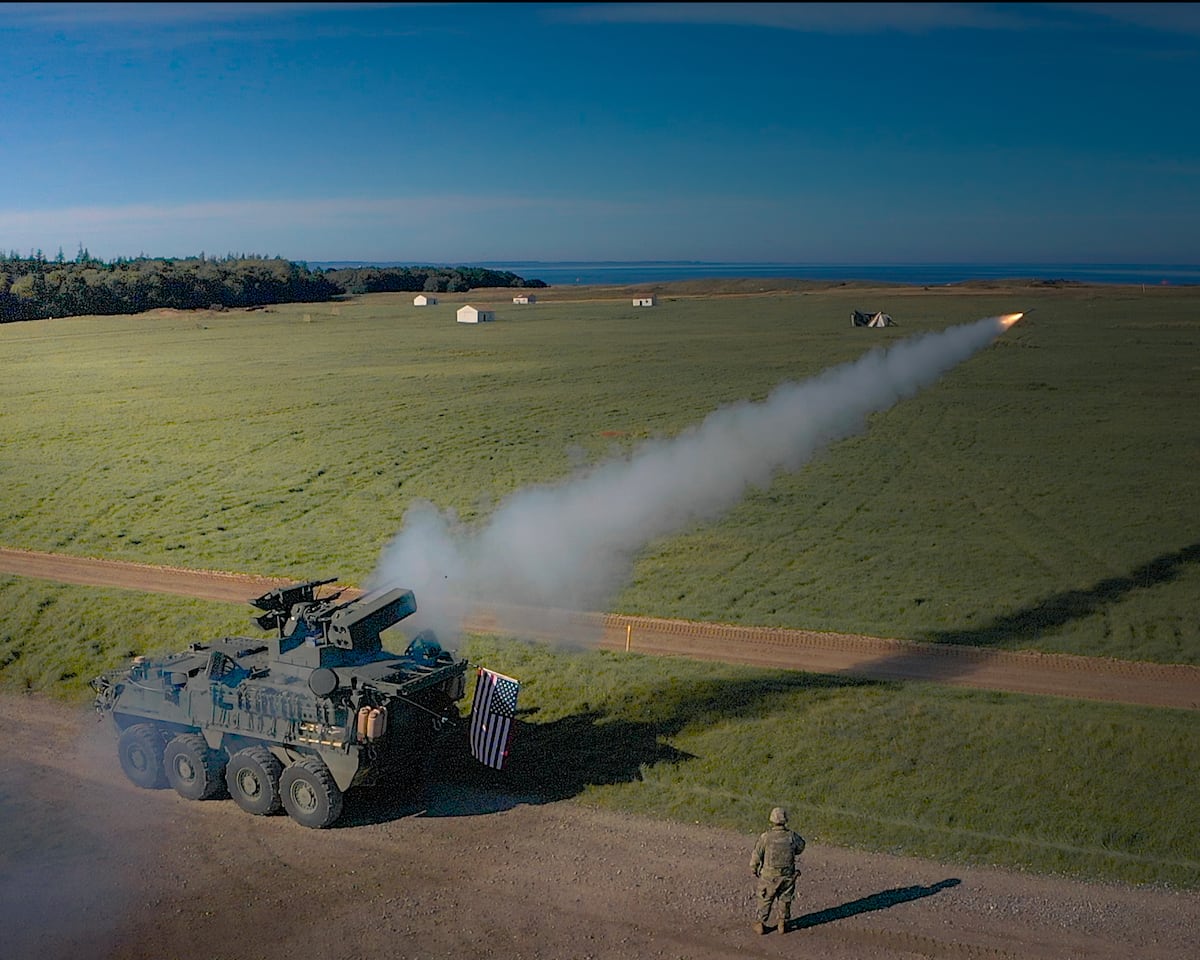
WASHINGTON — The U.S. Army is pursuing a Stinger missile replacement for short-range air defense that can go faster, survive jamming and more easily hit tougher targets like drones, according to the service’s program executive officer for missiles and space.
The service last month awarded RTX and Lockheed Martin with contracts to competitively develop the Stinger replacement. The RTX-manufactured Stinger missiles are currently used in the Army’s interim Maneuver-Short Range Air Defense system and also in a man-portable configuration to provide air defense.
The Army has long-planned to pursue a next-generation interceptor for short-range air defense, but the effort has become paramount as Stinger missiles were sent to Ukraine in response to Russia’s invasion of the country.
The Army no longer builds new Stinger missiles; it refurbishes old ones. To replenish its own stockpile, the Army would like to replace the old missiles with new ones.
But the service still plans to take five years to develop and qualify the new interceptor and move into low-rate production, Brig. Gen. Frank Lozano, who runs Program Executive Office Missiles and Space, told Defense News in a recent interview.
The Army will break up the five-year effort into two phases, he said. In the first two years, each of the two companies will develop missiles and then build a “very small quantity” of them. Then at the end of the period, the service will have a “fly-off,” Lozano said.
If both missiles perform well, then the Army would carry both vendors into the second phase of the rapid prototyping effort. During that phase, the Army will ask the teams to tweak and improve their missiles “in a few key areas” and have them build another round of prototypes, according to Lozano.
The competitors would go through another fly-off round. Then the service would select one vendor to move into production.
Of course, Lozano said, the Army plans to be flexible. “If one vendor does very well and the second vendor does very poorly, then we have that decision there at the end of the two-year time period to off ramp one of the vendors and just proceed with a single vendor for the final three years of the program. We’d really not prefer to do that; we really want to keep that competition as long as possible.”
The next-generation interceptors will have to go into two Stinger Vehicle Universal Launch systems on the Maneuver-Short Range Air Defense system turret, Lozano said, and into a man-portable system.
The Army wants an interceptor that can still fit into the Stinger Vehicle Universal Launch system and into the man-portable system but has a “shorter time to target,” Lozano added, which translates to having an advanced rocket motor.
The interceptor will also feature countermeasures so that it can repel electronic warfare threats the service has seen emerging on fixed-wing aircraft, Lozano noted.
Additionally, the new missile “needs to be more effective against [unmanned aircraft system] threats,” he said, which are more challenging to hit because they don’t give off a significant heat signature like fixed-wing or rotary-wing aircraft.
“They can be very difficult to target for some systems, so we need to have an advanced seeker,” Lozano explained.
Meanwhile, the Army is gearing up for a first user assessment for its Stryker-based Maneuver-Short Range Air Defense system in Germany. The service rapidly fielded an interim system nearly two years ago to address a rising need to provide air defense capability that can keep up with maneuver formations in the European theater. The capability gap was first identified by then-U.S. Army Europe Commander Gen. Ben Hodges in 2016.
The Army outfitted a platoon within the 5th Battalion, 4th Air Defense Artillery Regiment in Europe with the interim short-range air defense systems, which Lozano said he visited last month.
The unit is gearing up to conduct a user assessment in the spring of next year, after it was delayed from earlier this year due to scheduling conflicts, according to Lozano.
“It’s important to us to perform that user assessment to build the body of test data that will support eventually taking the systems to a milestone C [production phase],” he said.
“Once the Army makes a decision on whether or not we’re going to buy more battalions, then that will allow me to better shape what the initial operational test and evaluation looks like,” he added, which is forecast for the fiscal 2025 or fiscal 2026 time frame.
Jen Judson is an award-winning journalist covering land warfare for Defense News. She has also worked for Politico and Inside Defense. She holds a Master of Science degree in journalism from Boston University and a Bachelor of Arts degree from Kenyon College.
华盛顿——据美国陆军导弹与太空项目执行官称,美国陆军正在研发一种能够替代“毒刺”导弹的短程防空导弹,这种导弹速度更快、能够抵御干扰,并且更容易击中无人机等更难对付的目标。
上个月,美国陆军授予RTX公司和洛克希德·马丁公司合同,以竞争性方式开发“毒刺”导弹的替代产品。RTX公司生产的“毒刺”导弹目前用于陆军的临时机动短程防空系统,并有便携式版本用于防空作战。
美国陆军长期以来一直计划研发下一代短程防空拦截器,但随着俄罗斯入侵乌克兰,美国向乌克兰派遣了毒刺导弹,这项工作变得至关重要。
陆军已不再生产新的毒刺导弹,而是翻新旧导弹。为了补充自身库存,陆军希望用新导弹替换旧导弹。
但负责导弹与航天项目执行办公室的准将弗兰克·洛萨诺在最近接受《防务新闻》采访时表示,军方仍计划用五年时间开发和鉴定新型拦截器,并进入小批量生产阶段。
他说,陆军将把这项为期五年的计划分为两个阶段。在前两年,两家公司将各自研发导弹,并生产“极少量”的导弹。洛萨诺说,之后,陆军将进行一次“试飞”。
如果两款导弹性能良好,陆军将把这两家供应商都纳入快速原型研发的第二阶段。洛萨诺表示,在这一阶段,陆军将要求各团队“在几个关键领域”对导弹进行调整和改进,并让他们制造新一轮原型。
参赛者将进行另一轮飞行比拼。然后,该服务商将选择一家供应商投入生产。
洛萨诺表示,陆军当然会保持灵活性。“如果一家供应商表现出色,而另一家供应商表现糟糕,那么在两年期满时,我们可以决定终止其中一家供应商的合同,只与一家供应商合作完成该项目的最后三年。我们真的不希望这样做;我们希望尽可能长时间地保持这种竞争状态。”
洛萨诺说,下一代拦截器将需要装入机动短程防空系统炮塔上的两个毒刺通用发射系统和一个单兵便携式系统。
陆军希望拦截器能够装入毒刺导弹通用发射系统和便携式发射系统,但“到达目标的时间要短”,洛萨诺补充道,这意味着它需要配备先进的火箭发动机。
洛萨诺指出,拦截机还将配备对抗措施,以便抵御军方在固定翼飞机上发现的电子战威胁。
此外,他还表示,新型导弹“需要对付无人机系统威胁更加有效”,因为无人机不像固定翼或旋翼飞机那样会发出明显的热信号,所以更难击中。
“对于某些系统来说,它们可能很难被锁定,所以我们需要一种先进的导引头,”洛萨诺解释说。
与此同时,美国陆军正准备在德国对其基于“斯特瑞克”装甲车的机动短程防空系统进行首次用户评估。近两年前,为了满足欧洲战区日益增长的防空能力需求,美国陆军迅速部署了一套过渡系统,以应对机动编队部署速度不足的问题。这一能力缺口最早由时任美国陆军欧洲司令本·霍奇斯将军于2016年提出。
陆军为驻欧洲的第4防空炮兵团第5营的一个排配备了临时短程防空系统,洛萨诺说他上个月参观了该排。
据洛萨诺称,该部门正准备在明年春季进行用户评估,此前由于日程冲突,该评估从今年早些时候推迟了下来。
他说:“对我们来说,进行用户评估非常重要,这样才能建立测试数据,最终支持系统达到里程碑 C(生产阶段)。”
“一旦陆军决定是否购买更多营,我就可以更好地制定初步作战测试和评估方案,”他补充道,预计该方案将在 2025 财年或 2026 财年期间实施。
珍·贾德森是一位屡获殊荣的记者,为《防务新闻》报道陆地战争。她也曾为《政治报》和《内幕防务》工作。她拥有波士顿大学新闻学硕士学位和凯尼恩学院文学学士学位。