In Estonia, Europe’s last road through Russia has closed for good在爱沙尼亚,欧洲最后一条穿越俄罗斯的公路已经永久关闭。
Across the snowy and muddy forests of eastern Estonia, NATO and Russia are locked in a staring match.
LUTEPÄÄ, Estonia — Across the snowy and muddy forests of eastern Estonia, NATO and Russia are locked in a staring match. It’s here, the frontier between a country with a population smaller than Vienna’s and the largest nuclear power in the world, that many analysts fear Russian President Vladimir Putin may one day be inclined to conduct a limited invasion into NATO.
The mood at the border here is tense and silent. Stretching inland from the tall barbed-wire fence is a “border regime area” patrolled by special police units and dotted with guard towers. There are just a few villages in this zone – many of them Russian-speaking – connected by deserted but immaculately maintained roads.
Until this fall, this border was home to an oddity that served as a reminder that, despite the politics, the people here have long been connected. Estonian Road 178, built in Soviet times, cuts through Russian territory in two separate spots, connecting several towns to the regional center of Värska. A low-key agreement between the local border guards on either side of the fence meant that residents could use the road without checks, provided they stayed in their vehicles and would not stop in the approximately one kilometer of Russian territory that they traversed.
This arrangement, never codified in official government policy on either side, came to an abrupt end on Oct. 10.
“We saw a bigger group of soldiers. Some of them – most of them – had equipment like regular soldiers, not border guard uniforms and equipment,” said Renet Merdikes, the Border Police captain in charge of this stretch of the border known as the Saatse Kordon.
Merdikes has worked all along the frontier for the past thirteen years.
“We haven’t before seen this kind of unit around,” he added.
This photo shows a group of Russian soldiers, according to Estonian authorities, on the road through the Saatse Boot on the border between Estonia and Russia on Oct. 10, 2025. (Estonian Police and Border Guard Board)
Merdikes counted eleven Russian men in uniforms, who had come from different directions and loitered for a while in the Saatse Boot, the piece of Russian territory that juts into Estonia and through which the road cuts. They were even on the strip of tarmac itself, he said, all the while Estonian vehicles were still using it to get from Sesniki to Lutepää, two tiny villages on the southern and northern end, respectively, of the Russian pocket.
Estonian authorities quickly closed the road. It hasn’t reopened since.
“We didn’t want to wait for the first serious incident,” said Merdikes. “We can’t do anything on the Russian territory, we can’t protect our citizens.”
The soldiers ultimately left not long after they arrived, having walked around the area for a while and seemingly doing nothing else. Merdikes says that the Estonians picked up a hotline to their Russian counterparts, set up to defuse potential “emergency incidents,” asking for an explanation. They were told that there was nothing out of the ordinary and it was “usual activities.”
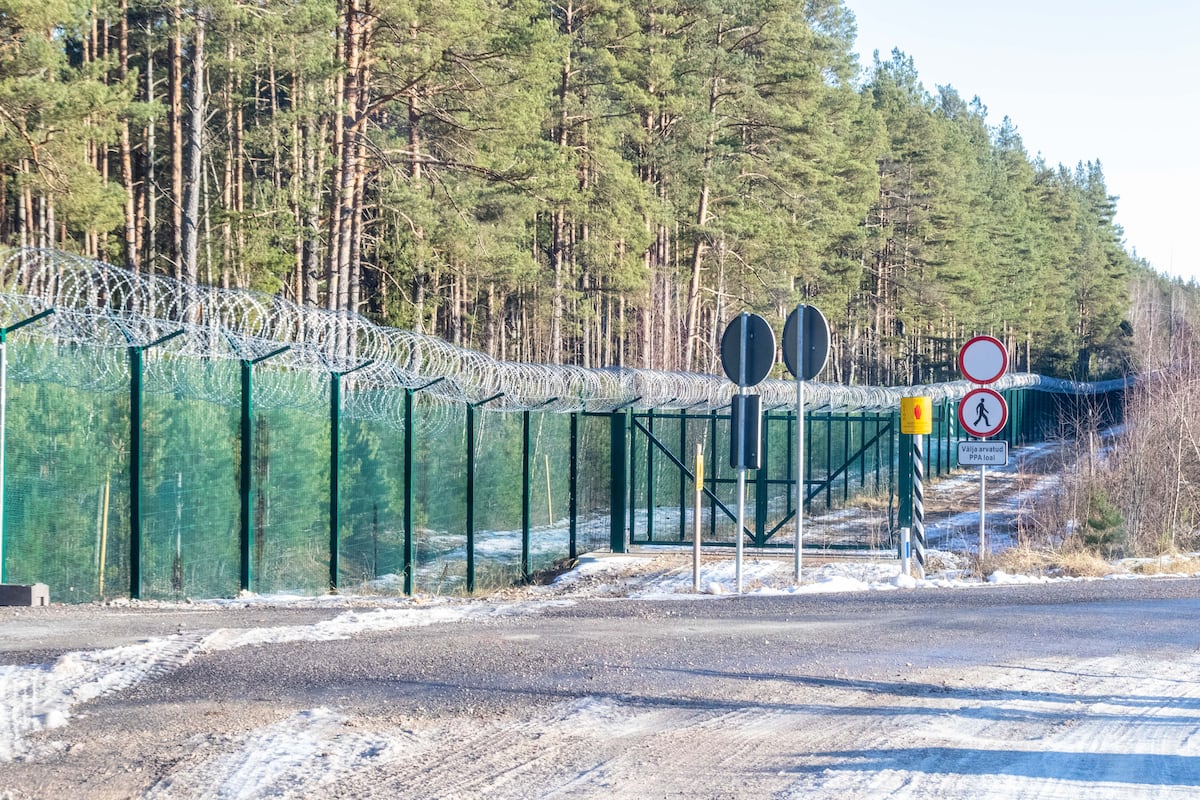
Initially, the road was blocked with a street sign, then concrete barriers and a temporary fence were set up. This week, a permanent fence has been constructed, sealing off the two road segments for good. Work has also started on replacement routes, with the longer of the two stretches set to be done by late next year, an expedited schedule pushed by the Estonian government for a project that was already underway to rectify the peculiar cross-border arrangement.
The Estonian road that led through Russian territory until October 2025, with temporary barriers blocking passage, as seen on Nov. 22. A few weeks later, a permanent fence was installed in their place. (Linus Höller/staff)
Until about 35 years ago, this line separating Russia from Estonia, which follows a river, the middle of a lake and then cuts through a series of forests, marshlands and Road 178, mattered relatively little. Since being invaded by the Soviet Union in 1940, and for five decades thereafter, the Estonian Soviet Socialist Republic was just one of 15 constituent republics of the world’s preeminent communist state. The frontier between Estonia and the Russian Soviet Federative Socialist Republic – which everyone understood was the dominant power in the “union” – was just an internal border of the same country.
Personal ties across the border remained close even after the dissolution of the Union, and pragmatic arrangements like the one in the Saatse Boot were par for the course. Until Russia’s invasion of Ukraine in 2022, even the Estonian border guards themselves would make use of the road leading through Russia.
Now, they have to take a detour to go around, out of an abundance of caution, the border guard captain said.
A map of Estonia. (Nzeemin, CC BY-SA 4.0, via Wikimedia Commons. Annotated by Linus Höller)
A closeup map of the "Saatse Boot" section of Estonia's border with Russia, with a now-closed shortcut road marked in red. (OpenStreetMap contributors, modified by Linus Höller)
Even before the Soviet Union, under the Tsarist Russian Empire, Estonia had been under some form of Russian control for centuries. Legacies of the countries’ complicated but nonetheless shared past are plentiful – a large Russian Orthodox church, part of the Kremlin-aligned Moscow patriarchate, stands opposite the Estonian parliament in the capital Tallinn; census data shows that two in every three Estonians live in Soviet-era apartment blocks; and ethnic Russians make up more than a fifth of the population.
Still, Estonia’s national identity is distinct and specifically European. Its heritage is linked to the Hanseatic League and the traders of the Baltic Sea, and its language carries strong traces of both Finnish and German. Museums in Tallinn, are quick to point out these historic connections and relativize ties to Russia, the Soviet period being described as a phase of Russian occupation. Practically no Soviet symbols or iconography remain even in remote backwaters, with round hammer-and-sickle plaques removed from buildings, leaving conspicuous circles, and statues of Lenin scrapped.
But ties across the border don’t disappear overnight. In Narva, a city in northeastern Estonia that is also its largest border town, there is a constant flow of people walking across the border to and from the twin city of Ivangorod, on the eastern – Russian – bank of the river, even now in late 2025. The crossing has been closed to vehicle traffic since 2022, ostensibly for construction works, although none were visible in mid-November three years later. Instead, the bridge has been fortified with tank barriers, electronic gates capable of closing within seconds, and a generous helping of barbed wire on all sides.
The bridge leading from Narva to Russia's Ivangorod (in the distance), now barricaded with anti-vehicle barriers, is still open to pedestrian traffic under strict conditions in late 2025. (Linus Höller/staff)
A little farther south, a seldom-used railroad bridge forms another physical connection between the two countries, spanning a gorge forged by the Narva River.
Since Jan. 1, 2023,, a year into Russia’s invasion of Ukraine, Estonia has suspended all cross-border rail traffic from and to the east.
A bored-looking Russian border guard, Kalashnikov rifle slung over his shoulder and dressed in a thick camouflage coat, observed this Defense News reporter through his binoculars as he snapped pictures of Russian fishermen braving the cold and reeling in a meager haul on his side of the river. The soldier was the only sign of activity on the once-busy railroad bridge.
A Russian border guard looks through his binoculars at the railroad bridge across the border between Narva, Estonia, and Ivangorod, Russia in November 2025. (Linus Höller/staff)
Just south of the city, next to the abandoned Soviet textile mill that used to employ 13,000 people, a dam spans the river. No crossing of the border is intended here, as is made clear by the razor wire and two opposing guard towers, myriad cameras and warning signs with a big red exclamation mark on a bright yellow background.
There were several other people on this dam on a blustery late November day, just short of the fence, pacing up and down and speaking into their phones in Russian. The manmade peninsula, it seems, juts far enough into Russia’s cell network to make domestic phone calls with a Russian number. Geopolitics has hardened this previously porous border, but the connections across it are similarly entrenched.
The dam in the south of Narva is heavily guarded, but also serves as a point from which Estonians can connect with Russia's mobile networks. The Orthodox church in the distance stands on Russian soil. (Linus Höller/staff)
But they are becoming harder to maintain. Many crossing points have been indefinitely closed and others are open only to pedestrians or specific types of travelers, and sanctions have ground cross-border economic activity to an effective halt.
The frontier itself is being fortified, too.
“Border building is ongoing right now,” said Merdikes. A modern fence is already installed along most of the land border. In the Saatse area, the current project is to create a gapless string of cameras to observe every meter of the fence. “Our goal is that we have eyes throughout the border so we know where to react,” said Merdikes. “We are the first eyes on the border in case something happens.”
Beyond the immediate fence, Estonia, Latvia and Lithuania have teamed up to construct what they dub the Baltic Defense Line. The project was announced in January 2024, and construction is now ongoing in all three Baltic Republics.
Primarily meant to deter and, if necessary, slow a Russian invasion, it will consist of a series of anti-tank obstacles, dragon’s teeth, barbed wire coils, bunkers and areas designated for laying landmines should the situation necessitate. Estonia alone plans to build 600 bunkers along its frontier with Russia, and the other Baltic states are expected to follow suit. The plans are being coordinated multilaterally between the countries and within the framework of NATO, according to the Estonian government.
“The war in Ukraine has shown that taking back already conquered territories is extremely difficult and comes at great cost of human lives, time and material resources,” said the Estonian National Defence Investment Center ECDI in a report outlining the large peacetime construction project. “In addition to equipment, ammunition and manpower, we need physical installations to defend our countries efficiently.”
Estonia expects to spend around €60 million ($70 million) on the project. It is meant to be completed by the end of 2027, according to the head of infrastructure at the Center for Defense Investments, Kadi-Kai Kollo. This represents a delay of about a year due to unexpected complications in developing the modular bunkers that are to serve as the main backstop of the fortifications.
“We have seen different estimates on how quickly Russia can rebuild its military, we need to use this time wisely – the time to make all the necessary preparations is now,” the ECDI report said.
The last remaining Soviets
On the Soviet-built House of Culture in Sillamäe, a grand Stalinist building, hangs a conspicuous sign featuring a blue triangle on an orange base. Scattered around Estonian towns, this sign marks that the building has a publicly accessible bomb shelter. The symbols started appearing in June 2022 as a direct consequence of Russia’s invasion of Ukraine and the fears it caused in Estonia. Within six months, shelter spots for more than 60,000 residents were marked accordingly. In the case of war, they would seek refuge in World War-era citadels, parking lots, and under schools and hospitals.
The main avenue of the formerly secret city of Sillamäe, Estonia, has seen better days. (Linus Höller/staff)
Sillamäe is emblematic of the difficult relationship with the big neighbor to the east. The town on the northern coast of Estonia was constructed from scratch under strict secrecy by the Soviet Union. It housed one of the country’s main uranium enrichment plants, creating the fuel for 70,000 Soviet atomic bombs as well as the civilian nuclear power plants that dotted the empire’s territory.
In Soviet times, it was a closed city – not marked on any official maps and requiring a special permit to enter.
“Back then, the stores were always well stocked, and you could get whatever you wanted,” recalls Larisa, a resident who moved here in 1985, just before Soviet premier Gorbachev’s policy of radical reform changed everything. Today, the town is largely forgotten, and the grand, palatial architecture of the workers’ apartment complexes with a splendid view of the ocean is coming apart.
It’s hard to say whether life was better in the Soviet Union or now in the European Union, Larisa said. “People adapt.”
Like most people in this part of the country – Sillamäe is just half an hour’s drive from the border – Larisa speaks Russian at home, even though she is originally from Ukraine. At the time she moved here due to her husband’s work as a driver, it was all one country.
“My motherland no longer exists,” she said while going for a Sunday stroll along the Baltic promenade, her favorite place in town. Her passports are Estonian and Ukrainian. To her, the border, located just 25 kilometers to the east, is a distant thought.
“I haven’t crossed it in many years; I have no reason to,” she says. “I don’t even know whether it is still open.”
It’s here and especially in nearby Narva, right on the border, that some analysts worry Putin might try to test the West’s resolve with a limited incursion, perhaps modeled on how he annexed Crimea in 2014. The area is ethnically primarily Russian, its population is Russian-speaking.
Bruno Kahl, the head of Germany’s Federal Intelligence Service (BND), has said that Putin may initiate such a scenario to test NATO’s resolve on its collective defense provision in the form of Article 5, sparking a “grey-zone conflict” that doesn’t quite meet the bar for other alliance members to feel comfortable engaging in war with Russia.
Others, especially Estonians, have pushed back on the idea, saying such a scenario is improbable given the risks associated and the precautions that the country has taken.
Estonia will defend itself and is counting on its allies to come to its aid, is the government’s message.
“Would a U.S. president risk dying for Tallinn, Riga and Vilnius?” spy chief Kahl asked in an interview with Germany-based Table Media June. “We are quite certain – and we have intelligence to back this up – that Ukraine is only the first step. The NATO commitment to collective defense is going to be challenged.”
Narva, Estonia, in November 2025. (Linus Höller/staff)
Whether it’s here or elsewhere along NATO’s extensive frontier with Russia – or if it never happens at all – the border in Estonia will remain tense for the foreseeable future. New fences will appear, bunkers will be buried, and cross-border connections will be strained.
But fundamentally, none of this is new. Russia’s presence just to the east has been a constant for many years. “Some things don’t happen overnight,” said Merdikes, the border police chief from Saatse.
“For us, we patrol the border. At the border, it’s quite calm – but still, we have to be ready and look for any changes to the threat level.”
Linus Höller is Defense News' Europe correspondent and OSINT investigator. He reports on the arms deals, sanctions, and geopolitics shaping Europe and the world. He holds master’s degrees in WMD nonproliferation, terrorism studies, and international relations, and works in four languages: English, German, Russian, and Spanish.
爱沙尼亚卢特帕——在爱沙尼亚东部白雪皑皑、泥泞不堪的森林中,北约和俄罗斯正进行着一场对峙。正是在这里,这个人口比维也纳还少的国家与世界上最大的核大国之间的边界,让许多分析人士担心,俄罗斯总统弗拉基米尔·普京或许有一天会倾向于对北约发动有限入侵。
这里的边境气氛紧张而寂静。从高高的铁丝网向内陆延伸的是一片“边境管制区”,由特警部队巡逻,并点缀着瞭望塔。这片区域内只有几个村庄——其中许多村民讲俄语——村庄之间由荒凉但维护得一尘不染的道路相连。
直到今年秋天,这条边境线一直存在着一个奇特的现象,它提醒人们,尽管政治纷争不断,但这里的人们早已紧密相连。建于苏联时期的爱沙尼亚178号公路在两处路段穿过俄罗斯领土,连接着几个城镇和地区中心瓦尔斯卡。边境两侧的边防人员达成了一项低调的协议:只要居民待在车内,并且不在穿越的约一公里俄罗斯领土上停留,他们就可以免于检查使用这条公路。
双方从未将这种安排写入官方政府政策,该安排于 10 月 10 日突然终止。
“我们看到一大群士兵。他们中的一些人——或者说大多数人——装备的是正规军的装备,而不是边防警卫的制服和装备,”负责萨特塞科尔顿边境地区的边防警察队长雷内特·梅尔迪克斯说道。
在过去的十三年里,梅尔迪克斯一直在边境地区工作。
“我们以前从未见过这种类型的部队,”他补充道。
据爱沙尼亚当局称,这张照片显示一群俄罗斯士兵于2025年10月10日出现在爱沙尼亚和俄罗斯边境萨特塞湾的道路上。(爱沙尼亚警察和边防局)
梅尔迪克斯数了数,有十一名身穿制服的俄罗斯男子,他们来自四面八方,在萨特塞靴状地带——这片伸入爱沙尼亚的俄罗斯领土,公路从中穿过——徘徊了一会儿。他说,他们甚至就站在柏油路上,而与此同时,爱沙尼亚的车辆仍在从塞斯尼基前往卢特帕,这两个小村庄分别位于这片俄罗斯“口袋”的南端和北端。
爱沙尼亚当局迅速封锁了这条道路,至今尚未重新开放。
“我们不想等到第一起严重事件发生才采取行动,”梅尔迪克斯说。“我们在俄罗斯领土上什么也做不了,我们无法保护我们的公民。”
士兵们抵达后不久便离开了,他们在附近转悠了一会儿,似乎什么也没做。梅尔迪克斯说,爱沙尼亚人接通了俄罗斯方面设立的用于化解潜在“紧急事件”的热线电话,要求对方做出解释。他们得到的答复是,一切正常,这只是“例行活动”。
最初,道路被路牌封锁,随后设置了混凝土路障和临时围栏。本周,永久围栏建成,彻底封闭了这两段道路。替代路线的建设工作也已启动,其中较长的一段预计将于明年年底完工。爱沙尼亚政府加快了这一进度,该项目旨在纠正这种特殊的跨境交通安排,此前已在进行中。
11月22日拍摄的照片显示,这条爱沙尼亚公路在2025年10月之前一直穿过俄罗斯领土,期间设置了临时路障阻挡通行。几周后,临时路障被永久性围栏取代。(Linus Höller/工作人员)
大约35年前,这条分隔俄罗斯和爱沙尼亚的界线——它沿着一条河流,穿过一个湖泊中央,然后横穿一系列森林、沼泽地和178号公路——相对来说并不重要。自1940年被苏联入侵以来,在接下来的五十年里,爱沙尼亚苏维埃社会主义共和国只是这个世界上最杰出的共产主义国家——苏联——的15个加盟共和国之一。爱沙尼亚与俄罗斯苏维埃联邦社会主义共和国(人人都明白它是“联盟”中的主导力量)之间的边界,只不过是同一个国家的内部边界而已。
即使在联盟解体后,两国人民的私人关系依然密切,像萨特塞靴形公路那样的务实安排也司空见惯。直到2022年俄罗斯入侵乌克兰之前,就连爱沙尼亚边防部队也会使用这条途经俄罗斯的道路。
边防队长说,现在,出于谨慎起见,他们不得不绕道而行。
爱沙尼亚地图。(Nzeemin,CC BY-SA 4.0,来自 Wikimedia Commons。由 Linus Höller 注释)
这是一张爱沙尼亚与俄罗斯边境“萨特塞靴”地带的近景地图,图中红色标记的是一条现已封闭的捷径道路。(OpenStreetMap贡献者提供,Linus Höller修改)
早在苏联成立之前,在沙皇俄国统治下,爱沙尼亚就已在俄罗斯的控制下生活了数个世纪。两国复杂而又共同的历史遗迹比比皆是——在首都塔林,一座隶属于克里姆林宫的莫斯科东正教大主教区的大型教堂与爱沙尼亚议会隔街相望;人口普查数据显示,三分之二的爱沙尼亚人居住在苏联时期建造的公寓楼里;俄罗斯族人口占爱沙尼亚总人口的五分之一以上。
尽管如此,爱沙尼亚的民族认同依然鲜明独特,具有浓厚的欧洲特色。其历史遗产与汉萨同盟和波罗的海的贸易往来紧密相连,其语言也深受芬兰语和德语的影响。塔林的博物馆会着重强调这些历史渊源,并淡化与俄罗斯的关系,将苏联时期描述为俄罗斯占领的一个阶段。即使在偏远地区,也几乎看不到任何苏联的标志或图像,建筑物上的圆形锤子镰刀牌匾已被移除,只留下显眼的圆圈,列宁雕像也被拆除。
但跨境联系不会在一夜之间消失。在爱沙尼亚东北部城市纳尔瓦,这座同时也是该国最大的边境城镇,即使到了2025年末,仍有络绎不绝的人们步行往返于位于河东岸(俄罗斯一侧)的姊妹城市伊万哥罗德。自2022年起,过境点已禁止车辆通行,表面上是为了施工,但三年后的11月中旬,却不见任何施工迹象。取而代之的是,桥梁周围布满了坦克路障、可在数秒内关闭的电子闸门以及密集的铁丝网。
连接纳尔瓦和俄罗斯伊万哥罗德(远处)的桥梁,目前已设置了车辆防撞路障,但在2025年底仍对行人开放,但需遵守严格的通行条件。(Linus Höller/工作人员)
再往南一点,一座很少使用的铁路桥横跨纳尔瓦河冲刷形成的峡谷,构成了两国之间的另一条物理连接。
自 2023 年 1 月 1 日起,也就是俄罗斯入侵乌克兰一年后,爱沙尼亚暂停了所有往返东部的跨境铁路交通。
一名神情百无聊赖的俄罗斯边防军士兵,肩上挎着一支卡拉什尼科夫步枪,身穿厚厚的迷彩服,正用望远镜观察着这位《防务新闻》的记者。记者正在河对岸拍摄俄罗斯渔民冒着严寒捕鱼,却收获寥寥无几的渔获。在这座曾经繁忙的铁路桥上,这名士兵是唯一的活动迹象。
2025年11月,一名俄罗斯边防警卫正用望远镜观察横跨爱沙尼亚纳尔瓦和俄罗斯伊万哥罗德边境的铁路桥。(Linus Höller/工作人员摄)
在城市南部,毗邻曾经雇佣13000名工人的废弃苏联纺织厂,一座大坝横跨河流。铁丝网、两座相对而立的瞭望塔、无数摄像头以及醒目的黄色背景上印着红色感叹号的警告标志都清楚地表明,这里禁止越境。
十一月下旬一个狂风呼啸的日子,在这座大坝上,离围栏不远的地方,还有几个人来回踱步,用俄语对着手机说话。看来,这片人工半岛已经深入俄罗斯的移动网络,可以用俄罗斯号码拨打国内电话。地缘政治因素使得这条原本漏洞百出的边界变得更加坚固,但边界两侧的联系也同样根深蒂固。
纳尔瓦南部的这座水坝戒备森严,但同时也是爱沙尼亚人连接俄罗斯移动网络的枢纽。远处的东正教教堂矗立在俄罗斯的土地上。(Linus Höller/工作人员)
但这些通道越来越难以维持。许多过境点已被无限期关闭,其他一些过境点则只对行人或特定类型的旅客开放,制裁措施实际上已使跨境经济活动陷入停滞。
边境本身也在加固。
“边境建设工作目前正在进行中,”梅尔迪克斯说。大部分陆地边界已经安装了现代化围栏。在萨特塞地区,目前的项目是安装一条无缝隙的摄像头网络,监控围栏的每一米。“我们的目标是让整个边界都有摄像头,这样我们就能知道在哪里做出反应,”梅尔迪克斯说。“一旦发生什么事,我们就是边境上的第一道防线。”
在波罗的海三国边境围栏之外,爱沙尼亚、拉脱维亚和立陶宛三国联手修建了他们所谓的“波罗的海防线”。该项目于2024年1月宣布,目前已在波罗的海三国全面展开建设。
该项目的主要目的是威慑俄罗斯入侵,并在必要时延缓其行动。它将包括一系列反坦克障碍、龙牙障碍、铁丝网、碉堡以及用于布设地雷的区域(以备不时之需)。爱沙尼亚计划在其与俄罗斯接壤的边境沿线建造600个碉堡,预计其他波罗的海国家也将效仿。据爱沙尼亚政府称,这些计划正在各国之间以及北约框架内进行多边协调。
爱沙尼亚国防投资中心(ECDI)在一份概述大型和平时期建设项目的报告中指出:“乌克兰战争表明,收复已占领的领土极其困难,而且会付出巨大的人员伤亡、时间和物质资源代价。除了装备、弹药和人力之外,我们还需要实体设施来有效地保卫我们的国家。”
爱沙尼亚预计将在该项目上投入约6000万欧元(7000万美元)。据国防投资中心基础设施负责人卡迪-凯·科洛(Kadi-Kai Kollo)称,该项目原计划于2027年底竣工。但由于在开发作为防御工事主要后盾的模块化掩体过程中遇到了意料之外的复杂情况,该项目工期将延误约一年。
“我们看到对于俄罗斯重建军队的速度有不同的估计,我们需要明智地利用这段时间——现在是做好一切必要准备的时候了,”ECDI 的报告指出。
最后剩下的苏联人
在锡拉迈埃的苏联时期建造的文化宫——一座宏伟的斯大林式建筑——上,悬挂着一块醒目的标志牌,橙色底座上有一个蓝色三角形。这种标志牌在爱沙尼亚各城镇随处可见,表明该建筑内设有可供公众使用的防空洞。这些标志牌于2022年6月开始出现,直接源于俄罗斯入侵乌克兰以及由此在爱沙尼亚引发的恐慌。短短六个月内,超过六万名居民的防空洞位置就被标记出来。一旦战火爆发,他们将在二战时期的堡垒、停车场以及学校和医院的地下避难。
爱沙尼亚锡拉迈埃这座曾经神秘的小城的主干道,如今已不复往日荣光。(Linus Höller/工作人员)
锡拉迈埃是爱沙尼亚与其东部大邻国之间复杂关系的象征。这座位于爱沙尼亚北部海岸的城镇由苏联在严密保密的情况下从零开始建造。它曾是苏联主要的铀浓缩工厂之一,为7万枚苏联原子弹以及遍布帝国领土的民用核电站生产燃料。
在苏联时期,它是一座封闭的城市——没有在任何官方地图上标记,进入需要特别许可证。
“那时候,商店货源充足,你想要什么都能买到,”拉里萨回忆道。她于1985年搬到这里,就在苏联领导人戈尔巴乔夫推行激进改革政策改变一切之前。如今,这座小镇几乎已被人遗忘,那些曾经可以饱览壮丽海景的工人公寓楼,如今也已破败不堪。
拉里萨说,很难说苏联时期的生活比现在的欧盟生活更好。“人们会适应的。”
和这个地区的大多数人一样——锡拉迈埃距离边境只有半小时车程——拉里萨在家说俄语,尽管她来自乌克兰。她当年因为丈夫的司机工作搬到这里时,乌克兰还是一个国家。
“我的祖国已经不复存在了,”她一边沿着波罗的海海滨长廊散步,一边说道。这条长廊是她最喜欢的地方。她拥有爱沙尼亚和乌克兰双重国籍。对她来说,位于东部仅25公里处的边境线,仿佛是一个遥远的概念。
“我已经很多年没走过那条路了;我没有理由走,”她说。“我甚至不知道它是否还开放。”
一些分析人士担心,普京可能会在这里,尤其是在附近的纳尔瓦(紧邻边境),试图通过有限的入侵来试探西方的决心,其模式或许会效仿他在 2014 年吞并克里米亚的方式。该地区以俄罗斯族为主,居民讲俄语。
德国联邦情报局 (BND) 局长布鲁诺·卡尔表示,普京可能会发起这样的局面,以测试北约在集体防御条款(即《北约条约》第五条)上的决心,从而引发一场“灰色地带冲突”,这场冲突的程度还不足以让其他盟国安心地与俄罗斯开战。
其他人,尤其是爱沙尼亚人,对这种想法表示反对,认为考虑到相关的风险和该国已采取的预防措施,这种情况不太可能发生。
爱沙尼亚政府表示,爱沙尼亚将捍卫自身安全,并指望盟友前来援助。
“美国总统会为了塔林、里加和维尔纽斯冒生命危险吗?”情报局长卡尔在六月接受德国Table Media采访时问道。“我们非常肯定——而且我们有情报支持——乌克兰事件仅仅是第一步。北约的集体防御承诺将受到挑战。”
2025 年 11 月,爱沙尼亚纳尔瓦。(Linus Höller/工作人员)
无论是在这里,还是在北约与俄罗斯漫长边界的其他地方——或者即便最终没有发生——爱沙尼亚的边界在可预见的未来都将保持紧张状态。新的围栏将会出现,掩体将被掩埋,跨境联系也将变得紧张。
但从根本上讲,这一切并非新鲜事。俄罗斯在东部的存在已经持续多年。“有些事情不会在一夜之间发生,”萨特塞边防警察局长梅尔迪克斯说道。
“我们负责巡逻边境。边境地区目前相当平静——但即便如此,我们仍然要做好准备,密切关注威胁等级的任何变化。”
林努斯·霍勒是《防务新闻》的欧洲记者和开源情报调查员。他报道影响欧洲乃至全球的军火交易、制裁和地缘政治。他拥有大规模杀伤性武器不扩散、恐怖主义研究和国际关系三个硕士学位,并精通英语、德语、俄语和西班牙语四种语言。