Ex-EDB chairman and pioneer economic stalwart Chan Chin Bock dies at age 93前经济发展局主席、经济先驱陈振木逝世,享年93岁
Former EDB chairman Chan Chin Bock, a pioneer of Singapore’s economic development, expanded foreign investment and helped built the nation’s skilled workforce. Read more at straitstimes.com.
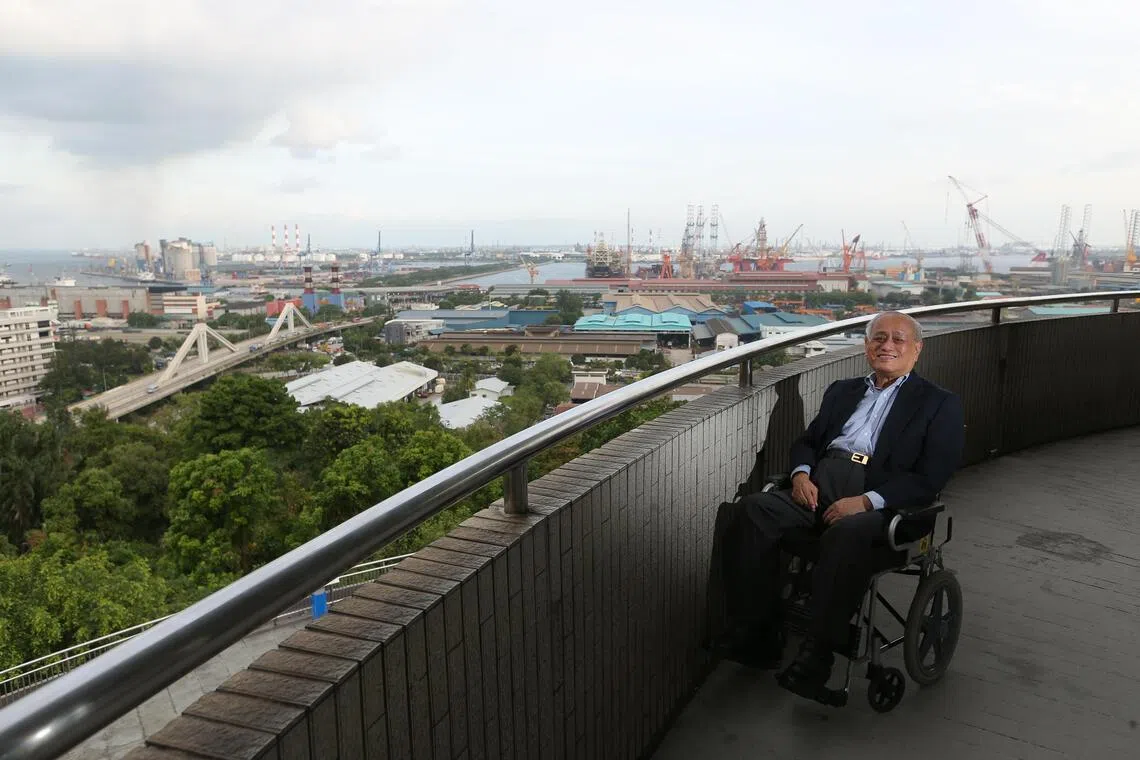
Former EDB chairman Chan Chin Bock in 2015. Despite being a wheelchair user after a stroke in 1997, he returned regularly to the office to train young officers.
Published Sep 12, 2026, 11:10 PM
Updated Sep 12, 2026, 11:10 PM
Chan Chin Bock, former EDB chairman and a key architect of Singapore's economic growth, died at 93, leaving a lasting legacy in attracting foreign investment and developing skilled labour.
He expanded EDB's global reach, secured major investments including in semiconductors, and mentored young officers even after retirement, despite health challenges.
Leaders praised his pioneering efforts and vision, highlighting his role in shaping Singapore's economy and inspiring future generations at EDB.
SINGAPORE – Former Economic Development Board (EDB) chairman Chan Chin Bock died on Sept 12 at age 93, leaving behind his wife Rose and daughter Grace.
One of the architects of the Republic’s economic take-off towards the end of the first decade of independence, h e spent over 30 years at the statutory board, and was its third chairman from 1972 to 1975, and alternate chairman from 1975 to 1987, when he was based in the US.
Chan expanded EDB’s international footprint, attracted prominent MNCs to Singapore, and created joint training centres to build up Singapore’s skilled labour pool.
He also continued to mentor young EDB officers after he left in 1995.
He received the Public Administration Medal (Silver) in 1969, the Public Administration Medal (Gold) in 1973 and the Meritorious Service Award in 1988.
Deputy Prime Minister Gan Kim Yong praised him as “one of the pioneers of Singapore’s economic development”, in a Facebook post on Sept 12 .
He wrote : “Mr Chan and others of his generation were working without a proven playbook, but they understood that Singapore’s future depended on staying open to the world, earning the confidence of investors, and continually building the capabilities of our people.
“Indeed, one of his major projects was to build up Singapore’s skill base, through apprenticeship and training programmes that laid the foundation for high-tech, capital intensive industries to come to Singapore and create jobs for our people.”
He added that Singapore owed Chan “a debt of gratitude for his contributions” and that “his family and loved ones may... find comfort in knowing that his life’s work has left an enduring mark on our country”.
In a separate Facebook post on the same day, Minister for Trade and Industry (Energy and Industry) Tan See Leng said: “ From helping to develop new industries in our early years to navigating the difficult economic conditions of the 1980s, Mr Chan witnessed first-hand how Singapore’s economy grew and transformed over the decades.
“His contributions left a lasting legacy at EDB, and helped shape the organisation as it evolved with Singapore’s changing needs.”
Chan was a teacher before he joined EDB in 1964, and worked under Hon Sui Sen – EDB’s founding chairman who was later Singapore’s Finance Minister.
He was then sent to the US to contact more than 300,000 multinational companies across 50 states, to woo them here to produce goods for export, according to a 2015 Straits Times report.
Chan himself knocked on the doors of these companies there and asked them to visit Singapore, then persuading them to open factories to create jobs here.
Among the colourful anecdotes of his illustrious career was when he told of refusing to sign a three-year bond for EDB sponsoring his four-month course at a United Nations Fellows Programme in 1968.
“I refused to sign the bond but instead I stayed for 30 years without the bond,” he quipped.
After retiring in 1995, he briefly led the EDB Consulting Group and undertook development projects in Oman, Ghana and Cambodia.
Despite having to use a wheelchair after a stroke in 1997, he returned regularly to the office to train young officers.
In its own Facebook post, EDB hailed him as “one of the pioneering leaders of Singapore’s economic story”.
It said that foreign investment commitments secured by EDB increased from $320 million to $1.7 billion annually when Chan oversaw its worldwide network of 17 offices. Chan also secured Singapore’s first investment in the semiconductor and precision engineering industries, according to the board.
“These industries laid the groundwork for the information technology, semiconductor and aerospace industries that Singapore has today,” EDB said, adding that he helped to establish its International Advisory Council.
“Mr Chan will always be remembered and admired for his leadership skills and his total dedication to Singapore. His passion and vision was his legacy, inspiring generations of EDB officers past and present,” the board said.
“EDB will honour his legacy and continue to attract investments, develop industries and create good jobs for Singaporeans.”
His wake is being held at the Church of St Stephen in MacPherson on Sept 13 from 11am to 10pm with a service at 8pm. The cortege leaves at 12.45pm on Sept 14 for Mandai Crematorium Hall 2 for cremation at 1.40pm.
前经济发展局主席陈振木于 2015 年。尽管他在 1997 年中风后一直使用轮椅,但他仍定期返回办公室培训年轻官员。
发布于2026年9月12日晚上11:10
更新于2026年9月12日晚上11:10
新加坡经济发展局前主席、新加坡经济增长的主要缔造者陈振木逝世,享年 93 岁,他在吸引外国投资和培养技术工人方面留下了持久的遗产。
尽管面临健康挑战,他仍扩大了经济发展局的全球影响力,获得了包括半导体在内的重大投资,并在退休后指导年轻官员。
领导们赞扬了他的开拓精神和远见卓识,强调了他在塑造新加坡经济和激励经济发展局未来一代方面所发挥的作用。
新加坡——前经济发展局(EDB)主席陈振木于9月12日去世,享年93岁,身后留下妻子Rose和女儿Grace。
作为共和国独立后第一个十年末期经济腾飞的缔造者之一,他在法定委员会工作了 30 多年,1972 年至 1975 年担任第三任主席,1975 年至 1987 年担任候补主席,当时他居住在美国。
陈先生扩大了新加坡经济发展局的国际影响力,吸引了众多知名跨国公司落户新加坡,并创建了联合培训中心,以培养新加坡的熟练劳动力。
1995年离开经济发展局后,他仍然继续指导年轻的经济发展局官员。
他于 1969 年获得公共行政奖章(银质),1973 年获得公共行政奖章(金质),1988 年获得功绩服务奖。
新加坡副总理颜金勇在9月12日的一篇Facebook帖子中称赞他是“新加坡经济发展的先驱之一”。
他写道:“陈先生和他那一代人虽然没有现成的模式可循,但他们明白新加坡的未来取决于保持对世界的开放,赢得投资者的信任,并不断提升人民的能力。
“事实上,他的主要项目之一就是通过学徒制和培训计划来提升新加坡的技能基础,为高科技、资本密集型产业落户新加坡、为新加坡人民创造就业机会奠定基础。”
他还补充说,新加坡“对陈先生的贡献感激不尽”,并且“他的家人和爱人或许会感到欣慰,因为他毕生的工作已经为我们国家留下了持久的印记”。
同一天,贸易及工业部长(能源及工业)陈思龙在另一篇脸书帖子中表示:“从早期帮助发展新兴产业,到应对 20 世纪 80 年代艰难的经济形势,陈先生亲眼见证了新加坡经济在过去几十年里的发展和转型。
“他为新加坡经济发展局留下了深远的影响,并帮助该机构随着新加坡不断变化的需求而发展演变。”
陈先生在 1964 年加入新加坡经济发展局之前是一名教师,曾在新加坡经济发展局的创始主席韩瑞生(后来的新加坡财政部长)手下工作。
据《海峡时报》2015 年的一篇报道,他随后被派往美国,与 50 个州的 30 多万家跨国公司联系,争取它们来美国生产出口商品。
陈先生亲自敲开了这些当地公司的大门,邀请他们来新加坡考察,然后说服他们在这里开厂,创造就业机会。
在他辉煌的职业生涯中,有很多精彩的轶事,其中就包括他讲述自己在 1968 年拒绝签署 EDB 赞助他参加联合国研究员计划为期四个月课程的三年合约。
“我拒绝签署保释金,但却在没有保释金的情况下待了30年,”他打趣道。
1995 年退休后,他曾短暂领导 EDB 咨询集团,并在阿曼、加纳和柬埔寨开展发展项目。
尽管在 1997 年中风后不得不使用轮椅,但他仍然定期回到办公室培训年轻警官。
新加坡经济发展局在其 Facebook 帖子中称赞他是“新加坡经济发展史上的先驱领导人之一”。
报告称,在陈先生领导新加坡经济发展局(EDB)遍布全球的17个办事处期间,EDB吸引的外商投资承诺额从每年3.2亿美元增至17亿美元。董事会还表示,陈先生促成了新加坡在半导体和精密工程行业的首笔投资。
“这些产业为新加坡如今的信息技术、半导体和航空航天产业奠定了基础,”经济发展局表示,并补充说他曾帮助成立了该局的国际顾问委员会。
“陈先生的领导才能和对新加坡的全心奉献将永远被人们铭记和敬仰。他的热情和远见卓识是他留给世人的宝贵遗产,激励着历届新加坡经济发展局官员,”该局表示。
“新加坡经济发展局将秉承他的遗志,继续吸引投资、发展产业,并为新加坡人创造良好的就业机会。”
他的遗体告别仪式将于9月13日上午11点至晚上10点在麦弗逊圣斯蒂芬教堂举行,追思礼拜将于晚上8点举行。送葬队伍将于9月14日下午12点45分出发前往万代火葬场2号厅,下午1点40分举行火化仪式。