Japan selects the T-6 Texan II as its new trainer aircraft日本选定T-6“德克萨斯人II”型教练机作为其新型教练机
The aircraft will be built in the United States rather than license-produced in Japan.
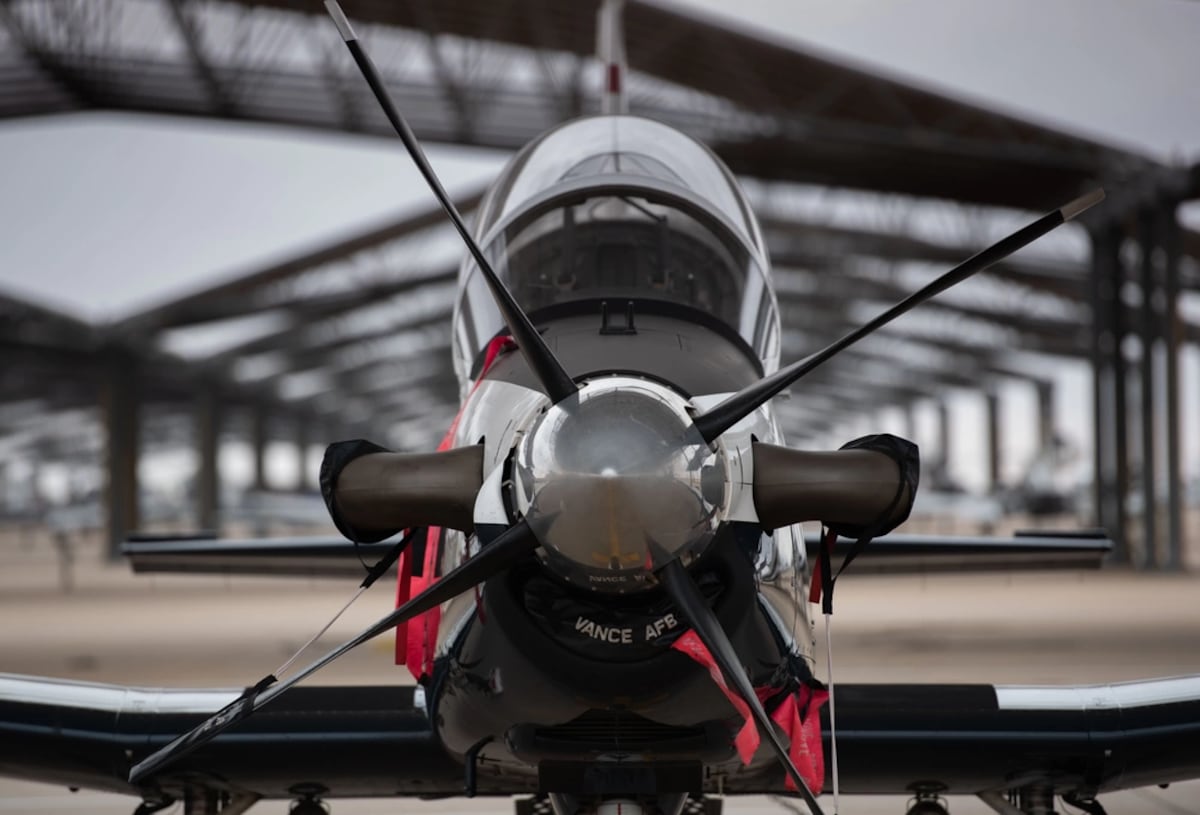
CHRISTCHURCH, New Zealand — The Japanese government has selected a new U.S.-built basic trainer aircraft and associated ground equipment for its air force’s pilot training program.
The Japan Air Self-Defense Force, or J.A.S.D.F., will adopt the Beechcraft T-6 Texan II, officials said in late November. Textron Aviation Defense and Japanese partner Kanematsu Corporation had teamed up to bid in the competition.
Japan invited bids in August, and the T-6 was selected ahead of Subaru’s proffer of the Pilatus PC-7 MKX and Daihyaku Shoji, which had teamed up with Turkish Aerospace to offer the Hürkus trainer. Another entry lodged by the Oct. 15 deadline had been Shintoa Trading, but it was rejected as it did not propose any aircraft.
Japan’s Ministry of Defense (MoD) explained that in the second-stage evaluation the T-6 and related ground training equipment had “the highest evaluation score” and was therefore selected as the J.A.S.D.F.’s next-generation basic trainer. The aircraft will be built in the United States rather than license-produced in Japan.
“The T-6 Integrated Training System (ITS) is a proven, highly capable, best-value system which enables the JASDF to fulfill not only their current training requirements, but can also grow and adapt to keep pace with evolving future requirements,” Tom Webster, vice president of sales at Textron Aviation Defense, said.
Japan’s MoD did not state how many aircraft would be acquired, since a contract has not yet been finalized.
The T-6, presumably the T-6C version aimed at export markets, is due to replace 49 examples of the T-7 in the basic trainer role. However, the quantity of T-6s will likely be less than that given that simulators play an important role in the ITS program.
The T-7, manufactured by Fuji Heavy Industries from 2002 onwards, derived from the Beechcraft T-34 Mentor. The T-7 is due to begin retiring in fiscal 2030.
In its fiscal 2025 budget proposal, released in August, the MoD listed a project to “acquire new primary trainer and ground training equipment with the aim of operating them integrally…to efficiently and effectively train pilots of advanced fighter aircraft.”
Beechcraft’s Texan II has enjoyed recent success in Asia-Pacific. The company is on tap to deliver 12 T-6Cs to Vietnam, with the first trio handed over last month. The sale followed Washington’s lifting of a ban on weapon sales to the Southeast Asian country in 2016.
Additionally, Thailand has received 12 T-6TH trainers, and eight AT-6TH Wolverines are in the midst of delivery. An earlier T-6C adopter in the region was New Zealand, which operates 11 examples in the training role.
Gordon Arthur is an Asia correspondent for Defense News. After a 20-year stint working in Hong Kong, he now resides in New Zealand. He has attended military exercises and defense exhibitions in about 20 countries around the Asia-Pacific region.
新西兰基督城——日本政府已为其空军飞行员训练计划选择了一款美国制造的新型初级教练机及相关地面设备。
日本航空自卫队(JASDF)官员在11月下旬宣布,将采用比奇T-6“德克萨斯人II”教练机。德事隆航空防务公司及其日本合作伙伴兼松株式会社曾联手参与竞标。
日本于8月发出招标邀请,T-6教练机击败了斯巴鲁的皮拉图斯PC-7 MKX教练机和与土耳其航空航天公司合作的“大百商事”的“赫尔库斯”教练机,最终胜出。另一家在10月15日截止日期前提交投标书的公司是新藤亚贸易株式会社,但由于该公司未提交任何具体机型,因此被驳回。
日本防卫省解释说,在第二阶段评估中,T-6教练机及其相关地面训练设备获得了“最高评估分数”,因此被选为日本航空自卫队的下一代初级教练机。该机型将在美国制造,而非在日本获得许可生产。
“T-6 综合训练系统 (ITS) 是一款成熟可靠、功能强大、性价比极高的系统,它不仅能够满足日本航空自卫队当前的训练需求,还能不断发展和适应,以跟上未来不断变化的需求,”德事隆航空防务公司销售副总裁汤姆·韦伯斯特表示。
由于合同尚未最终敲定,日本防卫省并未说明将采购多少架飞机。
据推测,T-6(可能是面向出口市场的T-6C型)将取代49架T-7作为基础教练机。然而,考虑到模拟器在智能飞行训练(ITS)项目中扮演着重要角色,T-6的实际交付数量可能会少于此。
T-7教练机由富士重工自2002年起生产,源自比奇T-34“导师”教练机。T-7计划于2030财年开始退役。
在8月份发布的2025财年预算提案中,国防部列出了一个项目,旨在“购置新的初级教练机和地面训练设备,以便将它们整合起来……从而高效有效地训练先进战斗机的飞行员”。
比奇飞机公司的Texan II型教练机近期在亚太地区取得了成功。该公司计划向越南交付12架T-6C教练机,首批三架已于上月交付。此次军售是在美国于2016年解除对越南的武器销售禁令之后进行的。
此外,泰国已接收12架T-6TH教练机,另有8架AT-6TH“金刚狼”教练机正在交付中。新西兰是该地区较早采用T-6C教练机的国家,拥有11架用于训练。
戈登·阿瑟是《防务新闻》的亚洲特派记者。在香港工作20年后,他现居新西兰。他曾到访亚太地区约20个国家,参加过军事演习和防务展览。