Singapore PC prices surge as growing AI infrastructure competes for components随着人工智能基础设施的不断发展,新加坡个人电脑价格飙升,零部件需求日益增长。
Singapore PC prices surged 40% in 2026 due to shortages in memory, storage and graphics cards amid global AI infrastructure demand. Read more at straitstimes.com.
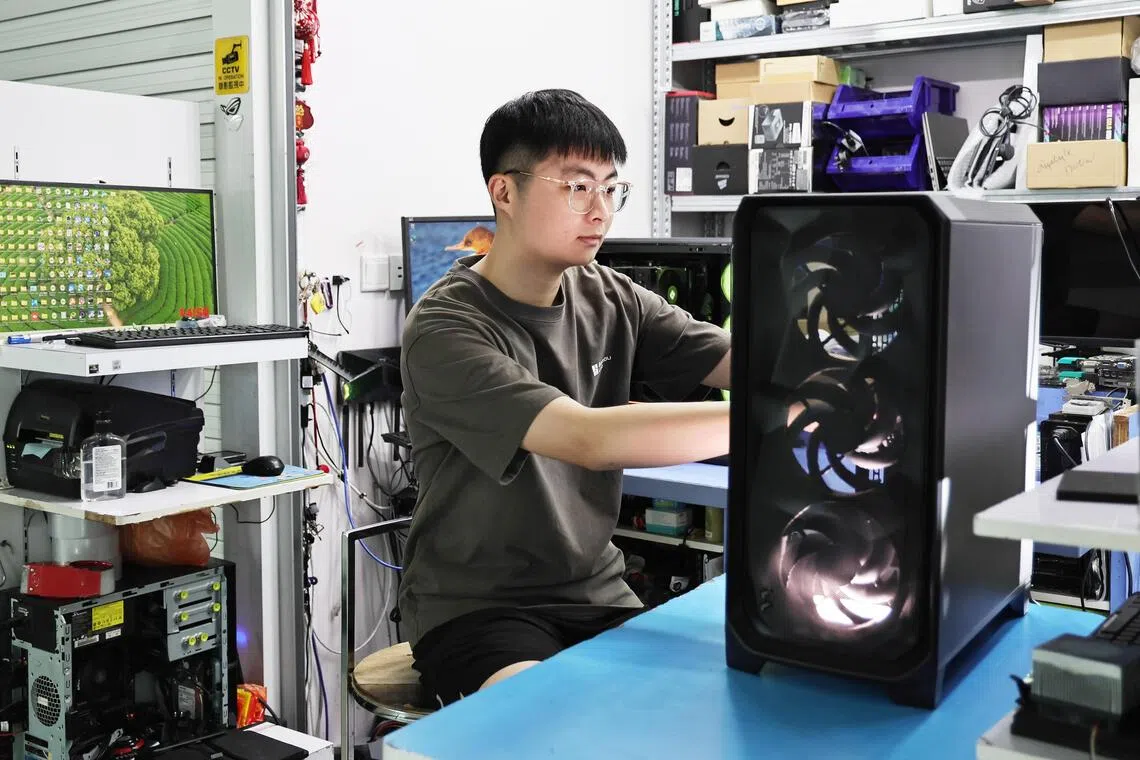
Bryan Fun, a sales assistant at retailer Bizgram Asia in Sim Lim Square, checking a newly assembled desktop PC tower.
ST PHOTO: KELVIN CHNG
Published Sep 13, 2026, 05:00 AM
Updated Sep 13, 2026, 05:00 AM
PC prices in Singapore surged about 40% in 2026 due to shortages of memory, storage and graphics cards driven by global AI infrastructure demand.
Memory chip shortages caused the biggest price hike, with some RAM prices increasing nearly 300% in a year.
PC sales dropped 20-80% for some retailers as consumers delay purchases amid high prices, with experts expecting price relief only from 2028 onward.
SINGAPORE – Consumers who plan to buy a new personal computer are in for sticker shock.
Latest market data from research firm IDC shows that average prices have surged by up to 40 per cent in the second quarter of 2026 from a year ago, driven by component shortages.
Specifically, computer memory, storage and graphics cards are in short supply because the expansion of global data centres to support artificial intelligence services has consumed the bulk of these components.
IDC expects PC prices to remain high throughout 2027, dipping slightly only towards the second half of 2027.
IDC figures show that the average price here for regular laptops rose by 26 per cent to $1,650 in the second quarter of 2026, from about $1,300 a year ago. These are laptops that run the Windows operating system, typically with 16GB of computer memory – or random-access memory (RAM) – and a 512GB solid-state drive (SSD) .
The average price of regular desktops was up 28 per cent, from around $1,100 to $1,410 over the same period . More powerful desktops geared towards gaming had their average price jump 39 per cent, from $1,330 to nearly $1,860.
The average price for gaming laptops also rose, but more modestly by 17 per cent, from $2,460 to $2,890, due partly to vendors selling some models at discounted prices to clear older stock, said IDC.
Apple also recently announced price increases of 15 per cent to 25 per cent across its product line-up.
The biggest contributor to the PC price surge is the shrinking supply of computer memory chips, or RAM, which is used to access computer data. The severe RAM shortage has led to some pundits nicknaming it a “RAMageddon”.
“Since last year, the PC market has seen significant price hikes, driven largely by the memory shortage crisis that has affected the whole information technology industry,” said Ho Jin Wei, an associate research analyst at IDC Asia Pacific.
With skyrocketing global AI demand , manufacturers are shifting computer memory production towards demand from businesses building AI infrastructure, said Ho. This is due to the much higher profit margins they can make from such sales as opposed to sales to PC vendors. And the shift has a knock-on effect on the prices of laptops and desktops that also need RAM.
Consumers upgrading or replacing just their computer’s RAM contend with sharp price spikes too.
Checks by The Straits Times at tech mall Sim Lim Square found that the average price of a 32GB dual-channel DDR5 RAM, a type of high-end computer memory, rose to almost fourfold from $195 in August 2025 to $763 about a year later.
Storage in general has also become more costly, partly because manufacturers prioritise enterprise and data centre demands over consumers, said Ho.
ST’s check found that, on average, a 1TB internal SSD used in computers more than doubled in price from $149 in August 2025 to $328 in August 2026. Meanwhile, a 4TB internal hard disk drive went from $205 to $336 on average over the same period, a 64 per cent jump.
ST also found that Nvidia’s 5060 series of graphics cards with 8GB of RAM went from $572 to $824 on average, a 44 per cent uptick. Graphics cards are used for rendering more intensive computer graphics.
A decline in the supply of a specialised computer memory used in graphics cards throughout the first half of 2026 has affected prices of graphics cards for consumers, said IDC.
“With major graphics card makers reportedly planning further price increases for their respective product lines in the last six months of 2026, this could push PC prices up further,” said Ho.
“Any meaningful easing on PC prices is more likely a story for 2028 and beyond rather than in the near term,” he added.
For now, soaring PC prices have given consumers another reason to tighten their belts. This comes amid broader economic jitters and global tensions that have already softened consumer spending, four retailers at Sim Lim Square told ST.
This has meant that PC sales are down 20 per cent to 80 per cent for them in 2026 compared with 2025.
John Soroya, owner of R Zech Laptop, whose sales of new and refurbished computers plummeted 80 per cent, said: “It’s very, very difficult. Sometimes we cannot cover our rent.”
A Fuwell sales representative, who said sales were affected by “quite a lot”, added that the store is relying on corporate clients and regular customers. Some die-hard enthusiasts who need the best and the latest will bite the bullet and buy computer parts even at their current elevated prices, he noted.
Other shoppers are taking a wait-and-see approach.
Bizgram sales assistant Bryan Fun said that two to three months ago, some customers still bought higher-priced computers, fearing they would get even more expensive.
But with prices at the highest they have ever been now, some are unsure where prices will go and are waiting, hoping that they will drop in 2027, he said.
There is more bad news. Fun received word from suppliers that the prices of motherboards – the main circuit board linking other PC components together – increased by about 10 per cent in September.
One consumer sitting on the fence is Bryan Ang, 38, who works in the IT industry. He was planning to buy a new PC, but after seeing how much prices have risen, he is undecided. “I’m not sure whether it’s actually a good time to buy now or if I should wait a bit to see whether prices will go down.”
AI/artificial intelligence
Consumer electronics
Bryan Fun,Bizgram Asia(位于Sim Lim Square)的销售助理,正在检查一台新组装的台式电脑主机。
《海峡时报》摄影:KELVIN CHNG
发布于 2026 年 9 月 13 日上午 5:00
更新于2026年9月13日凌晨5:00
由于全球人工智能基础设施需求推动内存、存储和显卡短缺,预计到 2026 年,新加坡的个人电脑价格将上涨约 40%。
内存芯片短缺导致价格大幅上涨,部分内存价格在一年内上涨了近 300%。
由于价格高企,消费者推迟购买,一些零售商的个人电脑销量下降了 20% 至 80%,专家预计价格要到 2028 年才会下降。
新加坡——计划购买新个人电脑的消费者将会被高昂的价格吓到。
市场研究公司IDC的最新市场数据显示,受零部件短缺的影响,2026年第二季度平均价格较上年同期上涨了40%。
具体来说,由于全球数据中心为支持人工智能服务而进行的扩张消耗了大部分计算机内存、存储设备和显卡,导致这些组件短缺。
IDC 预计 2027 年全年 PC 价格将保持高位,仅在 2027 年下半年略有下降。
IDC数据显示,2026年第二季度,美国普通笔记本电脑的平均价格上涨了26%,达到1650美元,而一年前约为1300美元。这些笔记本电脑运行Windows操作系统,通常配备16GB的计算机内存(或随机存取存储器,RAM)和512GB的固态硬盘(SSD)。
同期,普通台式机的平均价格上涨了28%,从约1100美元涨至1410美元。而面向游戏的高性能台式机的平均价格则上涨了39%,从1330美元涨至近1860美元。
IDC表示,游戏笔记本电脑的平均价格也有所上涨,但涨幅较为温和,为17%,从2460美元涨至2890美元,部分原因是供应商为了清理旧库存而以折扣价出售某些型号。
苹果公司最近也宣布,旗下所有产品的价格将上涨 15% 至 25%。
个人电脑价格飙升的最大原因是计算机内存芯片(即RAM)供应日益减少,RAM用于访问计算机数据。严重的RAM短缺导致一些专家将其戏称为“RAM末日”。
IDC亚太区副研究分析师何进伟表示:“自去年以来,个人电脑市场价格大幅上涨,这主要是由于影响整个信息技术行业的内存短缺危机所致。”
Ho表示,随着全球人工智能需求的飙升,制造商正将计算机内存生产转向满足构建人工智能基础设施的企业的需求。这是因为与向个人电脑厂商销售相比,此类销售的利润率要高得多。而这种转变也会对同样需要内存的笔记本电脑和台式机的价格产生连锁反应。
消费者如果只是升级或更换电脑的内存条,也会面临价格大幅上涨的问题。
《海峡时报》在科技商场森林广场进行的调查发现,32GB 双通道 DDR5 内存(一种高端电脑内存)的平均价格从 2025 年 8 月的 195 美元上涨到大约一年后的 763 美元,涨幅几乎是之前的四倍。
Ho表示,存储成本总体上也变得更高,部分原因是制造商优先考虑企业和数据中心的需求,而不是消费者的需求。
ST 的调查发现,平均而言,电脑中使用的 1TB 内置固态硬盘的价格从 2025 年 8 月的 149 美元上涨到 2026 年 8 月的 328 美元,涨幅超过一倍。与此同时,4TB 内置硬盘驱动器的价格在同一时期内平均从 205 美元上涨到 336 美元,涨幅高达 64%。
ST 还发现,配备 8GB 显存的英伟达 5060 系列显卡平均价格从 572 美元上涨至 824 美元,涨幅达 44%。显卡用于渲染更复杂的计算机图形。
IDC表示,2026年上半年显卡专用计算机内存的供应量下降,影响了消费者的显卡价格。
“据报道,主要显卡制造商计划在 2026 年下半年进一步提高各自产品线的价格,这可能会进一步推高 PC 价格,”Ho 说。
他补充说:“个人电脑价格的任何实质性下降更有可能发生在 2028 年及以后,而不是近期。”
目前,个人电脑价格飙升又给消费者带来了一个勒紧裤腰带的理由。森林广场的四位零售商告诉《海峡时报》,这种情况正值经济普遍动荡和全球局势紧张之际,这些因素已经抑制了消费者的支出。
这意味着,与 2025 年相比,他们 2026 年的个人电脑销量将下降 20% 至 80%。
R Zech Laptop 的老板 John Soroya 说:“这非常非常困难。有时候我们甚至付不起房租。”他的新电脑和翻新电脑的销量暴跌了 80%。
富威尔的一位销售代表表示,销售额受到“相当多”因素的影响,并补充说,该店主要依靠企业客户和老顾客。他还指出,一些追求极致、追求最新产品的铁杆发烧友,即使价格高昂,也会咬牙购买电脑配件。
其他购物者则采取观望态度。
Bizgram 销售助理 Bryan Fun 表示,两三个月前,一些顾客仍然购买了价格较高的电脑,因为他们担心电脑价格会变得更贵。
但他表示,由于目前价格处于历史最高水平,一些人不确定价格将走向何方,他们正在观望,希望价格在 2027 年会下降。
还有更多坏消息。Fun 从供应商处获悉,主板(连接其他电脑组件的主要电路板)的价格在 9 月份上涨了约 10%。
38岁的布莱恩·昂(Bryan Ang)是一名IT行业从业者,他正犹豫不决。他原本打算买一台新电脑,但看到价格上涨如此之多,他开始犹豫了。“我不确定现在是不是买的好时机,还是应该再等等,看看价格会不会下降。”
人工智能
消费电子产品