Pentagon’s strategy planner wants China crisis channels五角大楼战略规划师希望建立中国危机沟通渠道
Mara Karlin emphasized the importance of crisis hot lines with China while highlighting the ongoing U.S. role in the Middle East.
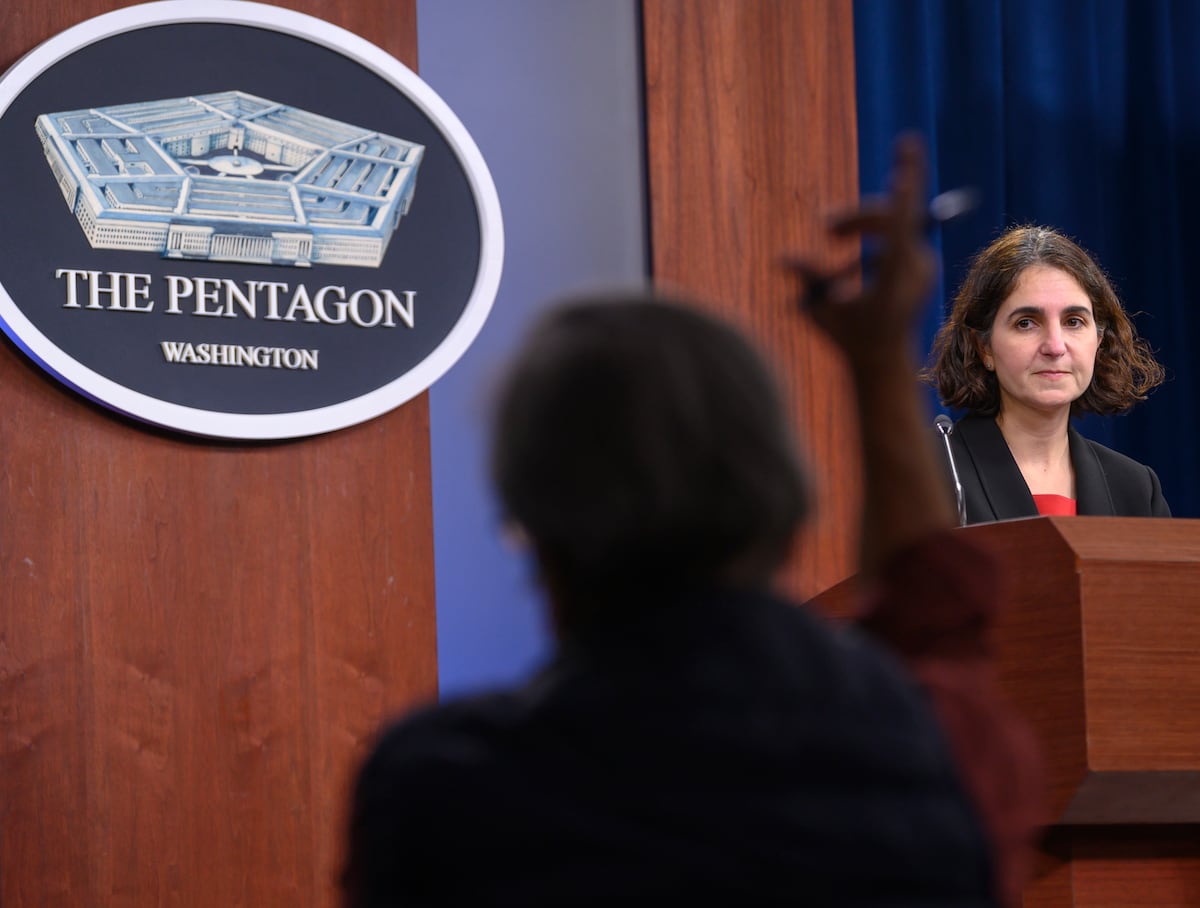
WASHINGTON ― A Pentagon official tasked with implementing the National Defense Strategy called on China to open crisis communications channels with the U.S. as Beijing continues to expand its nuclear arsenal.
Mara Karlin, the assistant secretary of defense for strategies, plans and capabilities, told reporters at a Defense Writers Group roundtable on Tuesday that “escalation management in the Indo-Pacific is so incredibly important” when asked about China’s accelerating nuclear capabilities.
“We have been trying really hard to set up communications channels, and they have not been enthusiastic about this,” said Karlin. “That’s really problematic. When we look at history, it is usually quite helpful for us to be able to sit down and speak with those whom we disagree not least so we can get an understanding of what they’re doing, what we’re doing, what we all think is escalatory and how we might understand it in different ways.”
U.S. Strategic Command, which oversees the nuclear arsenal, disclosed in February that China has more Intercontinental Ballistic Missile launchers than the United States , which has 450.
The Pentagon’s 2022 China military power report found that Beijing’s nuclear warhead stockpile has surpassed 400 and projected “it will likely field a stockpile of about 1,500 warheads by its 2035 timeline” if it continues its current rate of nuclear expansion. The U.S. stockpile contained 3,750 nuclear warheads as of 2021.
The Biden administration’s 2022 National Defense Strategy prioritizes deterring China in the Indo-Pacific followed by Russia’s challenge in Europe.
To that end, Karlin emphasized the deepening U.S. engagement with Indo-Pacific allies and partners while noting their growing investments in their own military capabilities.
Karlin singled out “Australia and Japan as two notable cases where they’re investing meaningfully in their military” and noted both countries “are putting out strategies that are very much in line” with the U.S. National Defense Strategy. She also noted the two U.S. allies are forging closer ties, while Japan and South Korea are collaborating more closely as well despite their historical tensions.
Additionally, she said overhauling export control regulations for Australia and the U.K as part of the trilateral AUKUS agreement would help get the three countries’ defense industrial bases “knitted together.”
Despite the emphasis on the Indo-Pacific, Karlin emphasized that U.S. force posture in other areas of the world, like the Middle East, has remained steady.
“There’s this notion, particularly held by some of our partners across the Middle East, that the United States is abandoning the region,” she said. “I just don’t really see the evidence that that is accurate. We still have something like 25,000 to 30,000 or so troops that are out there. We still have a bunch of capabilities.”
She also highlighted Israel’s 2021 integration into U.S. Central Command, which oversees forces in the region, as well as its recent normalization agreements with several Gulf Arab countries brokered by former President Donald Trump.
President Joe Biden recently has endeavored to follow up on these agreements by pursuing his own Israeli-Saudi normalization deal. The Saudis have reportedly asked for a mutual security pact with the U.S. as one of their conditions to normalize ties with Israel.
Karlin declined to discuss “internal deliberations” regarding a mutual defense pact with the Saudis, but said “to the extend you can more closely knit together across the region to help with security and stability in the Middle East, that’s a good thing.”
Bryant Harris is the Congress reporter for Defense News. He has covered U.S. foreign policy, national security, international affairs and politics in Washington since 2014. He has also written for Foreign Policy, Al-Monitor, Al Jazeera English and IPS News.
华盛顿——一位负责执行《国防战略》的五角大楼官员呼吁中国与美国开通危机沟通渠道,因为北京正在不断扩大其核武库。
负责战略、计划和能力的国防部助理部长玛拉·卡林周二在国防记者小组圆桌会议上告诉记者,当被问及中国不断增强的核能力时,“印太地区的升级管理极其重要”。
卡林说:“我们一直在努力建立沟通渠道,但他们对此并不热衷。这确实是个问题。回顾历史,与持不同意见者坐下来交谈通常对我们大有裨益,尤其有助于我们了解彼此的所作所为,以及我们各自认为哪些行为会加剧事态,并探讨我们可能存在的不同理解。”
负责监管核武库的美国战略司令部在2月份披露,中国的洲际弹道导弹发射装置数量比美国多,美国拥有450个。
五角大楼2022年发布的《中国军力报告》指出,北京的核弹头库存已超过400枚,并预测如果中国继续以目前的速度发展核武器,到2035年,“其核弹头库存可能达到约1500枚”。截至2021年,美国的核弹头库存为3750枚。
拜登政府2022年国防战略的优先事项是遏制印太地区的中国,其次是应对俄罗斯在欧洲的挑战。
为此,卡林强调了美国与印太地区盟友和伙伴日益密切的合作,同时指出这些国家也在不断加大对自身军事能力的投资。
卡林特别指出“澳大利亚和日本是两个在军事领域投入巨资的显著例子”,并指出两国“制定的战略与美国《国防战略》高度一致”。她还指出,这两个美国盟友正在建立更紧密的联系,而尽管存在历史恩怨,日本和韩国也在加强合作。
此外,她表示,作为三边 AUKUS 协议的一部分,对澳大利亚和英国的出口管制条例进行全面改革,将有助于将这三个国家的国防工业基地“连接起来”。
尽管印太地区备受重视,但卡林强调,美国在世界其他地区(如中东)的军事部署保持稳定。
她说:“有一种观点,尤其是在我们的一些中东伙伴中,认为美国正在放弃该地区。但我并没有看到任何证据表明这种说法是准确的。我们仍然在那里驻扎着大约2.5万到3万名士兵。我们仍然拥有大量的军事能力。”
她还重点介绍了以色列于 2021 年并入美国中央司令部(负责该地区的部队)的情况,以及以色列最近与几个海湾阿拉伯国家达成的关系正常化协议(该协议由前总统唐纳德·特朗普斡旋达成)。
拜登总统近期致力于落实这些协议,力求促成以色列与沙特阿拉伯的关系正常化。据报道,沙特阿拉伯方面要求与美国签署共同安全条约,以此作为与以色列关系正常化的条件之一。
卡林拒绝讨论与沙特阿拉伯达成共同防御条约的“内部讨论”,但他表示,“如果能够更紧密地团结起来,帮助维护中东的安全与稳定,那将是一件好事。”
布莱恩特·哈里斯是《防务新闻》的国会记者。自2014年以来,他一直在华盛顿报道美国外交政策、国家安全、国际事务和政治。他还曾为《外交政策》、《Al-Monitor》、《半岛电视台英语频道》和IPS新闻撰稿。