Life After... Stage 4 cancer: Producer-director wants to sleep more癌症晚期之后的生活:制片兼导演想多睡一会儿
Producer-director Desmond Tan used to get by on two hours of sleep a day, two cups of coffee and two cans of Red Bull. Read more at straitstimes.com.
So much of the news is about what’s happening at the moment. But after a major event, people pick up the pieces and life goes on. In this series, The Straits Times talks to the everyday heroes who have reinvented themselves, turned their lives around and serve as an inspiration to us all.
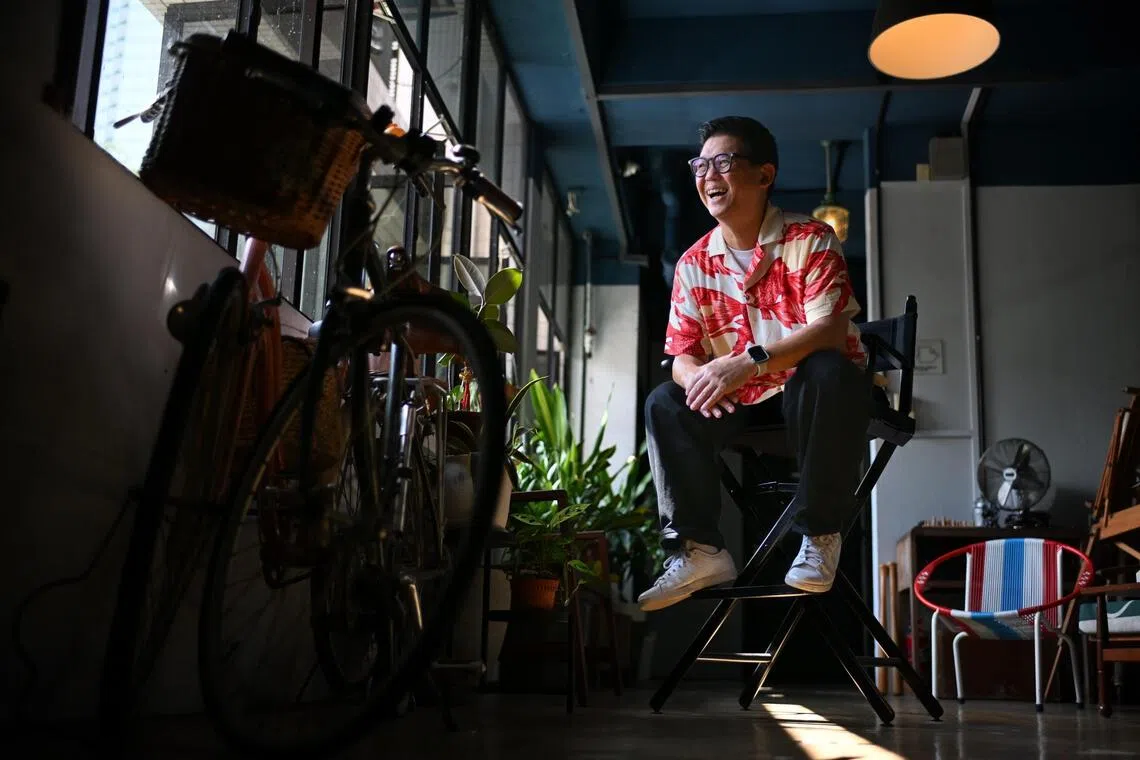
Veteran commercial film director and founder of Atypicalfilms Desmond Tan wants to change the highly charged, stressful lifestyle of the film industry after surviving Stage 4 colorectal cancer
ST PHOTO: CHONG JUN LIANG
Published Sep 13, 2026, 12:00 PM
Updated Sep 13, 2026, 12:00 PM
Desmond Tan, a commercial producer, developed Stage 4 colon cancer, which he attributes to extreme sleep deprivation and a stressful work lifestyle.
After diagnosis and intensive treatment including surgery and chemotherapy, Tan survived and gained new insights into the unsustainable work culture in the film production industry.
He now promotes a balanced lifestyle in his company, emphasising health, rest, and well-being, changing industry norms and valuing employees' time and space.
SINGAPORE – Prolonged, chronic lack of sleep is what producer-director Desmond Tan believes caused him to have Stage 4 colon cancer .
When he was at the peak of his career producing commercials for many big clients, he would survive on around two hours of sleep a day, along with two cups of coffee and two cans of Red Bull caffeinated energy drink, to push through on projects.
His mind was still preoccupied with work on the day in 2019 he found out he had a Stage 4 tumour in his colon.
“When the reality was sinking in, I was in a taxi on the way to post-production, where I had to touch up burger patties to make them perfect. There was no way I could go home, because I had a job to do. I had clients to answer to,” said Tan, 51.
“It was only that night, at about 11pm, that I could be home with my wife and I broke down. Reality had hit me. My son was then barely a year old.”
Around the time he received treatment, he found out he was not the only one in his small industry to be hit by cancer.
“My ex-colleague, also a very prominent commercials director, had the exact same cancer (as I did). He had since died. Others came down with breast cancer, pancreatic cancer, lung cancer, and colon cancer. There were seven of us when I last counted. Many of us were relatively young and healthy. That really got me thinking that something is wrong with the industry somewhere,” he said.
“I actually think that sleep is very underrated and people do not talk about enough,” Tan said.
He was in his early 40s when he received the diagnosis, and “pretty much at the peak of my career as a commercials director”.
“Most often, I would have just two hours of sleep, and then the next morning, pushed myself on two coffees, two Red Bulls, and cigarettes – just to function. I suffered heart palpitations, but thought that was just me thriving,” he said.
At the top of his game, the founder of production house Atypicalfilms was responsible for creating commercials, branded entertainment and marketing campaign videos for clients such as the Republic of Singapore Navy, Republic of Singapore Air Force, the Immigration and Checkpoints Authority (ICA), tech giants, fast food restaurants, banks, and luxury homes.
“I was even flying out of the country for shoots. So I was living the so-called high life of a working director,” he told The Straits Times.
Married with two young sons, Tan said he was pulled in several directions.
“I wanted to be there for my staff and for my young family. Something had to give. On average, I slept only between two and four hours (every day) . Night was the only time I had to do my own homework for work. I would sleep for a few hours, then I would wake up at around 3am. That was how I kept up with everything,” he said.
It was in January 2019 when Tan felt a severe and sharp pain in his lower abdomen.
“There was also blood in my stools (for a few months before January ). Yet I continued to press on at work. Like everyone else (who finds blood in his faeces), I thought it was just haemorrhoids,” he said.
However, the pain and blood persisted so Tan decided to consult a family doctor a month later. He was told there was a tumour in his colon and was referred to an oncologist. After a battery of tests and scans, the tumour was diagnosed to be at Stage 4 , the most advanced phase of the disease.
In Stage 4 cancer, also known as metastatic cancer or secondary cancer, the cells break away from the primary tumour and travel through the blood or lymph system to a new location where they grow into new tumours in other parts of the body.
“Mine had spread to my liver. That was when my whole world came crashing down. Of course, there were so many questions, so many uncertainties running through my mind,” Tan said.
As if he were “the protagonist in a sad movie”, he quipped to The Straits Times, he asked the doctor how much time he had left.
“Would it matter?” the doctor replied.
“He asked if I knew, would I live my life to the fullest and maximise every single day?” Tan said.
“He did not tell me then (what the prognosis was), and until now, I don’t know.”
The doctor told Tan they were going for “as much of a cure as is possible at Stage 4”.
“I started almost immediately, going through five rounds of chemotherapy and a surgery to remove 13cm of my colon. I went from having a colon to having a semi-colon,” Tan said with a laugh.
After all of that, which lasted about six months, Tan thought he was “good to go” and went back to business.
“I started going for meetings, getting briefs from ad agencies and clients. Then I got the result of a follow-up scan and realised the cancer had come back. This time, it had spread to the peritoneum,” he said.
The peritoneum is a continuous, thin protective membrane that lines the abdominal cavity and surrounds the internal abdominal organs. Patients whose cancer has spread to the peritoneum often face a grim prognosis and rapid disease progression.
“When I got the news, my heart really sank ,” Tan said.
That was when his wife, a family physician, did some research and decided he should see oncology surgeon Melissa Teo, who carries out specialised HIPEC procedure.
HIPEC, or hyperthermic intraperitoneal chemotherapy, is a specialised two-step cancer treatment that combines surgery with heated chemotherapy to target advanced abdominal cancers.
Teo, who is in private practice, told ST she had used the same treatment on another Stage 4 colorectal cancer patient, who went to live for over 10 years.
Tan described the HIPEC treatment he received with a visual imagination befitting a commercials director: “She removed the cancer, and then poured the chemo in my abdomen, shook me like bubble tea for one hour before stitching me up,” he said.
Cancer survivor and founder of Atypicalfilms Desmond Tan, 51, said he does not eat processed food but sio bak (Hokkien for roasted pork), once in a while “can lah”. ST PHOTO: CHONG JUN LIANG
Cancer survivor and founder of Atypicalfilms Desmond Tan, 51, said he does not eat processed food but sio bak (Hokkien for roasted pork), once in a while “can lah”.
Blessing in disguise
After Tan went through two surgeries and 20 rounds of chemotherapy in 1½ years, he found himself smack in the middle of the Covid-19 pandemic.
“It was perhaps a blessing. I was remotely running my company and there was no hustle and bustle of people around me, so the risk of infection was much less,” he said.
He also changed his entire view of work and approach to it.
“Film production is quite brutal – long hours. There’s an unspoken work ethic where we glamorise long hours and hard work. I am now able to see that it was not sustainable because I became the product of that,” he said.
Work is now “something that is a bit more balanced” for his staff and production crew members.
“I try to inculcate that in the company and among the crew working with me on projects. We would cater food that’s a little bit healthier. Even when I hire, I acknowledge that people are different. Young people today want their time, their energy and their space, and I agree with that,” he said.
“In hindsight, there’s a part of me that is thankful for cancer because it allowed me to pull the brakes and slow down to realise that it’s not all about the work. I think if I had continued on my breakneck speed, I might have ended up not being here today.”
He also goes to the gym or swims every day, does not eat processed food, and prefers fish and chicken.
“But sio bak (Hokkien for roasted pork), once in a while can lah,” he mused.
ST Life After series
如今的新闻大多关注当下发生的事情。但重大事件过后,人们会重整旗鼓,生活继续向前。在本系列报道中,《海峡时报》采访了那些重塑自我、扭转人生、激励人心的平凡英雄。
资深商业电影导演、Atypicalfilms创始人Desmond Tan在战胜四期结直肠癌后,希望改变电影行业高压紧张的生活方式。
《海峡时报》照片:梁崇俊
发布于2026年9月13日下午12:00
更新于2026年9月13日中午12:00
商业制片人德斯蒙德·谭患上了四期结肠癌,他将此归咎于极度睡眠不足和压力巨大的工作生活方式。
经过诊断和包括手术和化疗在内的强化治疗后,谭幸存了下来,并对电影制作行业不可持续的工作文化有了新的认识。
他现在在公司里提倡平衡的生活方式,强调健康、休息和福祉,改变行业规范,重视员工的时间和空间。
新加坡——制片人兼导演陈德蒙认为,长期慢性睡眠不足导致他患上第四期结肠癌。
在他事业的巅峰时期,为许多大客户制作广告时,他每天只睡大约两个小时,喝两杯咖啡和两罐红牛能量饮料,就能坚持完成项目。
2019 年的某一天,他发现自己的结肠里长了一个 4 期肿瘤,当时他仍然心不在焉,一心扑在工作上。
“当我终于意识到发生了什么事的时候,我正坐在出租车上,前往后期制作部门,在那里我需要对汉堡肉饼进行精细的修饰,使它们达到完美。我根本没法回家,因为我还有工作要做。我还要向客户交代情况,”51岁的谭说道。
“直到那天晚上11点左右,我才终于能和妻子待在家里,我崩溃了。现实狠狠地打击了我。我的儿子当时还不到一岁。”
在他接受治疗前后,他发现自己并不是他所在的小行业中唯一一个罹患癌症的人。
“我的一位前同事,也是一位非常知名的广告导演,得了和我一模一样的癌症。他后来去世了。其他人也分别患上了乳腺癌、胰腺癌、肺癌和结肠癌。我上次统计的时候,我们一共七个人。我们当中许多人都比较年轻健康。这让我开始反思,这个行业肯定出了问题,”他说。
“我其实觉得睡眠被严重低估了,人们谈论睡眠的时间也太少了,”谭说道。
他确诊时年过四十,正处于他作为广告导演的事业巅峰时期。
“大多数时候,我只睡两个小时,然后第二天早上就得靠两杯咖啡、两罐红牛和香烟才能勉强维持正常生活。我经常心悸,但我以为那只是我状态好的表现,”他说。
在其事业巅峰时期,Atypicalfilms 制作公司的创始人负责为新加坡共和国海军、新加坡共和国空军、移民与关卡局 (ICA)、科技巨头、快餐店、银行和豪宅等客户制作广告、品牌娱乐和营销活动视频。
“我甚至经常飞到国外去拍戏。所以,我过着所谓职业导演的奢华生活,”他告诉《海峡时报》。
谭先生已婚,有两个年幼的儿子,他说自己被各种事情牵扯。
“我想兼顾我的员工和我的小家庭。但总得有所取舍。我平均每天只睡两到四个小时。晚上是我唯一能做工作的时间。我会睡几个小时,然后凌晨三点左右醒来。我就是这样才能应付所有的事情,”他说。
2019年1月,谭先生感到下腹部一阵剧烈疼痛。
“在1月份之前的几个月里,我的粪便里也有血。但我还是继续上班。和其他(粪便带血的人)一样,我以为只是痔疮,”他说。
然而,疼痛和出血持续不断,一个月后,谭决定去看家庭医生。医生告诉他结肠里长了肿瘤,并把他转诊给了肿瘤科医生。经过一系列检查和扫描后,肿瘤被确诊为第四期,即癌症晚期。
第四期癌症,也称为转移性癌症或继发性癌症,癌细胞从原发肿瘤脱落,通过血液或淋巴系统转移到新的位置,并在身体其他部位生长成新的肿瘤。
“我的癌细胞已经扩散到肝脏了。那时我的整个世界都崩塌了。当然,我的脑海里充满了无数的疑问和不确定感,”谭说道。
他向《海峡时报》打趣道,自己就像“一部悲伤电影中的主角”,他问医生自己还剩下多少时间。
“这重要吗?”医生回答道。
“他问我,如果我知道了,我是否会尽情享受生活,充分利用每一天?”谭说道。
“他当时没有告诉我(预后情况),直到现在,我也不知道。”
医生告诉谭,他们的目标是在第四期尽可能地治愈。
“我几乎立刻就开始了治疗,经历了五轮化疗和一次切除13厘米结肠的手术。我从一个完整的结肠变成了只剩半个结肠,”谭笑着说。
经历了大约六个月的时间后,谭认为自己“一切就绪”,于是重新开始营业。
“我开始参加各种会议,从广告公司和客户那里接到项目简报。然后我拿到了复查结果,发现癌症复发了。这一次,癌细胞已经扩散到腹膜,”他说。
腹膜是一层连续的、薄的保护膜,覆盖在腹腔内壁并包裹着腹腔内脏器官。癌症扩散到腹膜的患者通常预后不良,病情进展迅速。
“当我听到这个消息时,我的心都沉到了谷底,”谭说道。
那时,他的妻子,一位家庭医生,做了一些调查,决定让他去看肿瘤外科医生梅丽莎·特奥,她专门进行 HIPEC 手术。
HIPEC,即腹腔热灌注化疗,是一种专门的两步癌症治疗方法,它将手术与加热化疗相结合,以治疗晚期腹部癌症。
在私人诊所执业的 Teo 告诉《海峡时报》,她曾对另一名 4 期结直肠癌患者使用过同样的治疗方法,该患者存活了 10 多年。
Tan 用堪比广告导演的生动想象力描述了他接受的 HIPEC 治疗:“她切除了癌细胞,然后把化疗药物灌进我的腹部,像摇晃珍珠奶茶一样摇晃了我一个小时,然后才缝合伤口。”
现年51岁的癌症幸存者、Atypicalfilms创始人陈德明表示,他不吃加工食品,但偶尔吃一次烧肉(福建话烤猪肉)“可以啦”。(海峡时报照片:梁崇俊)
51岁的癌症幸存者、Atypicalfilms创始人Desmond Tan表示,他不吃加工食品,但偶尔吃一次烧肉(福建话烤猪肉)“可以啦”。
塞翁失马,焉知非福
在谭医生一年半的时间里经历了两次手术和 20 轮化疗后,他发现自己正处于新冠肺炎疫情的中心。
“这或许是一种幸运。我远程运营公司,周围没有熙熙攘攘的人群,所以感染的风险要小得多,”他说。
他也彻底改变了自己对工作的看法和工作方式。
“电影制作非常残酷——工作时间很长。业内存在一种不成文的职业道德,那就是把长时间工作和辛勤付出美化。我现在意识到这种风气是不可持续的,因为我自己也成了这种风气的受害者,”他说。
对于他的员工和制作团队成员来说,现在的工作“更加平衡了”。
“我努力将这种理念灌输到公司以及与我一起参与项目的团队成员中。我们会提供更健康的食物。即使在招聘时,我也承认每个人都不一样。现在的年轻人想要自己的时间、精力和空间,我同意这一点,”他说。
“回想起来,我内心深处感谢癌症,因为它让我有机会停下来,放慢脚步,意识到生活并非只有工作。我想,如果我一直以那种飞快的速度前进,或许就不会有今天的我了。”
他每天还去健身房或游泳,不吃加工食品,更喜欢鱼和鸡肉。
“不过,偶尔吃一次烧肉也无妨啦,”他沉思道。
星际迷航:余生系列