Spottiswoode residents get $188,000 to turn ground-up ideas into estate upgradesSpottiswoode居民获得18.8万美元,用于将最初的设想转化为房屋升级改造。
The ideas include beautified void decks, a reflexology pebble path and stone seats. Read more at straitstimes.com.
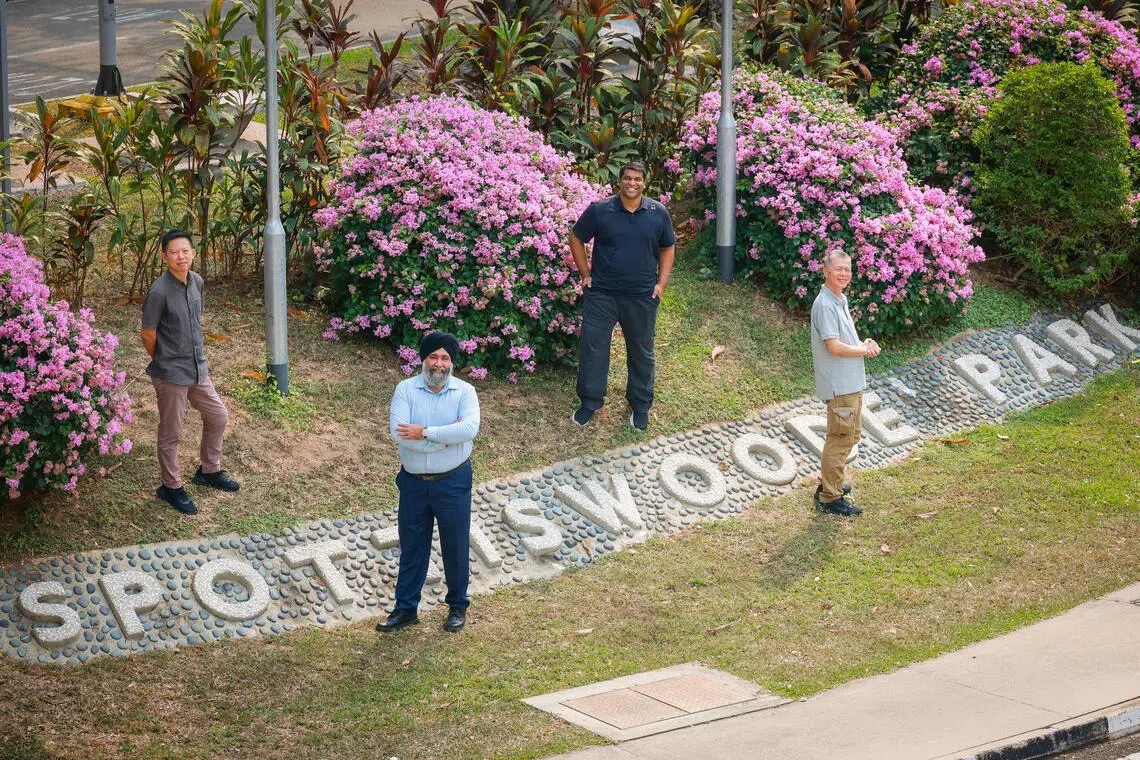
(From left) IPS senior research fellow Justin Lee; Spottiswoode Park resident Jagwinder Singh, IPS research fellow Nicholas Thomas, and resident Roy Fung, pictured on Sept 4.
ST PHOTO: JASON QUAH
Published Sep 13, 2026, 12:00 PM
Updated Sep 13, 2026, 12:00 PM
SINGAPORE – To create a more inviting environment at void decks, Spottiswoode Park resident Roy Fung suggested beautifying the tables and chairs with various themes.
“Void decks tend to be places where people just pass by. I wanted to have a standout feature – such as a seaside or forest theme – that will encourage conversation among residents,” said the 57-year-old, who has been living in the estate for 25 years.
A total of $130,000 was granted to bring his idea to life at seven void decks in the estate, under Singapore’s first participatory budgeting trial. The amount comprises the cost of materials, epoxy coating to seal the designs onto the tables, as well as labour.
The trial gave residents a say in how funds are allocated, from proposing ideas to deciding on neighbourhood improvements .
Another two ideas for a reflexology pebble path and stone seats were granted $48,000 and $10,000 respectively.
Residents were involved from the start – from suggesting the improvements they hoped to see to coming up with a full proposal themselves.
Six proposals were shortlisted from 162 ideas and put to a vote in July . The three winning proposals received a total of $188,000. The three other ideas that did not receive enough votes were for a rock climbing wall, a pickleball court and barbecue pits.
The total budget for this participatory budgeting exercise – a collaboration between Tanjong Pagar Town Council and the Institute of Policy Studies (IPS) – was $200,000 and was drawn from the Future-Ready Society Impact Fund administered by the Tote Board.
Fung, who is also the Residents’ Committee chairman for the estate, said he met his team of six weekly to firm up the details of their proposal – from the concept to the budget and execution.
The resident who suggested the reflexology pebble path, Jagwinder Singh, 55, said he came up with the idea because there are many seniors in the estate.
A pebble path was wellness-focused, feasible and within the budget, said Singh, who also submitted several other ideas such as a garden with a pond.
“This process empowers us. Rather than (agencies) telling us what is best for the estate, we get to play a part,” he added.
The construction of the projects is expected to start in late 2026, after tenders are called for each project.
Spottiswoode Park residents Jagwinder Singh (left) and Roy Fung, pictured Sept 4. ST PHOTO: JASON QUAH
Spottiswoode Park residents Jagwinder Singh (left) and Roy Fung, pictured Sept 4.
The trial ran alongside the estate’s Neighbourhood Renewal Programme (NRP) but was separately funded, and 26 resident proposals – such as sheltered walkways and barrier-free access ramps – were also incorporated into the NRP’s plans.
National Development Minister Chee Hong Tat said in a written parliamentary reply to Tanjong Pagar GRC MP Foo Cexiang in August that town councils can use their NRP budget to implement estate improvement projects that residents propose and vote on, subject to technical feasibility.
Foo said he asked the question as he saw good outcomes from the trial in Spottiswoode Park – residents felt involved in rejuvenating their estate, and the process also brought them closer to each other.
Chee’s clarification paves the way for participatory budgeting exercises to be expanded, he added.
Justin Lee, senior research fellow and head of the policy lab at IPS, said the trial at Spottiswoode Park was unique because it brought together residents from the public and private parts of the estate.
The nine blocks were built by the Port of Singapore Authority in the 1970s, and five were taken over by the HDB while the other four remained privately owned.
The private blocks were not included in the voting process for the NRP, but they were involved in the participatory budgeting trial, Lee noted.
He added that residents from the private blocks were glad to have a say in the amenities in their neighbourhood.
The pilot is part of IPS Policy Lab’s wider work to test how Singaporeans can take a more direct role in the decisions that shape their everyday environment.
IPS research fellow Nicholas Thomas said he hopes the exercise helped residents think about the collective interest of the community, rather than just their own self-interest.
“The usual expectation is that the Government will come in and do the fixing, but this has inadvertently crowded out the space for decision-making and, over time, the civic muscle starts to atrophy,” he said.
“The exercise lets residents reclaim that space and, equally important, it required the Government to cede it.”
Isabelle Liew is a journalist at The Straits Times. She covers housing issues in Singapore, with a focus on public housing.
(从左至右)IPS 高级研究员 Justin Lee;Spottiswoode Park 居民 Jagwinder Singh、IPS 研究员 Nicholas Thomas 和居民 Roy Fung,摄于 9 月 4 日。
《海峡时报》摄影:JASON QUAH
发布于2026年9月13日下午12:00
更新于2026年9月13日中午12:00
新加坡——为了营造更宜人的组屋底层环境,斯波蒂斯伍德公园居民罗伊·冯建议用各种主题美化桌椅。
“组屋底层往往是人们匆匆而过的地方。我希望打造一个引人注目的特色——比如海边或森林主题——以鼓励居民之间的交流,”这位57岁的居民说道,他已在该组屋区居住了25年。
在新加坡首个参与式预算试点项目中,他获得了总计13万美元的拨款,用于在组屋区的七个底层空间实现他的创意。这笔款项包括材料费、用于将设计图案密封在桌面上的环氧树脂涂层费用以及人工费。
这项试验让居民有机会参与资金分配,从提出想法到决定社区改善方案。
另外两个关于足底按摩鹅卵石小径和石凳的方案分别获得了 48,000 美元和 10,000 美元的资助。
居民们从一开始就参与其中——从提出他们希望看到的改进措施,到自己提出完整的方案。
从162个创意中选出了6个入围方案,并在7月份进行投票表决。最终三个获奖方案共获得18.8万美元的资助。另外三个未获得足够票数的方案分别是攀岩墙、匹克球场和烧烤坑。
这项参与式预算编制活动的总预算为 20 万美元,由丹戎巴葛市镇理事会和政策研究所 (IPS) 合作开展,资金来自博彩管理局管理的“未来就绪社会影响基金”。
冯先生同时也是该屋邨居民委员会主席,他表示自己每周都会与他的六人团队会面,敲定提案的细节——从概念到预算和执行。
55岁的居民贾格温德·辛格(Jagwinder Singh)建议修建一条鹅卵石按摩小径,他说他之所以想到这个主意,是因为这个小区里有很多老年人。
辛格表示,鹅卵石小径注重健康,切实可行,且在预算之内。他还提交了其他几个想法,例如带池塘的花园。
“这个过程赋予了我们权力。与其让(机构)告诉我们什么对庄园最有利,不如让我们参与其中,”他补充道。
这些项目的建设预计将于 2026 年底开始,届时将对每个项目进行招标。
斯波蒂斯伍德公园居民贾格温德·辛格(左)和罗伊·冯,摄于9月4日。(海峡时报摄影:杰森·夸)
Spottiswoode Park 居民 Jagwinder Singh(左)和 Roy Fung,摄于 9 月 4 日。
该试验与该住宅区的邻里更新计划 (NRP) 同时进行,但资金来源不同,26 项居民提案(例如有遮蔽的人行道和无障碍坡道)也被纳入 NRP 的计划中。
国家发展部长徐芳达在8月份给丹戎巴葛集选区议员符策祥的书面国会答复中表示,市镇理事会可以使用其国民经济计划预算来实施居民提议和投票表决的住宅区改善项目,但须视技术可行性而定。
Foo 表示,他之所以提出这个问题,是因为他看到了 Spottiswoode Park 的试点项目取得了良好的成果——居民们觉得自己参与了社区的复兴,而且这个过程也拉近了他们之间的距离。
他补充说,Chee的澄清为扩大参与式预算编制活动铺平了道路。
IPS高级研究员兼政策实验室负责人贾斯汀·李表示,斯波蒂斯伍德公园的试验是独一无二的,因为它将来自该住宅区公共部分和私人部分的居民聚集在一起。
这九栋楼是新加坡港务局在 20 世纪 70 年代建造的,其中五栋被建屋发展局接管,其余四栋仍为私人所有。
李指出,私人地块没有被纳入国家重建计划的投票过程,但它们参与了参与式预算试点。
他还补充说,私人住宅区的居民很高兴能够对社区的配套设施发表意见。
该试点项目是 IPS 政策实验室更广泛工作的一部分,旨在测试新加坡人如何才能在塑造其日常环境的决策中发挥更直接的作用。
IPS 研究员尼古拉斯·托马斯表示,他希望这项活动能帮助居民思考社区的集体利益,而不仅仅是他们自身的利益。
“人们通常期望政府介入并解决问题,但这无意中挤占了决策空间,久而久之,公民的力量就开始萎缩,”他说。
“这项举措让居民重新获得了那片空间,而且同样重要的是,它迫使政府让渡了这片空间。”
Isabelle Liew是《海峡时报》的记者,主要报道新加坡的住房问题,尤其关注公共住房。