Device placed under breastbone delivers life-saving shocks to restore heart rhythm置于胸骨下方的装置可释放挽救生命的电击,以恢复心律。
A new extravascular implantable cardioverter-defibrillator placed under the breastbone delivers life-saving shocks to restore heart rhythm safely. Read more at straitstimes.com.
Undergraduate Coeus Lee, 20, is one of the first patients in Singapore to receive an extravascular implantable cardioverter-defibrillator.
Published Sep 13, 2026, 03:00 PM
Updated Sep 13, 2026, 03:00 PM
Coeus Lee, a 19-year-old NUS student, suffered a sudden heart attack and was saved by emergency medics before receiving specialist care and surgery.
He was implanted with one of Singapore's first Extravascular Implantable Cardioverter Defibrillators (EV-ICDs) placed under the breastbone, which delivers lifesaving shocks without leads inside the heart.
The EV-ICD reduces long-term complications common to traditional devices and prevents future cardiac arrest, but Lee must avoid contact sports to protect the device.
SINGAPORE – At 19, Coeus Lee was hardly someone you would expect to suffer a cardiac arrest.
Yet, CCTV footage from his camp’s medical centre caught the undergraduate from the National University of Singapore, who turned 20 on Sept 12, collapsing moments after he walked through the door.
“I went to the medical centre to do my ORD FFI, the compulsory final medical check-up before I was deemed to have completed my national service,” Lee said.
When he came to, he did not realise that he had had a cardiac arrest.
“I was disoriented and missing my two front teeth. I thought I just had a bad fall, hit my head and blacked out,” he said.
Seow Swee Chong, a senior consultant with the Department of Cardiology at the National University Heart Centre, Singapore, told The Straits Times that Lee was fortunate that there were medics on hand to render emergency life-saving treatment.
“He survived without significant neurological impairment,” Seow said.
Lee was sent to Woodlands Hospital, the closest hospital to his camp, but was referred to the National University Hospital for specialist care.
To reduce Lee’s risk of another sudden cardiac arrest, Seow and his team decided to implant an extravascular implantable cardioverter-defibrillator (EV-ICD) – a new generation of defibrillators – under his breastbone, directly outside the heart.
The surgery was carried out about 1½ weeks later.
Lee’s young age made him a suitable candidate, making him one of the first patients in Singapore to receive the device.
It uses a lead, a thin wire placed outside the heart and veins, to deliver life-saving shocks and send tiny electrical pulses to the heart muscle.
“The lead goes under his breastbone (or sternum), with the main battery box placed under the skin near the left armpit. By doing so, the heart now sits behind the wire and the box. This allows the device to send painless electrical pulses like a pacemaker or, whenever there is the possibility of an arrest, stronger electric shocks to fix abnormal rhythms,” Seow said.
The battery box is about the size of the face of an Apple smartwatch.
“The part where we make the space under the breastbone is pretty painful. So that’s why we carry it out under general anaesthesia. Technically, it is not a difficult procedure, and it takes about an hour. The patient is usually discharged in a day with medication for pain management,” Seow said.
Lee said: “The first day was the worst, in terms of the pain, but as the days progressed, it got significantly better.”
Seow said Lee’s young age also made it a bit difficult to work through his muscles, compared with those of an older patient.
“I did not use any cutting tools to make my way through the sternum to be near the heart. Rather, I used my finger to pave the way, which is safer as it will not damage anything along the way,” he added.
More than 3,000 people suffer from out-of-hospital cardiac arrests each year across all ages, with close to four in five occurring in public or residential places.
However, according to the Ministry of Health, sudden cardiac death among those under the age of 35 is rare in Singapore, accounting for less than 3 per cent of all such deaths.
When sudden cardiac arrest strikes seemingly healthy young men, it is rarely caused by the standard lifestyle-related blocked arteries.
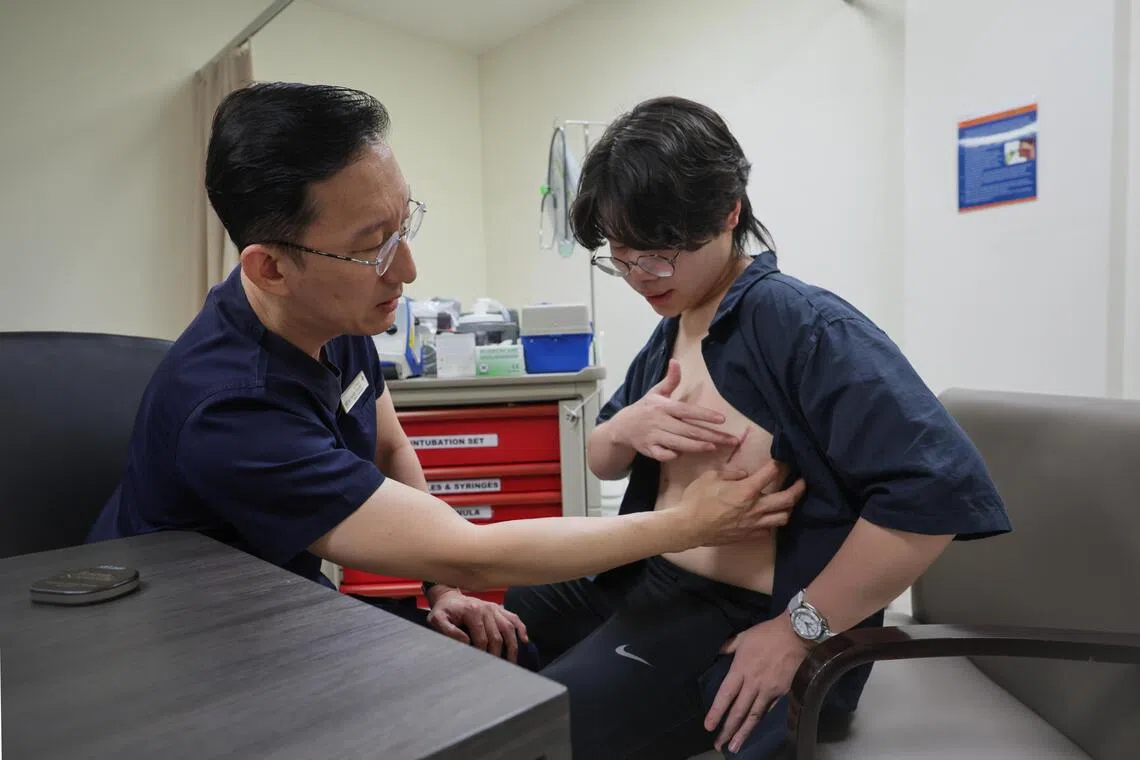
Coeus Lee is under the care of Adjunct Associate Professor Swee Chong Seow (left), a senior consultant with the National University Heart Centre. ST PHOTO: GIN TAY
Coeus Lee is under the care of Adjunct Associate Professor Swee Chong Seow (left), a senior consultant with the National University Heart Centre.
Instead, it is usually triggered by undiagnosed conditions such as a heart muscle disorder, an electrical problem, an infection weakening the heart muscle, or a congenital abnormality of the arteries.
Lee, however, said there was no history of congenital heart disease in his family.
Published studies estimate the incidence of sudden cardiac death among young athletes and active young adults to be approximately one to three cases for every 100,000 people annually.
Better fit for younger patients
Seow said the EV-ICD given to Lee was a “significant advancement in cardiac rhythm management”.
“Instead of placing the lead inside the heart and blood vessels, it is positioned beneath the breastbone, but outside the heart and vascular system. At the same time, it is near enough to detect irregularities and is able to rectify the situation,” he said.
In the traditional ICD, the box sits under the skin in the upper chest, and the lead runs through a blood vessel to attach to the inside of the heart.
Seow said: “This wire will last between 15 and 20 years before it breaks. When that happens, we can leave the old wire there and put in a new one, or take the old one out first. Either way, there are risks.
“If we were to leave the old one in, the wires could knock against each other, causing inappropriate shocks. The additional wire across the heart valve may also cause it to leak and might choke the vein.”
Adjunct Associate Professor Swee Chong Seow said the EV-ICD given to Coeus Lee was a “significant advancement in cardiac rhythm management”. ST PHOTO: GIN TAY
Adjunct Associate Professor Swee Chong Seow said the EV-ICD given to Coeus Lee was a “significant advancement in cardiac rhythm management”.
He said the old wire also cannot be removed from the vein without risks because it is usually in the vein for years, so it gets encased by the tissues of the walls of the vein, and removing it “requires quite a bit of work”.
“We would need to separate the wire from the tissues and there is always the risk of complications,” Seow added.
The EV-ICD would be the right fit for a young person like Lee, as changing a lead that is outside the heart would not result in such complications after 15 to 20 years.
With the EV-ICD implanted in him, Lee, who used to play ice hockey and basketball when he was growing up overseas, can no longer do so competitively.
“The clashes could and would cause trauma to the site where the defibrillator sits. For my peace of mind and safety, I guess I will have to comply,” Lee said.
Heart/Cardiac diseases
National University Hospital
20岁的本科生李科伊斯是新加坡首批接受血管外植入式心脏复律除颤器的患者之一。
发布于2026年9月13日下午3:00
更新于2026年9月13日下午3:00
19岁的新加坡国立大学学生李科厄斯突发心脏病,经急救人员抢救后接受了专科治疗和手术。
他接受了新加坡首批植入式心脏复律除颤器(EV-ICD)之一的手术,该装置放置在胸骨下方,无需在心脏内放置导线即可提供救命的电击。
EV-ICD 可减少传统设备常见的长期并发症,并预防未来的心脏骤停,但李必须避免接触性运动以保护设备。
新加坡——19岁的李科伊斯,你很难想象他会突发心脏骤停。
然而,他所在营地医疗中心的监控录像显示,这位来自新加坡国立大学的本科生(9 月 12 日刚满 20 岁)在走进大门后不久便倒下了。
李说:“我去医疗中心做了我的退伍体检,这是我完成国民服役前必须进行的最后一次体检。”
他醒来时,并不知道自己曾心脏骤停。
“我当时神志不清,还掉了两颗门牙。我以为我只是摔了一跤,撞到了头,然后就昏过去了,”他说。
新加坡国立大学心脏中心心脏病科高级顾问萧瑞忠告诉《海峡时报》,李很幸运,当时有医护人员在场,可以进行紧急救命治疗。
Seow说:“他活了下来,没有留下明显的神经系统后遗症。”
李被送往离他营地最近的伍德兰兹医院,但随后被转诊到国立大学医院接受专科治疗。
为了降低李再次发生心脏骤停的风险,Seow 和他的团队决定在他的胸骨下、心脏外侧植入一个血管外植入式心脏复律除颤器 (EV-ICD)——新一代的除颤器。
手术大约在一周半后进行。
李先生年纪轻轻,因此成为合适的候选人,也成为新加坡首批接受该设备治疗的患者之一。
它使用一根导线(一根放置在心脏和静脉外部的细导线)来输送救命的电击,并向心肌发送微小的电脉冲。
“导线置于胸骨下方,主电池盒则置于左侧腋窝附近的皮下。这样一来,心脏就位于导线和电池盒的后方。这使得该装置能够像心脏起搏器一样发出无痛的电脉冲,或者在可能发生心脏骤停时,发出更强的电击来纠正异常心律,”Seow说道。
电池盒的大小和苹果智能手表的表盘差不多。
“在胸骨下方创建空间的那部分会比较痛,所以我们会在全身麻醉下进行。从技术上讲,这并不是一个复杂的手术,大约需要一个小时。患者通常一天后就可以出院,并会带一些止痛药,”Seow说道。
李说:“第一天最难熬,疼痛难忍,但随着时间的推移,情况明显好转。”
Seow表示,与年长的患者相比,Lee的年龄较轻,这使得肌肉的治疗工作有些困难。
“我没有使用任何切割工具穿过胸骨到达心脏附近。相反,我用手指开辟道路,这样更安全,因为不会损伤沿途的任何组织,”他补充道。
每年有超过 3000 人发生院外心脏骤停,涉及各个年龄段,其中近五分之四发生在公共场所或住宅场所。
然而,据卫生部称,新加坡 35 岁以下人群中猝死的情况很少见,仅占此类死亡总数的不到 3%。
当看似健康的年轻男性突发心脏骤停时,很少是由常见的与生活方式相关的动脉阻塞引起的。
Coeus Lee目前由新加坡国立大学心脏中心高级顾问、兼职副教授Swee Chong Seow(左)负责诊治。(海峡时报摄影:GIN TAY)
Coeus Lee 由新加坡国立大学心脏中心高级顾问、兼职副教授 Swee Chong Seow(左)负责诊治。
相反,它通常是由未确诊的疾病引起的,例如心肌疾病、电生理问题、导致心肌衰弱的感染或先天性动脉异常。
然而,李先生表示,他的家族中并没有先天性心脏病史。
已发表的研究估计,年轻运动员和活跃的年轻人中,每年每 10 万人中约有 1 至 3 例猝死病例。
更适合年轻患者
Seow表示,为Lee植入的EV-ICD是“心脏节律管理方面的一项重大进步”。
他说:“这种导线不是放置在心脏和血管内,而是放置在胸骨下方,但位于心脏和血管系统之外。同时,它又足够接近心脏和血管,能够检测到异常情况并进行纠正。”
在传统的ICD中,盒子位于上胸部的皮下,导线通过血管连接到心脏内部。
Seow说:“这条电线可以使用15到20年才会断裂。到那时,我们可以保留旧电线并安装新电线,或者先将旧电线拆除。无论哪种方式,都存在风险。”
“如果我们保留旧的导线,导线可能会相互碰撞,导致不必要的电击。此外,横跨心脏瓣膜的额外导线也可能导致瓣膜渗漏,甚至阻塞静脉。”
兼职副教授萧瑞忠表示,为李科厄斯植入的EV-ICD是“心脏节律管理领域的一项重大进步”。(海峡时报照片:金泰)
兼职副教授萧瑞冲表示,为李科斯植入的EV-ICD是“心脏节律管理方面的一项重大进步”。
他说,由于旧导线通常在静脉中停留多年,会被静脉壁组织包裹,因此无法在不冒风险的情况下将其从静脉中取出,取出它“需要相当大的工作量”。
“我们需要将导线与组织分离,但始终存在并发症的风险,”Seow补充道。
对于像李这样的年轻人来说,EV-ICD 是合适的选择,因为更换心脏外部的导线不会在 15 到 20 年后导致此类并发症。
李在海外长大,小时候经常打冰球和篮球,但植入EV-ICD后,他再也不能参加竞技比赛了。
“这些冲突可能会对放置除颤器的地方造成破坏。为了我自己的安心和安全,我想我只能遵守规定了。”李说。
心脏/心脏疾病
国立大学医院