See Taiwanese jets take off from rural roads, and more from its latest drill观看台湾战机从乡村公路起飞,以及其最新演习的更多内容
The Taiwanese military exercise envisioned a Chinese attack taking out the island’s main airfields, necessitating the use of rural roads as runways to carry on the fight.
An American-made E-2K early warning aircraft takes off from a motorway in Pingtung, southern Taiwan, on Sept. 15, 2021. (Sam Yeh/AFP via Getty Images)
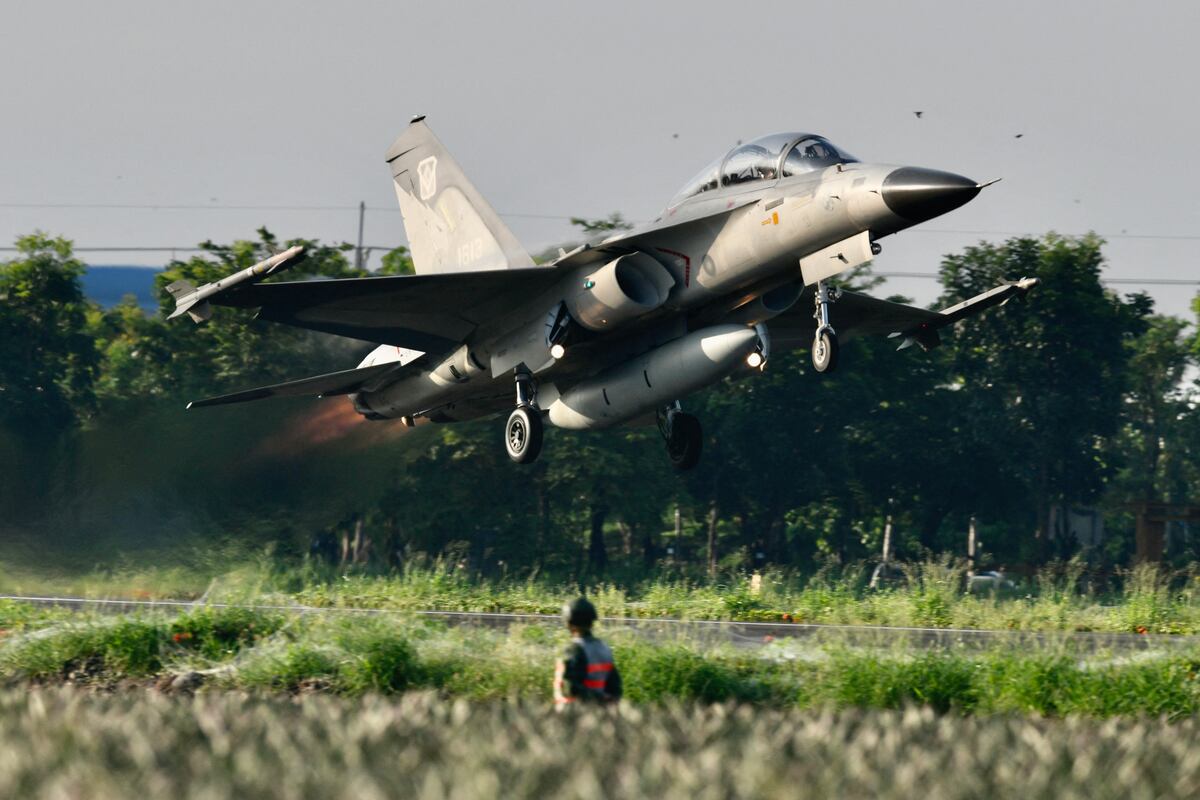
An armed, homemade Indigenous Defense Fighter takes off from a motorway in Pingtung, southern Taiwan, during the annual Han Kuang drill. (Sam Yeh/AFP via Getty Images)
A tank prepares to take part in the annual Han Kuang live-fire drills in Hualian, eastern Taiwan, in the early hours of Sept. 14, 2021. (Military News Agency via AP)
Taiwan's annual five-day Han Guang military exercise is designed to prepare the island's forces for an attack by China, which claims Taiwan as part of its own territory. (Military News Agency via AP)
A Taiwanese soldier prepares artillery rounds for a live-fire drill to deter a coastal landing force on Sept. 15, 2021. (Military News Agency via AP)
A military jet taxis along a highway in Jiadong, Taiwan, on Sept. 15, 2021. Four military aircraft landed on the highway and took off again that day as part of Taiwan's five-day Han Guang military exercise designed to prepare the island's forces for an attack by China, which claims Taiwan as part of its own territory. (Taiwan Presidential Office via AP)
Taiwanese armored units conduct a live-fire drill to deter a coastal landing force during the Han Guang exercise held on the island of Penghu county. (Military News Agency via AP)
A Taiwanese artillery unit conducts a live-fire drill the Han Guang exercise. (Military News Agency via AP)
Taiwanese President Tsai Ing-wen, center, speaks with military personnel near aircraft parked on a highway in Jiadong, Taiwan, on Sept. 15, 2021. (Taiwan Presidential Office via AP)
JIADONG, Taiwan — The F-16 screeched across the sky Wednesday before landing on a highway cut through pineapple fields in southwestern Taiwan to refuel quickly and take off again.
The Taiwanese military exercise envisioned a Chinese attack taking out the island’s main airfields, necessitating the use of rural roads as runways to carry on the fight.
War is not imminent, but as China has grown increasingly assertive in both the East China and South China Seas, Taiwan is stepping up its defense. Across the region, the United States and its allies are deepening military cooperation and strategizing over an effective response.
China, which claims Taiwan as part of its territory, flies fighter jets toward Taiwan on a regular basis in an effort to warn and intimidate the island’s air force. Last month, Chinese fighter jets, anti-submarine aircraft and combat ships conducted joint assault drills near Taiwan with China saying the exercise was necessary to safeguard its sovereignty.
U.S. President Joe Biden on Tuesday announced a meeting next week with key regional players that form the so-called “Quad” — India, Australia and Japan together with the U.S. — for in-person talks the White House said are meant to show the administration’s commitment to “promoting a free and open Indo-Pacific.”
Chinese Foreign Ministry spokesperson Zhao Lijian slammed the U.S. for “forming exclusive cliques” after the meeting was announced and countered that China was a “firm defender of regional peace and stability.”
“China’s development is a growing force for peace in the world and a boon to the prosperity and development of the region,” he said. “The countries concerned should abandon the outdated zero-sum mentality and narrow-minded geopolitical thinking.”
Japan, a U.S. ally that hosts the U.S. Navy’s 7th Fleet, has long moved cautiously with regard to China, an important trading partner. But it has recently become less reserved in the face of Beijing’s growing military activity and broad territorial claims in the western Pacific, including to a group of islands near Taiwan that Japan controls.
Masahisa Sato, a senior lawmaker of the governing Liberal Democratic Party and an expert on defense, told a recent forum on security in Asia that right now the U.S.-Japan alliance is focused largely on a response to a possible conflict stemming from the Korean Peninsula, and it needs to be broadened to consider what to do if there is a Chinese attack on Taiwan.
He noted that the Sakishima island group, which includes some of Okinawa’s remote islands, “is right next to Taiwan and is part of a same theater.”
“We should consider a Taiwan contingency as nearly equal to a Japan contingency,” Sato said.
All three candidates running on Sept. 29 to become Japan’s new leader are proposing hawkish policies toward China, though still acknowledging its importance as a trading partner.
Taro Kono, the minister in charge of vaccinations who is seen as a front runner, has said he will seek to establish a regional framework that adds to Japan’s alliance with the United States in countering China’s growing military activity.
In a joint statement after they met in April, outgoing Prime Minister Yoshihide Suga and Biden said they “recognize the importance of deterrence to maintain peace and stability in the region” and added that they “oppose any unilateral attempts to change the status quo in the East China Sea” and reiterated their “objections to China’s unlawful maritime claims and activities in the South China Sea.”
Underscoring its concerns, Japan’s Defense Ministry added a new section on Taiwan in its annual report released in July, saying the situation requires a “sense of crisis.” It says China’s military capability has become far greater than that of Taiwan and that Japan must pay attention to further increases on both sides.
Suga announced he will not run in the Sept. 29 Liberal Democratic Party leadership vote, which chooses a new party leader who will become Japan’s next prime minister.
Taiwan has stepped up purchases from the U.S. of weapons including missiles and aircraft over the past two years.
Taiwan’s defense ministry submitted a budget of $16.8 billion for the next year, a modest increase from last year’s $16.2 billion. Some of the funds would purchase 66 F-16V fighter jets, according to the semiofficial Central News Agency.
Many believe, however, that despite the bellicose rhetoric and drills like the Han Guang exercise on Wednesday, as well as the Chinese posturing, that open conflict is not on the horizon.
“This is a type of gray zone tactic — military intimidation,” said Ou Xifu, a researcher at the Institute for National Defense and Security Research in Taiwan. “This shouldn’t lead to war.”
Wu reported from Taipei and Yamaguchi from Tokyo. Associated Press researcher Yu Bing contributed to this report from Beijing.
2021年9月15日,一架美国制造的E-2K预警机从台湾南部屏东的一条高速公路上起飞。(Sam Yeh/AFP via Getty Images)
在一年一度的汉光演习期间,一架武装的自制原住民防卫战飞机从台湾南部屏东的一条高速公路上起飞。(图片来源:Sam Yeh/AFP via Getty Images)
2021年9月14日凌晨,一辆坦克在台湾东部花莲参加一年一度的汉光实弹演习。(美联社/军事新闻社)
台湾一年一度为期五天的汉光联合军事演习旨在使台湾军队做好应对中国进攻的准备。中国声称台湾是其领土的一部分。(军事新闻社 via AP)
2021年9月15日,一名台湾士兵正在准备炮弹,进行实弹演习以威慑沿海登陆部队。(军事新闻社/美联社)
2021年9月15日,一架军用飞机在台湾嘉东的一条高速公路上滑行。当天,四架军用飞机在该高速公路上起降,这是台湾为期五天的“汉光”联合军事演习的一部分,旨在使台湾军队做好应对中国攻击的准备。中国声称台湾是其领土的一部分。(台湾总统府供图,美联社发布)
在澎湖县举行的汉光演习中,台湾装甲部队进行实弹演练,以威慑海岸登陆部队。(军事新闻社/美联社)
台湾某炮兵部队在“汉光”演习中进行实弹射击演练。(军事新闻社/美联社)
2021年9月15日,台湾总统蔡英文(中)在台湾嘉东高速公路旁与停放的飞机附近的军方人员交谈。(台湾总统府供图,美联社发布)
台湾嘉东——周三,一架F-16战斗机呼啸着划过天空,随后降落在台湾西南部一条穿过菠萝田的公路上,迅速加油后再次起飞。
台湾的军事演习设想中国军队攻击并摧毁该岛的主要机场,因此需要利用乡村道路作为跑道来继续战斗。
战争尚未迫在眉睫,但随着中国在东海和南海日益强硬,台湾正在加强防御。在整个地区,美国及其盟友正在深化军事合作,并制定有效的应对策略。
中国声称台湾是其领土的一部分,并经常派遣战斗机飞向台湾,意在警告和威慑台湾空军。上个月,中国战斗机、反潜机和作战舰艇在台湾附近海域举行了联合突击演习,中国称此举是为了维护其主权。
美国总统乔·拜登周二宣布,下周将与组成所谓“四方安全对话”(Quad)的关键地区参与者——印度、澳大利亚、日本以及美国——举行面对面会谈。白宫表示,此次会谈旨在表明本届政府致力于“促进自由开放的印太地区”。
会晤宣布后,中国外交部发言人赵立坚抨击美国“形成排外集团”,并反驳说中国是“地区和平稳定的坚定捍卫者”。
他说:“中国的发展是世界和平日益增长的力量,也是该地区繁荣发展的福音。有关国家应该摒弃过时的零和博弈思维和狭隘的地缘政治思想。”
日本是美国的盟友,也是美国海军第七舰队的驻地。长期以来,日本对中国这个重要的贸易伙伴一直保持谨慎态度。但近年来,面对北京日益增强的军事活动以及在西太平洋地区广泛的领土主张(包括对日本控制的台湾附近一组岛屿的主张),日本的态度有所松懈。
自民党资深议员、国防专家佐藤正久在最近一次亚洲安全论坛上表示,目前美日同盟主要关注的是应对朝鲜半岛可能发生的冲突,需要扩大范围,考虑如果中国攻击台湾该怎么办。
他指出,包括冲绳一些偏远岛屿在内的先岛群岛“紧邻台湾,属于同一战区”。
佐藤表示:“我们应该把应对台湾的突发事件视为与应对日本的突发事件同等重要。”
9月29日竞选日本新首相的三位候选人都提出了对华强硬政策,但同时也承认中国作为贸易伙伴的重要性。
负责疫苗接种的部长河野太郎被视为领跑者,他表示将寻求建立一个区域框架,以加强日本与美国的联盟,共同对抗中国日益增长的军事活动。
即将卸任的日本首相菅义伟和拜登在4月会晤后发表联合声明称,他们“认识到威慑对于维护地区和平与稳定的重要性”,并补充说,他们“反对任何单方面改变东海现状的企图”,并重申了他们“反对中国在南海的非法海洋主张和活动”。
为了强调其担忧,日本防卫省在7月发布的年度报告中新增了关于台湾的章节,称当前局势需要“危机意识”。报告指出,中国的军事能力已远超台湾,日本必须密切关注双方军事力量的进一步增长。
菅义伟宣布他将不会参加9月29日举行的自民党总裁选举,此次选举将选出一位新的党魁,他将成为日本下一任首相。
过去两年,台湾加大了从美国购买武器的力度,包括导弹和飞机。
台湾国防部提交了下一年度的预算,金额为168亿美元,较去年的162亿美元略有增长。据半官方的中央通讯社报道,部分资金将用于购买66架F-16V战斗机。
然而,许多人认为,尽管中国方面发表了好战言论,并举行了像周三的“汉光”演习这样的演习,以及采取了各种姿态,但公开冲突尚未到来。
“这是一种灰色地带的战术——军事恐吓,”台湾国防安全研究院研究员欧锡福说。“这不应该导致战争。”
吴从台北报道,山口从东京报道。美联社研究员于冰从北京对此报道亦有贡献。