Sanctioned North Korean arms makers find new cover in Russia’s shadow受制裁的朝鲜武器制造商在俄罗斯的阴影下找到了新的庇护所
A North Korean company started marketing its products with a reference to lessons learned in Russia's fight against Ukraine.
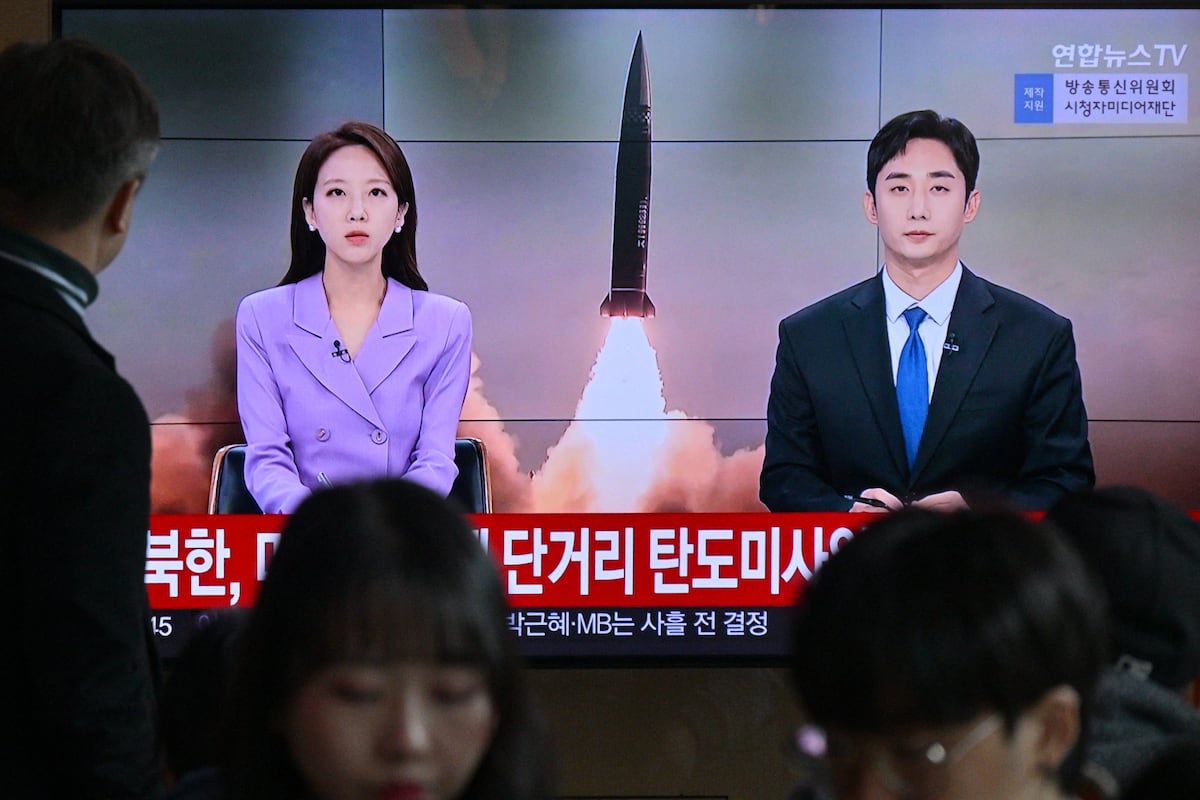
BERLIN – A notorious North Korean military manufacturer selling its wares internationally remains active and is expanding its catalog despite international sanctions, a Defense News investigation shows.
It is just the tip of a vast, global network of obscure front companies that Kim Jong Un’s regime uses to sell weapons abroad and procure components for his military programs at home. Following a Russian veto in the Security Council, North Korea may be trying to expand these operations significantly.
Global Communications Co., or Glocom, has been in the crosshairs of the United Nations and many Western governments since 2016. The company sells advanced military radio equipment, missile components and command-and-control systems. More significantly, it has also been identified by the UN as a front for Pyongyang’s Reconnaissance General Bureau, North Korea’s central intelligence agency.
The website remains online today, continues to see changes, and, in 2024, was updated with a new product: a telemetry system for missiles. The product page boasts of the device’s technical specifications and presents a photograph of the aluminum-colored device superimposed over a stock photo of a rocket blasting off into space.
In a May 10, 2024, press release , Glocom referenced lessons learned in the Ukraine war as being crucial to the development of the new data transmitter. “In particular, as we can see from the war in Ukraine, surveillance and reconnaissance using various unmanned surveillance means, as well as attacks by drones and missiles, are becoming essential processes in all military operations,” the company wrote.
“Reflecting these demands, the GR-8422 broadband data transmitter was introduced.” According to the makers, “This data transmitter can be installed on various platforms such as fighter jets, drones … and ships, launchers, tanks, armored vehicles, etc.”
Nowhere, of course, is there any mention of the North Korea connection. In promotional materials, Glocom went to great lengths to expunge any signs of its true origin, even blurring Korean script on product photos and using fictional locations.
The North Korean regime operates a web of likely hundreds of similar entities stretching around the world to get around sanctions imposed by the international community, including the UN Security Council, in service of the Kim family’s pursuit of weapons of mass destruction.
The target markets are countries embroiled in active conflict and are often themselves under arms embargoes, with North Korea supplying governments that quickly need cheap gear. Insurgency groups and even private military contractors are also would-be customers, said Robert Shaw, program director for the Export Control and Nonproliferation Program at the California-based James Martin Center for Nonproliferation Studies.
“My impression is that the North Korean government has made an effort to increase its arms trade,” he added.
Obtaining hard cash is assessed to be one of the regime’s top priorities, and the state runs various enterprises dabbling in arms sales, construction work in places such as Zambia, IT services for unwitting U.S. companies through impersonation of American citizens, or organized crime that involves hacking banks and making and selling drugs like heroin.
Shaw said Glocom’s new message of advertising high-tech devices is a significant step and a whole new ball game from assembling relatively simple radios. “Who are they marketing this to? This opens up a whole set of questions,” he wondered. “This is getting more into major customer territory.”
Glocom’s website claims that the company was founded in 1996, though this date is impossible to independently verify. According to the official chronology, it started out with the aim of modernizing antiquated radar systems at home. The company appears to be connected with an enterprise by the name of Pan Systems, operating out of Singapore and founded in the same year, according to a UN investigation and sanctions databases.
Pan Systems Singapore soon opened an office in the North Korean capital city of Pyongyang. In an interview by UN experts, cited in a 2017 report , as well as in public statements , the company’s owner said he had been approached by a North Korean representative in the late 90s and thought that it seemed like a good idea at the time to facilitate trade. Back then, North Korea was not yet subject to the extensive international sanctions that were imposed on it following its first nuclear test in 2006.
Pan Systems in 2017 claimed that it no longer had any ties to the North Korean office and had exited North Korea when sanctions were imposed in 2007. Indeed, experts assessed that Pan Systems Pyongyang is run by the North Korean intelligence agency RGB. However, Glocom’s director, Ryang Su Nyo – a woman in her sixties and herself an agent of the RGB – traveled to Singapore repeatedly from 2010 to 2016 to meet with Pan Systems’ boss, also making stops in Malaysia to meet with other representatives of Glocom, the 2017 UN report revealed, suggesting that a certain level of cooperation likely still existed around that time.
According to a UN panel of experts, which was established by the Security Council to investigate North Korea’s sanctions evasion and WMD programs, the head of Pan Systems said that Ms. Ryang’s visits to Singapore were related to a health condition.
Malaysian authorities have told the panel that “Glocom has never operated in Malaysia,” despite the company’s claimed address in Kuala Lumpur’s Little India district. However, the UN said it and Malaysian authorities tracked down several North Korean citizens connected to Glocom who were active in Malaysia at the same time, as well as associated front companies that were registered at the same address and had made bank transfers on Glocom’s and North Korea’s behalf.
Malaysia has served as a hotbed for North Korean sanctions evasion in the past. The countries historically had comparatively warm ties, and many DPRK nationals and front companies were based there. MKP , one of the largest networks of North Korean overseas companies doing everything from construction to running hospitals, was based in Kuala Lumpur.
However, in recent years, especially following the assassination of Kim Jong Un’s half-brother with a nerve poison in Kuala Lumpur’s international airport in 2017, relations between the countries have cooled markedly. Malaysia has cracked down on North Korean activity within its borders since and implemented state-of-the-art export control laws to counteract illicit trade.
For a while in 2016, after the United Nations had reached out to Glocom’s front companies in Malaysia for information, it seemed like the company might descend into the wastebasket of history. Like many other North Korean front companies before it and since, its website was taken down and mentions of it were erased from the internet. Unusually, however, it returned just a year later with an updated product catalog and a revamped design. In the official company chronology, it is written that the “year 2016 was the most difficult, but innovative year for Glocom.”
Glocom differs from other North Korean front companies in its persistence and the quality of its international presence. It has participated in trade fairs in Southeast Asia since 2006 and maintains a polished website, product catalogs written in reasonably good English, and, at one point, even had Twitter, Facebook and YouTube accounts – until the respective platforms suspended them as part of a crackdown on North Korean profiles. Its promotional videos, since deleted, showed dynamic animations of battlefield scenarios with explosions and military vehicles and touted the products’ advanced capabilities.
In contrast, many other North Korean front companies’ websites look dated, are riddled with spelling errors and broken links, lack depth and raise other red flags.
“I suspect many of the actual deals and transfers are being developed and conducted through personal networks and possibly with the assistance of embassy personnel,” Shaw said.
What purpose websites like Glocom’s serve is unclear, he added, saying that perhaps it was political signaling for domestic forces, or to show defiance on the world stage.
Over the years, Glocom managed to land a number of sales, including to Eritrea, Syria and Ethiopia, the latter as recently as 2022. It seems likely that more sales have occurred but simply flown under the radar thanks to North Korea’s extensive use of convoluted shipping and payment networks to obscure the origin of wares and the destination of money. Similar North Korean arms deals have occurred with Yemen, Cuba, Egypt, Russia, Myanmar, Sudan, Iran and others.
In the 2022 sale of military radios to the Ethiopian army, an Indonesian company by the name of Advanced Technology Facility was involved with training the recipients in the equipment’s use. ATF had previously been exposed by the United Nations’ experts for selling Glocom’s equipment on their website under a different brand name, EDSAT. A photo published in Ethiopian media in November 2022 showed the chief of the General Staff of the Armed Forces, Field Marshal Birhanu Jula, using what appears to be one of the North Korean military radios.
Neither Ethiopia nor Advanced Technology Facility responded to the UN’s request for further information.
More sales may be forthcoming. Aside from the website being recently updated, in 2024, South Korea informed the UN that “Glocom persists in selling Democratic People’s Republic of Korea-manufactured military telecommunications equipment.”
The Russian invasion of Ukraine and subsequent shifting of international geopolitics has opened a new door for North Korean arms dealers that the country may be trying to exploit. Shunned by much of the international community, North Korea and Russia have grown closer in recent years, and Moscow has used its position in the Security Council to shield Pyongyang from any new sanctions – and to roll back enforcement of existing measures.
North Korean state enterprises and even government departments are often tasked with paying for their own operation and making money for the regime at all costs, said Shaw, of the Center for Nonproliferation Studies. “If I were an exec with one of those corporations, I would see this as a huge opportunity,” he said, referring to the budding “strategic partnership” between Pyongyang and Moscow.
Last year, Russia vetoed the continued existence of the United Nations’ panel of experts that had tracked North Korea’s sanctions evasion and WMD procurement efforts for over a decade and whose reports, published every half year and routinely hundreds of pages long, contributed significantly to shedding light on Glocom’s and other North Korean activities.
Russia itself increasingly came into the crosshairs of the reports as the country forged a military partnership with Pyongyang and started buying large quantities of North Korean weapons for its war in Ukraine.
Linus Höller is Defense News' Europe correspondent and OSINT investigator. He reports on the arms deals, sanctions, and geopolitics shaping Europe and the world. He holds master’s degrees in WMD nonproliferation, terrorism studies, and international relations, and works in four languages: English, German, Russian, and Spanish.
柏林——《防务新闻》的一项调查显示,一家臭名昭著的朝鲜军火制造商尽管受到国际制裁,仍在积极向国际市场销售其产品,并不断扩大其产品目录。
这仅仅是金正恩政权利用其庞大的全球性隐蔽幌子公司网络的一小部分,该网络旨在向海外出售武器,并为国内军事项目采购零部件。在俄罗斯于安理会否决相关决议后,朝鲜可能正试图大幅扩大这些业务。
自2016年以来,环球通信公司(Glocom)一直是联合国和许多西方国家政府的重点关注对象。该公司销售先进的军用无线电设备、导弹部件和指挥控制系统。更重要的是,联合国还认定该公司是朝鲜中央情报机构——朝鲜侦察总局的幌子公司。
该网站至今仍然在线,并持续更新。2024年,该网站新增了一款产品:导弹遥测系统。产品页面详细介绍了该设备的各项技术规格,并展示了一张铝色设备的照片,照片叠加在一张火箭发射升空的库存照片上。
在2024年5月10日的新闻稿中,Glocom公司指出,从乌克兰战争中汲取的经验教训对新型数据传输器的研发至关重要。该公司写道:“尤其值得注意的是,正如我们从乌克兰战争中看到的那样,利用各种无人侦察手段进行监视和侦察,以及使用无人机和导弹进行攻击,正成为所有军事行动中不可或缺的环节。”
“为了满足这些需求,GR-8422宽带数据发射器应运而生。” 制造商表示,“这款数据发射器可安装在各种平台上,例如战斗机、无人机……以及舰船、发射装置、坦克、装甲车等等。”
当然,所有资料中都只字未提与朝鲜的关联。在宣传材料中,Glocom竭尽全力抹去其真实来源的任何痕迹,甚至模糊了产品照片上的韩文,并使用了虚构的地点。
朝鲜政权运作着一个由数百个类似实体组成的庞大网络,这些实体遍布世界各地,旨在规避国际社会(包括联合国安理会)实施的制裁,以服务于金氏家族追求大规模杀伤性武器的目标。
目标市场是那些深陷冲突、且自身往往受到武器禁运的国家,朝鲜向这些国家政府提供廉价武器装备。加州詹姆斯·马丁防扩散研究中心出口管制与防扩散项目主任罗伯特·肖表示,叛乱组织甚至私人军事承包商也是潜在客户。
“我的印象是,朝鲜政府一直在努力增加其武器贸易,”他补充道。
获得硬通货被认为是该政权的首要任务之一,该国经营着各种企业,涉足武器销售、在赞比亚等地进行建筑工程、通过冒充美国公民为不知情的美国公司提供 IT 服务,以及涉及入侵银行和制造、销售海洛因等毒品的有组织犯罪。
肖恩表示,Glocom公司将广告重点转向高科技设备,这标志着其发展迈出了重要一步,与组装相对简单的收音机截然不同。“他们的目标客户是谁?这引发了一系列问题,”他疑惑道,“这正在向大型客户群体靠拢。”
Glocom公司网站声称该公司成立于1996年,但这一日期无法独立核实。根据官方资料,该公司最初的目标是对其国内老旧的雷达系统进行现代化改造。联合国的一项调查和制裁数据库显示,该公司似乎与一家名为Pan Systems的企业有关联,后者总部位于新加坡,并于同年成立。
Pan Systems Singapore很快在朝鲜首都平壤开设了办事处。该公司老板在2017年的一份报告中引用了联合国专家的采访,并在公开声明中表示,他在上世纪90年代末曾与一名朝鲜代表接触,当时他认为促进贸易是个好主意。那时,朝鲜尚未受到2006年首次核试验后国际社会对其实施的广泛制裁。
Pan Systems公司在2017年声称已与朝鲜办事处断绝一切联系,并在2007年制裁实施时撤离朝鲜。然而,专家评估认为,Pan Systems平壤办事处实际上由朝鲜情报机构金边情报局(RGB)运营。但联合国2017年的报告显示,Glocom公司董事梁秀女(Ryang Su Nyo)——一位六十多岁的女性,同时也是金边情报局的特工——在2010年至2016年间多次前往新加坡与Pan Systems公司负责人会面,并曾到访马来西亚与Glocom公司的其他代表会面。这表明,当时双方可能仍存在一定程度的合作。
据联合国安理会设立的专家小组称,该小组负责调查朝鲜规避制裁和大规模杀伤性武器计划的情况。据该小组称,Pan Systems 的负责人表示,梁女士访问新加坡与健康状况有关。
马来西亚当局告诉调查小组,“Glocom从未在马来西亚开展业务”,尽管该公司声称其地址位于吉隆坡小印度区。然而,联合国表示,它与马来西亚当局追踪到多名与Glocom有关联的朝鲜公民,这些人当时都在马来西亚活动,此外还追踪到一些注册地址相同的关联空壳公司,这些公司曾代表Glocom和朝鲜进行银行转账。
马来西亚过去曾是朝鲜规避制裁的温床。两国历史上关系相对友好,许多朝鲜公民和幌子公司都设在马来西亚。朝鲜最大的海外公司网络之一——MKP,业务涵盖建筑、医院运营等各个领域,其总部就设在吉隆坡。
然而,近年来,尤其是在2017年金正恩的同父异母哥哥在吉隆坡国际机场遭神经毒剂暗杀之后,两国关系明显降温。此后,马来西亚加强了对朝鲜在其境内活动的打击力度,并实施了最先进的出口管制法律以打击非法贸易。
2016年,联合国曾联系Glocom在马来西亚的幌子公司获取信息,一度让人觉得这家公司可能要被历史遗忘。和许多其他朝鲜幌子公司一样,Glocom的网站被关闭,互联网上的所有相关信息也被抹去。然而,出人意料的是,仅仅一年后,它就带着更新的产品目录和全新的设计重新出现。在Glocom的官方大事记中,写道:“2016年是Glocom发展历程中最艰难但也最具创新性的一年。”
与其他朝鲜幌子公司不同,Glocom 的优势在于其持久性和高质量的国际影响力。自 2006 年以来,该公司一直参加东南亚的贸易展览会,并维护着一个精美的网站、英文水平尚可的产品目录,甚至一度拥有 Twitter、Facebook 和 YouTube 账号——直到这些平台因打击朝鲜账号而将其账号封禁。该公司此前发布的宣传视频(现已删除)展示了战场场景的动态动画,包括爆炸和军用车辆,并大力宣传其产品的先进性能。
相比之下,许多其他朝鲜幌子公司的网站看起来过时,充斥着拼写错误和失效链接,缺乏深度,并引发其他危险信号。
肖恩说:“我怀疑许多实际的交易和转移都是通过私人关系网络进行策划和实施的,而且可能还有使馆人员的协助。”
他补充说,像 Glocom 这样的网站究竟有何用途尚不清楚,或许是为了向国内势力发出政治信号,或是为了在国际舞台上表示反抗。
多年来,Glocom 成功达成了一系列军售,包括向厄立特里亚、叙利亚和埃塞俄比亚的军售,其中与埃塞俄比亚的军售最近一次是在 2022 年。很可能还有更多军售发生,但由于朝鲜广泛利用错综复杂的运输和支付网络来掩盖货物来源和资金去向,这些交易才得以瞒天过海。类似的朝鲜军售也发生在也门、古巴、埃及、俄罗斯、缅甸、苏丹、伊朗等国。
在2022年向埃塞俄比亚军队出售军用无线电设备的过程中,一家名为“先进技术设施”(Advanced Technology Facility,简称ATF)的印尼公司参与了对接收方设备的培训。此前,联合国专家曾揭露ATF在其网站上以EDSAT品牌销售Glocom公司的设备。2022年11月,埃塞俄比亚媒体刊登的一张照片显示,武装部队总参谋长比尔哈努·朱拉元帅正在使用疑似朝鲜军用无线电设备。
埃塞俄比亚和先进技术设施均未回应联合国要求提供更多信息的请求。
未来可能还会有更多销售。除了网站最近进行了更新之外,韩国在2024年向联合国通报称,“Glocom公司仍在继续销售朝鲜民主主义人民共和国制造的军用通信设备。”
俄罗斯入侵乌克兰以及随后国际地缘政治格局的转变,为朝鲜军火商打开了一扇新的大门,而朝鲜可能正试图利用这扇门。尽管受到国际社会的普遍冷落,朝鲜与俄罗斯近年来关系日益密切,莫斯科利用其在安理会的席位,保护平壤免受任何新的制裁,并削弱现有制裁措施的执行力度。
朝鲜防扩散研究中心的肖恩表示,朝鲜国有企业甚至政府部门往往被要求不惜一切代价为政权赚钱,并承担自身运营的费用。“如果我是这些企业的管理人员,我会把这视为一个巨大的机会,”他指的是平壤和莫斯科之间正在萌芽的“战略伙伴关系”。
去年,俄罗斯否决了联合国专家小组继续存在。该小组十多年来一直追踪朝鲜规避制裁和采购大规模杀伤性武器的行为,其每半年发布一次、通常长达数百页的报告,对揭露Glocom和其他朝鲜的活动做出了重大贡献。
随着俄罗斯与平壤建立军事伙伴关系,并开始大量购买朝鲜武器用于其在乌克兰的战争,俄罗斯本身也日益成为报道的焦点。
林努斯·霍勒是《防务新闻》的欧洲记者和开源情报调查员。他报道影响欧洲乃至全球的军火交易、制裁和地缘政治。他拥有大规模杀伤性武器不扩散、恐怖主义研究和国际关系三个硕士学位,并精通英语、德语、俄语和西班牙语四种语言。