First German-UK defense pact since WWII followed by Moscow warning二战后首个德英防御条约签署,随后莫斯科发出警告
On the sidelines of the signing, the leaders also teased a new phase in the provision of long-range weapons to Ukraine.
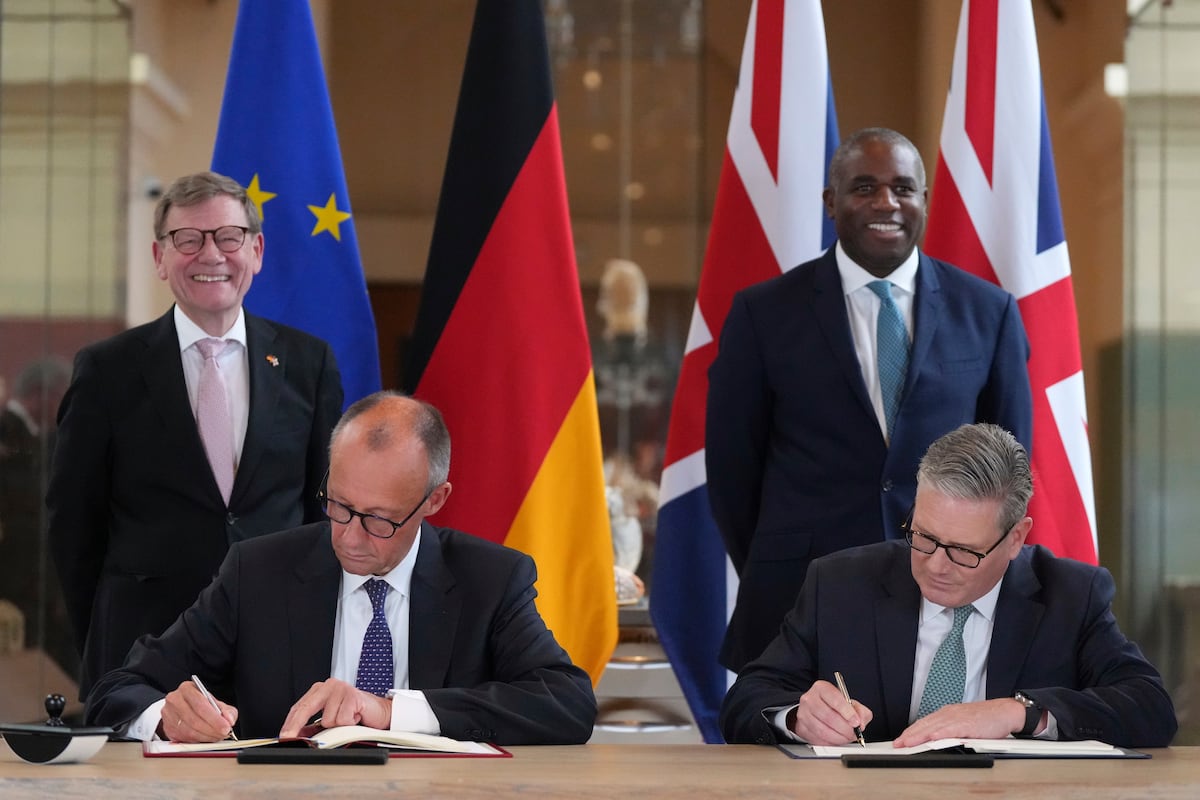
THE HAGUE, Netherlands — Germany and the United Kingdom have signed their first bilateral defense pact since World War II, promising to come to each other’s aid in the case either is attacked and deepening defense integration.
On the sidelines of the signing, the leaders also teased a new phase in the provision of long-range weapons to Ukraine. Shortly thereafter, Russia’s foreign ministry renewed warnings that such a move may be met with military strikes against European countries.
The new bilateral agreement, referred to as the “Kensington Treaty,” was signed on Thursday in London. It includes a broad range of promises, ranging from joint military-industrial exports to facilitating school exchanges between the two countries. It additionally commits the NATO allies to “assist one another, including through military means, in the event of an armed attack on the other.”
Germany’s Chancellor Friedrich Merz called it a “pivotal day for the relations between Germany and Britain.”
He also said that he had spoken with British Prime Minister Keir Starmer about Ukraine’s need for long-range weapons systems.
“Ukraine will soon receive substantial additional support in this area,” Merz told the press.
Both leaders emphasized their continued support for Ukraine in light of Russia’s war against the country.
Just hours later, Russian Foreign Ministry spokeswoman Maria Zakharova repeated earlier warnings that Russia may see itself forced to strike targets in Western Europe if Kyiv receives long-range weapons.
“In the event of further escalation, we will respond decisively and in a tit-for-tat manner,” Tass, a Russian news agency, quoted her as saying with a nod to supposed German plans for providing Kyiv with the Taurus long-range cruise missile. “Russia considers itself entitled to use its weapons against the military facilities of countries that permit the use of their weapons against us.”
The new agreement, formally known as the Treaty of Friendship and Bilateral Cooperation, encompasses 17 projects that the U.K. and Germany will jointly undertake. Among them is the joint development of a deep precision strike weapon capable of hitting targets at ranges of greater than 2,000 kilometers, to be completed within the next decade.
“It will be among the most advanced systems ever designed,” the German government touted in a document.
Berlin and London will also cooperate to address submarine threats in the Northern Seas, to develop vehicles and doctrine for uncrewed aerial systems and to strengthen NATO’s eastern flank.
“The UK and Germany commit to building a much deeper Defense partnership which will endure in the long term,” the German government wrote.
The countries will also pursue joint export initiatives of military products designed to boost international sales of collaboratively produced military equipment, such as the Eurofighter Typhoon jets and Boxer armored vehicles. Germany’s strict rules for arms exports had previously served as a roadblock for some proposed exports, such as the sale of the Eurofighter to Saudi Arabia.
The treaty continues a trend of rapid European defense integration kick-started by Russia’s full-scale invasion of Ukraine in 2022 and turbocharged by President Donald Trump’s return to the White House in Washington. It strengthens the key role of the E3 — Germany, U.K. and France — in Europe’s defense. The U.K. signed a separate, sweeping treaty with France last week , which included the groundwork for a potential European nuclear umbrella.
Linus Höller is Defense News' Europe correspondent and OSINT investigator. He reports on the arms deals, sanctions, and geopolitics shaping Europe and the world. He holds master’s degrees in WMD nonproliferation, terrorism studies, and international relations, and works in four languages: English, German, Russian, and Spanish.
荷兰海牙——德国和英国签署了二战以来的首个双边防务条约,承诺在任何一方遭受攻击时互相援助,并深化防务一体化。
在签字仪式间隙,两国领导人还暗示将进入向乌克兰提供远程武器的新阶段。此后不久,俄罗斯外交部再次警告称,此举可能招致对欧洲国家的军事打击。
这项被称为“肯辛顿条约”的新双边协议于周四在伦敦签署。协议内容广泛,涵盖联合军工出口、促进两国学生交流等诸多方面。此外,协议还承诺北约盟国“在一方遭受武装攻击时,将相互提供援助,包括通过军事手段”。
德国总理弗里德里希·默茨称这是“德英关系的关键一天”。
他还表示,他曾与英国首相基尔·斯塔默谈及乌克兰对远程武器系统的需求。
梅尔茨告诉媒体:“乌克兰很快将在这一领域获得大量额外支持。”
鉴于俄罗斯对乌克兰发动战争,两国领导人都强调将继续支持乌克兰。
几个小时后,俄罗斯外交部发言人玛丽亚·扎哈罗娃重申了早前的警告,称如果基辅获得远程武器,俄罗斯可能会被迫打击西欧目标。
俄罗斯塔斯社援引她的话说:“如果局势进一步升级,我们将采取果断的以牙还牙式回应。”她此番言论似乎意有所指地暗示了德国向基辅提供“金牛座”远程巡航导弹的计划。“俄罗斯认为,如果某个国家允许其武器攻击我们,那么俄罗斯也有权对其军事设施使用武器。”
这项正式名称为《友好与双边合作条约》的新协议涵盖了英国和德国将共同开展的17个项目。其中包括联合研发一种能够打击2000公里以外目标的远程精确打击武器,该项目将在未来十年内完成。
德国政府在一份文件中宣称:“这将是迄今为止设计得最先进的系统之一。”
柏林和伦敦还将合作应对北海的潜艇威胁,开发无人空中系统的飞行器和理论,并加强北约东翼。
德国政府写道:“英国和德国承诺建立更加深入的防务伙伴关系,这种伙伴关系将长期持续下去。”
两国还将推进联合出口军事产品的计划,旨在促进合作生产的军事装备(例如欧洲台风战斗机和拳击手装甲车)的国际销售。德国严格的武器出口规定此前曾阻碍了一些拟议的出口,例如向沙特阿拉伯出售欧洲台风战斗机。
该条约延续了欧洲防务一体化快速发展的趋势,这一趋势始于2022年俄罗斯全面入侵乌克兰,并因唐纳德·特朗普总统重返白宫而加速推进。它强化了“英法三国”(德国、英国和法国)在欧洲防务中的关键作用。英国上周与法国签署了一项单独的、影响深远的条约,其中包括为建立潜在的欧洲核保护伞奠定基础。
林努斯·霍勒是《防务新闻》的欧洲记者和开源情报调查员。他报道影响欧洲乃至全球的军火交易、制裁和地缘政治。他拥有大规模杀伤性武器不扩散、恐怖主义研究和国际关系三个硕士学位,并精通英语、德语、俄语和西班牙语四种语言。