Australia makes another order for Boeing’s Loyal Wingman drones after a successful first flight在波音公司的“忠诚僚机”无人机首飞成功后,澳大利亚再次订购了该型无人机。
The design will also be the basis of one of the U.S. Air Force's Skyborg entrants.
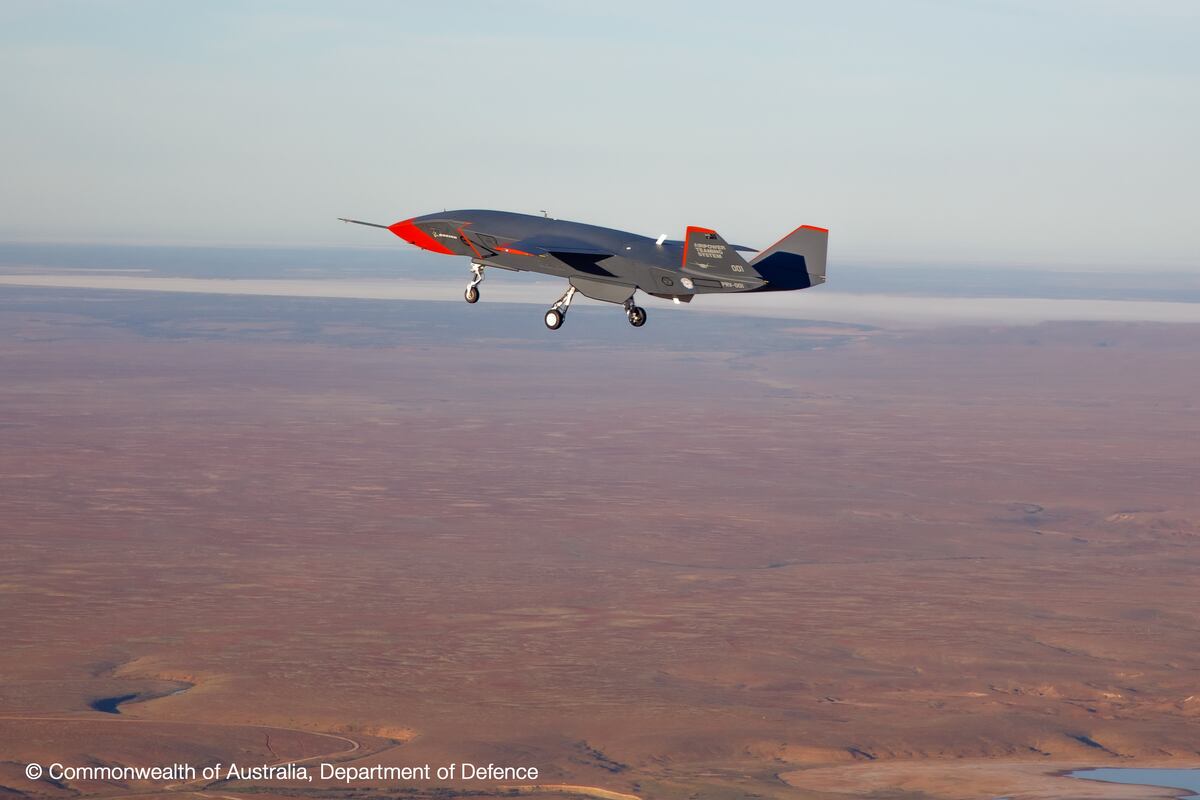
WASHINGTON — The Royal Australian Air Force on Tuesday signed a $115 million contract to buy three more autonomous “Loyal Wingman” drones from Boeing, raising its total order to six aircraft just days after the first system made its inaugural flight.
Following a series of ground tests to validate its navigation and pilot control systems, the first Loyal Wingman — which Boeing also calls the Airpower Teaming System — took flight from Woomera Range Complex in South Australia on Feb. 27, the company announced on Monday.
During the flight, the aircraft followed a preplanned route where the vehicle flew at different speeds and altitudes. The drone was monitored by a Boeing test pilot located on site.
“Most of the interaction by the human is really in mission planning,” said Shane Arnott, Boeing’s ATS program director. “The test pilot was in the loop throughout. He gave commands at each phase, if you will —taxi, takeoff, return … it’s almost as simple as that.”
Eventually, the Loyal Wingman will be able to fly autonomously with manned fighter jets, and may even use artificial intelligence in order to respond to new information on the battlefield. However, for this first flight, testing the drone’s AI capabilities was not a major priority, Arnott said.
In a statement, RAAF Air Vice-Marshal Cath Roberts, Australia’s head of air force capability, called the first flight a significant step forward for the program.
“The Loyal Wingman project is a pathfinder for the integration of autonomous systems and artificial intelligence to create smart human-machine teams,” she said. “Through this project we are learning how to integrate these new capabilities to complement and extend air combat and other missions.”
The Loyal Wingman air vehicle is 38 feet long and has a 24 foot wingspan, with a removable nose that can be packed with mission-specific sensors and other payloads. It can fly at a range in excess of 2,000 nautical miles.
The ATS is the “first military combat aircraft to be designed, engineered and manufactured in Australia in more than 50 years,” according to Boeing. More than 35 Australian companies, including BAE Systems Australia, RUAG Australia, AME Systems and Ferra Engineering, are involved in the production of the aircraft.
Boeing rolled out the first ATS system in May 2020, and has other aircraft in development. Arnott declined to discuss future tests of the system or when the six systems would be delivered to the RAAF.
Soon Australia won’t be the only air force operating the system. The air vehicle also serves as the basis for Boeing’s entrant in the Skyborg program for the U.S. Air Force, said Jerad Hayes, Boeing’s senior director of autonomous aviation and technology.
“We’re leveraging a common core across all of the programs,” Hayes said. What’s different, he added, will be the specific mission equipment — items like communications gear and sensors.
Boeing has multiple payloads in development for different customers, said Arnott, who declined to give further details.
In December, the U.S. Air Force awarded Boeing, General Atomics and Kratos contracts to produce air vehicles for the Skyborg program , which seeks to create a low-cost, artificially intelligent, autonomous drone that can perform missions in contested environments alongside fighter aircraft.
At the time, Boeing received $25.7 million for a two-year period of performance. The Air Force has stated that first prototypes will be received from the vendors no later than May for initial flight experiments beginning in July.
Hayes declined to say whether the aircraft would be delivered by May, but said “the aircraft will be available in time to support the milestone events as part of the Skyborg program.”
Valerie Insinna is Defense News' air warfare reporter. She previously worked the Navy/congressional beats for Defense Daily, which followed almost three years as a staff writer for National Defense Magazine. Prior to that, she worked as an editorial assistant for the Tokyo Shimbun’s Washington bureau.
华盛顿——澳大利亚皇家空军周二签署了一份价值 1.15 亿美元的合同,从波音公司购买三架自主“忠诚僚机”无人机,使其订单总数达到六架,而就在几天前,该系统才进行了首次飞行。
经过一系列地面测试以验证其导航和飞行员控制系统后,波音公司周一宣布,首架“忠诚僚机”(波音公司也称之为“空中力量协同系统”)于 2 月 27 日从南澳大利亚的伍默拉靶场综合体首飞。
飞行过程中,无人机按照预先设定的路线飞行,飞行速度和高度各不相同。现场的波音试飞员对无人机进行了监控。
波音公司ATS项目主管肖恩·阿诺特表示:“人为干预的大部分环节实际上都集中在任务规划上。试飞员全程参与,在每个阶段——滑行、起飞、返航……他都会发出指令,流程几乎就是这么简单。”
最终,“忠诚僚机”无人机将能够与有人驾驶战斗机自主飞行,甚至可能利用人工智能来应对战场上的新信息。然而,阿诺特表示,对于此次首飞而言,测试无人机的人工智能能力并非首要任务。
澳大利亚皇家空军空军副元帅凯瑟琳·罗伯茨(Cath Roberts)在一份声明中称,首次飞行是该计划向前迈出的重要一步。凯瑟琳·罗伯茨是澳大利亚空军能力建设的负责人。
她表示:“‘忠诚僚机’项目是自主系统与人工智能融合,打造智能人机协作团队的先行者。通过这个项目,我们正在学习如何整合这些新技术,以补充和扩展空战及其他任务。”
“忠诚僚机”飞行器长38英尺,翼展24英尺,机头可拆卸,可搭载任务专用传感器和其他有效载荷。其飞行航程超过2000海里。
据波音公司称,ATS是“50多年来首款在澳大利亚设计、研发和制造的军用作战飞机”。包括BAE系统澳大利亚公司、RUAG澳大利亚公司、AME系统公司和Ferra工程公司在内的35多家澳大利亚公司参与了该飞机的生产。
波音公司于2020年5月推出了首套ATS系统,并正在为其他机型研发该系统。阿诺特拒绝透露该系统的未来测试计划,也拒绝透露这六套系统何时交付给澳大利亚皇家空军。
不久之后,澳大利亚将不再是唯一使用该系统的空军。波音公司自主航空与技术高级总监杰拉德·海耶斯表示,该飞行器也是波音公司参与美国空军“天网”(Skyborg)项目竞标的基础。
海耶斯说:“我们正在所有项目中采用一个通用核心技术。” 他补充说,不同之处在于具体的任务设备——例如通信设备和传感器。
阿诺特表示,波音公司正在为不同的客户开发多种有效载荷,但他拒绝透露更多细节。
去年 12 月,美国空军授予波音公司、通用原子公司和克拉托斯公司合同,为 Skyborg 计划生产飞行器。该计划旨在创造一种低成本、人工智能、自主的无人机,使其能够与战斗机一起在对抗环境中执行任务。
当时,波音公司获得了2570万美元的合同,为期两年。空军方面表示,首批原型机最迟将于5月从供应商处交付,并于7月开始进行初步飞行试验。
海耶斯拒绝透露飞机是否会在 5 月份交付,但他表示“飞机将及时到位,以支持 Skyborg 计划的里程碑事件”。
瓦莱丽·因西纳是《防务新闻》的空战记者。此前,她曾在《防务日报》负责海军/国会新闻报道,在此之前,她曾在《国家防务杂志》担任了近三年的专职撰稿人。再之前,她曾在《东京新闻》华盛顿分社担任编辑助理。