Man drove around Singapore with 'SMS blaster' that sent more than 10,000 phishing messages, gets jail男子驾车在新加坡四处行驶,携带“短信群发器”发送超过1万条钓鱼短信,被判入狱
When he visited his sister while the device was in his car, he warned her about phishing messages targeting WhatsApp users.
When he visited his sister while the device was in his car, he warned her about phishing messages targeting WhatsApp users.
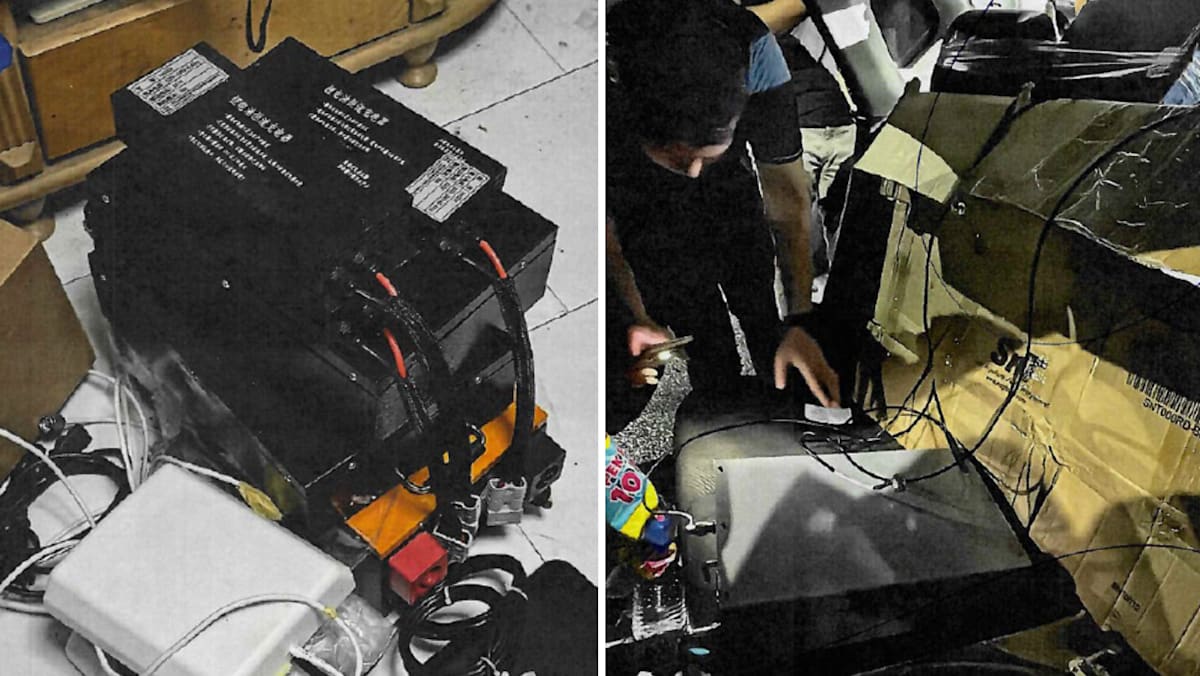
(Left photo) An antennae, small battery packs and charger at a housing unit. (Right photo) A man looking at an SMS blaster device found at the back of Ong Kak Seng's car. (Photos: Court documents)
This audio is generated by an AI tool.
SINGAPORE: A man spent up to 12 hours a day driving around Singapore with a device in his car that sent messages to thousands of nearby mobile phones, believing that he was helping to promote illegal online gambling.
However, the device, known as an SMS blaster, was really transmitting phishing messages intended to trick phone users into providing their WhatsApp login details through a fraudulent webpage. Third parties could then use the information to take over WhatsApp accounts.
Ong Kak Seng, who was heavily in debt, continued doing the job for money after he found out about the scam. He even warned his own sister about phishing messages when he visited her with the SMS blaster in his car.
The device mimicked a mobile network to push messages to phones within its range.
Ong, a 28-year-old Malaysian, was sentenced to one year and nine months' jail and a S$1,500 fine on Monday (Sep 14).
He pleaded guilty to a charge of cheating as part of a criminal conspiracy. He will serve one more week in jail if he fails to pay the fine.
Two other charges were taken into consideration for sentencing. One was for causing a computer to perform a function with the intention of committing an offence, and the other for retaining a device to commit an offence.
Around 2023, Ong first got to know a man called "Bai Ge" while tasked by someone to collect debt repayments from him. The two later became friends.
Two years later, in October 2025, Bai Ge learned that Ong owed unlicensed moneylenders around RM80,000, or S$24,900 (US$19,650). He offered Ong the chance to earn RM1,000 a day.
In exchange, Ong would have to drive around densely populated areas in Singapore or Hong Kong for 10 to 12 hours a day with a device in his car.
Bai Ge also told Ong about a "boss" in China who specialised in operating SMS blasters and disseminating messages through them.
Court documents stated that Ong believed the SMS blaster device would be used to disseminate messages promoting illegal online gambling platforms to people in the vicinity.
He knew the work was illegal because the sum offered by Bai Ge was almost 10 times what legitimate drivers earned in Malaysia.
Ong chose to work in Singapore so that he could use his own car. In Hong Kong, he would have to rent a car, which would eat into his earnings.
He then headed to Bai Ge's home in Malaysia to learn how to assemble an SMS blaster from its components, including batteries, an antenna, wires and remote controls.
On Oct 11, 2025, Ong travelled to Singapore and met someone who handed him the SMS blaster's components. He assembled the device the next day and placed it in the back of his car.
Ong then bought two mobile phones, one of which he used to operate the SMS blaster.
Between Oct 13 and Nov 18, 2025, Ong drove around Singapore for between 10 and 12 hours every day, with the SMS blaster device and components placed at the back of his car.
He hid the blaster by placing a cardboard box over it.
PROTECTED HIS OWN SISTER
After a few days of driving, Ong discovered that the device was transmitting WhatsApp account phishing messages to people in the vicinity.
On Oct 15, 2025, he went to visit his sister in Singapore.
Deputy Public Prosecutor Ong Xin Jie said: "As the accused knew that his sister might receive the WhatsApp account phishing messages transmitted by the SMS blaster device in his motorcar, the accused informed his sister not to visit any webpage on any WhatsApp or text messages that she received.
"The accused did so as he knew the messages transmitted by the SMS blaster device were part of a coordinated effort designed to scam individuals into delivering money to third parties.
"The accused additionally knew that his sister was vulnerable to falling prey to such scams, as she had previously been a victim of a scam."
During his time in Singapore, Ong met another person whom he understood was also driving around Singapore for the same purpose.
MORE THAN 31,000 PHONES WITHIN RANGE
Between October and November 2025, the police received reports of suspicious WhatsApp or text messages. Between Nov 18 and 19, police officers conducted an islandwide operation to apprehend those involved in sending the phishing messages.
Ong was arrested on Nov 18.
His car and lodgings were searched, and the device was seized.
Ong said that he received RM5,000 for his services before he was arrested.
The authorities analysed the contents of the seized SMS blaster device and found that at least 31,820 mobile phones had fallen within its area of coverage, and 10,533 WhatsApp account phishing messages were successfully sent to mobile devices during the period that Ong was operating it.
At least one police report involved a victim who reported a loss of about S$1,800 after being led to transfer money to a bank account controlled by a third party.
SCAM OFFENCES A MAJOR CONCERN
The prosecution sought between 21 and 25 months' jail and a fine of RM5,000, equivalent to the amount that the offender benefited from his crime.
The prosecutor said that the potential for harm was high, referring to the number of WhatsApp phishing messages that were sent, but noted that the actual amount lost from the scams was not high.
"However, we note that there may have been other victims that have not yet come forward," the prosecutor said, adding that the police's advisory on such scams, released on Nov 20, 2025, may have helped in preventing more losses.
He also highlighted the syndicated and transnational nature of the crime as aggravating factors.
Ong had displayed an element of sophistication in assembling and operating the SMS blaster, the prosecution noted.
Scam-related offences remain a "major and fast-growing crime of concern in Singapore", the prosecutor said.
"When members of transnational crime syndicates are apprehended, the appropriate response is the unflinching imposition of appropriately stiff sentences in dealing with transgression."
POTENTIAL HARM, ACTUAL HARM
Ong's lawyer, Ms Claire Chong from law firm Chooi Jing Yen, argued for no more than 18 months' jail.
She said that her client used to work on a farm before entering a pawn-related business in Malaysia. He accrued substantial debts due to gambling.
On the offence, Ms Chong noted that although 10,533 phishing messages were sent, the actual harm identified involved one victim.
"A transmitted message is not equivalent to a completed instance of cheating. Nor does the evidence establish that every transmitted message was received, read, believed or acted upon," Ms Chong said.
"The disparity between the potential and actual harm is therefore stark," she added.
She cautioned against speculating that there could have been other victims who had not stepped forward, as the prosecution had suggested.
"The prosecution cannot introduce new aggravating facts beyond the admitted facts through its submissions on sentence.
"Further, given that the messages were transmitted in October to November 2025, it is highly unlikely that any further victims will come forward now, if they have not already," Ms Chong said.
She also argued that even though the device required some technical knowledge in assembly and operation, Mr Ong had not planned or devised a sophisticated scheme.
"Mr Ong plugged things into a machine and placed this in his car. He covered the SMS blaster device with a cardboard box. All of this was done in accordance with instructions and teaching from Bai Ge. This was not, by any means, sophisticated."
For cheating, Ong could have been jailed for up to 10 years and fined.
Get our pick of top stories and thought-provoking articles in your inbox
Stay updated with notifications for breaking news and our best stories
Join our channel for the top reads for the day on your preferred chat app
当他把设备放在车里去看望姐姐时,他警告姐姐注意针对 WhatsApp 用户的网络钓鱼信息。
(左图)住宅单元内的天线、小型电池组和充电器。(右图)一名男子正在查看在王觉胜(Ong Kak Seng)汽车后部发现的短信群发装置。(图片来源:法庭文件)
这段音频由人工智能工具生成。
新加坡:一名男子每天花长达 12 个小时在新加坡开车,车里装有可以向附近数千部手机发送信息的装置,他认为自己是在帮助推广非法网络赌博。
然而,这种被称为“短信群发器”的设备实际上是在发送钓鱼信息,旨在诱骗手机用户通过虚假网页提供他们的 WhatsApp 登录信息。第三方随后可以利用这些信息接管 WhatsApp 帐户。
身负巨债的翁觉胜在发现骗局后,为了赚钱仍然继续做这份工作。他甚至在去看望妹妹时,用车里的短信群发器提醒她提防网络钓鱼短信。
该设备模拟移动网络,向其覆盖范围内的手机推送消息。
28岁的马来西亚人翁某于周一(9月14日)被判处一年零九个月监禁和1500新元罚款。
他承认犯有欺诈罪,该罪名是参与刑事共谋。如果他未能缴纳罚款,他将在监狱中再服刑一周。
量刑时还考虑了另外两项指控。一项指控是故意使计算机执行某种功能以实施犯罪,另一项指控是持有用于实施犯罪的设备。
大约在2023年,翁受人委托向一个名叫“白哥”的男子讨债,由此结识了他。两人后来成为了朋友。
两年后,即2025年10月,白哥得知翁欠无牌放贷人约8万令吉,约合2.49万新元(1.965万美元)。他给翁提供了一个每天赚取1000令吉的机会。
作为交换,翁每天需要驾车在新加坡或香港人口稠密的地区行驶 10 到 12 个小时,车里必须装有监控设备。
白歌还告诉翁,中国有个“老板”专门运营短信群发器,通过这些短信群发器传播信息。
法庭文件显示,翁认为该短信群发设备将被用来向附近的人散布宣传非法网络赌博平台的短信。
他知道这份工作是非法的,因为白哥提供的报酬几乎是马来西亚合法司机收入的 10 倍。
Ong选择在新加坡工作,就是为了能用自己的车。在香港,他得租车,这会减少他的收入。
然后他前往马来西亚,拜访白哥的家,学习如何用电池、天线、电线和遥控器等部件组装短信群发器。
2025年10月11日,翁前往新加坡,与人见面后获得了短信群发器的组件。第二天,他组装好该设备并将其放在汽车后备箱中。
随后,翁购买了两部手机,其中一部用来操作短信群发器。
2025 年 10 月 13 日至 11 月 18 日期间,翁每天驾车在新加坡行驶 10 至 12 小时,并将短信群发装置和组件放置在车后。
他用纸箱盖住爆能枪,把它藏了起来。
他保护了自己的妹妹
经过几天的驾驶,翁发现该设备正在向附近的人发送 WhatsApp 帐户钓鱼信息。
2025年10月15日,他去新加坡探望他的姐姐。
副检察官王欣杰表示:“被告知道他的妹妹可能会收到他车内短信群发设备发送的WhatsApp账户钓鱼信息,因此被告告知他的妹妹不要访问她收到的任何WhatsApp或短信中的任何网页。
“被告人明知通过短信群发设备发送的信息是旨在诈骗个人向第三方汇款的协同犯罪活动的一部分,却仍然这样做。”
“被告还知道他的妹妹很容易成为此类骗局的受害者,因为她之前就曾是骗局的受害者。”
在新加坡期间,翁遇到了另一个人,他了解到此人也在新加坡四处驾车,目的相同。
信号范围内有超过31000部手机
2025年10月至11月期间,警方接到多起关于可疑WhatsApp或短信的举报。11月18日至19日,警方在全岛范围内开展行动,抓捕参与发送钓鱼信息的嫌疑人。
Ong于11月18日被捕。
他的汽车和住所被搜查,该装置被缴获。
Ong表示,他在被捕前收到了5000令吉的报酬。
当局分析了缴获的短信群发设备的内容,发现至少有 31,820 部手机在其覆盖范围内,并且在 Ong 操作该设备期间,成功向移动设备发送了 10,533 条 WhatsApp 帐户钓鱼信息。
至少有一份警方报告称,一名受害者被诱骗将钱款转入第三方控制的银行账户,损失了约 1800 新元。
诈骗犯罪是一个重大问题
检方要求判处 21 至 25 个月监禁,并处罚款 5000 令吉,相当于罪犯从犯罪中获利的金额。
检察官表示,考虑到发送的 WhatsApp 网络钓鱼信息数量,潜在的危害很大,但他指出,诈骗造成的实际损失金额并不高。
“然而,我们注意到可能还有其他受害者尚未站出来,”检察官说,并补充说,警方于 2025 年 11 月 20 日发布的关于此类诈骗的警示可能有助于防止更多损失。
他还强调了犯罪的集团性和跨国性,认为这是加重情节的因素。
检方指出,翁某在组装和操作短信群发器方面表现出了一定的老练程度。
检察官表示,诈骗相关犯罪仍然是“新加坡一个主要且快速增长的令人担忧的犯罪”。
“当跨国犯罪集团成员被抓获时,恰当的回应是毫不动摇地对其违法行为处以适当的严厉刑罚。”
潜在危害,实际危害
Ong的律师,来自Chooi Jing Yen律师事务所的Claire Chong女士,辩称应判处不超过18个月的监禁。
她说,她的客户在马来西亚从事典当行业之前曾在农场工作。他因赌博而欠下巨额债务。
关于这起犯罪事件,钟女士指出,虽然发送了 10,533 条网络钓鱼信息,但实际造成的损害只涉及一名受害者。
“发送信息并不等同于作弊行为的完成。证据也无法证明每条发送的信息都被接收、阅读、相信或采取了行动,”钟女士说。
“因此,潜在危害与实际危害之间的差距非常明显,”她补充道。
她告诫人们不要像检方所暗示的那样,猜测可能还有其他受害者没有站出来。
“控方不能在量刑陈述中提出除已承认的事实之外的新加重情节。”
“此外,鉴于这些信息是在 2025 年 10 月至 11 月期间发送的,即使现在还没有受害者站出来,现在也不太可能再有受害者站出来了,”钟女士说。
她还辩称,尽管该装置在组装和操作上需要一些技术知识,但翁先生并没有计划或设计复杂的方案。
“翁先生把东西插到一台机器上,然后把机器放在车里。他用纸箱盖住了短信群发装置。所有这些都是按照白哥的指示和教诲完成的。这绝非什么高明的做法。”
如果犯了欺诈罪,翁某可能被判处最高 10 年监禁并处罚款。
订阅我们的邮件,即可获取精选热点新闻和引人深思的文章。
订阅通知,第一时间获取突发新闻和精彩报道。
加入我们的频道,即可在您常用的聊天应用上获取当日热门文章。