Singapore approaching nuclear energy with 'open mind' but mindful of constraints: Grace Fu新加坡以“开放心态”对待核能,但也关注其局限性:傅海燕
Any decision will weigh safety, environmental sustainability, economic viability and public confidence, among other considerations, says the Minister for Sustainability and the Environment.
Any decision will weigh safety, environmental sustainability, economic viability and public confidence, among other considerations, says the Minister for Sustainability and the Environment.
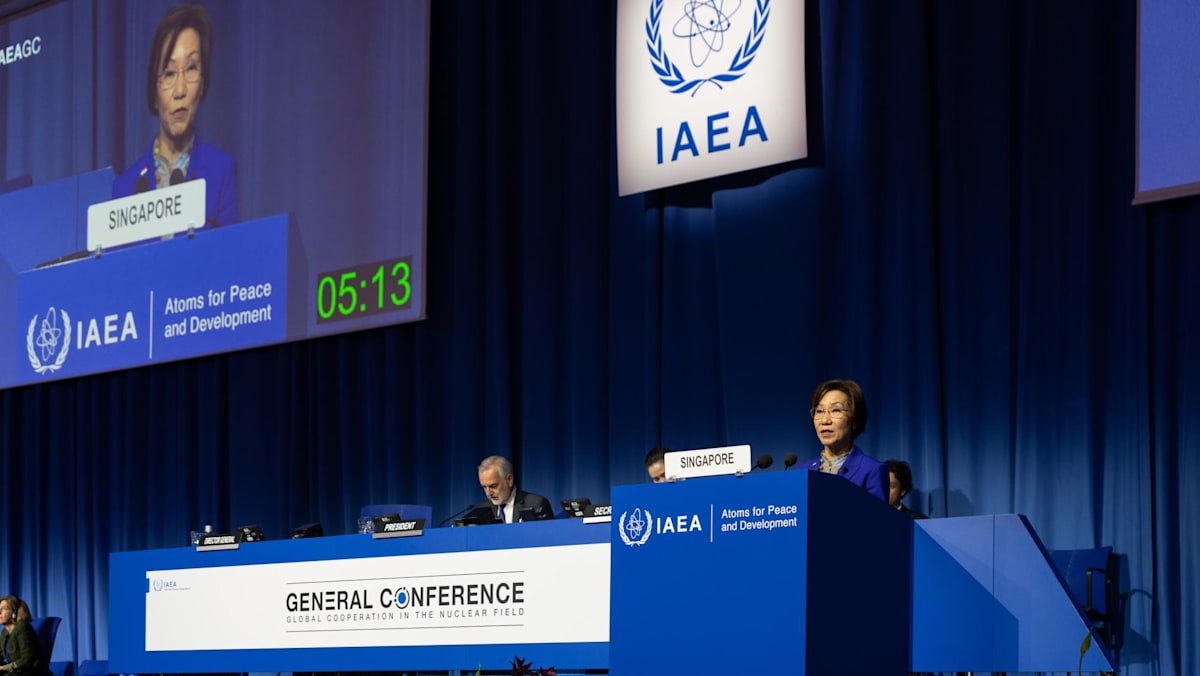
Minister for Sustainability and the Environment and Minister-in-charge of Trade Relations Grace Fu delivers Singapore's National Statement on Sep 14, 2026, at the 70th IAEA General Conference in Vienna, Austria. (Photo: Ministry of Sustainability and the Environment)
This audio is generated by an AI tool.
SINGAPORE: Singapore is approaching nuclear energy with an open mind while recognising its constraints as a small and densely populated city-state , the Minister for Sustainability and the Environment Grace Fu said on Monday (Sep 14).
Representing Singapore at the International Atomic Energy Agency (IAEA) General Conference in Vienna, Ms Fu said the country, in looking at possible pathways to meet its long-term climate and energy goals, is studying whether nuclear energy could be viable and is building its capabilities to assess advanced nuclear technologies, including small modular reactors.
"We approach this with an open mind, but also with a clear recognition of our circumstances as a small, densely populated, and alternative energy disadvantaged city-state," she said.
Ms Fu said the country’s approach will be "deliberate, structured, and rigorous", with assessments covering nuclear safety, security and safeguards, environmental sustainability, economic viability, public confidence and Singapore's international obligations.
CNA Games Guess Word Crack the word, one row at a time Buzzword Create words using the given letters Mini Sudoku Tiny puzzle, mighty brain teaser Mini Crossword Small grid, big challenge Word Search Spot as many words as you can Show More Show Less Before any decision is made, Singapore must have the scientific, technical, institutional and regulatory capabilities needed to evaluate reactor technologies objectively, she said. To that end, Singapore is steadily developing these capabilities across government, research institutions and its regulatory system, while also strengthening cooperation with nuclear regulators and international partners to learn from their approaches to governance, regulation and safety. As part of this process, Singapore will embark on the first of three phases of a nuclear readiness review - known as an Integrated Nuclear Infrastructure Review (INIR) with the IAEA in 2027. The review will allow Singapore to benchmark its capabilities against the IAEA's milestones approach, assess the country’s readiness to make an informed decision on deploying nuclear energy, and identify areas that require further development.
Before any decision is made, Singapore must have the scientific, technical, institutional and regulatory capabilities needed to evaluate reactor technologies objectively, she said.
To that end, Singapore is steadily developing these capabilities across government, research institutions and its regulatory system, while also strengthening cooperation with nuclear regulators and international partners to learn from their approaches to governance, regulation and safety.
As part of this process, Singapore will embark on the first of three phases of a nuclear readiness review - known as an Integrated Nuclear Infrastructure Review (INIR) with the IAEA in 2027.
The review will allow Singapore to benchmark its capabilities against the IAEA's milestones approach, assess the country’s readiness to make an informed decision on deploying nuclear energy, and identify areas that require further development.
"The INIR mission is not a commitment to adopt nuclear energy. But it is a way to help determine whether Singapore has the expertise, institutions, and frameworks to make an informed decision," said Ms Fu, who is also Minister-in-charge of Trade Relations.
She said regional cooperation would become more important as interest in nuclear energy and other nuclear applications grows across Southeast Asia.
As such, Singapore will work with ASEAN member states and the IAEA to strengthen emergency preparedness and response, put regional protocols into operation, expand radiation monitoring networks and information-sharing arrangements, and conduct readiness exercises.
“These efforts build confidence, improve coordination, and strengthen the region's ability to respond to a nuclear or radiological emergency,” said Ms Fu, adding that Singapore welcomes the strengthening of regional cooperation through the proposed ASEAN-IAEA strategic partnership on nuclear energy, safety, and governance.
Beyond its consideration of nuclear energy, Singapore believes that building human capital, institutional capabilities and technical expertise is essential for the effective and sustainable application of nuclear science and technology, Ms Fu said.
It has partnered with the IAEA since 2000 through the Singapore-IAEA Third Country Training Programme to share expertise and strengthen capabilities in the region in areas including nuclear medicine, radiotherapy, radiation protection, accelerator applications, radiochemistry, environmental monitoring and climate-related measurements.
“We are a long-standing supporter of the Technical Cooperation Programme in helping member states harness nuclear science and technology for development,” said Ms Fu.
“We have once again pledged our full TC Fund target share for 2027. We urge all member states to pay their contributions in full and on time.”
Ms Fu said Singapore remains “gravely concerned” over nuclear safety and security amid conflicts in Ukraine and the Middle East.
“Any attack on nuclear power plants will pose significant and undeniable risks to nuclear safety,” she said.
“We urge all parties to respect the seven indispensable pillars and refrain from actions that could compromise nuclear safety and security of nuclear energy facilities devoted to peaceful purposes.”
Singapore also remains concerned by " unresolved issues surrounding Iran’s compliance " with its legally binding safeguards obligations, Ms Fu said, adding that any nuclear material not accounted for presents a proliferation risk.
She said that Singapore also continues to be concerned by North Korea’s " unconstrained development of its nuclear weapons and ballistic missile programmes", given the considerable risks these pose to regional and global peace, security, and stability.
As Singapore assumes the ASEAN chairmanship in January 2027, the country looks forward to working with other ASEAN member states and the IAEA to strengthen regional and international cooperation on the safe, secure and peaceful uses of nuclear technology, said Ms Fu.
Get our pick of top stories and thought-provoking articles in your inbox
Stay updated with notifications for breaking news and our best stories
Join our channel for the top reads for the day on your preferred chat app
可持续发展和环境部长表示,任何决定都将权衡安全、环境可持续性、经济可行性和公众信心等因素。
2026年9月14日,新加坡永续及环境部长兼贸易关系主管部长傅海燕在奥地利维也纳举行的国际原子能机构第70届大会上宣读新加坡国家声明。(图片:新加坡永续及环境部)
这段音频由人工智能工具生成。
新加坡:新加坡永续发展及环境部长傅海燕周一(9月14日)表示,新加坡正以开放的心态对待核能,同时也认识到作为一个人口稠密的小城邦国家所面临的限制。
傅女士代表新加坡出席在维也纳举行的国际原子能机构(IAEA)大会时表示,新加坡正在研究实现其长期气候和能源目标的可能途径,包括核能是否可行,并正在提升自身能力以评估包括小型模块化反应堆在内的先进核技术。
“我们以开放的心态来对待这件事,但同时也清楚地认识到我们作为一个小型、人口稠密、替代能源匮乏的城邦国家的处境,”她说。
傅女士表示,新加坡将采取“深思熟虑、有条不紊、严谨”的方式,评估内容将涵盖核安全、安保和保障措施、环境可持续性、经济可行性、公众信心以及新加坡的国际义务。
CNA游戏 猜词游戏 逐行破解单词 流行词游戏 用给定的字母组成单词 迷你数独 小谜题,脑力挑战 迷你填字游戏 小方格,大挑战 单词搜索 尽可能多地找出单词 显示更多 显示更少 她表示,在做出任何决定之前,新加坡必须具备客观评估反应堆技术所需的科学、技术、机构和监管能力。为此,新加坡正在政府、研究机构和监管体系中稳步发展这些能力,同时加强与核监管机构和国际伙伴的合作,学习他们在治理、监管和安全方面的经验。作为这一进程的一部分,新加坡将于2027年启动与国际原子能机构(IAEA)合作的核准备审查的第一阶段——即综合核基础设施审查(INIR)。此次审查将使新加坡能够根据国际原子能机构的里程碑方法评估自身能力,评估该国在部署核能方面做出明智决策的准备情况,并确定需要进一步发展的领域。
她表示,在做出任何决定之前,新加坡必须具备客观评估反应堆技术所需的科学、技术、制度和监管能力。
为此,新加坡正在政府、研究机构和监管体系中稳步发展这些能力,同时加强与核监管机构和国际伙伴的合作,以学习他们在治理、监管和安全方面的做法。
作为这一进程的一部分,新加坡将于 2027 年与国际原子能机构 (IAEA) 启动核准备审查(即综合核基础设施审查 (INIR))的三个阶段中的第一阶段。
此次审查将使新加坡能够根据国际原子能机构的里程碑方法对其能力进行基准测试,评估该国在部署核能方面做出明智决定的准备情况,并确定需要进一步发展的领域。
“INIR任务并非承诺采用核能。而是为了帮助确定新加坡是否具备做出明智决策所需的专业知识、机构和框架,”傅女士说道,她同时也是主管贸易关系的部长。
她表示,随着东南亚地区对核能和其他核应用领域的兴趣日益浓厚,区域合作将变得越来越重要。
因此,新加坡将与东盟成员国和国际原子能机构合作,加强应急准备和响应,实施区域协议,扩大辐射监测网络和信息共享安排,并开展准备演习。
傅女士表示:“这些努力有助于建立信心,改善协调,并增强该地区应对核或放射性紧急情况的能力。”她还补充说,新加坡欢迎通过拟议的东盟-国际原子能机构核能、安全和治理战略伙伴关系来加强区域合作。
傅女士表示,除了考虑核能之外,新加坡认为,建设人力资本、机构能力和技术专长对于有效和可持续地应用核科学技术至关重要。
自 2000 年以来,新加坡一直通过新加坡-国际原子能机构第三国培训计划与国际原子能机构合作,分享专业知识,加强该地区在核医学、放射疗法、辐射防护、加速器应用、放射化学、环境监测和气候相关测量等领域的能力。
傅女士说:“我们长期以来一直支持技术合作计划,帮助成员国利用核科学和技术促进发展。”
“我们再次承诺履行2027年TC基金的全部目标份额。我们敦促所有成员国按时足额缴纳会费。”
傅女士表示,鉴于乌克兰和中东的冲突,新加坡仍然“严重关切”核安全问题。
“任何对核电站的袭击都会对核安全构成重大且不容否认的风险,”她说。
“我们敦促各方尊重七项不可或缺的支柱,避免采取任何可能损害用于和平目的的核能设施的核安全和安保的行动。”
傅女士表示,新加坡仍然对伊朗遵守其具有法律约束力的保障监督义务方面“尚未解决的问题”表示关切,并补充说,任何未被清点的核材料都构成扩散风险。
她表示,鉴于朝鲜“不受约束地发展核武器和弹道导弹计划”对地区和全球和平、安全与稳定构成巨大风险,新加坡仍然对此表示关切。
傅女士表示,新加坡将于2027年1月担任东盟轮值主席国,期待与其他东盟成员国和国际原子能机构合作,加强在安全、可靠和和平利用核技术方面的区域和国际合作。
订阅我们的邮件,即可获取精选热点新闻和引人深思的文章。
订阅通知,第一时间获取突发新闻和精彩报道。
加入我们的频道,即可在您常用的聊天应用上获取当日热门文章。