Half-priced beers and discounted tea: Retailers slash prices on drinks without Return Right logo啤酒半价,茶饮打折:零售商大幅降低没有“退货权”标志的饮品价格
From Oct 1, it is an offence to sell beverages without the requisite logo. Read more at straitstimes.com.
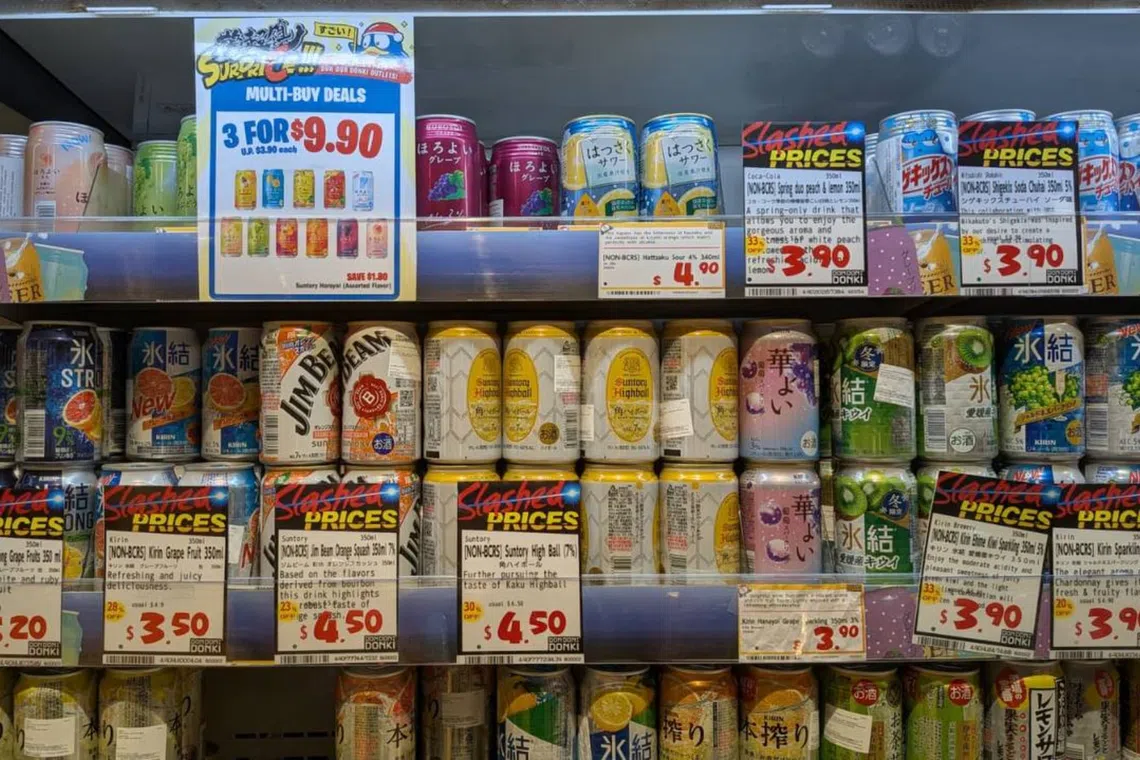
Japanese retail chain Don Don Donki was observed to be offering discounts for drinks labelled “non-BCRS” at at least two outlets including the outlet at 100AM mall in Tanjong Pagar.
Published Sep 15, 2026, 03:35 PM
Updated Sep 15, 2026, 03:35 PM
Some retailers are offering discounts of up to 50% on drink containers without the required Return Right logo ahead of the Beverage Container Return Scheme (BCRS) implementation on Oct 1.
The BCRS mandates a 10-cent deposit on plastic bottles and cans from 500ml to 3 litres, refundable via reverse vending machines; non-compliance after Sept 30 risks fines and jail.
Retailers and distributors like Don Don Donki and Watering Hole are clearing old stock with markdowns and special measures.
SINGAPORE – With over two weeks to go before the full implementation of the Beverage Container Return Scheme (BCRS), some retailers and distributors here are selling drink containers that do not carry the requisite return right logo at discounts of up to 50 per cent.
Under the scheme, all plastic bottles and cans from 150ml to three litres must be labelled with the 10-cent deposit mark from Oct 1, or they cannot be sold.
Customers pay an extra 10 cents for each drink purchased under the scheme , but get the money back when they drop the used containers into a reverse vending machine, also called a Return Right machine.
Over 1,000 machines became operational from April 1, 2026 , but the National Environment Agency (NEA) administering the scheme gave producers and retailers an extra six months to clear old stock. The transition period ends on Sept 30.
From Oct 1, it will be an offence for anyone, including supermarket operators, to supply any regulated beverages, if the beverage container is not affixed with the scheme’s deposit mark and a barcode.
Under the Resource Sustainability Act, those found guilty can face fines of up to $10,000 and/or up to three months’ jail.
Japanese retail chain Don Don Donki was observed to be offering discounts for drinks labelled “non-BCRS” at at least two outlets, at 100AM mall in Tanjong Pagar and Clarke Quay Central.
There were at least 25 alcoholic products being sold at the 100AM Mall outlet during ST checks on Sept 14, with discounts ranging from 20 per cent to 34 per cent. Don Don Donki declined to comment.
K-Market’s assistant manager for Mart Team Samuel Lee said the Korean specialty grocery chain has 3,258 non-labelled beverage containers across nine outlets as at Sept 14.
He added that it will use selected markdowns, prominent displays and stock transfers between outlets based on demand, to clear its remaining products. The company has also stopped replenishing affected products.
K-Market, or Koryo Market, has outlets across Singapore including Bukit Timah, Compass One and Parkway Parade.
Selling the remaining quantity is manageable, said Lee. But he noted that some beverages imported from Korea are niche products with slower or uneven demand across outlets.
From Oct 1, it will be an offence for anyone, including supermarket operators, to supply any regulated beverages, if the beverage container is not affixed with the scheme’s deposit mark and a barcode. PHOTO: NEA
He added that they are monitoring the inventory instead of applying the same clearance measure to every product.
“Our objective is to clear the affected stock during the transition period. Any regulated non-labelled products remaining after 30 September will be withdrawn from sale,” said Lee.
Meanwhile, beer distribution company Watering Hole sold 1,500 beer cans at half price over the past two weeks.
Its founder Lim Jialiang said he still has non-labelled products in his inventory but he will stagger the sales to “avoid overwhelming the market”.
“Unfortunately, there are very little avenues beyond clearance sales as the product can’t be sold from Oct 1,” he said.
Besides selling non-labelled containers at discounted prices, Watering Hole’s Lim said the transition period has also been difficult due to the technical requirements needed to meet the new packaging standards and coordinating with suppliers abroad.
He had purchased a labelling machine that cost $10,000 to apply stickers on products that are being imported without the BCRS-approved labels, instead of relying on manpower.
This sticker option is available for producers who are unable to print the deposit mark or new barcode directly on their product packaging.
At Cold Storage Singapore, clearance sales may be used selectively, depending on the remaining quantities, product shelf life and commercial arrangements with suppliers, said the spokesperson of Cold Storage and Giant.
Currently, there are about 5,000 non-labelled containers across Giant and Cold Storage stores, the spokesperson said.
“Our priority is to sell the remaining non-labelled stock responsibly before the deadline,” said the spokesperson, adding that some of the measures it has implemented or is considering include returning eligible stock to suppliers and re-allocating stock to stores with stronger sales demand.
There may also be operational challenges in accurately identifying and segregating labelled and non-labelled stock, particularly where both versions of the same product are present, said the Cold Storage and Giant spokesperson.
FairPrice Group is making good progress in its preparations for the scheme, said its spokesperson.
“We are working closely with our suppliers to transition to BCRS-compliant products and manage existing inventory, while ensuring a smooth implementation for our customers and partners,” the spokesperson added.
The Straits Times has contacted Prime Supermarket and Sheng Siong for more information.
Additional reporting by Ang Qing
Chin Hui Shan is a journalist covering the environment beat at The Straits Times.
Food and beverage sector
National Environment Agency
据观察,日本零售连锁店唐吉诃德(Don Don Donki)在至少两家门店(包括丹戎巴葛 100AM 购物中心的门店)对标有“非 BCRS”字样的饮料提供折扣。
发布于 2026 年 9 月 15 日下午 3:35
更新于2026年9月15日下午3:35
在 10 月 1 日饮料容器回收计划 (BCRS) 实施之前,一些零售商对没有必需的“退货权”标志的饮料容器提供高达 50% 的折扣。
BCRS 规定,500 毫升至 3 升的塑料瓶和易拉罐需缴纳 10 分的押金,可通过自动售货机退还押金;9 月 30 日之后不遵守规定者将面临罚款和监禁。
像唐吉诃德和水坑这样的零售商和分销商正在通过降价和特殊措施清理旧库存。
新加坡——距离饮料容器回收计划(BCRS)全面实施还有两周多的时间,一些零售商和分销商正在以高达 50% 的折扣出售没有必要回收标志的饮料容器。
根据该计划,从 10 月 1 日起,所有 150 毫升至 3 升的塑料瓶和罐都必须贴上 10 分的押金标签,否则将不能出售。
根据该计划,顾客每购买一杯饮料需额外支付 10 美分,但当他们将用过的容器投入反向自动售货机(也称为退货机)时,即可取回这笔钱。
超过1000台机器将于2026年4月1日投入使用,但负责管理该计划的国家环境局(NEA)给予生产商和零售商额外六个月的时间来清理旧库存。过渡期将于9月30日结束。
从 10 月 1 日起,任何人(包括超市经营者)供应任何受管制饮料,如果饮料容器上没有贴有该计划的押金标记和条形码,都将构成违法行为。
根据《资源可持续性法》,被判有罪者可面临最高 10,000 美元的罚款和/或最高三个月的监禁。
据观察,日本零售连锁店唐吉诃德(Don Don Donki)在至少两家门店(丹戎巴葛 100AM 购物中心和克拉码头中心)对标有“非 BCRS”字样的饮料提供折扣。
9月14日,《海峡时报》记者在100AM购物中心门店进行检查时发现,至少有25种酒精饮品在售,折扣力度从20%到34%不等。唐吉诃德公司拒绝置评。
K-Market 超市团队助理经理 Samuel Lee 表示,截至 9 月 14 日,这家韩国特色食品连锁店在九家门店共有 3,258 个未贴标签的饮料容器。
他还补充说,公司将根据需求,通过部分降价、醒目陈列和门店间库存调拨等方式清理剩余产品。公司也已停止补货受影响的产品。
K-Market(高丽市场)在新加坡各地设有分店,包括武吉知马、Compass One 和百汇广场。
李先生表示,剩余货源的销售尚可控制。但他指出,一些从韩国进口的饮料属于小众产品,在不同销售点的需求增长缓慢或不均衡。
自10月1日起,任何人,包括超市经营者,如果供应的受管制饮料容器未贴有该计划的押金标记和条形码,均属违法行为。图片:国家环境局
他还补充说,他们正在监控库存,而不是对所有产品都采取同样的清仓措施。
李表示:“我们的目标是在过渡期内清理受影响的库存。9月30日之后,任何剩余的未贴标签的管制产品都将停止销售。”
与此同时,啤酒分销公司 Watering Hole 在过去两周内以半价售出了 1500 罐啤酒。
其创始人林嘉良表示,他的库存中仍然有一些未贴标签的产品,但他会分批销售,以“避免市场供过于求”。
“不幸的是,除了清仓甩卖之外,几乎没有其他办法,因为该产品从10月1日起就不能销售了,”他说。
除了以折扣价出售无标签容器外,Watering Hole 的 Lim 表示,过渡期也十分困难,因为需要满足新的包装标准的技术要求,并且需要与国外供应商协调。
他购买了一台价值 10,000 美元的贴标机,用于给没有 BCRS 认证标签的进口产品贴上标签,而不是依靠人力。
对于无法直接在产品包装上打印押金标记或新条形码的生产商,可以选择这种贴纸方式。
新加坡冷藏公司和巨人超市的发言人表示,根据剩余数量、产品保质期以及与供应商的商业安排,可能会有选择地进行清仓促销。
发言人表示,目前 Giant 和 Cold Storage 商店里大约有 5000 个未贴标签的容器。
发言人表示:“我们的首要任务是在截止日期前负责任地售出剩余的无标签库存。”他还补充说,公司已经实施或正在考虑的一些措施包括将符合条件的库存退还给供应商,并将库存重新分配给销售需求更强劲的商店。
冷藏公司和 Giant 的发言人表示,准确识别和区分贴标和不贴标的库存也可能面临操作上的挑战,尤其是在同一产品的两种版本同时存在的情况下。
平价医疗集团发言人表示,该集团在筹备该计划方面进展顺利。
发言人补充说:“我们正在与供应商密切合作,过渡到符合 BCRS 标准的产品并管理现有库存,同时确保为我们的客户和合作伙伴顺利实施。”
《海峡时报》已联系Prime超市和昇菘超市以获取更多信息。
昂青补充报道
Chin Hui Shan是《海峡时报》负责环境报道的记者。
食品和饮料行业
国家环境局