UK defense chief muses about replicating cluster munitions’ edge英国国防部长考虑复制集束弹药的优势
Militaries previously used the weapons to destroy adversary airfields, a task now faced by Ukraine, said Defence Secretary Ben Wallace.
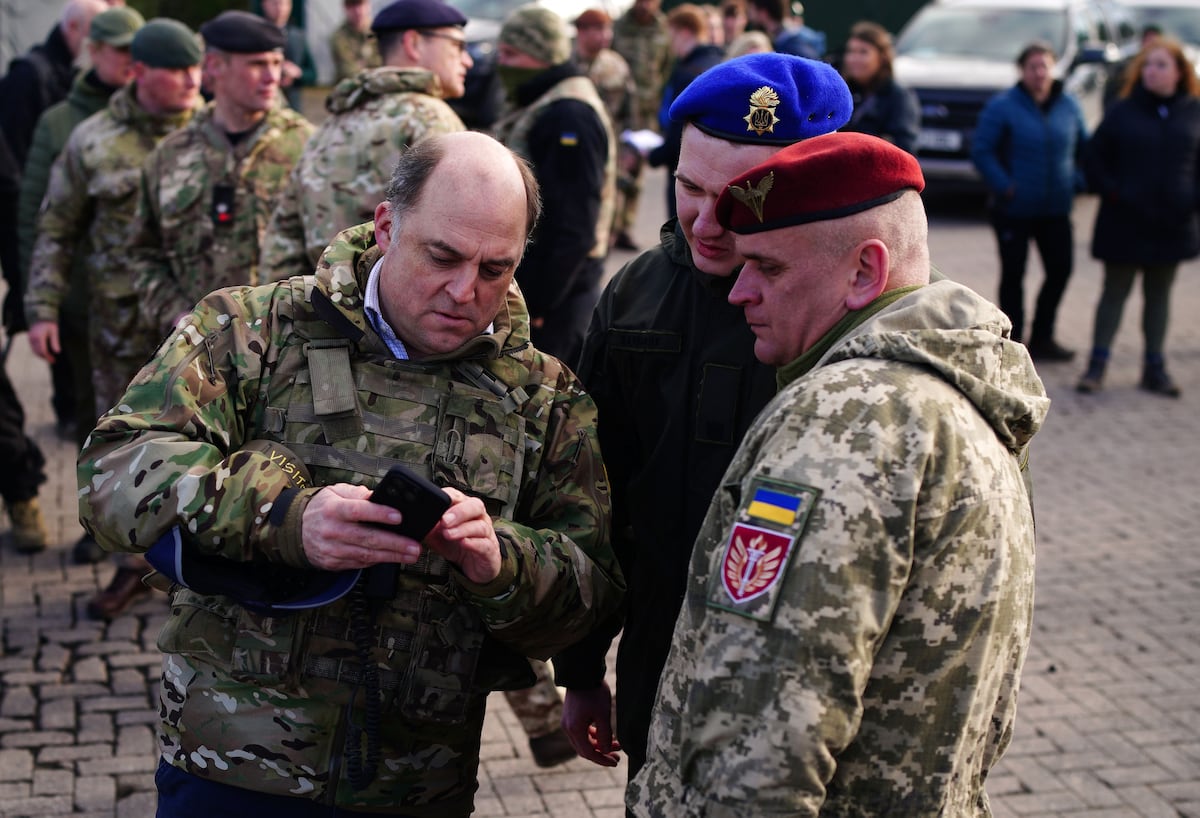
MILAN and COLOGNE, Germany — The debate over U.S. cluster munition deliveries to Ukraine has ignited a fresh look in the British military at a capability that has faded along with their banning: the destruction of enemy airfields.
That is according to the U.K. Defence Minister Ben Wallace, who was speaking at a side event of the NATO summit in Vilnius, Lithuania, on July 12.
Wallace said he wants British industry to come up with an alternative to achieve the same destructive effects, albeit without the danger of unexploded ordnance left behind by the types of submunition-laden shells that the United States is giving to Ukraine .
“One challenge to our industry is, we see the Ukrainians struggle to shut down runways,” he said at the NATO Public Forum, an event organized by a smattering of think tanks from both sides of the Atlantic. “So what I have got in my weapons stock, should we find ourselves in a conflict where I need to do this? It goes back to: If you can’t use cluster munitions, you need to innovate and come up with something else,” Wallace said.
An international convention bans the production, use and transfer of cluster munitions because of the risks they pose to civilians even long after wars end. The United States and Ukraine are not a signatory to that treaty, and neither is Russia, whose forces have reportedly clusters munitions “and even worse,” as Dutch Defense Minister Kajsa Ollongren, who was speaking alongside Wallace at the event in Vilnius, put it.
There is a history of militaries developing munitions, mostly in the 1970s, specifically aimed at damaging enemy runways so comprehensively that any repairs would take a long time. Such strikes would effectively keep valuable adversary warplanes off the battlefield, the thinking went.
British forces used to have the so-called JP233 submunition dispensing pods, for example, notes Mark Cancian, an analyst at the Washington-based Center for Strategic and International Studies. Strapped under warplanes, the weapons were designed to blanket runways with hundreds of exploding bomblets.
A French-designed weapon, the Durandal, consisted of a warhead plowing underneath the tarmac to deliver a series of explosions aimed mangling a runway’s foundation, according to Cancian.
Defense experts believe there are several methods today that could deliver a wider area of destructive coverage without the design constraints of cluster munitions: the saturation of target areas with conventional, air-burst munitions, or by sending swarms of cheap drones.
“A swarm of 1,000 mini drone-copters could cover a very large area, especially if launched via a GMLRS rocket,” said Nicholas Drummond, an adviser to Krauss-Maffei Wegmann in the U.K., referring to the Guided Multiple Launch Rocket System.
Elisabeth Gosselin-Malo was a Europe correspondent for Defense News. She covers a wide range of topics related to military procurement and international security, and specializes in reporting on the aviation sector. She is based in Milan, Italy.
Sebastian Sprenger is associate editor for Europe at Defense News, reporting on the state of the defense market in the region, and on U.S.-Europe cooperation and multi-national investments in defense and global security. Previously he served as managing editor for Defense News. He is based in Cologne, Germany.
米兰和德国科隆——关于美国向乌克兰交付集束弹药的争论,引发了英国军方对一种随着集束弹药禁令而逐渐消失的能力的重新审视:摧毁敌方机场。
这是英国国防大臣本·华莱士在7月12日于立陶宛维尔纽斯举行的北约峰会边会上发表的讲话。
华莱士表示,他希望英国工业界能够找到一种替代方案,以达到同样的破坏效果,但又不会像美国向乌克兰提供的那种装有子弹药的炮弹那样,留下未爆炸的弹药。
“我们行业面临的一个挑战是,我们看到乌克兰在关闭跑道方面举步维艰,”他在北约公共论坛上说道。该论坛由大西洋两岸的一些智库联合举办。“那么,如果我发现自己身处需要使用这些武器的冲突之中,我现有的武器储备又能派上用场吗?归根结底,如果你不能使用集束弹药,你就需要创新,想出其他办法,”华莱士说道。
一项国际公约禁止生产、使用和转让集束弹药,因为即使在战争结束后很久,它们仍然会对平民构成威胁。美国和乌克兰并非该条约的缔约国,俄罗斯也不是。据报道,俄罗斯军队拥有集束弹药,“甚至更糟糕的武器”,正如荷兰国防部长卡伊莎·奥隆格伦(Kajsa Ollongren)在维尔纽斯与华莱士一同出席活动时所言。
历史上,各国军队曾研制出专门用于彻底破坏敌方跑道的弹药,尤其是在20世纪70年代,其目的是使敌方跑道的修复工作耗时极长。当时的设想是,这种打击能够有效地阻止敌方宝贵的战机投入战场。
例如,华盛顿战略与国际研究中心分析师马克·坎西安指出,英国军队过去曾使用过所谓的JP233子弹药投放吊舱。这种武器被绑在战机下方,旨在用数百枚爆炸子弹药覆盖跑道。
据坎西安称,法国设计的杜兰达尔武器,其弹头会钻入跑道下方,引发一系列爆炸,旨在破坏跑道的地基。
国防专家认为,如今有几种方法可以在不受集束弹药设计限制的情况下,实现更大范围的破坏性覆盖:用常规空爆弹药饱和目标区域,或者派出大量廉价无人机。
“1000架微型无人机组成的集群可以覆盖非常大的区域,特别是如果通过GMLRS火箭发射的话,”英国克劳斯-玛菲·韦格曼公司的顾问尼古拉斯·德拉蒙德说,他指的是制导多管火箭系统。
伊丽莎白·戈斯林-马洛曾任《防务新闻》欧洲通讯员。她的报道涵盖军事采购和国际安全等广泛领域,尤其擅长航空领域的报道。她常驻意大利米兰。
塞巴斯蒂安·斯普伦格是《防务新闻》欧洲版副主编,负责报道该地区的防务市场状况,以及美欧在防务和全球安全领域的合作和多国投资。此前,他曾担任《防务新闻》执行主编。他现居德国科隆。