Iran strikes exposed gaps in medical evacuation ops across Middle East: IG伊朗空袭暴露了中东地区医疗后送行动的漏洞:监察长
Medical professionals have long warned that drones would cause higher U.S. battlefield casualties. A new Inspector General report shows the military is still scrambling to meet that challenge.
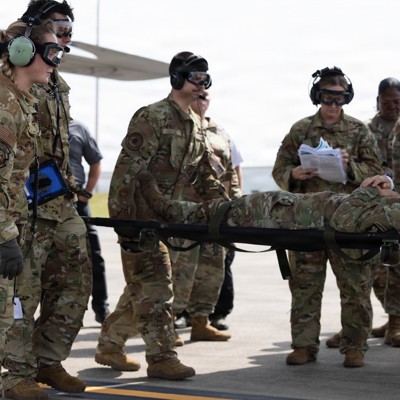
Soldiers conduct simulated casualty movement training during a joint medical exercise in Kentucky, Sept. 10, 2026. U.S. Army / Staff Sgt. Brianna Jenkins
Medical professionals have long warned that drones would cause higher U.S. battlefield casualties. A new Inspector General report shows the military is still scrambling to meet that challenge.
The military abandoned plans to use Army helicopters to evacuate wounded troops involved in the war with Iran, and instead resorted to slower ground-based evacuations, in part due to the threat of drone strikes, according to a Defense Department Office of the Inspector General report released Monday. The shift illustrates a problem medical officials had warned about for years.
At the start of the operation, the U.S. used Army helicopters in Kuwait and Iraq for medical evacuation, but then moved them due to concerns about Iranian drone and missile strikes.
“Most evacuations during [Operation Epic Fury] were ultimately conducted by ground,” according to the report. In addition to the drone threat, the United States had the additional hurdle of relying on host country hospitals for what’s called “advanced, hospital level care” for particularly severe injuries, since establishing such hospitals on U.S. bases would require a large and more targetable footprint.
The move follows warnings from medical officials that future conflicts would be more dangerous for U.S. troops, as adversaries develop more advanced weapons—particularly drones. A 2022 Army University Press article by Lt. Col. Matthew Marsh and Capt. Ryan Hampton eerily forecasts the situation described in the inspector general report: “Medical personnel will experience intermittent air and ground evacuation with medical logistics constraints,” it reads.
Just as new technology has allowed some adversaries to become more dangerous and inflict higher casualties, other pressures led to cutbacks in medical evacuation capability, particularly in the Middle East. A July 2025 Pulse of Army Medicine article by Sgt. Maj. Sandra Johnson describes how, across U.S. Central Command, “Due to competing requirements, many of these bases only have one medic on post and no medical provider. A medic may have to care for a patient for several hours until they arrive at a local national hospital.”
She noted specifically the problem of “no Medical Evacuation (MEDEVAC) by flight or ground capability, or only ground Casualty Evacuation (CASEVAC) options,” across CENTCOM.
An April U.S. Naval Institute report explains: “Drone warfare [in Ukraine] has disrupted casualty movement from the point of injury throughout the combat casualty continuum of care.”
The IG report acknowledges that CENTCOM officials worked to rapidly develop new plans and strategies when faced with Iranian drone capabilities, moving troops and materiel.. “During OEF, USCENTCOM shifted personnel, assets, and storage facilities as locations came under Iranian and proxy attacks,” it reads.
The report carries a strong recommendation: To find and fix “the gaps in [Department of Defense counter-drone] interoperability, and the corrective actions needed to standardize” those capabilities.
NEXT STORY: 25 years after 9/11, spy agencies face old lessons and new threats
2026年9月10日,在肯塔基州举行的一次联合医疗演习中,士兵们正在进行模拟伤员转移训练。美国陆军/参谋军士布里安娜·詹金斯
医学专家长期以来一直警告说,无人机将导致美军战场伤亡人数增加。一份新的监察长报告显示,军方仍在努力应对这一挑战。
据国防部监察长办公室周一发布的一份报告显示,军方放弃了使用陆军直升机撤离在伊朗战争中受伤士兵的计划,转而采用速度较慢的地面撤离方式,部分原因是受到无人机袭击的威胁。这一转变凸显了医疗官员多年来一直警告的一个问题。
行动初期,美国在科威特和伊拉克使用陆军直升机进行医疗后送,但后来由于担心伊朗的无人机和导弹袭击而转移了这些直升机。
报告指出,“在‘史诗狂怒行动’期间,大多数撤离行动最终都是通过地面进行的。” 除了无人机威胁之外,美国还面临着另一个难题:由于在美军基地内建立此类医院需要占用大量空间,更容易成为攻击目标,因此美国只能依赖驻在国医院为重伤人员提供所谓的“高级医院级护理”。
此举源于医疗官员的警告,他们指出,随着对手研发更先进的武器——尤其是无人机——未来的冲突对美军而言将更加危险。陆军中校马修·马什和上尉瑞安·汉普顿在2022年发表于陆军大学出版社的一篇文章中,令人不安地预言了监察长报告中所描述的情况:“医疗人员将面临间歇性的空中和地面撤离,并受到医疗后勤保障的限制。”
正如新技术使一些敌对势力变得更加危险并造成更大伤亡一样,其他压力也导致了医疗后送能力的削减,尤其是在中东地区。2025年7月,桑德拉·约翰逊军士长在《陆军医学脉搏》杂志上发表文章,描述了美国中央司令部的情况:“由于各种需求相互冲突,许多基地只有一名医务人员驻守,而且没有医疗服务提供者。医务人员可能需要照顾病人几个小时,直到他们被送往当地的国家医院。”
她特别指出,中央司令部存在“没有飞行或地面医疗后送(MEDEVAC)能力,或者只有地面伤员后送(CASEVAC)选项”的问题。
美国海军研究所四月份的一份报告解释说:“(在乌克兰的)无人机战争扰乱了伤员从受伤地点到整个战斗伤亡护理过程的转移。”
监察长报告承认,面对伊朗的无人机能力,中央司令部官员努力迅速制定新的计划和战略,并调动部队和物资。报告指出:“在持久自由行动期间,随着伊朗及其代理人对不同地点发动袭击,美国中央司令部调动了人员、资产和储存设施。”
该报告提出了一项强有力的建议:找出并解决“国防部反无人机互操作性方面的差距,以及为实现这些能力的标准化所需的纠正措施”。
下一篇报道:9·11事件25年后,间谍机构面临旧的经验教训和新的威胁