Some organisations in Singapore take haze-related measures as air quality worsens随着空气质量恶化,新加坡一些机构采取了与雾霾相关的措施。
Doctors have seen a 20 per cent rise in patients with asthma flare-ups, nose allergies and throat irritation. Read more at straitstimes.com.
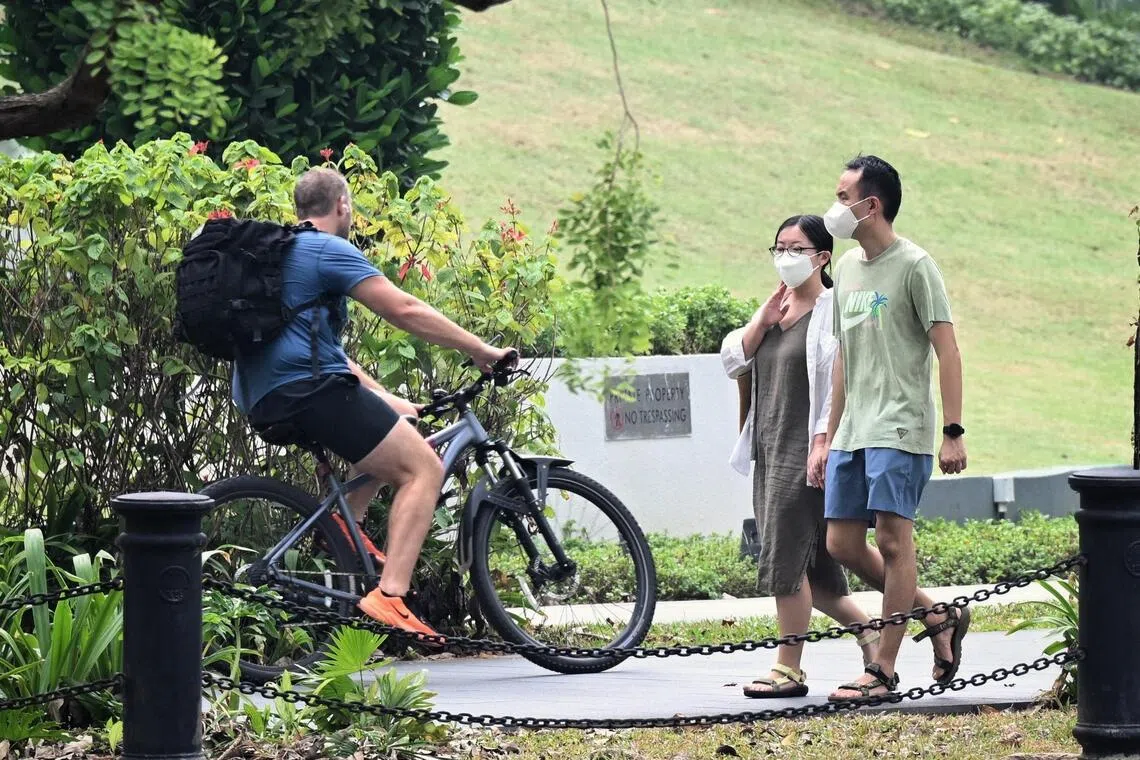
A couple in mask seen during at the haze at Robertson Quay at about 12pm on Sept 14.
ST PHOTO: CHONG JUN LIANG
Published Sep 15, 2026, 10:00 PM
Updated Sep 15, 2026, 10:00 PM
Haze in Singapore caused a 20% rise in asthma, allergies, and respiratory issues, with doctors seeing more flare-ups and advising reduced outdoor exposure.
Sports bodies introduced stricter health protocols, including suspensions and hydration breaks, to protect athletes during elevated pollution levels.
The Ministry of Health has not reactivated the 2015 Haze Subsidy Scheme, while schools and parents are urged to take preventive measures for children's health.
SINGAPORE – Air quality deteriorated over Singapore on Sept 15 , with the Pollutant Standards Index (PSI) reaching unhealthy levels in all parts of the country in the middle of the night before improving slightly.
Previously, bouts of unhealthy haze were only detected in certain parts of the country.
The PSI, a measure of air quality here, registered readings of between 104 and 154 at 6am on Sept 15, before dropping slightly to between 92 and 131 at 6pm.
Air quality is considered moderate when PSI levels are between 51 and 100, and unhealthy when PSI readings are above 100.
At that level, healthy people should reduce prolonged or strenuous outdoor activities, while those with chronic heart and lung disease should avoid such activities.
Unhealthy levels of haze were first detected in central Singapore on Sept 4. Since then, hazy conditions have prevailed across Singapore.
The PSI on Sept 16 is expected to be between the high-moderate to mid-unhealthy range, said the National Environment Agency.
Some organisations have implemented measures to protect people against the haze.
ST understands that Outward Bound School, an adventure camp for students , was cancelled for CHIJ St Nicholas Girls’ School students due to the worsening PSI on Sept 14.
The Singapore Hockey Federation (SHF) said it will suspend hockey matches in the men’s leagues if the PSI exceeds 100.
This is according to SHF’s own haze protocol, introduced last week when conditions started worsening. This will be applied to matches in the ongoing Divisions 3 to 5, which started in July at the Sengkang Hockey Stadium. The next round is slated to take place on Sept 19.
The protocol is more stringent than the advisory from national sports agency SportSG, which recommends that programmes and activities in outdoor and non-air-conditioned facilities be suspended when the PSI is above 200.
SHF president Aw Bang Hui said the federation decided on stricter measures as there are players who are in their 50s and 60s .
Aw said: “We are monitoring the situation closely and will actively apply contingency measures, depending on how haze conditions progress over the coming weeks. Players’ health and safety are of utmost importance to us and we do not take things lightly.”
The Football Association of Singapore said two hydration breaks will be introduced in all Singapore Premier League (SPL) and SPL2 matches amid the ongoing haze. Hydration breaks are introduced during football matches as a precautionary measure against conditions such as heat.
The breaks will take place about midway through each half, and last up to three minutes. The FAS spokesperson added that matches may be delayed, suspended or postponed if the 24-hour PSI reading for the area is above 200. Air quality is considered very unhealthy at this threshold, and healthy individuals should avoid lengthy or strenuous outdoor activities. Clubs have also been briefed on match-day protocol regarding the thresholds for postponement, delayed kick-off and in-match suspension, said the spokesperson, adding that matches will start no later than 9.30pm, and end by 11.30pm. The situation will be reassessed as the haze situation improves .
Doctors interviewed by The Straits Times also said they have seen at least a 20 per cent rise in the number of patients with asthma flare-ups, nose allergies, sinus, throat irritation and wheezing. They did not provide actual figures .
Mohamed Baisal, a general practitioner at Shifa Clinic and Surgery, suspects that the number could be higher as some prefer to self-medicate or opt for traditional Chinese medicine.
The Raffles Medical clinics have seen a 20 to 30 per cent rise in haze-related conditions in seniors, children and adults, said its family physician Yak Sin Lin.
Lee Joon Loong, medical director of Paddington Medical Clinic, said: “From our day-to-day experience, the increase has been very noticeable, possibly approaching twice what we would normally see.
“The main things we are seeing are asthma exacerbations, cough and throat irritation, allergic rhinitis and sinus symptoms and eye irritation, as well as eczema and other skin irritation flaring up.” Rhinitis symptoms include a stuffy nose, sneezing and itching in the eyes and throat.
He has also seen asthmatic patients return to his clinic years after being stable.
“Some have not needed their reliever inhalers for months or even years. When the haze triggers their asthma again, they can be caught unprepared,” he said.
At the Thomson Paediatric Centre’s JEM outlet, paediatrician Lim Yang Chern has noticed an increase in children coming in with runny nose, cough, asthma flare-ups and rhinitis.
Telemedicine platform Rexmed.io has also seen a 20 per cent increase in such cases in adults.
Dana Elliott, medical director of Rexmed.io, said: “Everyone including the healthy, should minimise outdoor exposure because PM2.5 (pollutants) can travel deep into the lungs. Prolonged exposure can cause long-term effects such as heart attacks, reduced lung development and asthma.”
PM2.5 refers to micro-pollutants found in smoke haze.
Lim from the Thomson Paediatric Centre urged schools and parents to take preventive steps to minimise haze-related symptoms in children .
These include monitoring students who are more vulnerable to respiratory illness and remind them to carry their inhalers and medication.
He also added that the air quality in school buses must not be overlooked.
“In school buses, keep windows closed but with good ventilation. (Switch the) air-conditioning to recirculate mode rather than allow outside air entry.”
The doctors also urged the public to refer to the one-hour PM2.5 levels to decide whether to do outdoor activities in the next hour.
As at 8pm on Sept 15, only the central region’s PM2.5 levels were elevated at 69 micrograms per cubic m, above the threshold of 56mcg per cubic m.
Lee said: “When you’re exercising hard, your ventilation increases substantially, so you’re potentially inhaling a much greater amount of PM2.5 deep into the respiratory tract.”
During the haze crisis of 2015, when air quality reached hazardous levels, the Ministry of Health activated the Haze Subsidy Scheme.
Under it, the Pioneer and Merdeka generations paid only $5 and other eligible Singaporeans – such as those with blue and orange Community Health Assist Scheme cards – paid $10 at clinics and polyclinics for haze-related conditions.
That was the last time that the subsidy kicked in, and about 50,000 benefited from the scheme.
Ong Guan Hong, chief executive of PanCare Medical Clinic, and Healthway Medical Group’s chief medical officer John Cheng said MOH has not alerted clinics about the scheme in 2026 .
Shabana Begum is a correspondent, with a focus on environment and science, at The Straits Times.
Laura Chia is a journalist covering breaking news and current affairs, with an interest in sports.
Respiratory illnesses
9月14日中午12点左右,在罗伯逊码头烟雾弥漫期间,有人看到一对戴着口罩的情侣。
《海峡时报》照片:梁崇俊
发布于2026年9月15日晚上10:00
更新于2026年9月15日晚上10:00
新加坡的雾霾导致哮喘、过敏和呼吸系统疾病病例增加了 20%,医生发现病情加重的情况增多,并建议减少户外活动。
体育机构出台了更严格的健康规程,包括停赛和暂停补水,以在污染水平升高期间保护运动员。
卫生部尚未重新启动 2015 年雾霾补贴计划,同时敦促学校和家长采取预防措施,保障儿童健康。
新加坡——9月15日,新加坡空气质量恶化,污染标准指数(PSI)在午夜时分在全国各地达到不健康水平,之后略有改善。
此前,只有在该国某些地区才会出现不健康的雾霾天气。
9 月 15 日上午 6 点,这里的空气质量指数 PSI 读数在 104 到 154 之间,之后在下午 6 点略微下降到 92 到 131 之间。
当 PSI 值介于 51 和 100 之间时,空气质量被认为是中等的;当 PSI 读数超过 100 时,空气质量被认为是不健康的。
在这个层面上,健康人群应该减少长时间或剧烈的户外活动,而患有慢性心脏和肺部疾病的人应该避免此类活动。
9月4日,新加坡中部地区首次检测到不健康的雾霾浓度。此后,新加坡各地一直笼罩在雾霾之中。
国家环境局表示,预计9月16日的PSI指数将处于高至中等偏上到中等不健康范围之间。
一些组织已经采取措施保护人们免受雾霾影响。
据《海峡时报》了解,由于9月14日PSI疫情恶化,圣尼各拉女校学生的户外探险营“户外拓展学校”被取消。
新加坡曲棍球协会(SHF)表示,如果PSI超过100,将暂停男子联赛的曲棍球比赛。
这是根据新加坡曲棍球联合会(SHF)上周推出的雾霾应对方案制定的,当时雾霾情况开始恶化。该方案将适用于目前正在进行的第三至第五级别联赛的比赛,这些比赛于7月在盛港曲棍球场开赛。下一轮比赛定于9月19日举行。
该协议比国家体育机构 SportSG 的建议更为严格,SportSG 建议当 PSI 指数超过 200 时,应暂停在室外和非空调设施中进行的项目和活动。
新加坡羽毛球联合会主席 Aw Bang Hui 表示,由于一些球员已经 50 多岁甚至 60 多岁,联合会决定采取更严格的措施。
阿瓦表示:“我们正在密切关注情况,并将根据未来几周雾霾情况的发展积极采取应急措施。球员的健康和安全对我们至关重要,我们绝不会掉以轻心。”
新加坡足球协会表示,鉴于目前持续的雾霾天气,所有新加坡超级联赛(SPL)和SPL2联赛的比赛将增加两次补水休息时间。在足球比赛中增加补水休息时间是为了预防高温等天气状况对球员的影响。
比赛将在上下半场进行到大约一半时暂停,每次最多持续三分钟。新加坡足协发言人补充说,如果比赛区域24小时空气污染指数(PSI)超过200,比赛可能会被延迟、暂停或推迟。空气质量达到此阈值即被认为非常不健康,健康人群应避免长时间或剧烈的户外活动。发言人表示,各俱乐部已被告知比赛日的相关规定,包括比赛推迟、延迟开球和比赛中暂停的阈值。他还补充说,比赛最晚将于晚上9:30开始,最晚将于晚上11:30结束。随着雾霾情况的改善,足协将重新评估比赛安排。
《海峡时报》采访的医生们也表示,他们接诊的哮喘发作、鼻过敏、鼻窦炎、咽喉刺激和喘息等症状的患者人数至少增加了20%。但他们没有提供具体数字。
Shifa Clinic and Surgery 的全科医生 Mohamed Baisal 怀疑,实际数字可能更高,因为有些人更喜欢自行用药或选择传统中医。
莱佛士医疗中心的家庭医生林耀新表示,该中心的诊所发现,老年人、儿童和成人中与雾霾相关的疾病增加了 20% 到 30%。
帕丁顿医疗诊所的医疗主任李俊龙表示:“从我们日常的经验来看,这种增长非常明显,可能接近我们通常所见数量的两倍。”
“我们目前主要观察到的症状包括哮喘加重、咳嗽和咽喉刺激、过敏性鼻炎和鼻窦炎症状、眼部刺激,以及湿疹和其他皮肤刺激的复发。”鼻炎症状包括鼻塞、打喷嚏以及眼睛和喉咙发痒。
他还见过一些哮喘患者在病情稳定几年后又回到他的诊所就诊。
“有些人几个月甚至几年都不需要使用缓解型吸入器。当雾霾再次诱发他们的哮喘时,他们可能毫无准备,”他说。
汤申儿科中心 JEM 分院的儿科医生林扬振注意到,前来就诊的儿童中,流鼻涕、咳嗽、哮喘发作和鼻炎的病例有所增加。
远程医疗平台 Rexmed.io 也发现,成人此类病例增加了 20%。
Rexmed.io的医疗总监达娜·艾略特表示:“包括健康人群在内的所有人都应该尽量减少户外活动,因为PM2.5(污染物)可以深入肺部。长期暴露于PM2.5会导致心脏病发作、肺部发育不良和哮喘等长期影响。”
PM2.5 指的是烟雾中发现的微污染物。
汤姆森儿科中心的林医生敦促学校和家长采取预防措施,以尽量减少儿童因雾霾引起的症状。
这些措施包括监测更容易患呼吸系统疾病的学生,并提醒他们随身携带吸入器和药物。
他还补充说,校车上的空气质量不容忽视。
“在校车上,保持车窗关闭但通风良好。(将)空调设置为内循环模式,而不是让外部空气进入车内。”
医生们还敦促公众参考一小时 PM2.5 水平来决定是否在接下来的一个小时内进行户外活动。
截至9月15日晚上8点,只有中部地区的PM2.5浓度升高至每立方米69微克,超过了每立方米56微克的阈值。
李说:“当你剧烈运动时,你的通气量会大幅增加,因此你可能会吸入更多量的 PM2.5 进入呼吸道深处。”
2015 年雾霾危机期间,空气质量达到危险水平,卫生部启动了雾霾补贴计划。
根据该政策,建国一代和独立一代只需支付 5 新元,其他符合条件的新加坡人(例如持有蓝色和橙色社区健康援助计划卡的人)在诊所和综合诊所治疗与雾霾相关的疾病时只需支付 10 新元。
那是补贴政策最后一次生效,约有 5 万人从中受益。
PanCare Medical Clinic 首席执行官 Ong Guan Hong 和 Healthway Medical Group 首席医疗官 John Cheng 表示,卫生部尚未就 2026 年的该计划通知各诊所。
沙巴娜·贝古姆是《海峡时报》的记者,主要关注环境和科学领域。
Laura Chia是一位报道突发新闻和时事的记者,对体育也颇感兴趣。
呼吸系统疾病