Leaders unveil a circuitous path to nuke-powered Australian subs领导人揭示了澳大利亚建造核动力潜艇的迂回路线
The ambitious AUKUS mega-project formally sets sail, as questions swirl about shipbuilding capacity, funding and information-sharing.
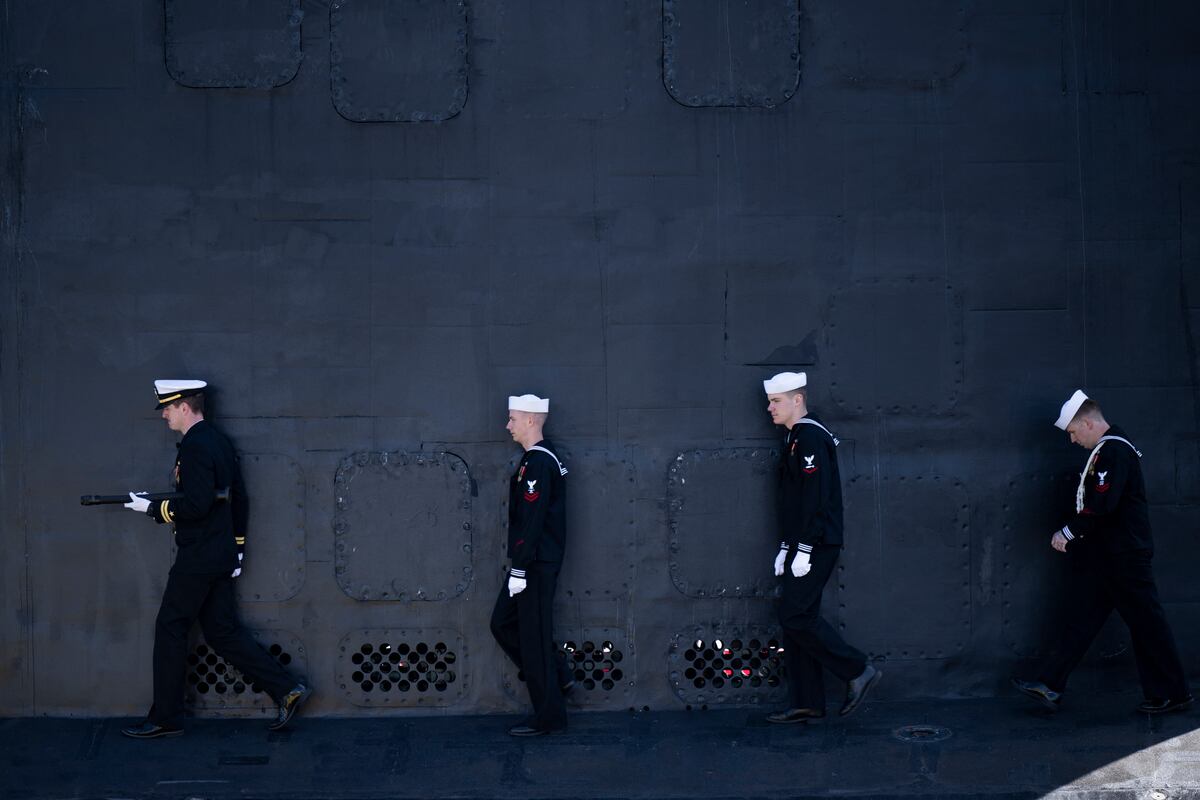
WASHINGTON — U.S., British and Australian leaders are slated to kick off Monday a decades-long project aimed at fielding what would eventually amount to a joint fleet of nuclear-powered submarines suitable for checking China’s military clout in the Asia-Pacific region.
The announcement in San Diego by U.S. President Joe Biden, U.K. Prime Minister Rishi Sunak and Australian Prime Minister Anthony Albanese has been 18 months in the making. Biden and his counterparts’ respective predecessors said in September 2021 they would form an alliance around equipping the Royal Australian Navy with secretive naval nuclear propulsion technology, naming the endeavor after the three countries’ initials: AUKUS .
Senior administration officials, who briefed reporters ahead of the announcement on the condition of anonymity, detailed the broad outlines of the arrangement. In a first phase, U.S. officials will help Australia build the capacity to maintain and employ nuclear-powered submarines, namely American Virginia-class and British Astute-class boats that will begin operating out of Perth, in southeastern Australia, in 2027.
In a second phase, in the 2030s, Australia will buy at least three and as many as five Virginia-class boats of its own from the U.S. Navy, either newly built or used. The exact number will depend on the progress in the third and final phase, which envisions Canberra to build a new nuclear-powered submarine type in the 2040s based on a nascent design of the follow-on submarine for the Astute.
U.S. officials have emphasized that while the design is British, the eventual submarine, dubbed SSN-AUKUS, would still be stacked with American tech.
The mega-project seeks to overcome Australia’s lack of exposure to the secrets of nuclear propulsion through billions of dollars invested by all three participants. A U.S. shipbuilding budget line newly added last year is set to grow to $4.6 billion this year. The funds are meant to patch industry capacity shortfalls now and pave the way for increased AUKUS production levels later.
“Those are down-payments on what needs to be done for the U.S. submarine industrial base,” the administration official said, adding the White House would “work with Congress to get very substantial lifts in the U.S. submarine industrial base — lifts that go significantly beyond the $4.6 billion we will have submitted with the president’s budget submission.”
Australia, in turn, will make a “proportional and appropriate,” contribution, said the official without giving on a dollar amount. The British on Monday announced a £3 billion ($3.6 billion) boost for nuclear submarine spending, some of which will go, directly or indirectly, to AUKUS.
Submarines powered by atomic reactors can stay on mission longer, travel farther and maneuver more quickly than those running on diesel generators or fuel cells — key benefits, in the eyes of AUKUS proponents, for securing stability in the Asia-Pacific amid Chinese military flexing.
Canberra eventually wants to replace its conventionally-powered Collins-class boats with nuclear submarines. Australia’s original plan before AUKUS was to buy 12 conventional submarines from France’s Naval Group, and nixing that deal in favor of the nuclear pact with the United States and Britain caused a major diplomatic uproar with Paris in 2021 that has since mostly abated.
U.S. military analysts say stealthy attack submarines would play a pivotal role in any conflict with China or another adversary, and the Navy has doubled down on its undersea advantage, making investments to increase the lethality of its submarines and the fleet’s ability to detect enemy subs.
But the major weakness has been capacity. Industry has not been able to achieve and maintain a two-a-year production rate for the Navy, and the COVID-19 pandemic and subsequent changes in the labor market have only further challenged submarine builders General Dynamics’ Electric Boat and HII’s Newport News Shipbuilding and their thousands of suppliers. The Navy would need to buy at least three submarines a year to achieve its own planned fleet size, but that has not been realistic based on industry’s recent performance.
Analysts point to shipbuilding capacity as the key bottleneck for AUKUS. “The aim seems to be to increase the number of boats in or, rather, under the water, but there’s an open question as to the production capacity of our and really all three nations’ shipyards,” said Charles Edel, a former State Department official now at the Washington-based Center for Strategic and International Studies think tank. “Again, the ambition is to expand shipbuilding here. The question is how quickly this can be accomplished.”
Congressional buy-in will be crucial to get AUKUS on track, both for approving new shipbuilding money and for allowing in-service U.S. Navy Virginia-class boats to be sold to Australia as an interim capability. For now, White House officials said they came away optimistic from briefings in recent weeks.
While Congress would not have to act on any Virginia-class sales until the 2030s, when Australia wants the submarines, U.S. officials said doing so earlier would give Canberra peace of mind.
“There are advantages to make it clear to the Australians and to the world that the United States is committed,” said the administration official.
Also high on the to-do list for AUKUS is a refresh of U.S. policies that allow for sharing sensitive nuclear-propulsion technology. While an initial defense agreement with Australia to that end has been in effect since February 2022, officials plan to negotiate a new text with a wider scope.
Joe Gould in Washington contributed to this report.
Sebastian Sprenger is associate editor for Europe at Defense News, reporting on the state of the defense market in the region, and on U.S.-Europe cooperation and multi-national investments in defense and global security. Previously he served as managing editor for Defense News. He is based in Cologne, Germany.
Megan Eckstein is the naval warfare reporter at Defense News. She has covered military news since 2009, with a focus on U.S. Navy and Marine Corps operations, acquisition programs and budgets. She has reported from four geographic fleets and is happiest when she’s filing stories from a ship. Megan is a University of Maryland alumna.
Bryant Harris is the Congress reporter for Defense News. He has covered U.S. foreign policy, national security, international affairs and politics in Washington since 2014. He has also written for Foreign Policy, Al-Monitor, Al Jazeera English and IPS News.
华盛顿——美国、英国和澳大利亚领导人计划于周一启动一项为期数十年的项目,旨在最终组建一支联合核动力潜艇舰队,以遏制中国在亚太地区的军事影响力。
美国总统乔·拜登、英国首相里希·苏纳克和澳大利亚总理安东尼·阿尔巴尼斯在圣地亚哥宣布的这项合作计划酝酿了18个月之久。拜登及其各自前任于2021年9月表示,他们将围绕为澳大利亚皇家海军配备秘密的核动力推进技术而结成联盟,并将这项合作计划以三国国名的首字母命名为“AUKUS”。
在正式宣布之前,几位不愿透露姓名的美国高级官员向记者简要介绍了该协议的大致框架。在第一阶段,美国官员将帮助澳大利亚建立维护和使用核动力潜艇的能力,具体而言,就是美国弗吉尼亚级和英国机敏级潜艇,这些潜艇将于2027年开始以澳大利亚东南部珀斯港为基地服役。
在第二阶段,即2030年代,澳大利亚将从美国海军购买至少三艘、至多五艘弗吉尼亚级潜艇,可以是新建的,也可以是二手的。具体数量将取决于第三阶段(也是最后一个阶段)的进展情况。第三阶段设想堪培拉在2040年代建造一种新型核动力潜艇,该潜艇将基于“机敏”级潜艇后续型号的初步设计。
美国官员强调,虽然设计来自英国,但最终的潜艇(命名为 SSN-AUKUS)仍将采用大量美国技术。
这项巨型项目旨在通过三方数十亿美元的投资,弥补澳大利亚在核动力推进技术方面的知识匮乏。去年新增的美国造船预算项目今年预计将增至46亿美元。这些资金旨在弥补当前行业产能不足的问题,并为未来提高AUKUS级核动力艇的产量铺平道路。
这位政府官员表示:“这些只是美国潜艇工业基础所需工作的预付款。”他还补充说,白宫将“与国会合作,为美国潜艇工业基础争取非常实质性的提升——这些提升将远远超过我们将在总统预算案中提交的 46 亿美元。”
这位官员表示,澳大利亚也将做出“成比例且适当的”贡献,但并未透露具体金额。英国周一宣布将增加30亿英镑(约合36亿美元)的核潜艇开支,其中一部分将直接或间接用于AUKUS项目。
与使用柴油发电机或燃料电池的潜艇相比,使用原子反应堆作为动力的潜艇可以执行任务更长时间、航行更远、机动速度更快——在 AUKUS 支持者看来,这是确保亚太地区在中国军事扩张背景下保持稳定的关键优势。
堪培拉最终希望用核潜艇取代其常规动力柯林斯级潜艇。在奥库斯协议签署之前,澳大利亚最初的计划是从法国海军集团购买12艘常规动力潜艇,但为了与美国和英国达成核协议而取消了这笔交易,这在2021年引发了与巴黎之间的一场重大外交风波,不过此后风波已基本平息。
美国军事分析人士表示,隐形攻击潜艇将在与中国或其他对手的任何冲突中发挥关键作用,海军已加倍重视其水下优势,并进行投资以提高其潜艇的杀伤力和舰队探测敌方潜艇的能力。
但最大的弱点在于产能。业界一直未能达到并维持海军每年两艘潜艇的生产速度,而新冠疫情及其引发的劳动力市场变化更是雪上加霜,给通用动力电船公司和HII纽波特纽斯造船厂及其数千家供应商带来了更大的挑战。海军若要实现其规划的舰队规模,每年至少需要采购三艘潜艇,但根据业界近期的表现来看,这并不现实。
分析人士指出,造船能力是奥库斯计划的关键瓶颈。“目标似乎是增加水下船只的数量,但我们以及三国造船厂的生产能力仍然是个未知数,”前国务院官员、现任华盛顿战略与国际研究中心智库研究员查尔斯·埃德尔表示。“再次强调,我们的目标是扩大本地造船规模。问题在于,这一目标能否迅速实现。”
国会的支持对于“奥库斯”项目能否顺利推进至关重要,这不仅关系到批准新的造船资金,还关系到允许将现役的美国海军弗吉尼亚级潜艇出售给澳大利亚作为过渡能力。目前,白宫官员表示,他们对最近几周的简报感到乐观。
虽然国会直到 2030 年代(澳大利亚需要这些潜艇的时候)才需要对弗吉尼亚级潜艇的销售采取行动,但美国官员表示,提前采取行动会让堪培拉安心。
这位政府官员表示:“向澳大利亚和全世界明确表明美国的承诺是有益的。”
AUKUS的另一项重要任务是更新美国允许共享敏感核动力推进技术的政策。虽然美国与澳大利亚为此目的达成的初步防务协议已于2022年2月生效,但官员们计划就一份范围更广的新文本进行谈判。
华盛顿的乔·古尔德对本报道亦有贡献。
塞巴斯蒂安·斯普伦格是《防务新闻》欧洲版副主编,负责报道该地区的防务市场状况,以及美欧在防务和全球安全领域的合作和多国投资。此前,他曾担任《防务新闻》执行主编。他现居德国科隆。
梅根·埃克斯坦是《防务新闻》的海军作战记者。自2009年以来,她一直从事军事新闻报道,主要关注美国海军和海军陆战队的行动、采购项目和预算。她曾报道过四个不同地理区域的舰队,最喜欢在舰艇上进行新闻报道。梅根毕业于马里兰大学。
布莱恩特·哈里斯是《防务新闻》的国会记者。自2014年以来,他一直在华盛顿报道美国外交政策、国家安全、国际事务和政治。他还曾为《外交政策》、《Al-Monitor》、《半岛电视台英语频道》和IPS新闻撰稿。