New Details On How Space Force Has Waged Electronic Warfare Against Iran太空部队如何对伊朗发动电子战的新细节
Space Force says it has learned important lessons from the war with Iran about operations inside and outside of the atmosphere.
By Joseph Trevithick
Published Sep 15, 2026 3:14 PM EDT
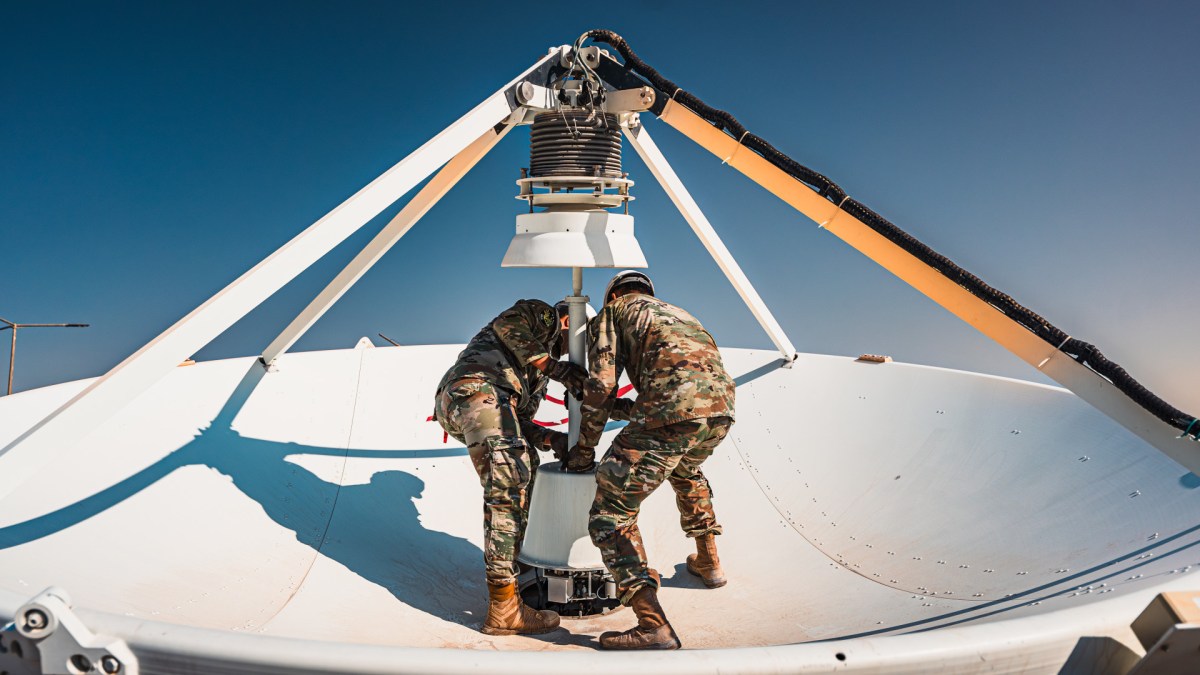
Members of the 42nd Electromagnetic Warfare Combat Detachment seen working on a trailer-mounted antenna somewhere in the Middle East in 2024. USAF/Senior Airman Zeeshan Naeem
U.S. Space Force’s top officer has shared new details about his service’s use of electronic warfare capabilities during Operation Epic Fury against Iran earlier this year. This underscores how space is steadily becoming an arena where conflict actually occurs , and the implications this has for forces operating inside and outside of the Earth’s atmosphere.
Chief of Space Operations Gen. Douglas Schiess highlighted the actions of a member of the 42nd Electromagnetic Warfare Combat Detachment (EWCD) in support of Epic Fury during a keynote speech earlier this morning. Schiess’ remarks came at the Air & Space Forces Association’s (AFA) 2026 Air, Space & Cyber Conference , at which TWZ is in attendance. This is his first major engagement since taking over as head of Space Force less than two weeks ago.
A previously released picture showing a member of the 42nd Electromagnetic Warfare Combat Detachment forward-deployed somewhere in the Middle East in 2024. USAF/Senior Airman Zeeshan Naeem
“During Operation Epic Fury, our components, notably at U.S. Central Command and Space Command, with support from our components at European Command and Pacific Command, demonstrated that Guardians [the official term for uniformed Space Force personnel] are not supporting from the sidelines as a nice-to-have [sic], but we are delivering space power directly into the fight as a need-to-have,” Schiess said. “One of those impressive Guardians is Specialist Gray, who hails from Tampa, Florida. She joined the Space Force just two years ago, but listen to the impact she [has] made in her short term already.”
“She deployed to the CENTCOM AOR [Central Command area of responsibility] as a part of the 42nd Electronic Warfare Detachment [sic], and within hours of OEF kicking off, she received a top priority target package with one critical objective: reconfigure her weapon system and execute critical non-kinetic fires,” he continued. “She locked onto the target, optimized her weapon system, and waged electromagnetic warfare against a determined adversary. Even as ‘Alarm Red’ sirens were blaring, and incoming missiles targeted her site, she courageously held the line, protecting forces, denying adversary capability, and delivering space effects, until her commander had to literally pull her from the console to safety.”
“Specialist Gray is just one of the outstanding members of the entire enterprise of dedicated guardians, including the acquisition professionals that developed and fielded the weapon system that she operated, the intel Guardians that developed the targeting package that she used, and the cyber guardians who ensured communication, connectivity, and network defense for the command and control, the guardian instructors who trained her for combat, and the list goes on and on,” the Chief of Space Operations added.
Schiess did not name the system in question or elaborate further on how it was employed. However, previously released pictures of elements of the 42nd EWCD in the Middle East have shown personnel working with trailer-mounted multi-band antennas that have been associated in the past with variants of the Counter Communications System (CCS). CCS is a family of ground-based electronic warfare jammers primarily designed to disrupt enemy space-based communications capabilities. Prior to yesterday, CCS was the U.S. military’s only publicly acknowledged anti-satellite weapon. Space Force has now confirmed it also has weapons in orbit , which we will come back to later on.
Members of the 42nd EWCD pose in front of a trailer-mounted antenna at an undisclosed location in the Middle East in 2024. USAF/Senior Airman Zeeshan Naeem
A picture released in 2020 showing members of the 4th Space Control Squadron standing in front of what is explicitly said to be an element of the Block 10.2 version of the Counter Communications System. USAF
The 42nd Electromagnetic Warfare Combat Detachment has been operating in the Middle East since at least 2024 under the umbrella of Space Force’s main headquarters in the region, U.S. Space Forces – Central (SPACECENT) . President Donald Trump briefly called attention to the detachment’s “cutting-edge defense activities” during a Christmas Eve conference call with deployed service members last year.
“Sometimes we have to be within the footprint of the satellite, and so that’s why Guardians go into harm’s way,” Gen. Schiess did tell TWZ and other outlets at a roundtable after his speech this morning when asked for more details about the 42nd EWCD’s role in Operation Epic Fury, and what lessons Space Force has been learning from the conflict more broadly.
“Electromagnetic warfare was a big part of that, but also satellite communications,” he added. “The ability to keep communications, obviously GPS and PNT [positioning, navigation, and timing], were important there.”
“And then, really, missile warning and missile tracking was [sic] incredibly important. Both [Air Force Chief of Staff] Gen. Wilsbach and I talked about ‘Red Alarm’ situations ,” the Chief of Space Operations continued. “Being able to tell our forces to be able to take cover was extremely important. And as we’ve seen from Ukraine to Iran, the amount of missiles and the amount of things, the folks that are doing that each and every day are incredible, and they are saving lives.”
Chief of Space Operations Gen. Douglas Schiess. USAF
Gen. Schiess’s anecdote about Specialist Gray and the 42nd ECWD did highlight how Iran, especially in the opening phases of the conflict earlier this year, was able to deal real blows to U.S. and allied facilities and forces across the Middle East. Iranian missiles, drones, and other capabilities were able to damage and/or destroy a variety of high-value assets, including aircraft and radars , and cause hundreds of casualties, as TWZ has drawn attention to on several occasions in the past. This has already been a sobering wake-up call with serious implications for potential future conflicts against larger and even more capability opponents, especially China.
“I think the whole joint force is learning a lot from Operation Epic Fury, the previous operation there, on exactly what needs to be in underground facilities, [and] what maybe can we do from remote locations,” the head of Space Force said at the roundtable today. “You could also look at what can we do from space to do some of those things? And so we’re looking at all those [lessons learned].”
Gen. Schiess mentioning subterranean facilities and remote operations is particularly notable. Even before Operation Epic Fury began, the U.S. Air Force had been working to expand options for directing operations in the Middle East from a command center in the United States . The service had also been looking to push certain command and control functions at Al Udeid Air Base in Qatar underground . Al Udeid was among the many bases Iran subsequently targeted.
Operation Epic Fury has already added new fuel to a larger ongoing debate about balancing U.S. military base defense priorities globally, including the relative value of investing in new physically hardened infrastructure . TWZ has been following these discussions very closely in recent years . The conflict with Iran has raised serious questions about future operations of any kind at certain bases across the Middle East, and there have been reports that a larger reorientation of America’s force posture in the region could be coming.
For Space Force, operations against Iran have provided a broader opportunity for the service to demonstrate its active role in forward-deployed operations. That, in turn, has generated its own lessons learned beyond just steps needed to help better protect units in the field.
Then-Lt. Gen. Douglas Schiess meets with forward-deployed members of the 42nd Electromagnetic Warfare Combat Detachment in 2025. Schiess was head of US Space Forces – Space (S4S) and the Combined Joint Force Space Component Commander at SPACECOM at the time. Space Force
This extends to “reconstitution [of forces] in a combat environment, the logistics and the importance of that relationship with TRANSCOM [U.S. Transportation Command] and to be able to get supplies and replenishment into the theater,” Chief Master Sergeant of the Space Force John Bentivegna also said today, speaking alongside Gen. Schiess at the roundtable. That is “something we haven’t really worked on before. So definitely, it was a great lesson learned.”
Space-based capabilities including early warning, general intelligence gathering, weapons guidance, near-real-time communications, and more, are already absolutely central to U.S. military operations. America’s long-standing dominance in space is also steadily being eroded, with China, in particular, surging ahead in the deployment of new satellites to support a host of mission requirements, including intelligence-gathering and long-range targeting . The ability to leverage space is also proliferating to smaller adversaries, including Iran .
In addition, as mentioned, the space domain is no longer limited to just supporting operations within the atmosphere, but is a place where real engagements happen. The U.S. military is now capable of generating so-called counter-space effects using forces and assets within the atmosphere as well as in orbit, as was just disclosed yesterday .
Overall, Gen. Douglas Schiess’ comments today about the role played by Specialist Gray and the 42nd ECWD during Operation Epic Fury are indicative of not just what is to come in future operations, but how the Space Force is already engaged in combat missions now.
Contact the author: joe@twz.com
Comments couldn’t be loaded. Please refresh the page.
作者:约瑟夫·特雷维西克
发布于美国东部时间2026年9月15日下午3:14
2024年,美国空军第42电磁战作战分遣队的成员在中东某地检修一辆拖车式天线。(美国空军/高级空军兵 Zeeshan Naeem)
美国太空军最高指挥官透露了该军种在今年早些时候针对伊朗的“史诗狂怒行动”中使用电子战能力的最新细节。这凸显了太空正逐渐成为实际冲突发生的场所,以及这对地球大气层内外作战力量的影响。
太空作战部长道格拉斯·希斯将军今天上午在一次主题演讲中重点介绍了第42电磁战战斗分遣队(EWCD)一名成员在“史诗狂怒”(Epic Fury)行动中的英勇表现。希斯将军是在空军与太空部队协会(AFA)2026年空天网络大会上发表上述讲话的,TWZ也出席了此次大会。这是希斯将军上任太空部队司令不到两周以来的首次重要活动。
此前发布的一张照片显示,2024年,美国空军第42电磁战作战分遣队的一名成员前沿部署在中东某地。照片由美国空军高级飞行员齐山·纳伊姆拍摄。
“在‘史诗狂怒行动’期间,我们的各部门,特别是美国中央司令部和太空司令部的部队,在欧洲司令部和太平洋司令部的支持下,证明了太空部队人员(太空军制服人员的正式名称)并非可有可无地在旁支援,而是将太空力量直接投入战斗,这至关重要,”希斯说道。“这些令人印象深刻的太空部队人员中,有一位名叫格雷的专家,她来自佛罗里达州坦帕市。她加入太空部队仅仅两年,但听听她在短短时间内就产生了多么巨大的影响。”
“她作为第42电子战分遣队的一员部署到中央司令部责任区,在持久自由行动开始后的几个小时内,她就收到了一份优先级极高的目标包,其关键任务只有一个:重新配置武器系统并执行关键的非动能火力打击,”他继续说道。“她锁定目标,优化武器系统,并对顽固的敌人发动了电磁战。即使警报声响彻云霄,来袭导弹瞄准了她的阵地,她依然英勇坚守阵地,保护部队,削弱敌人的能力,并实施空间效应,直到她的指挥官不得不将她从控制台拉到安全地带。”
“格雷专家只是整个敬业守护者队伍中众多杰出成员之一,这支队伍还包括开发和部署她所操作的武器系统的采购专业人员、开发她所使用的目标包的情报守护者、确保指挥控制通信、连接和网络防御的网络守护者、训练她进行战斗的守护者教官等等,”太空作战部长补充道。
希斯并未透露所涉系统的名称,也未详细说明其使用方式。然而,此前公布的驻中东第42电子战司令部部分人员的照片显示,他们正在使用拖车式多频段天线,这些天线过去曾与反通信系统(CCS)的变型设备相关联。CCS是一系列地面电子战干扰器,主要用于干扰敌方天基通信能力。在昨天之前,CCS是美军唯一公开承认的反卫星武器。太空部队现已确认其在轨也拥有此类武器,我们稍后会对此进行讨论。
2024年,美国空军第42远征航空指挥中心(42nd EWCD)的成员在中东某处一处未公开地点,在一辆拖车式天线前合影。(美国空军/高级空军兵 Zeeshan Naeem)
2020年发布的一张照片显示,美国空军第4太空控制中队的成员站在一个据称是Block 10.2版本反通信系统组件的前面。
第42电磁战作战分遣队至少从2024年起就在中东地区执行任务,隶属于美国太空军在该地区的主要总部——中央太空军(SPACECENT)。去年圣诞前夕,唐纳德·特朗普总统在与部署在外的军人举行的电话会议上,曾简要提及该分遣队的“尖端防御活动”。
“有时候我们必须进入卫星的辐射范围内,所以守护者们才会身处险境,”希斯将军今天上午在演讲后的圆桌会议上告诉 TWZ 和其他媒体,当时他被问及第 42 远征军司令部在“史诗狂怒行动”中的作用,以及太空军从这场冲突中吸取了哪些教训的更多细节。
他补充说:“电磁战是其中的重要组成部分,卫星通信也同样重要。保持通信的能力,显然,GPS和PNT(定位、导航和授时)系统,在当时至关重要。”
“导弹预警和导弹跟踪真的非常重要。我和空军参谋长威尔斯巴赫将军都讨论过‘红色警报’的情况,”太空作战部长继续说道。“能够及时通知部队寻找掩护至关重要。正如我们从乌克兰到伊朗所看到的,导弹的数量和威胁程度都非常巨大,那些每天都在从事这项工作的人员令人敬佩,他们正在拯救生命。”
太空作战部长道格拉斯·席斯将军。美国空军
希斯将军关于格雷下士和第42电子战联队的轶事确实凸显了伊朗,尤其是在今年早些时候冲突的初期阶段,是如何对美国及其盟国在中东的设施和部队造成切实打击的。正如TWZ过去多次指出的那样,伊朗的导弹、无人机和其他武器装备能够破坏甚至摧毁包括飞机和雷达在内的各种高价值资产,并造成数百人伤亡。这已经敲响了警钟,对未来可能与实力更强、能力更强大的对手(尤其是中国)发生的冲突具有深远的影响。
“我认为整个联合部队都在从之前的‘史诗狂怒行动’(Operation Epic Fury)中吸取很多经验教训,包括地下设施需要配备哪些设施,以及我们可以从偏远地区开展哪些行动,”太空部队司令在今天的圆桌会议上表示。“我们还可以考虑从太空开展哪些行动来完成这些任务。因此,我们正在研究所有这些经验教训。”
希斯将军提及地下设施和远程作战尤其值得注意。早在“史诗狂怒行动”开始之前,美国空军就一直在努力拓展从美国本土指挥中心指挥中东作战行动的选项。空军还曾考虑将卡塔尔乌代德空军基地的某些指挥控制功能转移到地下。乌代德空军基地是伊朗随后袭击的众多基地之一。
“史诗狂怒行动”已经为一场关于平衡美国全球军事基地防御优先事项的持续辩论火上浇油,这场辩论包括投资建设新型加固基础设施的相对价值。近年来,TWZ一直密切关注着这些讨论。与伊朗的冲突引发了人们对未来在中东某些基地开展任何类型行动的严重质疑,并且有报道称,美国在该地区的军事部署可能会进行更大幅度的调整。
对于太空军而言,针对伊朗的军事行动为其提供了一个更广泛的机会,使其能够展现自身在前沿部署行动中的积极作用。反过来,这也使其积累了除更好地保护一线部队所需步骤之外的其他经验教训。
2025年,时任美国太空部队中将道格拉斯·希斯会见了第42电磁战作战分遣队的前沿部署成员。希斯当时是美国太空部队太空司令部(SPACECOM)司令兼联合部队太空作战司令。
太空部队首席军士长约翰·本蒂韦尼亚今天在与希斯将军一同出席圆桌会议时也表示,这还包括“在作战环境下进行部队重组、后勤保障以及与美国运输司令部(TRANSCOM)保持密切联系的重要性,以及如何将物资和补给运送到战区”。他补充说:“这是我们以前从未真正研究过的领域。所以,这无疑是一次非常宝贵的经验。”
包括预警、通用情报收集、武器制导、近实时通信等在内的天基能力,对美国军事行动而言已至关重要。然而,美国在太空领域的长期优势正逐渐被削弱,尤其是中国,在部署新型卫星以支持包括情报收集和远程目标定位在内的诸多任务需求方面,正迅速占据领先地位。利用太空的能力也正向包括伊朗在内的较小对手扩散。
此外,正如前文所述,太空领域不再仅仅局限于支持大气层内的作战行动,而是成为真正交战发生的场所。正如昨天披露的那样,美军现在能够利用大气层内以及轨道上的兵力和资源,产生所谓的反太空效应。
总的来说,道格拉斯·希斯将军今天对格雷专家和第 42 电子战联队在“史诗狂怒行动”中所扮演的角色发表的评论,不仅表明了未来行动的发展方向,也表明了太空部队目前是如何参与作战任务的。
联系作者:joe@twz.com
评论加载失败,请刷新页面。