Her sister struggled with feeding breast milk on the go – so this 23-year-old invented a better way她的妹妹在外出时很难喂母乳——于是这位23岁的女孩发明了一种更好的方法。
Nicolette Wong discovered that parents often pieced together different products to store, warm and feed breast milk on the go. Her answer was Momigo, an all-in-one system that made her the Singapore winner of the James Dyson Award 2026.
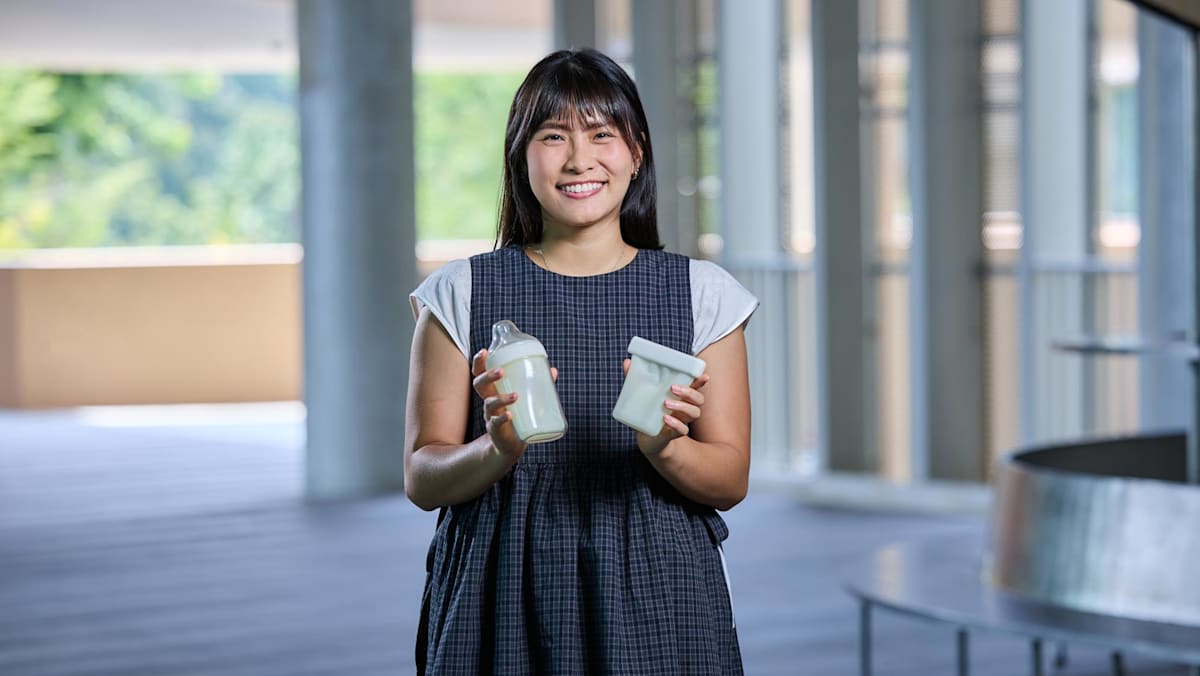
Nicolette Wong discovered that parents often pieced together different products to store, warm and feed breast milk on the go. Her answer was Momigo, an all-in-one system that made her the Singapore winner of the James Dyson Award 2026.
Nicolette Wong designed momigo as an integrated breast milk storage and feeding system that allows expressed breast milk to be stored, warmed and fed from the same container. (Photo: James Dyson Award)
This audio is generated by an AI tool.
Nicolette Wong picked breastfeeding as her thesis project in her final year of industrial design at the National University of Singapore. Her sister Stephanie had just given birth to her first child and Wong witnessed firsthand the challenges she faced with breastfeeding.
“I thought (breastfeeding) would be very natural, very easy – but it wasn’t for my sister,” the 23-year-old told CNA Women.
She also saw her sister and brother-in-law struggle with bottle-feeding breast milk to their baby while they were out – from warming the expressed milk efficiently to pouring it from the storage bag into a feeding bottle.
This made her decide to focus her design project on the “logistical burden of breastfeeding”.
“As I spoke to more parents, I realised that each breastfeeding on-the-go product functioned independently, and parents had to piece together all of these different products into one continuous journey,” Wong explained.
“So this led me to the idea of a bottle-bag system designed around the entire experience, rather than individual steps.”
The result is Momigo, a reusable silicone breast milk storage and feeding system.
Wong invented momigo, an all-in-one system for breast milk storage and feeding. (Photo: James Dyson Award)
On Wednesday (Sep 16), Wong was named the national winner of the James Dyson Award 2026. The competition, which is marking its 20th anniversary, celebrates problem-solving inventions by current and recent university students in engineering, product design and industrial design.
Wong received S$8,620 to support the next stage of Momigo’s development and proceeds to the international stage, where she has a chance to win the top prize of S$51,700. The winner will be handpicked by James Dyson, the English inventor who founded household appliances brand Dyson, in November.
ONE CONTINUOUS BREASTFEEDING JOURNEY
The Momigo system allows expressed breast milk to be stored, warmed and fed from the same container – a silicone bag with a circular opening and a tapered base – turning storage, warming and feeding into a single, continuous journey.
After pumping, mothers can pour their expressed breast milk into the silicone bag, which seals into a thin profile for storage in the fridge or freezer.
Before heading out, parents fill Momigo’s insulated flask with hot water. At feeding time, all they have to do is clip the silicone milk bag onto the lid of the flask and let it sit in warm water for around three minutes.
The bag can then be slid out of the flask, unclipped and slotted into a plastic holder. Attach a teat and it’s ready for a hungry baby.
The system reduces the number of products that need to be washed, as well as minimises the risk of spillage that often happens when pouring milk from one vessel to another.
“The main focus is the silicone bag but because I wanted to design it for this continuous experience – designing the supporting components was necessary as well,” Wong said.
The momigo reusable silicone bag seals into a thin, flat shape, making it easier to store breast milk. (Photo: James Dyson Award)
The milk-filled silicone bag is clipped onto the lid of the insulated flask and submerged in hot water to warm up. (Photo: James Dyson Award)
Once the milk is warmed, the silicone bag is placed into a plastic bottle, then a teat is attached and it’s ready for baby. (Photo: James Dyson Award)
For her final prototypes, Wong created a 3D-printed mould for the storage bag, then mixed and cast the silicone. The plastic bottle and insulated flask were 3D-printed too; the actual flask will be made of metal.
Wong used an existing, commercially available silicone teat, as the teat itself wasn’t a focus of her design innovation.
“I looked at the current market and realised disposable solutions create continual waste and expose milk to microplastics during freezing and warming stages,” Wong explained.
“Whereas the reusable solutions were very bulky to store and transport, and they only allow for warming of milk in bottles which generally takes longer than warming in bags.”
She added: “That’s the biggest difference between momigo and what’s on the market right now. No material is completely impact-free but silicone aligned better with the system that I was trying to create.”
INPUT FROM PARENTS AND LACTATION EXPERTS
Wong began working on Momigo in August 2025. She spoke to lactation consultants for expert knowledge and reached out to more than 15 parents to get different perspectives on the breastfeeding journey.
However, she couldn’t test the product with their babies because the components that make up Momigo are prototypes.
Wong spent 10 months working on momigo, experimenting to get the best design for the silicone bag, then producing 3D-printed prototypes. (Photo: James Dyson Award)
She narrowed her focus to the silicone bottle-bag concept around October 2025 and the bulk of the prototyping and refinement that led to the final outcome was carried out in early 2026.
“I was printing non-stop at one point, just to try and figure out what I could create. I brought my prototypes to parents as well, to get their feedback,” said Wong.
She described the 10 months working on Momigo as “a very, very arduous process” and “the longest design project I’ve worked on” but said she was pleased with the end product.
“I really wanted to intervene into this space meaningfully so I took a lot of time considering every single design requirement that was necessary, trying to balance the different stages,” she recalled.
She said that not being a parent helped in developing Momigo. “I heard a super wide range of preferences and I realised parents have their own ways of doing things even if they have the exact same products.”
CONTRIBUTING TO CONVERSATIONS ABOUT MOTHERHOOD CARE
Wong graduated in July and is currently job hunting.
“I’m hoping to go into research and development. I’m interested in the research side of things, like consumer insights, then translating that into a physical product,” she said.
This isn’t her first invention, though. She was previously part of a group project that created Stomo, a wearable stoma care training toolkit for nursing students.
Wong explained: “It was developed in collaboration with NUS Nursing to help nursing students build confidence before caring for real patients. We produced six wearable Stomo models and handed them over to NUS Nursing for pilot testing with students in a training setting.”
Wong (left) with her sister Stephanie Wong and nephew Jeremiah – she was inspired by her sister’s breastfeeding journey to create momigo, which made her the Singapore winner of the James Dyson Award 2026. (Photo: Nicolette Wong)
Wong admitted she was “taken by surprise” when she found out she was the national winner of this year’s James Dyson Award.
“I was in Johor Bahru with my friends when I got the call; I was quite shocked,” she said. “But I was very happy and very thankful too, for the opportunity to share my project.
“I hope it can open doors to contribute to conversations about how we design for motherhood care as a whole – that’s quite important to me.”
Wong plans to use the prize money to develop momigo into a commercial product.
“I’m open to opportunities to help bring Momigo closer to real-world use, whether through further development, collaboration or industry expertise,” she said. “There’s still a lot I want to validate, particularly around the materials and manufacturing, and extended user testing.
“I’m quite excited to see where the recognition or attention from this award might take the project and I’ll consider these next steps as the right opportunities arise. There’s no specific timeline for commercialisation at the moment,” she added.
So, what does her sister think of her win?
“She is very proud of me. She’s also happy that she got to share her experience. It was also very meaningful for me to be able to bring to light all the voices of the parents that I heard along the way,” said Wong.
CNA Women is a section on CNA Lifestyle that seeks to inform, empower and inspire the modern woman. If you have women-related news, issues and ideas to share with us, email CNAWomen [at] mediacorp.com.sg .
A single handpicked story that we think you shouldn't miss. Just one a day.
妮可莱特·王发现,父母们常常需要拼凑不同的产品才能在外出时储存、加热和喂哺母乳。她的解决方案是Momigo,一个一体化的系统,也正是凭借这个系统,她荣获了2026年新加坡詹姆斯·戴森奖。
Nicolette Wong设计的momigo是一款集母乳储存和喂养于一体的系统,可将挤出的母乳储存、加热并直接在同一个容器中喂食。(图片:詹姆斯·戴森奖)
这段音频由人工智能工具生成。
妮可莱特·王(Nicolette Wong)在新加坡国立大学工业设计专业最后一年的毕业论文选题是母乳喂养。她的姐姐斯蒂芬妮(Stephanie)刚刚生下第一个孩子,王亲眼目睹了姐姐在母乳喂养过程中遇到的种种挑战。
“我以为(母乳喂养)会非常自然、非常容易——但对我妹妹来说并非如此,”这位 23 岁的女孩告诉 CNA Women。
她还看到她的姐姐和姐夫在外出时,为了给宝宝喂母乳而苦恼——从有效地加热挤出的母乳到将母乳从储奶袋倒入奶瓶。
这促使她决定将设计项目重点放在“母乳喂养的后勤负担”上。
“随着我与更多父母交谈,我意识到每款外出哺乳用品的功能都是独立的,父母必须将所有这些不同的产品组合成一个连续的过程,” Wong 解释说。
“因此,我萌生了设计一个围绕整个体验而非单个步骤的瓶袋系统的想法。”
最终的成果是 Momigo,一款可重复使用的硅胶母乳储存和喂养系统。
黄女士发明了momigo,这是一款集母乳储存和喂养于一体的系统。(图片:詹姆斯·戴森奖)
周三(9月16日),黄被授予2026年詹姆斯·戴森奖全国冠军。该奖项今年迎来20周年,旨在表彰工程、产品设计和工业设计领域在读和应届大学生的创新发明,以解决问题。
黄女士获得了8620新元的奖金,用于支持Momigo的下一阶段发展,并晋级国际赛场,有机会赢得51700新元的最高奖金。最终获奖者将于11月由英国发明家、戴森品牌创始人詹姆斯·戴森亲自选出。
一段持续的母乳喂养之旅
Momigo 系统允许将挤出的母乳储存、加热和喂食于同一个容器中——一个带有圆形开口和锥形底部的硅胶袋——将储存、加热和喂食变成一个连续的过程。
吸奶后,母亲可以将挤出的母乳倒入硅胶袋中,硅胶袋可以密封成薄片状,以便储存在冰箱或冷冻室中。
出门前,家长们会将Momigo的保温瓶装满热水。喂奶时,他们只需将硅胶奶袋夹在保温瓶盖上,然后将其浸泡在温水中约三分钟即可。
然后就可以把奶袋从保温瓶里滑出来,解开卡扣,装进塑料支架里。接上奶嘴,就可以给饥饿的宝宝用了。
该系统减少了需要清洗的产品数量,并最大限度地降低了将牛奶从一个容器倒入另一个容器时经常发生的溢出风险。
“主要重点是硅胶袋,但因为我想把它设计成可以持续使用的,所以设计配套组件也是必要的,” Wong 说。
momigo可重复使用的硅胶袋可以密封成薄而扁平的形状,方便储存母乳。(图片:詹姆斯·戴森奖)
装满牛奶的硅胶袋夹在保温瓶盖上,然后浸入热水中加热。(图片:詹姆斯·戴森奖)
牛奶加热后,将硅胶袋放入塑料奶瓶中,然后装上奶嘴,就可以给宝宝喝了。(图片:詹姆斯·戴森奖)
为了制作最终原型,黄女士先用3D打印技术制作了储物袋的模具,然后混合硅胶并进行浇铸。塑料瓶和保温瓶也是用3D打印技术制作的;实际的保温瓶将采用金属材质。
Wong 使用的是市面上现有的硅胶奶嘴,因为奶嘴本身并不是她设计创新的重点。
“我考察了目前的市场,发现一次性解决方案会不断产生垃圾,并在冷冻和复温过程中使牛奶接触到微塑料,”黄解释说。
“而可重复使用的解决方案体积庞大,不便于储存和运输,而且它们只能加热瓶装牛奶,这通常比加热袋装牛奶需要更长的时间。”
她补充道:“这就是 momigo 与目前市面上产品的最大区别。没有哪种材料能完全避免冲击,但硅胶更符合我想要打造的系统。”
来自家长和哺乳专家的意见
Wong 于 2025 年 8 月开始着手开发 Momigo。她与哺乳顾问交流以获取专业知识,并联系了 15 多位父母,以了解他们对母乳喂养过程的不同看法。
然而,她无法用自己的孩子测试该产品,因为 Momigo 的组成部件都是原型产品。
Wong花了10个月的时间研发momigo,反复试验,力求找到硅胶袋的最佳设计,然后制作了3D打印原型。(图片:詹姆斯·戴森奖)
2025 年 10 月左右,她将注意力集中在硅胶水瓶袋的概念上,并在 2026 年初完成了大部分原型制作和改进工作,最终形成了最终产品。
“我一度不停地打印,只是想弄清楚我能创造出什么。我还把我的原型带给父母,征求他们的意见,”黄说道。
她形容开发 Momigo 的 10 个月是“一个非常非常艰辛的过程”,也是“我参与过的最长的设计项目”,但她表示对最终成果感到满意。
“我真的很想对这个领域进行有意义的介入,所以我花了很多时间考虑每一个必要的设计要求,努力平衡不同的阶段,”她回忆道。
她说,自己不是父母这件事对她开发 Momigo 很有帮助。“我听到了各种各样的喜好,我意识到,即使使用完全相同的产品,父母们也有自己独特的育儿方式。”
参与有关母婴护理的对话
黄同学于7月毕业,目前正在找工作。
“我希望从事研发工作。我对研究方面很感兴趣,比如消费者洞察,然后将其转化为实际产品,”她说。
但这并非她的第一次发明。她之前曾参与一个小组项目,该项目开发了 Stomo,这是一款面向护理专业学生的可穿戴式造口护理培训工具包。
黄解释说:“这款产品是与新加坡国立大学护理学院合作开发的,旨在帮助护理专业的学生在实际护理病人之前建立信心。我们生产了六个可穿戴的Stomo模型,并将它们交给新加坡国立大学护理学院,在培训环境中对学生进行试点测试。”
黄妮可(左)与妹妹黄思敏和侄子杰里迈亚合影——她受到妹妹母乳喂养经历的启发,创立了 momigo 品牌,并因此荣获 2026 年新加坡詹姆斯·戴森奖。(摄影:黄妮可)
黄女士承认,当她得知自己获得今年的詹姆斯·戴森奖全国冠军时,她感到“非常意外”。
“接到电话时,我正和朋友们在柔佛新山,我感到非常震惊,”她说。“但我也非常高兴,非常感谢有机会分享我的项目。”
“我希望它能为探讨我们如何全面设计母婴护理方案打开一扇门——这对我来说非常重要。”
Wong计划利用奖金将momigo开发成商业产品。
“我乐于接受各种机会,帮助 Momigo 更接近实际应用,无论是通过进一步的开发、合作还是行业专业知识,”她说。“我还有很多东西需要验证,尤其是在材料和制造方面,以及更广泛的用户测试。”
“我很兴奋地想看看这个奖项带来的认可和关注会给这个项目带来怎样的发展,我会根据合适的时机考虑下一步的计划。目前还没有具体的商业化时间表,”她补充道。
那么,她妹妹对她的胜利有什么看法呢?
“她为我感到非常自豪。她也很高兴能够分享自己的经历。对我来说,能够把我一路听到的所有家长的声音都表达出来,也意义非凡,”黄女士说道。
CNA Women是CNA Lifestyle旗下的一个版块,旨在为现代女性提供信息、赋能和灵感。如果您有与女性相关的新闻、议题或想法想要与我们分享,请发送电子邮件至CNAWomen[at]mediacorp.com.sg。
每天一篇,我们精心挑选一篇您不容错过的精彩故事。