USAF’s Fighter Drones To Make Debut In A Large Scale Exercise美国空军战斗无人机将在大规模演习中首次亮相
Exercise Emerald Flag will give the USAF a completely new opportunity to test how its CCA drones work together with crewed assets.
新闻视频
By Joseph Trevithick
Published Sep 15, 2026 8:25 PM EDT
U.S. Air Force Collaborative Combat Aircraft (CCA) are set to take part in a large-force employment (LFE) exercise for the first time later this year. Sending CCAs to the next iteration of the Emerald Flag test exercise is another important new stepping stone toward fielding the drones operationally.
“We have not yet done a LFE with these [CCAs], for real. The first one is going to be Emerald Flag. That’s in December,” Lt. Col. Lyndon “OTTO” Bartlett, Director of Operations for the Experimental Operations Unit (EOU) at Nellis Air Force Base in Nevada, said earlier today. “That’ll be our first tip dip of the toe in an actual force integration.”
One of the Air Force’s YFQ-44A Fury CCA drones flies together with an F-35 Joint Strike Fighter. Anduril
Bartlett was speaking during a panel at the Air & Space Forces Association’s (AFA) 2026 Air, Space & Cyber Conference , at which TWZ is in attendance. The EOU has been leading Air Force efforts to lay the groundwork for future CCA operations. The unit has already been conducting various types of testing using prototypes of the General Atomics FQ-42A Vengeance and Anduril FQ-44 Fury . The Air Force announced in June that its initial operational CCA fleet would consist of a mix of FQ-42s and FQ-44s.
The Air Force’s 96th Test Wing at Eglin Air Force Base in Florida first began hosting Emerald Flag exercises in 2020 . The exercise series has historically focused heavily on demonstrating new and improved aerial networking architectures and other command and control capabilities, which will be especially critical elements for future CCA operations. Emerald Flag, with its not purely limited to the air domain, is often tied in with other large force test exercise series . Other branches of the U.S. military regularly take part, as well.
It is worth noting here that Boeing’s MQ-28 Ghost Bat , a CCA-type design, did take part in Valiant Shield 26 , another LFE exercise, earlier this year. The EOU was also involved . However, the MQ-28, originally developed for the Royal Australian Air Force, is not officially part of the Air Force’s CCA program at present.
Emerald Flag in December “will, in OTTO’s mind, be the first time that we will ever do some CCA end-to-end chain [demonstration] live. That’s the first time we’ll ever be integrated in a fourth- and fifth-gen combined OCA [ offensive counter air ] push,” Lt. Col. Bartlett added. “It’ll be small, but those type [sic] of building blocks are where I think you get the intangibles like trust in the CCA.”
“Those learnings are going to be just as valuable as the technical, [like] does the radio work properly? Does the button I push to say ‘target’ work properly?” he continued.
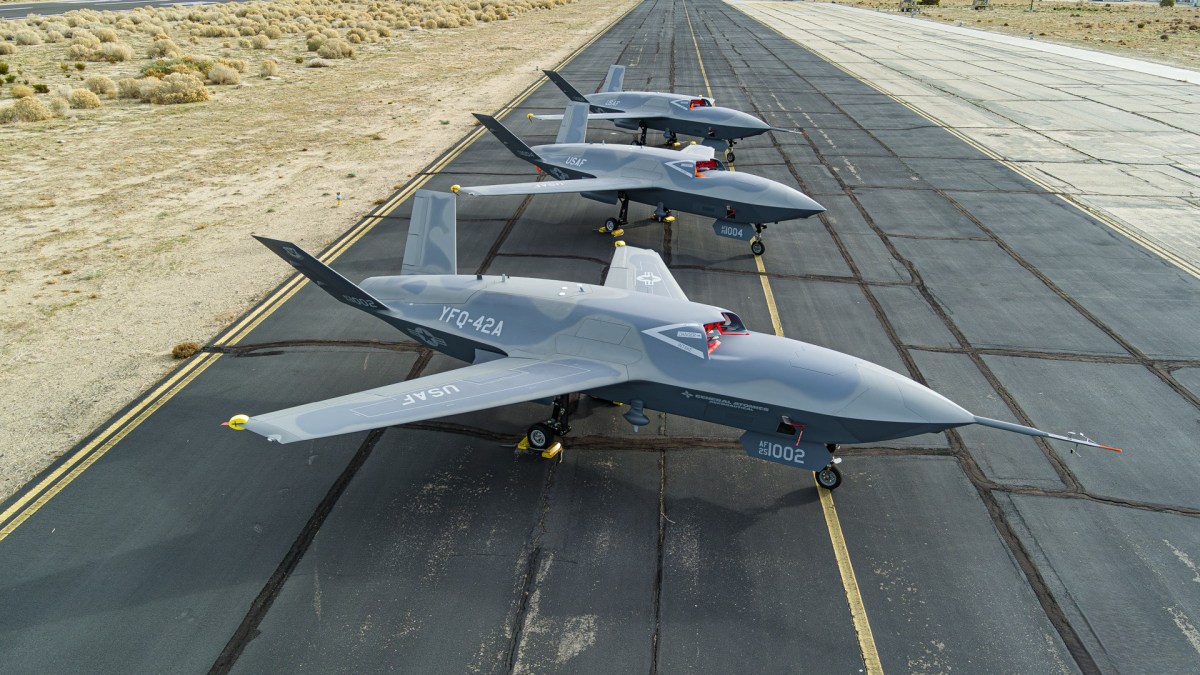
A General Atomics YFQ-42A CCA drone during an earlier test flight. General Atomics
U.S. military officers , including tactical jet pilots , regularly talk about the critical need for trust in autonomous systems to perform as expected when directed in future operations. Establishing that trust, and doing so in real-world environments, is seen as foundational to answering larger outstanding questions about how CCA-type drones will be deployed, launched, recovered, supported, and otherwise operated , let alone employed tactically.
The EOU, together with other partners within the U.S. military and industry , have been working for years now to validate and improve autonomous capabilities in the virtual realm , and then test in more limited real-world contexts . Virtualized testing does offer immense benefits for rapid iterative development of the underlying software ahead of live demonstrations.
“If it’s in a simulated environment, it’s immediate,” Lt. Col. Bartlett said during the panel when asked about the “feedback loop” in testing the EOU is already taking part in. In that environment, “when the mission autonomy iterations are happening, our guys are literally with the programmers … They give the feedback, and if it’s possible to do immediately, they take that feedback. If not, then they work on it on the next turn of the software.”
Real-world testing, of course, offers opportunities to explore additional aspects of future CCA operations, including when it comes to loading weapons and maintenance. A key component of the Air Force’s vision for CCA employment is being able to forward deploy the drones to far-flung locations , including airstrips with limited infrastructure and access to logistics chains. Rapid, distributed deployments like this are central to still-evolving concepts of operations currently referred to collectively as Agile Combat Employment (ACE). The EOU has been involved in at least two rounds of ACE-focused testing this year, one at Edwards Air Force Base in California in April and another at Creech Air Force Base in Nevada in July. TWZ was the first to report on the latter event .
During the panel today, Lt. Col. Bartlett also talked more generally about work EOU has done to date. This has included exploring “sortie generation, how easy they are to maintain, [and] how small a footprint could be.”
“We’ve been pleasantly surprised. The jets are extremely easy to maintain,” he continued. “We’re at a one-to-one maintainer-to-airplane ratio, which is crazy small.”
With “CCAs, [it] seems like because they’re a little bit simpler, because their role is so focused, what we found is that just about any – not just about, but we found that any AFSC [Air Force Specialty Code; alphanumeric codes used to identify specific jobs within this service] can be trained to generate sorties to load weapons, and we’ve done some of those things already,” he further explained. “It’s our job to bring them [CCAs] out and make sure that, beyond the technical specifications of it, that we’re kind of experimenting with the more complex things like logistics, and C2 [command and control, and how do we battle manage these things.”
Airmen prepare to load an inert AIM-120 Advanced Medium Range Air-to-Air Missile onto a YFQ-44A CCA drone. USAF/Senior Airman Renee Blundon
The head of the EOU did acknowledge challenges that still have to be surmounted. This notably includes hurdles currently imposed by Federal Aviation Administration (FAA) regulations on the operation of fully uncrewed aircraft, even by the U.S. military, within U.S. airspace. This is further compounded by the explicit intention to operate CCAs with far more minimal human engagement compared to most existing drones.
“Mission autonomy is going to be the secret sauce that lets these things become decisive or not, and we’ll know that over the next couple years as that develops,” according to Bartlett. “If I were to identify the two biggest problems from the trenches of the EOU, [one] is FAA integration or policy implications to an autonomous airplane.”
“So these things don’t have pilots. They’re not RPAs [remotely-piloted aircraft]. They’re not manned fighters. They have no pilots,” he continued. “Our system is not set up for that, and that is a challenge that we are finding extremely hard to navigate through, and to not go around, but to make a policy.”
“We need to make sure the Air Force is ready for these things, to set policies that make sure the enterprise and the country is [sic] ready to receive these, and internalize an autonomous fighter that does not have a pilot that is running on a mission autonomy agent that doesn’t listen to ATC [air traffic control],” he added.
Another look at a YFQ-44A prototype during at test in 2026. USAF
The second problem, per Bartlett, is making sure the Air Force develops new internal policies and doctrine that are not “copy and pastes from old regulations” that do not take into account the specific nuances that CCAs will bring. What the service needs is “something that enables us to move quickly with these things, to weigh what we need, and to experiment with novel types of air superiority.”
All of this circles back to the discussion of trust in autonomous capabilities. It also speaks to the potential for future operations where CCAs could operate far more independently.
“It’s in the name that they’re collaborative,” Bartlett said. “Taking them out of that could technically be effective, but would not enhance the joint force the way that we see a collaborative, integrated force package to be.”
“What we need autonomously to do is written down. I won’t discuss the particulars in this forum, but we know what we need it to do, or we know what we think it really needs to do,” he noted. “We’ve structured our experimentation game plan to analyze ‘can it do those things?,’ and if not, then how do they need to be different? And then as they iterate on it, which we’ve already seen a couple times, we get that at the EOU, we get the new version down, we fly it again. Is it fixed? Yes or no.”
A General Atomics YFQ-42A seen from another angle during earlier testing. General Atomics
Some members of industry are clearly envisioning futures with different definitions of ‘collaborative’ that could lean more toward independent operations involving highly autonomous drones.
What “the whole entire program is trying to do is [figure out] what is the requirement to put out into the field to get to the warfighter and to start operating this thing this [sic; in] real time?” Robert “Otis” Winkler, Vice President of Corporate Development & National Security Programs at dronemaker Kratos, another one of the panelists, said. “The collaborative part of this makes it a much easier, I think, technical problem to be able to limit and grow the autonomy as you field this.”
“I think eventually we may see these aircraft utilized as collaborative aircraft, but not in conjunction with your traditional pulsed operation, but in support of that pulsed operation when the pulse isn’t there yet. But I do think that that is a bit of a stretch goal that’s going to be down the road.”
CCAs “have been designed really around increasing both survivability and lethality of current force packages. So there are many manned platforms that you would describe in the exact same fashion,” Jason Levin, Senior Vice President for Air Dominance and Strike at Anduril, who was also on the panel, said. He was responding here to a specific question about whether his use of the term “fighter” to describe these drones implied more emphasis on independent operations.
All of this underscores the importance of bringing CCAs to Emerald Flag in December, as well as other events in the future offering opportunities to see how the drones really fit in with other crewed platforms. The Air Force is hoping to start seeing CCAs enter operational service around the end of the decade , and have 500 of them, at least, in inventory by 2032 .
During the panel today, the EOU’s Lt. Col. Bartlett made clear that “we’re going to learn a lot over the next couple years.”
Contact the author: joe@twz.com
Comments couldn’t be loaded. Please refresh the page.
作者:约瑟夫·特雷维西克
发布于美国东部时间2026年9月15日晚上8:25
美国空军协同作战飞机(CCA)将于今年晚些时候首次参加大规模兵力部署(LFE)演习。派遣CCA参加下一轮“翡翠旗”测试演习,是无人机投入作战部署的又一重要里程碑。
“我们还没有真正与这些联合作战中心(CCA)进行过实战演练(LFE)。第一次演练将是‘翡翠旗’演习,时间是12月,”内华达州内利斯空军基地实验作战部队(EOU)作战主任林登·“奥托”·巴特利特中校今天早些时候表示。“这将是我们首次试探性地进行实际部队整合。”
美国空军的一架YFQ-44A“狂怒”CCA无人机与一架F-35联合攻击战斗机一同飞行。安杜里尔
巴特利特是在空军与航天部队协会(AFA)2026年空天网络大会的一个小组讨论会上发表上述讲话的,TWZ也出席了此次大会。EOU一直领导着空军为未来CCA作战奠定基础的工作。该部队已经使用通用原子公司FQ-42A“复仇”和安杜里尔公司FQ-44“狂怒”的原型机进行了各种类型的测试。空军在6月份宣布,其最初的CCA作战机队将由FQ-42和FQ-44混合组成。
美国空军第96测试联队于2020年首次在佛罗里达州埃格林空军基地举办“翡翠旗”演习。该系列演习历来侧重于展示新型和改进型空中网络架构以及其他指挥控制能力,这些能力对于未来的协同作战能力至关重要。“翡翠旗”演习并非完全局限于空中领域,通常与其他大规模部队测试演习系列相结合。美国其他军种也定期参与其中。
值得注意的是,波音公司的MQ-28“幽灵蝙蝠”无人机(一种CCA型设计)曾于今年早些时候参加了“勇敢之盾26”(Valiant Shield 26)演习,这是另一项低强度飞行演习(LFE)。欧洲联合作战部队(EOU)也参与其中。然而,MQ-28最初是为澳大利亚皇家空军开发的,目前尚未正式纳入美国空军的CCA项目。
巴特利特中校补充道:“在OTTO看来,12月的‘翡翠旗’演习将是我们首次进行端到端CCA(进攻性反空袭)链的实战演示。这将是我们首次整合第四代和第五代联合OCA(进攻性反空袭)体系。规模虽小,但我认为正是这类基础性训练才能建立起CCA体系中诸如信任等无形优势。”
他继续说道:“这些经验教训与技术知识同样重要,比如无线电是否正常工作?我按下的‘目标’按钮是否正常工作?”
一架通用原子公司YFQ-42A CCA无人机在早期的试飞中。通用原子公司
包括战术喷气式飞机飞行员在内的美国军官经常谈到,在未来的作战行动中,必须建立对自主系统的信任,确保其在接到指令后能够按预期执行任务。建立这种信任,尤其是在真实环境中,被视为解答诸如CCA型无人机如何部署、发射、回收、维护以及其他操作等一系列悬而未决的问题的基础,更不用说将其用于战术用途了。
EOU 与美国军方和工业界的其他合作伙伴多年来一直致力于在虚拟环境中验证和改进自主能力,然后在更为有限的真实环境中进行测试。虚拟化测试确实为在现场演示之前快速迭代开发底层软件提供了巨大的优势。
“如果是在模拟环境中,反馈是立竿见影的,”巴特利特中校在小组讨论中被问及EOU目前正在参与的测试中的“反馈循环”时说道。在这种环境下,“当任务自主性迭代进行时,我们的人员会与程序员们一起工作……他们提供反馈,如果可以立即实施,他们就会采纳这些反馈。如果不行,他们就会在软件的下一轮迭代中进行改进。”
当然,实战测试为探索未来CCA作战的其他方面提供了机会,包括武器装载和维护。空军CCA部署愿景的关键组成部分是能够将无人机前沿部署到偏远地区,包括基础设施有限、后勤保障不足的简易机场。这种快速、分散的部署对于目前统称为“敏捷作战部署”(ACE)的、仍在不断发展的作战概念至关重要。今年,EOU至少参与了两轮以ACE为重点的测试,一次是4月份在加利福尼亚州的爱德华兹空军基地,另一次是7月份在内华达州的克里奇空军基地。TWZ率先报道了后一次测试。
在今天的小组讨论中,巴特利特中校还更广泛地谈到了EOU迄今为止所做的工作。这包括探索“出动架次生成、维护的便捷性以及占地面积的最小化”。
“我们感到非常惊喜。这些喷气式飞机维护起来极其容易,”他继续说道。“我们的维护人员与飞机比例是1:1,这简直太低了。”
“由于CCA(作战能力评估员)相对简单,职责也更加明确,我们发现几乎任何——不只是几乎,而是任何AFSC(空军专业代码;用于识别空军特定岗位的字母数字代码)都可以接受训练,执行武器装载任务,而且我们已经做了一些这方面的工作,”他进一步解释道。“我们的职责是让他们(CCA)参与进来,确保除了技术规范之外,我们还能尝试一些更复杂的操作,比如后勤保障、指挥控制以及如何进行作战管理。”
空军人员准备将一枚惰性AIM-120先进中程空空导弹装载到YFQ-44A CCA无人机上。美国空军/高级空军兵蕾妮·布伦顿
EOU负责人承认仍有一些挑战需要克服。这尤其包括美国联邦航空管理局(FAA)目前对在美国领空内运行完全无人驾驶飞机(即使是美国军方)所施加的诸多限制。此外,与大多数现有无人机相比,CCA的明确目标是尽可能减少人为干预,这进一步加剧了挑战。
巴特利特表示:“任务自主性将是决定这些事情能否取得决定性成果的关键所在,未来几年随着它的发展,我们将见分晓。如果让我从EOU的实际操作中找出两大难题,[其中之一]是FAA对自主飞机的整合或政策影响。”
“所以这些飞行器没有飞行员。它们不是遥控飞行器,也不是有人驾驶战斗机。它们没有飞行员,”他继续说道。“我们的系统没有为此做好准备,这是一个我们目前面临的极其棘手的挑战,我们无法回避这个问题,而是必须制定相应的政策。”
“我们需要确保空军为这些事情做好准备,制定政策以确保空军和国家做好准备迎接这些事情,并将没有飞行员、依靠任务自主代理运行、不听从空中交通管制指令的自主战斗机内部化,”他补充道。
这是2026年YFQ-44A原型机测试期间的另一张照片。美国空军
巴特利特指出的第二个问题是,如何确保空军制定出新的内部政策和条令,而不是“照搬旧规章”,忽略了协同作战能力(CCA)带来的具体差异。空军需要的是“能够让我们快速推进这些工作、权衡需求并试验新型空中优势的机制”。
这一切最终都回到了对自主能力信任的讨论上。这也预示着未来作战行动中,CCA(协同作战能力)可能实现更加独立的运行。
巴特利特说:“顾名思义,它们都是协作部队。从技术上讲,将它们从协作中移除或许有效,但这并不会像我们所认为的协作一体化部队那样增强联合作战能力。”
“我们需要自主完成的任务都已记录在案。我不会在这个论坛上讨论具体细节,但我们知道它需要做什么,或者说,我们知道它真正需要做什么,”他指出。“我们已经制定了实验方案,分析‘它能做到这些吗?’,如果不能,那么需要做出哪些改变?然后,随着他们不断迭代(我们已经看到几次了),我们在最终用户测试中心(EOU)拿到新版本,再次进行飞行测试。问题解决了吗?是或否。”
这是通用原子公司YFQ-42A发动机在早期测试中从另一个角度拍摄的照片。通用原子公司
一些业内人士显然正在设想未来,他们对“协作”的定义有所不同,未来可能会更倾向于涉及高度自主无人机的独立运营。
“整个项目旨在弄清楚,要让无人机部署到战场上,并能实时投入作战人员使用,需要满足哪些条件?”无人机制造商克拉托斯公司企业发展与国家安全项目副总裁罗伯特·“奥蒂斯”·温克勒(Robert “Otis” Winkler)说道,他也是小组成员之一。“我认为,这种协作方式使得在部署过程中限制和扩展无人机的自主性变得更加容易解决。”
“我认为最终我们可能会看到这些飞机被用作协同作战飞机,但不是与传统的脉冲式作战相结合,而是在脉冲式作战尚未到来时提供支持。但我认为这还是一个比较远大的目标,还需要一段时间才能实现。”
“CCA的设计初衷就是为了提升现有部队的生存能力和杀伤力。因此,许多有人驾驶平台也具备同样的特性,”安杜里尔公司负责空中优势和打击的高级副总裁杰森·莱文(Jason Levin)说道,他当时也在小组讨论中。他是在回答一个具体问题时做出上述表述的,该问题涉及他用“战斗机”一词来描述这些无人机是否意味着更侧重于独立作战。
所有这些都凸显了在12月的“翡翠旗”军演以及未来其他活动中展示CCA无人机的重要性,这些活动将提供机会,让人们了解这些无人机如何与其他人载平台真正协同作战。空军希望CCA无人机能在本十年末开始投入使用,并在2032年之前至少拥有500架。
在今天的小组讨论中,EOU 的巴特利特中校明确表示,“在接下来的几年里,我们将学到很多东西。”
联系作者:joe@twz.com
评论加载失败,请刷新页面。