Europe’s PowerPoint panzer: Can Berlin and Paris pull off a new tank?欧洲的 PowerPoint 坦克:柏林和巴黎能否打造一辆新型坦克?
For German Defense Minister Boris Pistorius, the project is a test of whether the two countries can work together on large defense projects at all.
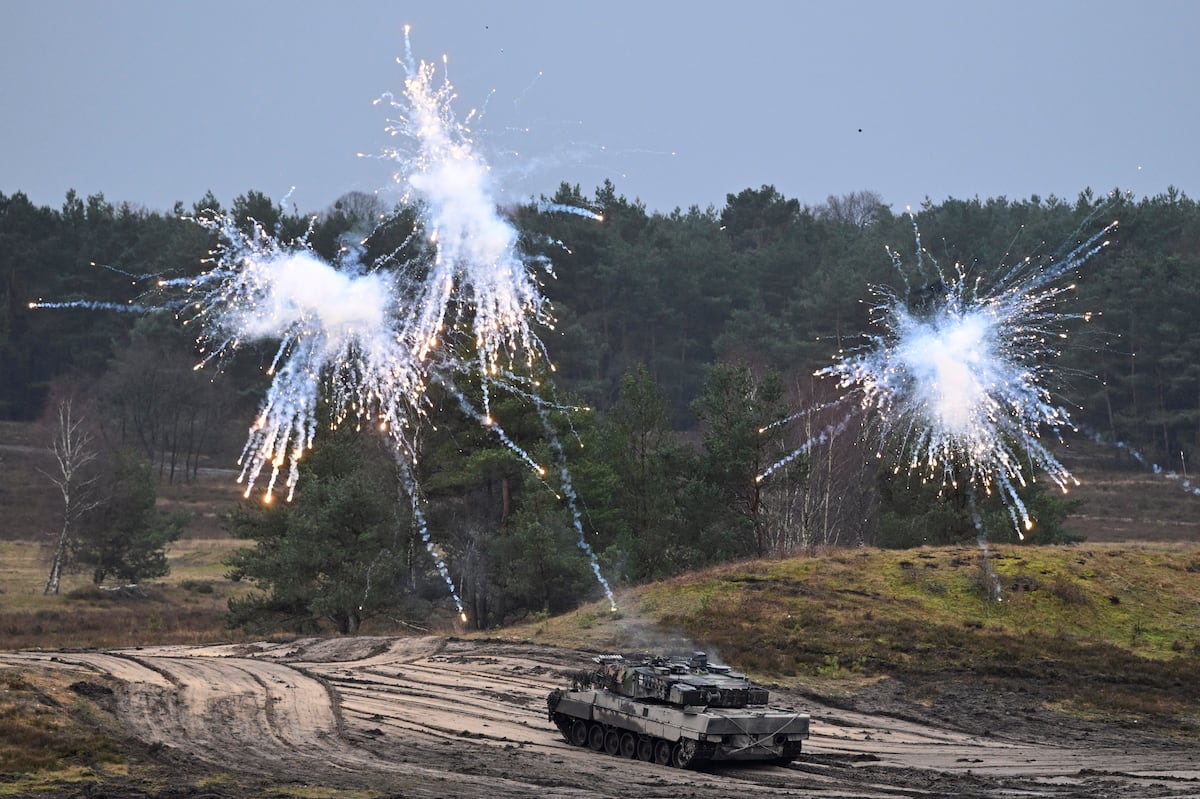
COLOGNE and STUTTGART, Germany — Tanks had fallen somewhat out of fashion — that is, before Feb. 24, 2022, when Russian tanks lined up to invade Ukraine. Conventional military lore holds that when faced with tanks on the battlefield, you’d better have your own.
And while it took more than a year, soon European and American tanks headed to the Ukrainian battlefield. This support for Kyiv has injected an almost mythical expectation into the tank as a guarantor of victory.
Indeed, Ukrainian leaders long had modern tanks near the top of their wish list of military equipment, though some Western officials tried to temper expectations that the steel behemoths’ arrival alone would yield miracles on the battlefield.
As the war draws new attention to the power and promise of the ground platforms, German and French officials are moving to reignite a joint next-generation tank program, perhaps one of the most high-profile illustrations of a renewed push for defense cooperation in Europe. After years of inaction, leaders from both countries are now vowing to make their vision for the Main Ground Combat System, or MGCS, a reality.
The stakes are high, essentially setting up yet another case study to see if European leaders can shake their national vanities and come up with a next-level weapon system. As German Defence Minister Boris Pistorius put it, the question is the “load bearing capacity” of a French-German armament program in the first place.
MGCS — a system of systems, in military speak — entails a novel main battle tank, accompanied by robots and enhanced by artificial intelligence. It is meant to replace the Leopard 2 and Leclerc fleets in Germany and France, respectively, beginning sometime between 2035 and 2040.
The idea hails from 2017, the heyday of the Berlin-Paris connection. The duo of then-German Chancellor Angela Merkel and French President Emmanuel Macron unveiled two major military projects — a new tank and a new warplane — intended to underpin Europe’s newfound defense ambitions with hundreds of billions of euros over their life cycles.
Neither project went according to plan, as the initial top-level enthusiasm gave way to industrial and political infighting over the question of which country, and which company, would lead them.
While the warplane program limped along , the tank initiative simply went quiet.
Speaking to reporters in Berlin this summer, Pistorius and his French counterpart Sébastien Lecornu said they were ready to turn the page after a drawn-out workshare distribution kerfuffle paralyzed the program. French officials had been wary that the inclusion of Germany’s Rheinmetall into the contractor pool, led by KNDS (a German-Franco joint venture of Krauss-Maffei Wegmann and Nexter), would make the project lean too Teutonic.
Krauss-Maffei Wegmann and Rheinmetall are Germany’s Leopard vendors; Nexter is the prime contractor for the French Leclerc.
But besides proclaiming a new can-do attitude and the pledge to meet again this month, there was little to announce in Berlin other than the fact there is now a mutual understanding that Germany will lead the tank program while France spearheads the warplane push, known as the Future Combat Air System, or FCAS.
Defense officials from both countries now hope experience with the FCAS program’s structure and workshare arrangements, however shaky, can propel the tank program forward. That includes the so-called pillar design — groupings of discrete capabilities like propulsion or sensors, each led by one company and supported by a smattering of subcontractors — that could be harvested even if the overall program fails.
In the case of the new tank, the two nations’ army chiefs are expected to come up with a kind of vision paper for the vehicle before the next Pistorius-Lecornu meeting scheduled for Sept. 22. By the end of the year, officials plan to digest the ideas into a single document that Macron and now-German Chancellor Olaf Scholz can use to chart a course.
From there, industry executives have said the onus is on the two governments to convey everything from cost expectations to envisioned performance features.
Ralf Ketzel, who leads Krauss-Maffei Wegmann, told the Münchner Merkur newspaper in August that “nobody has spoken with us about the financial requirements.” Rheinmetall is similarly taking a wait-and-see approach.
So far, government officials are sure only about a certain unpredictability of the end result: The tank that will one day roll out of a factory “will look nothing like today’s tanks,” Lecornu said in Berlin.
The emphasis by both ministers on a new development comes after Krauss-Maffei Wegmann and Rheinmetall signaled privately and publicly they would be able to go it alone with their tank expertise if the Main Ground Combat System program fails.
“We are certain that the Leopard 2, as the world’s most advanced main battle tank, will remain the European main battle tank for decades to come,” a KNDS spokesperson told Defense News.
As for MGCS, the Franco-German company’s “conceptual understanding” is that the envisioned architecture will entail “large-caliber duel capability” as well as unmanned turrets, manned-unmanned-teaming, the ability to deploy and defeat drones, laser technology and beyond-line-of-sight strike weaponry, the spokesperson said.
The main focus of the requirements is likely the vehicle’s firepower, including the type of gun and shell ammunition the tank will employ, said Gaspard Schnitzler, research director at the French Institute for International and Strategic Affairs.
KNDS has proposed a 140mm cannon, while Rheinmetall prefers a 130mm cannon. It remains to be seen which design will make the cut, but the winner will likely determine the NATO standard for a future tank cannon, Schnitzler noted.
Another decision pertains to the balance between mobility, weight and the ability to withstand hits. During Russia’s invasion of Ukraine, both sides have used missiles, unmanned systems, artillery and loitering munitions to crack open armored vehicles. Planners are expected to study those engagements, determining the placement and types of armor reinforcement — to protect elements like the more vulnerable roof and engine sections — while keeping the future tank light enough to use civilian transportation infrastructure for a ride into combat.
To be sure, the German Defence Ministry doesn’t see a direct link between the war in Ukraine and the renewed MGCS push. Asked about lessons learned from the war that could inform features of the envisioned tank, a spokesperson told Defense News there aren’t any because “such scenarios” are already baked into whatever requirements officials previously defined.
The program delay so far makes it difficult to predict if the project will be ready for a time when both nations’ tank fleets are inoperable. That means the pressure is on for France and Germany’s industries to launch this project, but especially for the former.
Germany dominates the European land vehicle market, and its products, chiefly the Leopard tank, have been exported far and wide, compared to Nexter’s Leclerc. France needs the MGCS to reinvigorate its production lines since the Leclerc ceased production in 2008, Schnitzler said.
Meanwhile, German news reports have indicated Krauss-Maffei Wegmann expects to produce its most modern Leopard 2, the A8 variant, through 2032.
“The French really need this tank by 2035, or even 2040 at the latest, while the Germans have an intermediate solution,” which means they could wait until 2045 or so, Schnitzler said. “There’s a risk of a timetable that’s not the same.”
The objectives of the MGCS project, meant to push the envelope of what tanks can do in the 21st century, make the compressed timeline even more “ambitious,” said Dan Darling, a market analyst at the U.S.-based firm Forecast International. When factoring in a potential change in government for both nations in the next several years — Germany’s next federal elections are scheduled for 2025, while France will elect a new president in 2027 — the pressure just keeps increasing, he noted.
As German and French industry officials remain skeptical, some neighboring governments are cautiously rooting for the project, weighing their options for getting involved.
Italian junior defense minister Isabella Rauti said in July a planned purchase of Leopard 2 A8 tanks would keep Rome in play for a role in the Main Ground Combat System program, helping Italy get more closely involved with German industry.
Britain is believed to have retained an interest in the Franco-German program but is also undertaking studies of its own, keeping the door open on other possible platforms, technologies and partner options.
“The U.K. is conducting studies into a future ground combat system along with its technology enablers,” a spokesperson for the British Defence Ministry told Defense News. “This is in coordination with MoD’s science and technology and [British] Army experimental work, and aligns with similar initiatives in Europe and the U.S.”
Britain has discussed signing up at some level on the European program for at least two years, and previously responded positively to taking on an observer status with the MGCS program. British officials said they expect France and Germany to discuss the status of the MGCS program and outline the next steps in the coming months.
For the moment, though, the prime focus of British heavy armor interest is centered not on a next-generation tank but rather upgrading the Army’s aging Challenger 2 tank fleet under a contract awarded to Rheinmetall BAE Systems Land. That work, to the tune of £800 million (U.S. $1 billion) would extend the vehicles’ service lives to around 2040, with 148 tanks of the new Challenger 3 standard to reach the force beginning 2027.
Poland’s government considered partaking in MGCS, but ultimately decided to focus on the more near-term threat of Russia following the invasion of Ukraine, by signing tank contracts with the United States and South Korea.
“Poland was observing this project with interest, and was analyzing the possibility of joining it as it was awaiting the reception of indispensable data, as it has been notified to our German and French partners during talks at various levels,” a spokesperson for the Polish Defence Ministry told Defense News. “Due to the distant implementation schedule of the MGCS project and the lack of decisions on its final form, a decision has been taken to reinforce the Polish Armed Forces with M1 Abrams and K2 Black Panther tanks.”
This said, should Warsaw receive the data it is awaiting, “we will make relevant analyses” with regard to MGCS, according to the spokesperson.
The representative also said the Polish military’s Technical Modernization Plan foresees the acquisition of new tanks under the Wilk program “based on the [Polish] industry or in cooperation with a foreign partner, taking into account the necessity to develop the Polish defense potential.”
This indicates that in the coming years, Warsaw could opt to develop a new tank model in partnership with foreign industry players, including European groups.
Last year, Poland signed a deal worth about $4.75 billion to buy 250 M1A2 Abrams SEPv3 tanks. In January 2023, the country inked a second contract, valued at about $1.4 billion, to acquire 116 used M1A1 Abrams from the United States.
Poland also signed a deal last year to procure about 1,000 K2 Black Panther tanks: 180 units produced by Hyundai Rotem in South Korea, and 820 tanks in the K2PL version to be jointly manufactured by the two nations’ industries.
Meanwhile, the U.S. military appears in no hurry to replace its main battle tank, the venerable Abrams. First fielded in the 1980s, the U.S. Army has banked on upgrade programs ever since, a strategy that is unlikely to change anytime soon, according to analysts.
Manufacturer General Dynamics unveiled its own concept for a next-generation tank, dubbed Abrams X, at the 2022 annual convention of the Association of the United States Army in Washington, but no government program has emerged to that end.
That is because other programs are deemed more important to the U.S. military portfolio, said Mark Cancian, a senior adviser with the Center for Strategic and International Studies think tank in Washington.
For one, the Bradley infantry fighting vehicle is “more vulnerable” and needs to be replaced sooner, Cancian said. Additionally, “there is much more interest in air defense and long-range precision strike.”
There is also the question of whether investments in newfangled tanks are worth it, given the ubiquity of stand-off anti-tank missiles and mines.
“If the Army went to the Office of the Secretary of Defense or Congress and said, ‘We want to start a new tank program based on what we’re seeing in Ukraine,’ most people would say, ‘That’s not what we see,’ ” Cancian said.
Sebastian Sprenger reported from Cologne and Vivienne Machi from Stuttgart in Germany; Andrew Chuter from London; and Jaroslaw Adamowski from Warsaw, Poland.
Sebastian Sprenger is associate editor for Europe at Defense News, reporting on the state of the defense market in the region, and on U.S.-Europe cooperation and multi-national investments in defense and global security. Previously he served as managing editor for Defense News. He is based in Cologne, Germany.
Vivienne Machi is a reporter based in Stuttgart, Germany, contributing to Defense News' European coverage. She previously reported for National Defense Magazine, Defense Daily, Via Satellite, Foreign Policy and the Dayton Daily News. She was named the Defence Media Awards' best young defense journalist in 2020.
Andrew Chuter is the United Kingdom correspondent for Defense News.
Jaroslaw Adamowski is the Poland correspondent for Defense News.
德国科隆和斯图加特——坦克曾经一度显得有些过时——至少在2022年2月24日俄罗斯坦克列队入侵乌克兰之前是如此。传统的军事理论认为,在战场上面对坦克时,你最好也拥有自己的坦克。
虽然历时一年多,但不久之后,欧美坦克便开往了乌克兰战场。这种对基辅的支持,使得坦克被赋予了一种近乎神话般的象征意义,被视为胜利的保证。
事实上,乌克兰领导人长期以来一直将现代化坦克列为他们最渴望获得的军事装备之一,尽管一些西方官员试图降低人们的期望,即这些钢铁巨兽的到来本身就能在战场上创造奇迹。
随着战争使地面平台的威力和潜力再次受到关注,德法两国官员正着手重启一项联合下一代坦克项目,这或许是欧洲防务合作再度加强的最引人注目的例证之一。经过多年的停滞,两国领导人如今誓言要将他们对主战地面作战系统(MGCS)的愿景变为现实。
此事意义重大,实际上又构成了一个案例研究,检验欧洲领导人能否摒弃民族虚荣心,共同研发出新一代武器系统。正如德国国防部长鲍里斯·皮斯托瑞斯所言,问题首先在于法德联合军备项目的“承载能力”。
MGCS——用军事术语来说就是“系统之系统”——包含一种新型主战坦克,配备机器人并由人工智能增强。它计划在2035年至2040年间的某个时间点,分别取代德国和法国现有的豹2和勒克莱尔坦克。
这一构想源于2017年,当时正值柏林与巴黎关系最为密切的时期。时任德国总理默克尔和法国总统马克龙联手推出了两项重大军事项目——新型坦克和新型战机——旨在通过在其整个生命周期内投入数千亿欧元,来支撑欧洲新近萌生的国防雄心。
这两个项目都没有按计划进行,因为最初高层的热情很快被围绕哪个国家和哪家公司将领导这些项目的产业和政治内斗所取代。
战机计划艰难推进的同时,坦克计划却陷入了沉寂。
今年夏天在柏林接受记者采访时,皮斯托瑞斯和他的法国同行塞巴斯蒂安·勒科尔努表示,在旷日持久的工作份额分配纠纷导致项目陷入瘫痪后,他们准备翻开新的一页。法国官员一直担心,将德国莱茵金属公司纳入由KNDS(克劳斯-玛菲·韦格曼和奈克斯特的德法合资企业)牵头的承包商团队,会使该项目过于“德式”。
Krauss-Maffei Wegmann 和 Rheinmetall 是德国的豹式坦克供应商;Nexter 是法国勒克莱尔坦克的总承包商。
除了宣称一种新的务实态度和承诺本月再次会面之外,柏林会议并没有宣布什么,只是双方现在达成共识,即德国将领导坦克项目,而法国将带头推进战机项目,即未来作战空中系统(FCAS)。
两国国防官员现在希望,尽管未来空中作战系统(FCAS)项目的结构和工作分工安排尚不完善,但其经验能够推动坦克项目向前发展。这其中就包括所谓的“支柱式设计”——将推进系统或传感器等独立功能组合在一起,每个功能由一家公司主导,并由少数分包商提供支持——即使整个项目失败,这些功能也能得到利用。
关于新型坦克,预计两国陆军首脑将在9月22日举行的下一次皮斯托瑞斯-勒科尔努会晤之前,就该坦克提出一份愿景文件。到年底,官员们计划将这些想法整理成一份文件,供马克龙和现任德国总理奥拉夫·朔尔茨用来制定方向。
业内高管表示,接下来就看两国政府如何传达从成本预期到预期性能特征等所有信息了。
克劳斯-玛菲·韦格曼公司首席执行官拉尔夫·凯策尔8月份告诉《慕尼黑信使报》,“没有人跟我们谈过财务方面的需求。”莱茵金属公司也采取了类似的观望态度。
到目前为止,政府官员唯一能确定的是最终结果的某种不可预测性:勒科尔努在柏林表示,有朝一日从工厂下线的坦克“将与今天的坦克截然不同”。
两位部长强调这一新进展之前,克劳斯-玛菲·韦格曼公司和莱茵金属公司曾私下和公开表示,如果主战坦克系统项目失败,他们将能够凭借自身的坦克技术独立推进该项目。
“我们确信,作为世界上最先进的主战坦克,豹2坦克将在未来几十年内继续成为欧洲的主战坦克,”KNDS的一位发言人告诉《防务新闻》。
发言人表示,就MGCS而言,这家法德合资公司的“概念理解”是,设想中的架构将包括“大口径对决能力”以及无人炮塔、有人-无人协同作战、部署和击败无人机的能力、激光技术和超视距打击武器。
法国国际与战略事务研究所研究主任加斯帕德·施尼茨勒表示,这些要求的重点很可能是车辆的火力,包括坦克将使用的火炮和炮弹类型。
KNDS公司提出了一款140毫米火炮方案,而莱茵金属公司则倾向于130毫米火炮。施尼茨勒指出,最终哪种设计方案能够胜出还有待观察,但胜出的方案很可能决定北约未来坦克火炮的标准。
另一个需要考虑的决定是机动性、重量和抗击打能力之间的平衡。在俄罗斯入侵乌克兰期间,双方都使用了导弹、无人系统、火炮和巡飞弹来击穿装甲车辆。规划人员预计将研究这些交战案例,确定装甲加固的位置和类型——以保护诸如车顶和发动机舱等较为脆弱的部件——同时还要保证未来的坦克足够轻便,能够利用民用交通工具运送到战场。
诚然,德国国防部并不认为乌克兰战争与重启MGCS项目之间存在直接联系。当被问及从战争中汲取的经验教训是否能为设想中的坦克提供借鉴时,一位发言人告诉《防务新闻》,目前尚无此类经验教训,因为“此类情况”早已纳入了官员们此前制定的所有需求之中。
该项目目前的延误使得预测其能否在两国坦克部队都无法作战时投入使用变得困难。这意味着法国和德国的工业界都面临着启动该项目的压力,尤其是法国。
德国在欧洲陆地车辆市场占据主导地位,其产品,尤其是豹式坦克,出口范围远超奈克斯特公司的勒克莱尔坦克。施尼茨勒表示,自勒克莱尔坦克于2008年停产以来,法国需要MGCS来重振其生产线。
与此同时,德国新闻报道指出,克劳斯-玛菲·韦格曼公司预计将生产其最先进的豹2坦克,即A8型,直至2032年。
施尼茨勒说:“法国人确实需要在2035年,最迟2040年之前获得这款坦克,而德国人则有一个折中的方案,”这意味着他们可以等到2045年左右。“这存在时间表不一致的风险。”
美国市场研究公司Forecast International的市场分析师丹·达林表示,MGCS项目旨在突破21世纪坦克性能的极限,其紧迫的时间表更显“雄心勃勃”。他还指出,考虑到未来几年两国政府可能发生更迭——德国的下一次联邦选举定于2025年举行,而法国将在2027年选出新总统——压力只会与日俱增。
尽管德国和法国的行业官员仍然持怀疑态度,但一些邻国政府正在谨慎地支持该项目,并权衡参与其中的各种选择。
意大利国防部副部长伊莎贝拉·劳蒂 (Isabella Rauti) 在 7 月份表示,计划购买豹 2 A8 坦克将使罗马继续参与主战地面作战系统计划,帮助意大利与德国工业更紧密地联系在一起。
据信英国仍然对法德合作项目感兴趣,但同时也在进行自己的研究,对其他可能的平台、技术和合作伙伴选择持开放态度。
英国国防部发言人告诉《防务新闻》:“英国正在对未来的地面作战系统及其技术配套设施进行研究。这项工作与国防部的科技部门和英国陆军的实验工作相协调,并与欧洲和美国的类似举措相一致。”
英国至少两年来一直在讨论加入欧盟的这项计划,此前也曾积极回应以观察员身份参与“全球海上安全合作计划”(MGCS)。英国官员表示,他们预计法国和德国将在未来几个月内讨论MGCS计划的现状,并概述下一步计划。
不过,目前英国重型装甲部队的主要关注点并非下一代坦克,而是根据授予莱茵金属BAE系统陆地公司的合同,对陆军老旧的挑战者2型坦克进行升级改造。这项耗资8亿英镑(约合10亿美元)的工程将使这些坦克的服役寿命延长至2040年左右,其中148辆符合新型挑战者3标准的坦克将于2027年开始交付部队。
波兰政府曾考虑参与MGCS项目,但最终决定将注意力集中在俄罗斯入侵乌克兰后更为紧迫的威胁上,并与美国和韩国签订了坦克合同。
波兰国防部发言人告诉《防务新闻》:“波兰一直密切关注该项目,并分析加入的可能性,同时也在等待关键数据的到来。此前,我们在与德国和法国伙伴的各级会谈中已获悉此事。” 他还表示:“由于MGCS项目实施时间尚远,且最终方案尚未确定,因此我们决定以M1艾布拉姆斯主战坦克和K2黑豹坦克来加强波兰武装部队的装备。”
发言人表示,即便如此,如果华沙方面收到其所期待的数据,“我们将对MGCS进行相关分析”。
该代表还表示,波兰军队的技术现代化计划预见到,将根据“威尔克”计划采购新型坦克,“基于波兰工业或与外国伙伴合作,同时考虑到发展波兰国防潜力的必要性”。
这表明,在未来几年,华沙可能会选择与包括欧洲集团在内的外国工业参与者合作开发一种新的坦克型号。
去年,波兰签署了一项价值约47.5亿美元的协议,购买250辆M1A2艾布拉姆斯SEPv3型坦克。2023年1月,该国又签署了第二份合同,价值约14亿美元,从美国购买116辆二手M1A1艾布拉姆斯主战坦克。
波兰去年也签署了一项协议,采购约 1000 辆 K2 黑豹坦克:其中 180 辆由韩国现代 Rotem 公司生产,820 辆为 K2PL 版本,将由两国工业联合生产。
与此同时,美军似乎并不急于更换其主战坦克——老旧的艾布拉姆斯坦克。艾布拉姆斯坦克于上世纪80年代首次服役,此后美国陆军一直依赖升级改造项目,分析人士认为,这一策略短期内不太可能改变。
制造商通用动力公司在 2022 年华盛顿举行的美国陆军协会年会上推出了其下一代坦克概念,名为艾布拉姆斯 X,但目前还没有任何政府项目启动该项目。
华盛顿战略与国际研究中心高级顾问马克·坎西安表示,这是因为其他项目对美国军方来说更为重要。
坎西安表示,首先,布雷德利步兵战车“更加脆弱”,需要尽快更换。此外,“人们对防空和远程精确打击的兴趣也大大增加”。
考虑到远程反坦克导弹和地雷的普遍存在,投资新型坦克是否值得也是一个问题。
坎西安说:“如果陆军去国防部长办公室或国会说,‘我们想根据我们在乌克兰看到的情况启动一个新的坦克项目’,大多数人会说,‘我们看到的并非如此’。”
Sebastian Sprenger 从德国科隆报道,Vivienne Machi 从德国斯图加特报道;Andrew Chuter 从英国伦敦报道;Jaroslaw Adamowski 从波兰华沙报道。
塞巴斯蒂安·斯普伦格是《防务新闻》欧洲版副主编,负责报道该地区的防务市场状况,以及美欧在防务和全球安全领域的合作和多国投资。此前,他曾担任《防务新闻》执行主编。他现居德国科隆。
薇薇安·马奇是驻德国斯图加特的一名记者,主要负责《防务新闻》的欧洲报道。她此前曾为《国家防务杂志》、《防务日报》、《卫星通讯》、《外交政策》和《代顿每日新闻》撰稿。2020年,她荣获防务媒体奖最佳青年防务记者称号。
Andrew Chuter 是《防务新闻》的英国记者。
Jaroslaw Adamowski 是《防务新闻》驻波兰记者。