Industrial Base Concerns Over Building F/A-XX And F-47 Remain: Top Pentagon Procurement Officer五角大楼最高采购官员:建造F/A-XX和F-47战斗机的工业基础问题依然存在
Gen. Dale White says while the F-47 will fly by 2028, doing F/A-XX at the same time is concerning, but that's not unique to just next gen fighters.
By Howard Altman , Tyler Rogoway
Published Sep 16, 2026 11:55 AM EDT
As both the Navy and the USAF were racing to field a new generation of advanced tactical jets , the seagoing service’s program hit a wall. A major reason behind this from the Pentagon was concern that the U.S. industrial base could not handle simultaneous final development and production of two extremely complex new fighter aircraft. This was a controversial justification that many had a hard time swallowing. The Navy’s program, dubbed F/A-XX, is supposedly back on and a down-select on who will build it is coming soon, but that concern appears to linger among at least one of the Department of War’s top acquisition officials.
Though he remains confident that the U.S. Air Force F-47 sixth-generation fighter will fly in the next two years, Air Force Gen. Dale R. White , Director, Critical Major Weapon Systems — the service’s leading weapons procurement advisor — remains concerned about the overall capacity of industry to provide the military with the aircraft it needs, including two new fighters. His comments were in response to questions about the Navy’s challenges in building its own sixth-gen fighter alongside F-47.
The concerns are “not unique” to the F-47 or the Navy’s program but the problem exists to various degrees across the industrial base too, White told reporters Tuesday during a media roundtable at the Air & Space Forces Air, Space and Cyber Conference that TWZ is attending.
White has a dual-hatted role, serving as the Pentagon’s top weapon’s procurement officer and as the senior acquisition advisor to the Secretary of the Air Force for all acquisition matters.
A rendering of the F-47. (U.S. Air Force) U.S. Air Force
“We’re seeing it in multiple platforms,” said White, who did not elaborate. “And so what we’re having to do is, at some point, we’re having to make some trade space in between some of these.”
“I see Boeing making smart investments,” White said of the prime contractor of the F-47, selected for the U.S. Air Force’s Next Generation Air Dominance (NGAD) ‘fighter’ initiative. “They have a lot of CAPEX [capital expenditure] that they’re pouring in, but we have to get through the process of the design piece, getting that completed and closed out. Then we all hit some major milestones with things like flight tests and software and those things.”
F-47 specifications infographic (USAF)
“Really, it’s just being able to manage the overall resourcing as it relates to number one, people resources,” the general added. “Number two, when you start getting into the production conversation, do we have enough capacity to be able to produce at that rate? And so, by and large, I have concerns. I have concerns about the capacity of our industrial base, but they are not unique to F-47 or to any program.”
As for the F-47, White said the program “continues to progress exceptionally well.”
“As you know, many, many years in tech maturation and risk reduction gave us a tremendous head start on this program,” White explained. “Extremely proud of what the team has done, what they continue to do each and every day. We are still absolutely on path to be able to hit the mark of flying within this administration. So we see no issues in front of us right now.”
While the first example of the F-47 has been in production for about a year now , the Navy has yet to even select a prime contractor for its next generation fighter. The current competitors for the F/A-XX are Boeing and Northrop Grumman . A decision was supposed to have been made by last month.
“The F/A-XX program remains on track, and we have no further information to provide at this time,” a Navy official told us last week.
Despite intervention from Congress , the next-generation carrier-based fighter has remained in question since the Pentagon moved to effectively shelve the program last year.
In response to a question from TWZ earlier this year, the Chief of Naval Operations acknowledged the uncertainty over the F/A-XX program.
“One of the challenges we’re seeing is, not only [are] our peer competitors improving their capability for anti-air, either air-to-air or surface-to-air, but the lower cost of entry of very capable weapons is also making more players on the field in which that level of stealth and technology is required,” Adm. Daryl Caudle told us back in April at the Sea-Air-Space 2026 exposition. “So this is not about the need for a peer adversary. This is just having an aircraft that can operate with a level of uncertainty and with the acceptable level of risk.”
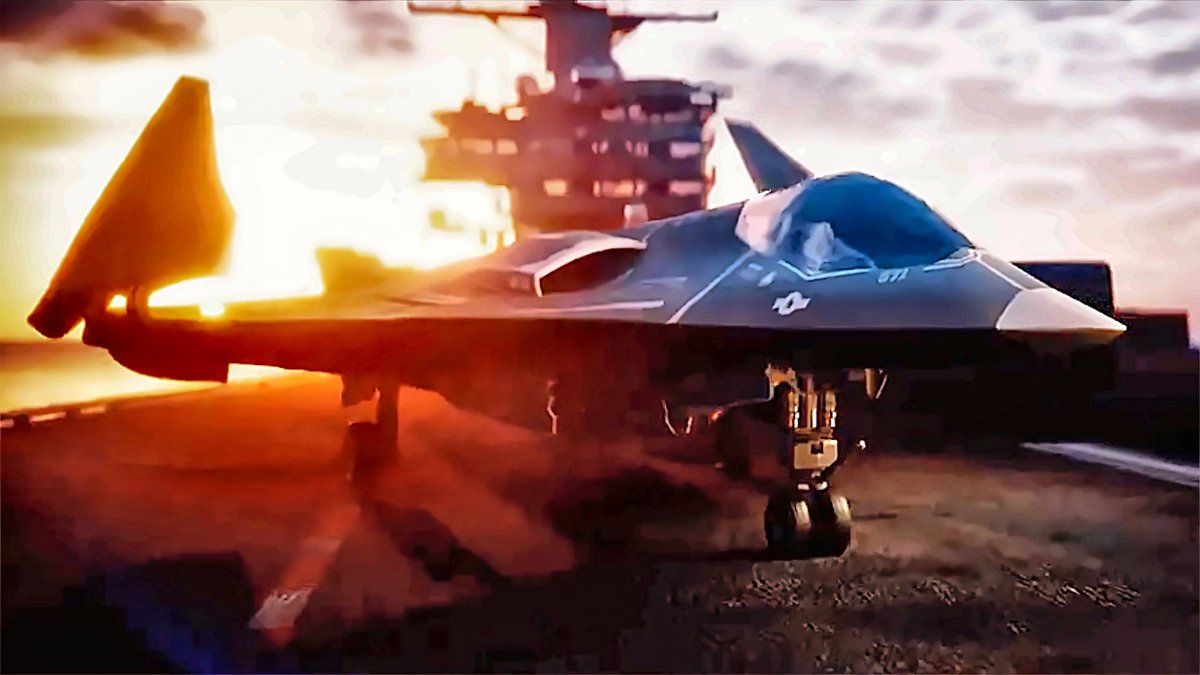
With Boeing as a finalist, it is also possible that F/A-XX could be a variant of the F-47. As we noted in a past story , the Boeing render for its F/A-XX concept is remarkably similar to artwork for its F-47.
Likely a navalized F-47 variant as expected. https://t.co/4lZkpUjqfz — Tyler Rogoway (@Aviation_Intel) August 28, 2025
Likely a navalized F-47 variant as expected. https://t.co/4lZkpUjqfz
Last year, Steve Parker, Boeing Defense and Space CEO, said he didn’t see a problem with his company building both jets stating that this had been part of the strategy all along.
If this is the case, the company’s claim that it would not have a problem building both the Navy and Air Force next-generation fighters would make more sense. There are a number of advantages when it comes to establishing a high-degree of commonality between F/A-XX and F-47, although there would also be challenges, especially when it comes to getting the most out of a design that was not meant to operate from a carrier deck and scaling production up for both services. There is already significant sharing of elements of both the Navy’s and Air Force’s sixth-generation fighter programs. So commonality in some subsystems and interoperability is already baked in .
We should hopefully finally get a clearer picture in the coming weeks about the status of the F/A-XX and possibly the answer to who will actually build it, which will give us a better idea of what the industrial base impact actually will be.
Contact the author: howard@twz.com
Comments couldn’t be loaded. Please refresh the page.
作者:霍华德·奥特曼、泰勒·罗戈威
发布于美国东部时间2026年9月16日上午11:55
在海军和空军竞相研发新一代先进战术喷气式战机之际,海军的研发项目却遭遇了瓶颈。五角大楼给出的一个主要原因是,他们担心美国的工业基础无法同时应对两款极其复杂的新型战斗机的最终研发和生产。这一理由颇具争议,令许多人难以接受。海军的F/A-XX项目据称已经重启,制造商的最终选定工作也即将展开,但至少一位美国陆军部高级采购官员似乎仍然对这一问题心存疑虑。
尽管美国空军关键主要武器系统主管、空军首席武器采购顾问戴尔·R·怀特上将仍然相信美国空军的第六代战斗机将在未来两年内投入使用,但他同时对整个工业界能否为军方提供所需的飞机(包括两款新型战斗机)表示担忧。他的这番言论是对有关海军在建造其第六代战斗机(与F-47并行)时所面临挑战的问题的回应。
怀特周二在空军和太空部队航空、航天和网络会议的媒体圆桌会议上告诉记者,这些担忧“并非F-47或海军项目独有”,而是整个工业基础在不同程度上都存在的问题。TWZ也参加了此次会议。
怀特身兼两职,既是五角大楼最高武器采购官员,又是空军部长所有采购事宜的高级采购顾问。
F-47战斗机的效果图。(美国空军)美国空军
“我们在多个平台上都看到了这种情况,”怀特说道,但他没有详细说明。“所以我们不得不做的是,在某种程度上,我们必须在这些平台之间做出一些妥协。”
“我认为波音公司正在进行明智的投资,”怀特在谈到F-47战斗机的主承包商时说道。F-47是美国空军下一代空中优势(NGAD)“战斗机”计划的指定机型。“他们投入了大量的资本支出,但我们必须先完成设计阶段,确保最终定稿。之后,我们才能在飞行测试、软件开发等关键节点上取得进展。”
F-47 规格信息图(美国空军)
“实际上,关键在于如何管理整体资源,首先是人力资源,”这位将军补充道。“其次,当我们开始讨论生产问题时,我们是否有足够的产能来达到这样的生产速度?所以,总的来说,我对此感到担忧。我担心我们工业基础的产能,但这并非F-47项目或任何其他项目所独有的问题。”
至于 F-47,怀特表示该项目“继续取得非常好的进展”。
“正如你们所知,多年来在技术成熟和风险规避方面的经验使我们在这个项目上拥有了巨大的先发优势,”怀特解释道。“我为团队所取得的成就感到无比自豪,他们每天都在坚持不懈地努力。我们仍然完全有信心在本届政府的领导下实现这一目标。因此,我们目前看不到任何问题。”
虽然首架F-47战斗机已经生产近一年,但海军至今仍未选定下一代战斗机的主承包商。目前F/A-XX的竞标者是波音公司和诺斯罗普·格鲁曼公司。原计划上个月就应该做出决定。
上周,一位海军官员告诉我们:“F/A-XX 项目仍在按计划进行,目前我们没有更多信息可以提供。”
尽管国会进行了干预,但自五角大楼去年搁置该计划以来,下一代舰载战斗机的前景仍然不明朗。
今年早些时候,在回答 TWZ 的提问时,海军作战部长承认了 F/A-XX 项目的不确定性。
“我们面临的挑战之一是,不仅我们的竞争对手在提升其防空能力,无论是空对空还是地对空,而且高性能武器准入门槛的降低也使得更多需要这种隐身技术和装备的厂商涌入战场,”达里尔·考德尔海军上将今年4月在2026年海空航天博览会上告诉我们。“所以,这并非是需要一个势均力敌的对手,而是我们需要一种能够在一定不确定性和可接受的风险水平下作战的飞机。”
波音公司入围最终候选名单,因此F/A-XX也有可能是F-47的衍生型号。正如我们之前报道过的,波音公司F/A-XX概念机的渲染图与F-47的渲染图惊人地相似。
正如预期的那样,很可能是F-47的舰载改进型。https://t.co/4lZkpUjqfz — Tyler Rogoway (@Aviation_Intel) 2025年8月28日
正如预期的那样,很可能是舰载版的F-47。https://t.co/4lZkpUjqfz
去年,波音防务与航天公司首席执行官史蒂夫·帕克表示,他不认为公司同时制造这两款喷气式飞机有什么问题,并指出这始终是公司战略的一部分。
如果情况属实,该公司声称能够同时为海军和空军建造下一代战斗机的说法就更有道理了。F/A-XX 和 F-47 之间建立高度通用性有很多优势,但也存在一些挑战,尤其是在如何最大限度地发挥原本并非为航母起降而设计的战机的性能,以及如何扩大生产规模以满足两军的需求方面。海军和空军的第六代战斗机项目已经实现了相当程度的部件共享,因此某些子系统的通用性和互操作性已经具备。
我们希望在接下来的几周内能够更清楚地了解 F/A-XX 的现状,并可能得到谁将实际建造它的答案,这将使我们更好地了解工业基础的实际影响。
联系作者:howard@twz.com
评论加载失败,请刷新页面。