She failed arts and crafts in school. Now, she makes one-of-a-kind macrame bags while helping others她在学校美术课不及格。现在,她一边制作独一无二的编织包,一边帮助别人。
She once thought she was hopeless at crafts. In her 50s, Lu-lyn Chang found calm, creativity and a new purpose through macrame and Bound Designs.
She once thought she was hopeless at crafts. In her 50s, Lu-lyn Chang found calm, creativity and a new purpose through macrame and Bound Designs.
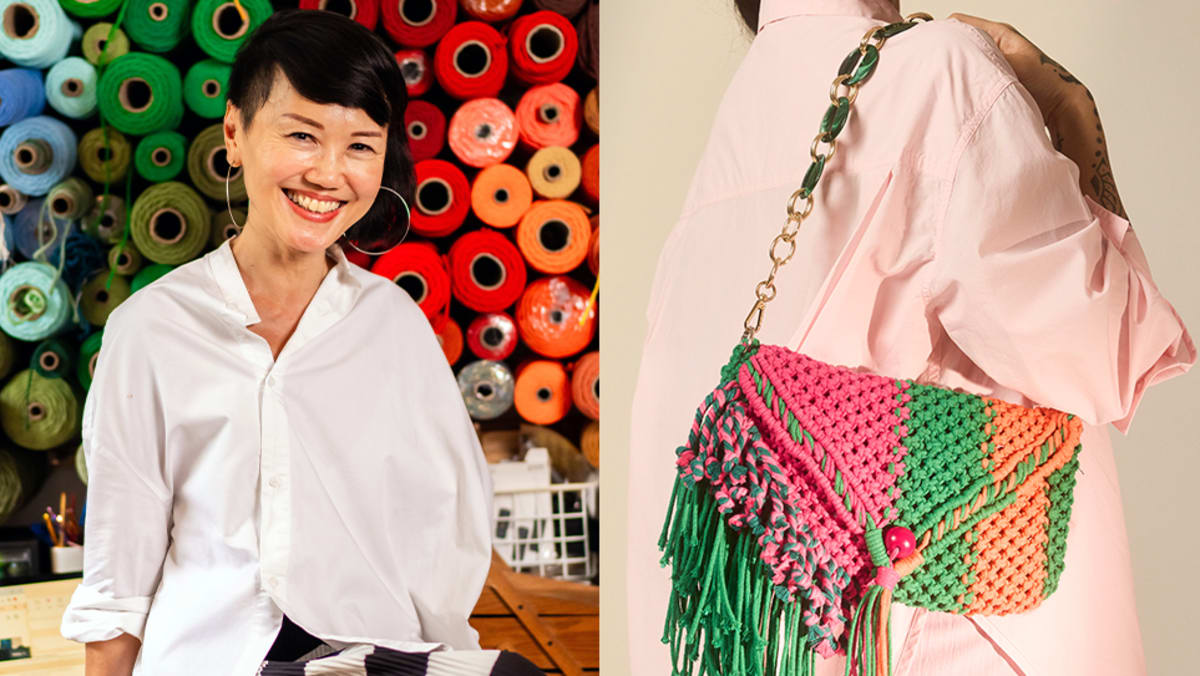
Lu-Lyn Chang founded Bound Designs, creating one-of-a-kind handmade bags instead of reproducing identical designs. (Photos: IAMinVISIBLE and Bound Designs)
This audio is generated by an AI tool.
Looking at the intricate macrame bags that Lu-lyn Chang makes by hand for her accessories brand, Bound Designs , it’s hard to believe she once considered herself completely hopeless at arts and crafts.
“I failed the subject terribly in school and cannot sew or fold a paper aeroplane to save my life,” she told CNA Lifestyle, in an email interview.
Chang, now in her 50s, discovered an unexpected knack for macrame much later in life, after turning to the craft of knot-tying to cope with her anxiety during the COVID-19 pandemic.
Bound Designs founder Ly-lyn Chang. (Photo: Bynd Artisan)
“That was a difficult time for me. It threw so many things out of my control and worrying thoughts occupied my mind. I was constantly thinking about my mum and children catching COVID, and so forth,” she recalled.
Desperate to keep herself occupied, she tried yoga, baking, gardening, meditation and crocheting. Nothing quite worked.
Then she chanced upon a YouTube tutorial on how to make a macrame plant potholder.
“Somehow, I got hooked. The repetitive, rhythmic pattern of knot-tying calmed my mind. The focus on creating the rows of knots did something to align my mind, breath and movement,” she said.
Unlike the other activities she had tried, the sense of calm lingered. “I couldn’t wait to get back to it.”
FROM A HOBBY TO A BUSINESS
It didn’t take long before plant holders gave way to something considerably more ambitious.
Chang had little interest in making the table runners and cushion covers commonly associated with macrame. Looking at the weave one day, she wondered if she could turn it into something she would actually use: a bag.
“So I researched materials and made a simple clutch bag in black. After that, I couldn’t stop,” she said.
She experimented with different colours, knots and materials, gradually developing bags that looked increasingly unlike the traditional macrame pieces that had first introduced her to the craft.
“The more bags I made, the better I got. I showed my girlfriends a few of my creations, and they all ooh-ed and ah-ed, so I ended up making a ton of bags for them,” she recalled with a laugh.
What began as something to occupy an anxious mind was slowly becoming something else.
Eventually, Chang launched Bound Designs, although she doesn’t describe the decision as some grand entrepreneurial epiphany.
A clutch bag from Bound Designs. (Photo: Bound Designs)
“I don’t know if I was inspired to start Bound so much as just taking what, to me, was one logical step after the next,” she said.
Today, Bound Designs' handmade bags start from S$269, while accessories start from S$79.
It is not Chang’s first brush with entrepreneurship. She is also the co-founder of a digital marketing agency she started with two partners in 2000. After selling a majority stake in the business to a UK media company in 2018, she stepped back from a full-time role, giving her more time to pursue other interests.
Bound, however, is a very different kind of business – one Chang is deliberately happy to keep small.
NOT YOUR GRANDMA’S MACRAME
Forget the beige, bohemian macrame of the 1970s.
Chang’s bags are bold, contemporary and often deliberately unruly, with oversized tassels, unexpected textures and dramatic silhouettes that make them difficult to ignore.
That is precisely the point.
A tote bag from Bound Designs. (Photo: Bound Designs)
“I love movement in bags, so the tassels are definitely a key design element. But I can, at times, move completely away from tassels and design something simple and quiet,” she said.
“I design from the heart and make what I like.”
That instinctive approach also means plenty of experimentation – and failure. Behind every finished Bound bag, Chang said, are numerous prototypes that never make it out into the world.
She imagines her pieces on confident women with a wild, creative streak, and says those are often exactly the customers who find her.
“My regular clients don’t care that they are lawyers or bankers who carry bags with gigantic tassels into meetings and town halls. They are confident expressing who they are,” she said.
There is a certain irony in the fact that Chang, who spent decades in marketing, has built a label that resists some of the usual instincts of a growing consumer brand.
(Photo: Bound Designs)
She has little interest in churning out identical versions of a bestseller. Bound remains intentionally small, allowing her to work according to her own creative rhythm. Every bag is a one-off design.
Even when customers ask her to recreate a sold piece, she won’t make an exact copy.
“I always tell clients I will make the bag, but it will be the same, yet different,” she explained.
She might alter the knot pattern or introduce a subtle variation in colour. “It is important for me to make a bag that is unique for that client and that client alone.”
Her materials are equally unpredictable. She has worked with raffia, wool, jute, rattan, recycled sari fabric and denim cords, and inspiration can come from just about anywhere.
“Just the other day, I was having breakfast with my husband and saw a rooster with the most fabulous fiery orange, red and black feathers,” she said with a laugh.
“You’ll be seeing a Bound Designs bag in those shades with feather tassels soon.”
KNOTTING WITH A DIFFERENT PURPOSE
A macrame black and white clutch. (Photo: Bound Designs)
But macrame has given Chang something beyond a creative outlet or a business.
The same repetitive act of knotting that once helped quiet her own anxious mind has become a way for her to connect with others.
She remembers watching a CNA documentary about inmates in Changi Prison and hearing about the anxiety some experienced while incarcerated, particularly when they were powerless to deal with family problems outside.
“Wow, that resonated with me. During COVID, I felt locked up and anxious about everything – I couldn’t sleep,” she recalled.
A chance introduction by a friend eventually brought her to the women’s wing at Changi Prison, where she taught a small group of five inmates how to knot and weave.
Chang with inmates at Singapore Women's Prison. (Photo: Singapore Women's Prison)
“We talked and learnt each other’s stories during my time there,” she said. “After that stint, I became motivated to work with marginalised segments of our society.”
Chang has since become a partner trainer with SG Enable, working on projects involving persons with intellectual disabilities and autistic individuals.
For these collaborations, she teaches participants the craft before engaging and paying them to produce bags, wall art and other pieces for Bound and commercial projects.
Chang at MINDS Singapore. (Photo: MINDS Singapore)
In a sense, macrame has come full circle for Chang: something she discovered because she needed to steady herself has become something she can now share with others.
And perhaps the biggest thing the craft has unravelled is an assumption Chang had carried about herself for much of her life – that creativity simply wasn't something she possessed.
She hopes her story might encourage others to question similar narratives they have built around themselves and what they believe they can or cannot do.
“I had always pictured myself retired, travelling and eating my way around the world, by the time I hit my 50s,” she said.
Instead, she finds herself designing fashion accessories, experimenting with knots and materials, and collaborating with communities and businesses in ways she could scarcely have imagined when she first clicked on that YouTube tutorial.
“But here I am, on this path of self-discovery, creating fashion accessories and working with different communities and businesses whenever I can to give back to society,” she said.
“It fuels my creative streak and fulfils me in a way that makes this phase of my life really exciting.”
For someone who once believed she couldn't even fold a paper aeroplane, it has turned out to be quite the second act.
A single handpicked story that we think you shouldn't miss. Just one a day.
她曾一度认为自己完全不擅长手工。五十多岁时,张璐琳通过编织和Bound Designs找到了内心的平静、创造力和新的目标。
张璐琳创立了Bound Designs,致力于打造独一无二的手工包袋,而非复制千篇一律的设计。(图片:IAMinVISIBLE和Bound Designs)
这段音频是由人工智能工具生成的。
看着 Lu-lyn Chang 为她的配饰品牌 Bound Designs 手工制作的精美编织包,很难相信她曾经认为自己完全不擅长艺术和手工艺。
“我在学校这门课学得很差,就算拼了命我也不会缝纫或折纸飞机,”她在接受 CNA Lifestyle 的电子邮件采访时说道。
现年 50 多岁的张女士在人生后期意外地发现了自己对绳结编织的天赋。在新冠疫情期间,她为了应对焦虑而开始学习绳结编织这门手艺。
Bound Designs创始人Ly-lyn Chang。(图片:Bynd Artisan)
“那段时间对我来说很艰难。很多事情都失去了我的控制,我的脑子里充满了担忧。我总是担心妈妈和孩子们会感染新冠病毒等等,”她回忆道。
为了打发时间,她尝试了瑜伽、烘焙、园艺、冥想和钩针编织。但这些都不太奏效。
然后,她偶然间在 YouTube 上看到一个关于如何制作编织花盆架的教程。
“不知怎么的,我就迷上了打结。重复而有节奏的打结方式让我的心情平静下来。专注于打结的过程,让我的身心、呼吸和动作都协调一致,”她说。
与她尝试过的其他活动不同,这种平静的感觉持续了很久。“我迫不及待地想再次参与其中。”
从爱好到事业
没过多久,植物架就被更具雄心壮志的东西所取代。
张女士对制作常见的绳结工艺品——桌旗和靠垫套——兴趣不大。有一天,她看着编织的绳子,心想自己能不能把它变成一些真正会用到的东西:一个包。
“所以我研究了各种材料,做了一个简单的黑色手拿包。之后,我就停不下来了,”她说。
她尝试了不同的颜色、绳结和材料,逐渐制作出与最初让她接触到这种工艺的传统编织作品越来越不同的包袋。
“我做的包越多,手艺就越好。我给我的闺蜜们看了几个我的作品,她们都赞不绝口,所以我最后给她们做了很多包,”她笑着回忆道。
最初只是为了打发焦虑的心情,却慢慢地演变成了别的东西。
最终,张女士创立了 Bound Designs 公司,尽管她并没有把这个决定描述为某种伟大的创业顿悟。
来自 Bound Designs 的手拿包。(图片:Bound Designs)
“我不知道我创办 Bound 是否受到了启发,只是顺其自然地迈出了一步,”她说。
如今,Bound Designs 的手工包袋起价为 269 新元,配饰起价为 79 新元。
这并非张女士首次涉足创业领域。她曾与两位合伙人于2000年共同创办了一家数字营销机构。2018年,她将公司的大部分股权出售给一家英国媒体公司后,便不再担任全职职务,从而有更多时间追求其他兴趣。
然而,Bound 却是一家截然不同的企业——张先生刻意保持着小规模经营。
这不是你奶奶的编织挂毯
忘掉上世纪70年代那种米色、波西米亚风格的流苏编织吧。
张的包袋设计大胆、现代,而且常常刻意追求不羁,超大的流苏、出人意料的纹理和引人注目的轮廓,让人难以忽视。
这正是关键所在。
来自 Bound Designs 的手提袋。(图片:Bound Designs)
“我喜欢包包的动感,所以流苏绝对是关键的设计元素。但有时候,我也可以完全摒弃流苏,设计出简约低调的款式,”她说。
“我用心设计,做自己喜欢的东西。”
这种凭直觉行事的方式也意味着大量的实验——以及失败。张先生说,每一款最终面世的Bound包袋背后,都有无数从未面世的原型。
她想象中的作品是为那些自信、充满创造力的女性设计的,她说,这些女性往往正是找到她的顾客。
“我的老客户并不在意自己是律师或银行家,也不在意自己拎着缀满流苏的大包去参加会议和市政厅活动。他们自信地展现着自己的身份,”她说。
张先生在市场营销领域耕耘数十年,却打造出一个与新兴消费品牌的一些常见本能背道而驰的品牌,这本身就具有一定的讽刺意味。
(图片:Bound Designs)
她对批量生产畅销书的复制品毫无兴趣。Bound 刻意保持小规模经营,让她能够按照自己的创作节奏工作。每一款包都是独一无二的设计。
即使顾客要求她重新制作一件已售出的作品,她也不会完全复制。
“我总是告诉客户,我会做出这个包,但它会和原来的包一样,但又不一样,”她解释说。
她可能会改变绳结的样式,或者在颜色上做出一些细微的变化。“对我来说,为每位顾客制作独一无二的包包至关重要。”
她使用的材料同样难以预测。她用过拉菲草、羊毛、黄麻、藤条、回收的纱丽布料和牛仔布绳,灵感几乎可以来自任何地方。
“就在前几天,我和丈夫一起吃早餐时,看到一只公鸡,它的羽毛有着绚丽的火橙色、红色和黑色,”她笑着说。
“不久之后,你就会看到一款采用这种色调并带有羽毛流苏的 Bound Designs 包包。”
用途不同的打结
一款黑白相间的手工编织手拿包。(图片:Bound Designs)
但对于张来说,编织不仅仅是一个创意出口或一门生意。
曾经帮助她平静自己焦虑心情的重复打结行为,如今已成为她与他人建立联系的一种方式。
她记得看过一部关于樟宜监狱囚犯的CNA纪录片,片中讲述了一些囚犯在狱中经历的焦虑,尤其是当他们无力处理狱外的家庭问题时。
“哇,这引起了我的共鸣。新冠疫情期间,我感觉被困住了,对所有事情都感到焦虑——我睡不着觉,”她回忆道。
一次偶然的机会,经朋友介绍,她来到了樟宜监狱的女子监区,在那里她教了五名女囚如何打结和编织。
张女士与新加坡女子监狱的囚犯们在一起。(图片:新加坡女子监狱)
“我在那里的那段时间里,我们互相交谈,了解彼此的故事,”她说。“那段经历之后,我更加坚定了为社会弱势群体服务的决心。”
此后,张先生成为 SG Enable 的合作培训师,参与涉及智力障碍人士和自闭症人士的项目。
在这些合作项目中,她会先教参与者相关技艺,然后再聘请他们为 Bound 和其他商业项目制作包袋、墙饰和其他作品,并支付报酬。
张先生在新加坡MINDS基金会。(图片:新加坡MINDS基金会)
从某种意义上说,对于张来说,编织工艺已经形成了一个完整的循环:她最初是因为需要让自己平静下来而发现的编织工艺,现在变成了她可以与他人分享的东西。
或许,这项技艺所揭示的最重要的事情,是张女士一生中大部分时间里对自己抱有的一个假设——那就是她根本不具备创造力。
她希望自己的故事能够鼓励其他人质疑他们围绕自身构建的类似叙事,以及他们认为自己能做什么或不能做什么。
“我一直想象着自己到了 50 多岁的时候退休,环游世界,品尝各地美食,”她说。
相反,她发现自己正在设计时尚配饰,尝试各种绳结和材料,并与社区和企业合作,而这些方式在她第一次点击观看 YouTube 教程时几乎是无法想象的。
“但我现在走上了这条自我发现的道路,创作时尚配饰,并尽可能与不同的社区和企业合作,回馈社会,”她说。
“它激发了我的创作灵感,让我感到充实,也让我的人生这个阶段变得非常精彩。”
对于一个曾经认为自己连纸飞机都折不好的人来说,这已经是她人生中精彩的第二篇章了。
每天一篇,我们精心挑选一篇您不容错过的精彩故事。