Pentagon seeks to ease China’s green tech chokehold amid GOP criticism五角大楼在共和党批评声中寻求放松中国在绿色技术领域的控制。
The Pentagon is trying to scale back China's outsized influence on the critical minerals needed to produce electric vehicles and build solar panels.
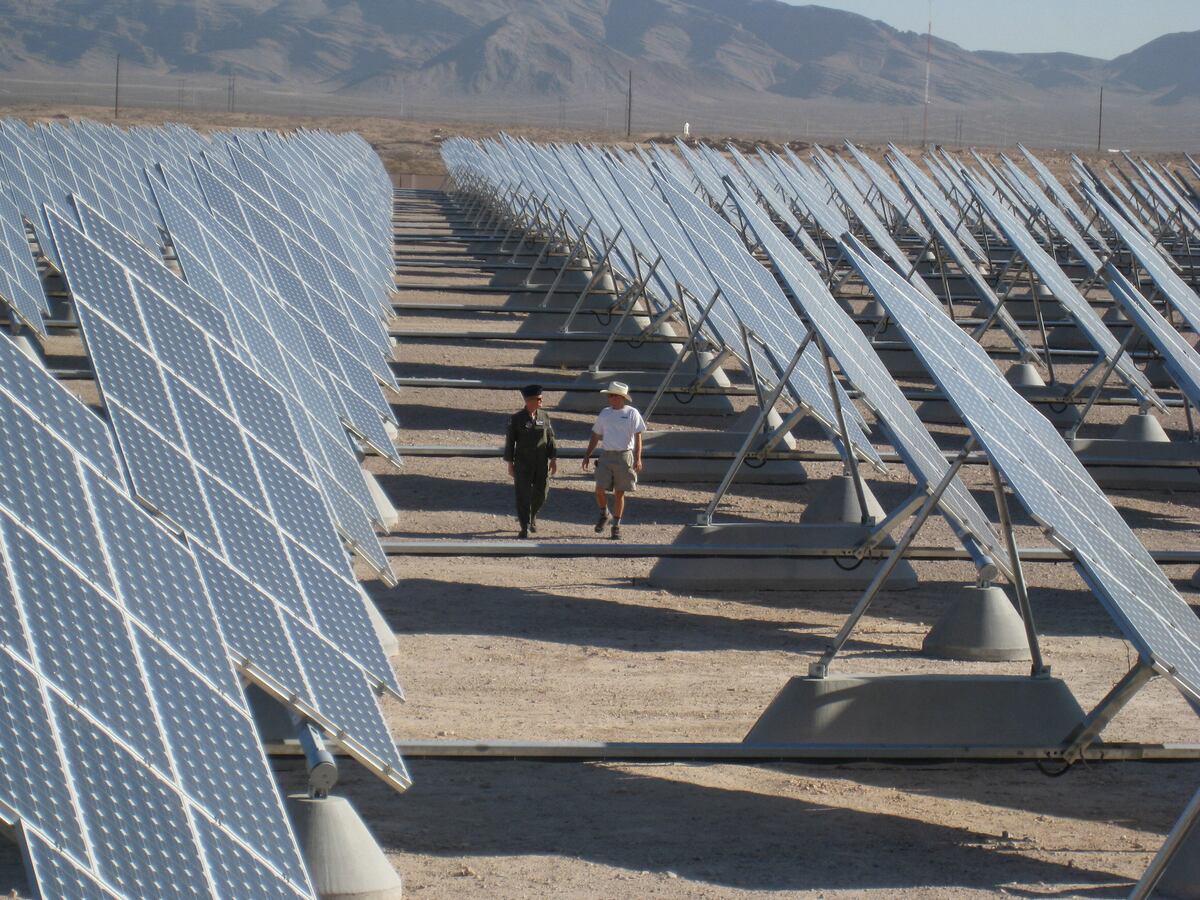
WASHINGTON — The Defense Department, the world’s largest institutional greenhouse gas emitter, is trying to reach net-zero emissions by 2050, even as it seeks to lessen its dependence on China in the renewable energy supply chain.
Republicans on Capitol Hill are pushing back against the Pentagon’s climate goals by invoking China’s dominance over the raw materials necessary to manufacture the electric vehicles and solar panels that the Defense Department needs to meet its emissions-reductions targets.
Sen. Joni Ernst, R-Iowa, took aim at the Pentagon’s goal of transitioning its roughly 170,000 non-tactical vehicle fleet to electricity or alternative fuels by 2030 in an April Senate Armed Services Committee hearing. She accused Energy Secretary Jennifer Granholm of “putting the climate crusade ahead of the [Defense] Department’s lethality,” an exchange the Republican National Committee spotlighted on Twitter.
“Right now, China controls the [electric vehicle] supply chain,” Ernst said in a subsequent floor speech. “The communist regime produces about 75% of all lithium-ion batteries that power those electric vehicles.”
Those batteries are also needed for military assets such as surveillance drones, and the Pentagon is trying to capitalize on recent spending Congress approved to help ease the defense industrial base’s reliance on the China-dominated critical minerals supply chain.
Late last month, Deputy Defense Secretary Kathleen Hicks discussed supply chain diversification with executives from lithium-ion battery and mineral companies Bren-Tronics, EaglePicher, Enersys, Forge Nano, General Motors Defense and Our Next Energy.
“Today, batteries are critical for powering our defense systems—from vehicles and aircraft, to munitions and platforms, to our unmanned systems and satellite systems and more,” Pentagon Spokesman Eric Pahon said in a readout of the April 28 meeting. “Deputy Secretary Hicks emphasized that increasing lethality and maintaining the United States’ asymmetric military edge will depend on advancing battery technology and ensuring a more resilient domestic supply chain.”
Undersecretary of Defense for Acquisition and Sustainment Bill LaPlante released a non-public, lithium-ion battery strategy in February, aimed at increasing the mining and production needed to produce them within the U.S. and friendly countries.
President Joe Biden last year also authorized defense production act authorities to address critical mineral shortfalls in large-capacity batteries. The Pentagon plans to spend $43 million on the effort in fiscal year 2023, which ends Sept. 30. It’s also collaborating with the Energy Department’s Federal Consortium for Advanced Batteries to improve supply chain resilience.
An Energy Department fact sheet issued on Thursday touted more than $95 billion private sector investment in domestic battery production since 2021 alongside 160 new or expanded minerals, processing and manufacturing facilities. The 2021 bipartisan infrastructure law and Democrats’ 2022 budget reconciliation bill included several subsidies for domestic electric vehicle and solar panel manufacturing.
‘Significant risk of disruption’
Rep. Mike Waltz, R-Fla., who chairs the House Armed Services Readiness subcommittee, suggested at an April 19 hearing that he may insert language in this year’s defense authorization bill requiring the Pentagon to certify that these solar panel and electric vehicle materials do not come from China.
“China controls over 80% of solar panel production and 95% of elements needed to produce such product,” Waltz wrote in a letter this week to Army Secretary Christie Wormuth.
Last year, Ernst inserted a provision in the fiscal 2023 defense authorization bill to slow the non-tactical vehicle fleet electric transition by requiring the Pentagon to first supply Congress with a report requiring the Pentagon to identify any components of the vehicles sourced from China.
Democrats counter that the green technology push increases military readiness while reducing emissions.
Sen. Tammy Duckworth, D-Ill., introduced a bill on Wednesday that would require the Pentagon to work with allies and partners to reduce “reliance on fossil fuels and employing more diverse and renewable operation energy sources.”
A factsheet accompanying her bill states “half of the U.S. combat-related casualties in Iraq and Afghanistan were directly tied to fuel and water resupply convoy operations,” citing a RAND Corporation study.
The frequent attacks on these convoys prompted the Defense Department to reduce fuel demand in both countries. For instance, the Marines deployed hybrid generators while relying on battery backups and solar power.
A February 2022 Energy Department report on solar panel supply chains noted that China produces 97% of the world’s silicon wafers need to make solar panels and that Chinese subsidiaries make 75% of the solar cells for modules imported into the U.S.
“The concentration of the [crystalline silicon] supply chain in companies with close ties to China, a country with documented human rights violations and an unpredictable trade relationship with the United States, poses a significant risk of disruption,” states the report.
Wormuth told Waltz at the House Armed Services Committee hearing that “We do need to work to get control of our supply chain so that the critical components we have, we control.”
Waltz pressed her on the origins of components for the new floating solar farm at Fort Bragg.
Ironically, an Army spokesperson told Defense News on Friday that the modules for the Fort Bragg solar farm were manufactured in South Korea before final assembly in Alabama.
A February 2022 Defense Department report on critical supply chain highlights the challenge of addressing China’s hold on solar panels and lithium batteries alike.
“Even materials and components manufactured domestically often have reliance on China-produced precursors or are fragile suppliers and single point failures within the supply chain,” it states. “As electrification is expected to accelerate dramatically by 2030, reliance on China will grow and China’s relative cell dominance is projected to remain stable.”
For instance, China has a majority ownership of 70% of the cobalt – an essential component of lithium-ion batteries – mined in the Democratic Republic of Congo, the world’s largest supplier of the metal.
China’s critical mineral dominance gives it significant leverage over other crucial defense supply chains, including the antimony alloy needed to produce ammunition .
Bryant Harris is the Congress reporter for Defense News. He has covered U.S. foreign policy, national security, international affairs and politics in Washington since 2014. He has also written for Foreign Policy, Al-Monitor, Al Jazeera English and IPS News.
Jen Judson is an award-winning journalist covering land warfare for Defense News. She has also worked for Politico and Inside Defense. She holds a Master of Science degree in journalism from Boston University and a Bachelor of Arts degree from Kenyon College.
华盛顿——作为全球最大的温室气体排放机构,美国国防部正努力在 2050 年前实现净零排放,同时寻求减少其在可再生能源供应链中对中国的依赖。
国会山的共和党人正在反对五角大楼的气候目标,他们援引中国在制造国防部为实现减排目标所需的电动汽车和太阳能电池板的原材料方面的主导地位。
在四月份参议院军事委员会的听证会上,爱荷华州共和党参议员乔尼·恩斯特抨击了五角大楼提出的到2030年将其约17万辆非战术车辆全部更换为电力或替代燃料的目标。她指责能源部长詹妮弗·格兰霍姆“将气候运动置于国防部的杀伤力之上”,共和党全国委员会在推特上重点报道了这一交锋。
恩斯特随后在议会发言中表示:“目前,中国控制着(电动汽车的)供应链。这个共产党政权生产了大约75%的电动汽车锂离子电池。”
这些电池也是侦察无人机等军事资产所必需的,五角大楼正试图利用国会最近批准的支出,以帮助减轻国防工业基础对中国主导的关键矿产供应链的依赖。
上个月底,国防部副部长凯瑟琳·希克斯与锂离子电池和矿物公司 Bren-Tronics、EaglePicher、Enersys、Forge Nano、通用汽车防务和 Our Next Energy 的高管讨论了供应链多元化问题。
五角大楼发言人埃里克·帕洪在4月28日会议纪要中表示:“如今,电池对于我们国防系统的供电至关重要——从车辆和飞机,到弹药和平台,再到无人系统和卫星系统等等。”他还指出:“副部长希克斯强调,提高杀伤力并保持美国不对称军事优势,取决于电池技术的进步和确保更具韧性的国内供应链。”
美国国防部负责采购和保障的副部长比尔·拉普兰特 (Bill LaPlante) 于 2 月份发布了一项非公开的锂离子电池战略,旨在增加美国及其友好国家所需的锂离子电池开采和生产。
去年,乔·拜登总统还授权动用《国防生产法》来解决大容量电池关键矿物短缺的问题。五角大楼计划在截至9月30日的2023财年为此投入4300万美元。此外,五角大楼还与能源部的联邦先进电池联盟合作,以提高供应链的韧性。
美国能源部周四发布的一份情况说明书指出,自2021年以来,私营部门已在国内电池生产领域投资超过950亿美元,同时还新增或扩建了160家矿产、加工和制造设施。2021年两党共同提出的基础设施法案以及民主党2022年的预算协调法案均包含多项针对国内电动汽车和太阳能电池板制造的补贴。
“存在重大中断风险”
众议院军事委员会战备小组委员会主席、佛罗里达州共和党众议员迈克·沃尔兹在 4 月 19 日的听证会上表示,他可能会在今年的国防授权法案中加入一项条款,要求五角大楼证明这些太阳能电池板和电动汽车材料并非来自中国。
沃尔兹本周在给陆军部长克里斯蒂·沃姆斯的一封信中写道:“中国控制着超过 80% 的太阳能电池板生产和 95% 的生产所需元素。”
去年,恩斯特在 2023 财年国防授权法案中加入了一项条款,要求五角大楼首先向国会提交一份报告,说明五角大楼从中国采购的车辆部件,以此来减缓非战术车辆车队向电动化的进程。
民主党人反驳说,推广绿色技术可以提高军事战备水平,同时减少排放。
伊利诺伊州民主党参议员塔米·达克沃斯周三提出一项法案,要求五角大楼与盟友和伙伴合作,减少“对化石燃料的依赖,并采用更多样化和可再生的运行能源”。
她的法案附带的一份情况说明书指出,“美国在伊拉克和阿富汗的战斗相关伤亡中有一半与燃料和水补给车队行动直接相关”,并引用了兰德公司的一项研究。
这些车队频繁遭到袭击,促使美国国防部降低两国的燃料需求。例如,海军陆战队部署了混合动力发电机,同时依靠电池备用电源和太阳能发电。
美国能源部2022年2月发布的一份关于太阳能电池板供应链的报告指出,中国生产了全球97%的太阳能电池板所需硅片,而中国子公司生产了进口到美国的太阳能电池组件中75%的太阳能电池。
报告指出:“晶体硅供应链集中在与中国关系密切的公司,而中国存在有据可查的人权侵犯问题,并且与美国的贸易关系难以预测,这构成了严重的供应链中断风险。”
沃姆斯在众议院军事委员会听证会上告诉沃尔兹:“我们确实需要努力控制我们的供应链,以便我们能够控制我们拥有的关键部件。”
沃尔兹追问她位于布拉格堡的新型漂浮式太阳能发电厂的组件来源。
具有讽刺意味的是,陆军发言人周五告诉《防务新闻》,布拉格堡太阳能发电厂的组件是在韩国制造的,然后在阿拉巴马州进行最终组装。
2022 年 2 月,美国国防部发布了一份关于关键供应链的报告,重点指出应对中国在太阳能电池板和锂电池领域占据主导地位所面临的挑战。
报告指出:“即使是国产材料和零部件,也往往依赖中国生产的前驱体,或者供应商本身就很脆弱,容易成为供应链中的单点故障。预计到2030年,电气化进程将大幅加速,对中国的依赖程度也会增加,而中国在电池领域的相对主导地位预计将保持稳定。”
例如,中国拥有刚果民主共和国(世界上最大的钴供应国)开采的钴(锂离子电池的重要组成部分)70% 的股份。
中国在关键矿产领域的优势使其对其他关键国防供应链拥有显著的影响力,包括生产弹药所需的锑合金。
布莱恩特·哈里斯是《防务新闻》的国会记者。自2014年以来,他一直在华盛顿报道美国外交政策、国家安全、国际事务和政治。他还曾为《外交政策》、《Al-Monitor》、《半岛电视台英语频道》和IPS新闻撰稿。
珍·贾德森是一位屡获殊荣的记者,为《防务新闻》报道陆地战争。她也曾为《政治报》和《内幕防务》工作。她拥有波士顿大学新闻学硕士学位和凯尼恩学院文学学士学位。