Countries need to expand access to cooling without raising emissions: Grace Fu傅海燕:各国需要在不增加碳排放的前提下扩大制冷服务的覆盖范围。
Asia is warming nearly twice as fast as the global average, says Minister for Sustainability and the Environment Grace Fu at the inaugural Global Cooling Pledge Assembly.
Asia is warming nearly twice as fast as the global average, says Minister for Sustainability and the Environment Grace Fu at the inaugural Global Cooling Pledge Assembly.
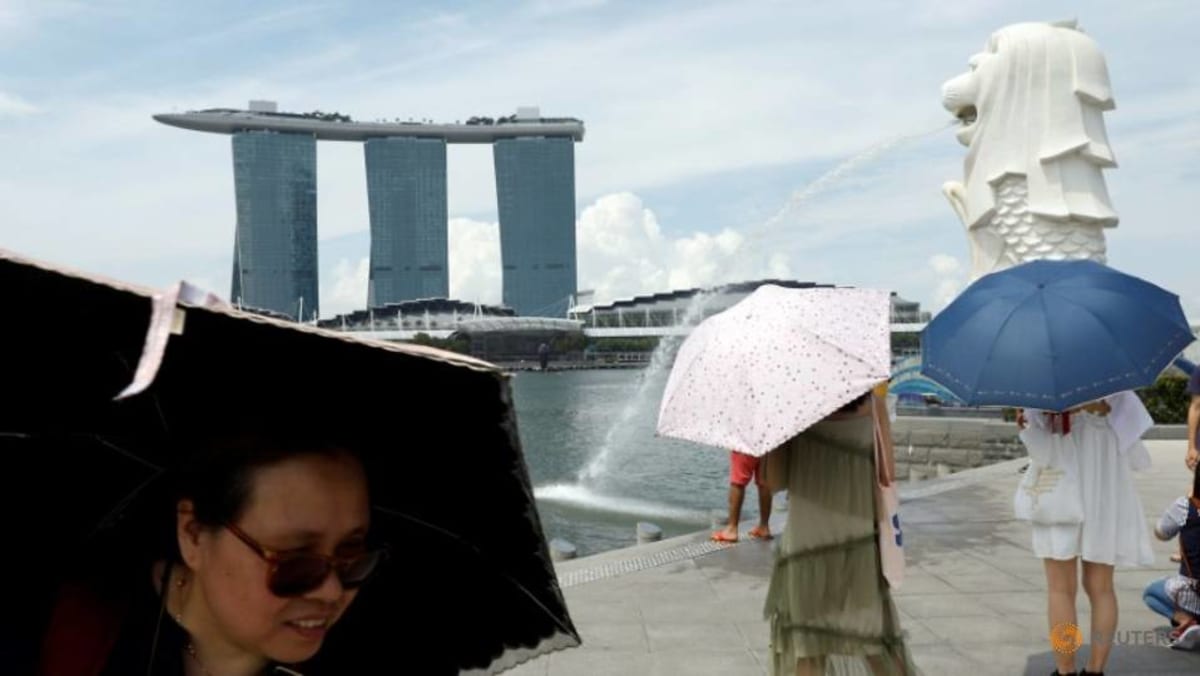
Tourists shield themselves with umbrellas on a hot day at the Merlion Park in Singapore on Jun 21, 2017. (Photo: REUTERS/Edgar Su)
This audio is generated by an AI tool.
SINGAPORE: Countries need to expand access to cooling without driving up emissions and energy demand as temperatures rise, Minister for Sustainability and the Environment Grace Fu said on Thursday (Sep 17).
Speaking at the inaugural Global Cooling Pledge Assembly, Ms Fu said Asia is warming nearly twice as fast as the global average, with extreme weather events becoming more severe, from a near-record-breaking El Niño to intense heatwaves and longer dry spells.
Ms Fu noted that Singapore's latest climate projections show that annual mean temperatures could rise by up to 5°C by the end of the century , bringing more very hot days, warmer nights and frequent periods of high heat stress.
"As temperatures rise, so will demand for cooling," she said. "Cooling already accounts for about 20 per cent of global electricity use, and demand is expected to more than triple by 2050."
CNA Games Guess Word Crack the word, one row at a time Buzzword Create words using the given letters Mini Sudoku Tiny puzzle, mighty brain teaser Mini Crossword Small grid, big challenge Word Search Spot as many words as you can Show More Show Less Singapore is co-hosting the assembly with the United Nations Environment Programme and the Cool Coalition, a global network of governments, international organisations, businesses, financial institutions and academia working to drive sustainable cooling. Ms Fu announced at the COP30 climate conference in Belém, Brazil, last year that Singapore would host the assembly. Running from Tuesday to Friday, the assembly also includes the first meeting of the Intergovernmental Committee on Cooling, which tracks progress on the Global Cooling Pledge. More than 230 leaders from government, academia and business across over 60 countries are attending, with the aim of turning sustainable cooling goals into action. Delegates spent the first two days exploring cooling and heat-resilience solutions for dense cities, and will spend the remaining two reviewing progress and sharing strategies to accelerate implementation. PLANNING, POLICY AND PARTNERSHIPS In her speech, Ms Fu outlined Singapore's three priorities for tackling sustainable cooling: planning, policy and partnerships. Singapore's adaptation plans are grounded in science and data and tailored to local conditions, Ms Fu said. For instance, the country has launched a dedicated R&D programme that includes a S$40 million (US$31.3 million) Adapting to Heat Impacts initiative. Research is translated into adaptation measures such as passive and hybrid cooling, greenery, wind flow and shade in urban developments. Planning must be backed by policy, she said, citing Minimum Energy Performance Standards for common household appliances as an example. Cooling also needs to stay accessible, she added, noting that the government will open more than 300 cooling centres islandwide during heatwaves, using community spaces where residents can seek respite from extreme heat.
Singapore is co-hosting the assembly with the United Nations Environment Programme and the Cool Coalition, a global network of governments, international organisations, businesses, financial institutions and academia working to drive sustainable cooling.
Ms Fu announced at the COP30 climate conference in Belém, Brazil, last year that Singapore would host the assembly. Running from Tuesday to Friday, the assembly also includes the first meeting of the Intergovernmental Committee on Cooling, which tracks progress on the Global Cooling Pledge.
More than 230 leaders from government, academia and business across over 60 countries are attending, with the aim of turning sustainable cooling goals into action.
Delegates spent the first two days exploring cooling and heat-resilience solutions for dense cities, and will spend the remaining two reviewing progress and sharing strategies to accelerate implementation.
PLANNING, POLICY AND PARTNERSHIPS
In her speech, Ms Fu outlined Singapore's three priorities for tackling sustainable cooling: planning, policy and partnerships.
Singapore's adaptation plans are grounded in science and data and tailored to local conditions, Ms Fu said.
For instance, the country has launched a dedicated R&D programme that includes a S$40 million (US$31.3 million) Adapting to Heat Impacts initiative. Research is translated into adaptation measures such as passive and hybrid cooling, greenery, wind flow and shade in urban developments.
Planning must be backed by policy, she said, citing Minimum Energy Performance Standards for common household appliances as an example.
Cooling also needs to stay accessible, she added, noting that the government will open more than 300 cooling centres islandwide during heatwaves, using community spaces where residents can seek respite from extreme heat.
Partnerships across government, business and the community are also needed, Ms Fu said.
"Heat affects public health, increases the risks of heat-related and infectious diseases, puts vulnerable groups at greater risk, and disrupts business operations," she said.
"No single agency or sector can address these effects alone. We must act together to protect our people, society and economy."
The Heat Resilience Policy Office coordinates efforts across government and supports a national action plan spanning infrastructure, health, economic and social needs, she said.
Martin Krause, director of the Climate Change Division at the UN Environment Programme, echoed Ms Fu's warning, saying that without action, cooling demand could more than triple by 2050 while emissions double and billions of people are left without adequate protection from heat.
"The task now is to bring these solutions together and take them to scale," Mr Krause said.
He pointed to the global heat resilience roadmap, which offers countries a framework integrating climate, health, labour, urban and development efforts, and "turns a fragmented response into coordinated delivery of solutions on the ground".
"Countries and cities must set the direction here through national cooling plans, through urban heat strategies, through enabling policies and pathways for transforming the market for energy-efficient equipment," he said.
Mr Krause also introduced the Cool Coalition Manufacturing Platform, a voluntary initiative bringing governments and manufacturers together to expand access to efficient cooling equipment and accelerate the transition to refrigerants with low- and ultra-low global warming potential.
Get our pick of top stories and thought-provoking articles in your inbox
Stay updated with notifications for breaking news and our best stories
Join our channel for the top reads for the day on your preferred chat app
可持续发展与环境部长傅海燕在首届全球降温承诺大会上表示,亚洲变暖的速度几乎是全球平均水平的两倍。
2017年6月21日,新加坡鱼尾狮公园,游客们在炎热的天气里撑伞遮阳。(图片:路透社/Edgar Su)
这段音频由人工智能工具生成。
新加坡:新加坡永续发展及环境部长傅海燕周四(9月17日)表示,随着气温升高,各国需要扩大降温措施的普及范围,同时避免增加排放和能源需求。
傅女士在首届全球降温承诺大会上发言时表示,亚洲的升温速度几乎是全球平均水平的两倍,极端天气事件也变得更加严重,从接近破纪录的厄尔尼诺现象到强烈的热浪和更长的干旱期。
傅女士指出,新加坡最新的气候预测显示,到本世纪末,年平均气温可能会上升高达 5°C,这将带来更多酷热的日子、更温暖的夜晚和更频繁的高温压力时期。
“随着气温升高,制冷需求也会增加,”她说道。“目前制冷已占全球电力消耗的约20%,预计到2050年,这一需求将增长三倍以上。”
CNA游戏猜词游戏:逐行破解单词;流行词游戏:用给定的字母组成单词;迷你数独:小巧的谜题,强大的脑力挑战;迷你填字游戏:小方格,大挑战;单词搜索:尽可能多地找出单词。显示更多 显示更少 新加坡与联合国环境规划署和“酷联盟”(一个由各国政府、国际组织、企业、金融机构和学术界组成的全球网络,致力于推动可持续制冷)共同主办此次大会。傅海燕女士去年在巴西贝伦举行的COP30气候大会上宣布,新加坡将主办此次大会。大会从周二持续到周五,期间还将举行政府间制冷委员会的首次会议,该委员会负责跟踪《全球制冷承诺》的进展情况。来自60多个国家的230多位政府、学术界和企业领导人出席了会议,旨在将可持续制冷目标转化为实际行动。代表们在前两天探讨了人口密集城市的制冷和耐热解决方案,并将在后两天回顾进展情况并分享加速实施的策略。规划、政策与合作 傅女士在演讲中概述了新加坡应对可持续降温的三大优先事项:规划、政策和合作。她表示,新加坡的适应计划以科学和数据为基础,并根据当地情况量身定制。例如,新加坡启动了一项专门的研发计划,其中包括一项耗资4000万新元(约合3130万美元)的“适应高温影响”计划。研究成果被转化为适应措施,例如在城市发展中采用被动式和混合式降温、绿化、风力流动和遮荫等。她指出,规划必须有政策支持,并以常用家用电器的最低能效标准为例。她补充说,降温也必须方便易得,并指出政府将在热浪期间在全岛开设300多个避暑中心,利用社区空间为居民提供躲避酷暑的场所。
新加坡与联合国环境规划署和“酷联盟”(一个由各国政府、国际组织、企业、金融机构和学术界组成的全球网络,致力于推动可持续制冷)共同主办此次大会。
傅海燕女士去年在巴西贝伦举行的COP30气候大会上宣布,新加坡将主办此次大会。大会将于周二至周五举行,期间还将召开政府间制冷委员会的首次会议,该委员会负责跟踪全球制冷承诺的进展情况。
来自 60 多个国家的 230 多位政府、学术界和商界领导人出席了会议,旨在将可持续制冷目标转化为实际行动。
与会代表们用前两天时间探讨了人口密集城市的降温和耐热解决方案,并将用剩下的两天时间回顾进展情况并分享加快实施的策略。
规划、政策与伙伴关系
傅女士在演讲中概述了新加坡在应对可持续制冷问题上的三个优先事项:规划、政策和伙伴关系。
傅女士表示,新加坡的适应计划以科学和数据为基础,并根据当地情况量身定制。
例如,该国已启动一项专门的研发计划,其中包括一项耗资4000万新元(约合3130万美元)的“适应高温影响”计划。研究成果被转化为适应措施,例如在城市发展中采用被动式和混合式冷却、绿化、风力引导和遮荫等。
她表示,规划必须有政策支持,并以常见家用电器的最低能效标准为例。
她还补充说,降温措施也需要方便民众使用。她指出,政府将在热浪期间在全岛开设 300 多个降温中心,利用社区空间让居民可以躲避极端高温。
傅女士表示,还需要政府、企业和社区之间的合作。
“高温会影响公众健康,增加与高温相关的传染病风险,使弱势群体面临更大的风险,并扰乱商业运营,”她说。
“没有任何一个机构或部门能够独自应对这些影响。我们必须共同努力,保护我们的人民、社会和经济。”
她表示,抗暑政策办公室负责协调政府各部门的工作,并支持一项涵盖基础设施、健康、经济和社会需求的国家行动计划。
联合国环境规划署气候变化司司长马丁·克劳斯也呼应了傅女士的警告,他表示,如果不采取行动,到 2050 年,制冷需求可能会增加两倍以上,而排放量将翻一番,数十亿人将无法得到足够的防暑保护。
克劳斯先生说:“现在的任务是将这些解决方案整合起来,并扩大规模。”
他指出,全球抗暑降温路线图为各国提供了一个整合气候、健康、劳动力、城市和发展工作的框架,“将零散的应对措施转变为在实地协调提供解决方案”。
他说:“各国和各城市必须通过国家降温计划、城市热岛效应战略、扶持政策和途径来引领节能设备市场的转型。”
克劳斯先生还介绍了“酷联盟制造平台”,这是一项自愿性倡议,旨在将各国政府和制造商聚集在一起,扩大高效制冷设备的普及范围,并加速向低全球变暖潜能值和超低全球变暖潜能值的制冷剂过渡。
订阅我们的邮件,即可获取精选热点新闻和引人深思的文章。
订阅通知,第一时间获取突发新闻和精彩报道。
加入我们的频道,即可在您常用的聊天应用上获取当日热门文章。