Swift trans-Atlantic action kept Turkey from fueling Belarus’ hybrid attacks迅速的跨大西洋行动阻止了土耳其为白俄罗斯的混合袭击提供资金。
The threats of coordinated U.S.-EU sanctions against Turkish Airlines — although neither Washington nor Brussels has explicitly indicated that the airline is in their crosshairs — appear to have delivered immediate results.
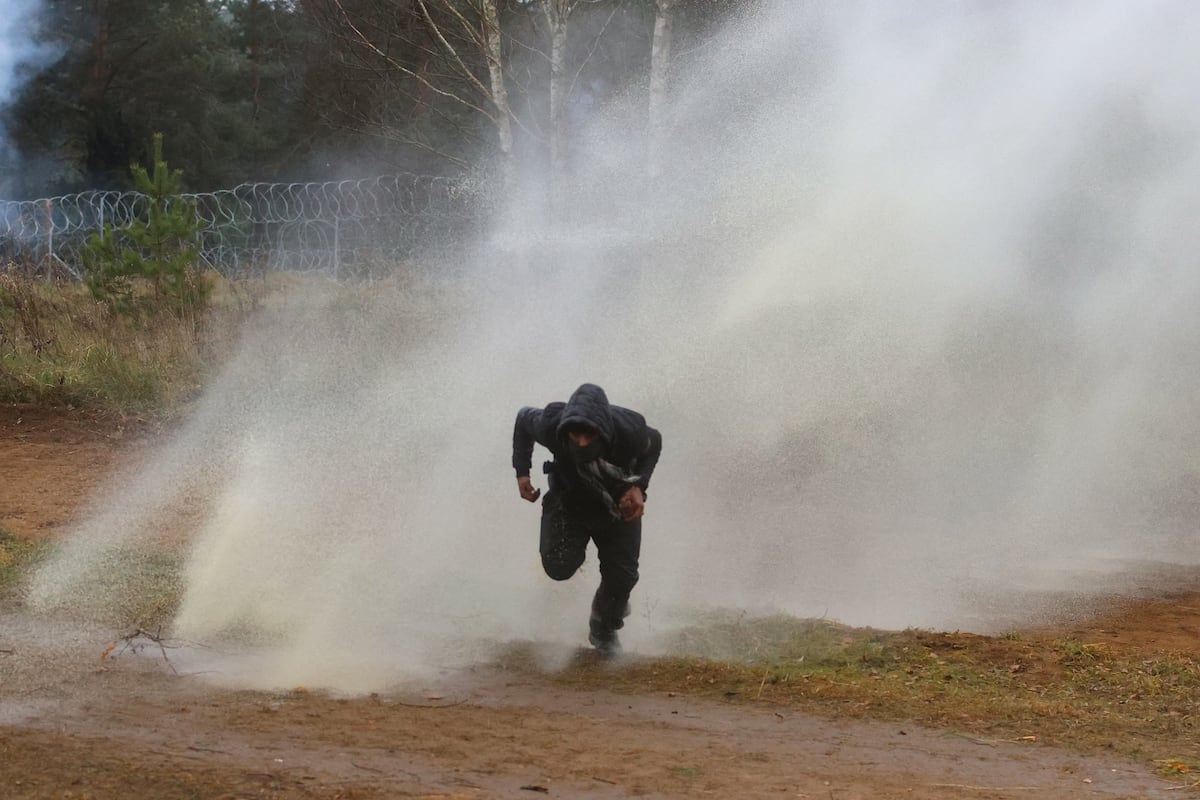
Following her meeting with President Biden at the White House last Wednesday, European Commission President Ursula von der Leyen stated on Twitter that the rising tensions on the Belarus-Poland border were not a “migration crisis” but a “hybrid attack,” a form of irregular warfare that blends military and non-military methods. She proceeded to announce that the European Union and the United States will cooperate on sanctioning third-country airlines involved in human trafficking. The unstated target of von der Leyen’s warning was the Turkish government, whose flag carrier had been delivering migrants to Belarus. When called out, Ankara reversed course, showing how coordinated transatlantic pressure can thwart a hybrid attack.
Belarusian strongman Alexander Lukashenko, whom Russian President Vladimir Putin vowed to support earlier this month against foreign “interference,” has been weaponizing migration into three EU member states— Latvia, Lithuania, and Poland —since June. Lukashenko has done so by luring migrants from Africa and the Middle East to Belarus, offering them unfettered passage to the EU border, often by government bus , and at times even forcing them at gunpoint to cross into the EU.
Lukashenko devised this hybrid attack in retaliation for a range of EU economic and financial sanctions imposed in June over what Brussels referred to as Lukashenko’s “serious human rights violations.” The EU imposed these sanctions after a Belarusian jet in May forced down a commercial plane in order to arrest Roman Protasevich , a dissident journalist on board.
Although Putin insists that Russia has “absolutely nothing to do with” the ongoing crisis on the Poland-Belarus border, the Kremlin demonstrated its support for Lukashenko by flying nuclear-capable strategic bombers over Belarus last week. Such coordinated Russian-Belarusian action is precisely what Maj. Gen. William Hickman, director of strategic plans and policy for NATO Allied Transformation Command in Norfolk, Virginia, warned against in 2019: “Our adversaries or competitors are seeing an ability to work below the level of Article 5. Or, as NATO would say, to work below the level of conflict.”
What made the Belarusian crisis more challenging compared to earlier hybrid attacks was the allegations by journalists that Turkey, a NATO member state, was also complicit. Last Tuesday, one day after von der Leyen announced that the EU is exploring “how to sanction third country airlines that are active in human trafficking,” EU Observer reported that Turkish Airlines was one of the carriers complicit with Belarus and a Politico Europe report pointed the finger at Turkey as being “one of the main points of origin for flights landing in Minsk.” The same day, Polish Prime Minister Mateusz Morawiecki tweeted : “We can see fully synchronised actions – Turkey’s actions with Belarus and Russia. We are worried, we do not like this.”
This is not the first time that Turkey’s authoritarian president Recep Tayyip Erdogan has played a spoiler role within NATO by rushing to the aid of fellow strongman Lukashenko. The Washington Post reported that Turkey used its veto power within NATO to water down an official condemnation of Lukashenko in May following the Protasevich incident. According to Reuters, Ankara blocked unspecified punitive steps that Baltic allies and Poland had advocated.
This follows two earlier episodes where the Erdogan government similarly blocked a harsher NATO response to Russia. First, Ankara watered down the wording of an April 15 NATO statement expressing solidarity with America over Russia’s cyberattacks on U.S. government agencies. Likewise, Turkey watered down an April 22 statement voicing concern over Russian military intelligence’s blowing up of ammunition storage depots in the Czech Republic in 2014. Turkey also blocked a NATO defense plan for Poland and the Baltic states for over six months until June 2020 , prompting The New York Times to label the country as “NATO’s ‘Elephant in the Room.’”
The threats of coordinated U.S.-EU sanctions against Turkish Airlines — although neither Washington nor Brussels has explicitly indicated that the airline is in their crosshairs — appear to have delivered immediate results. The day after von der Leyen’s White House announcement, Turkey’s foreign ministry issued a press release stating that Ankara “understands the challenges Poland, Lithuania and Latvia have been exposed to” and is “ready to give all necessary support in order to overcome this issue.”
The following day, Turkey’s Directorate General of Civil Aviation announced that Ankara would not allow citizens of Iraq, Syria, and Yemen, who comprised the bulk of migrants Lukashenko has been weaponizing, to board Belarus flights. Less than 24 hours after a Turkish Airlines statement denying any wrongdoing, Ankara bowed to pressure from NATO allies to take immediate action.
Last week’s developments show that concerted and swift transatlantic pushback was key to thwarting Minsk’s hybrid attacks as well as reversing the course of a complicit NATO member state with a troubling record of playing a spoiler role. This is a lesson the transatlantic alliance needs to keep in mind as Belarus, Russia and the like plan for their next hybrid attack.
Aykan Erdemir is a former member of the Turkish parliament and senior director of the Turkey Program at the Foundation for Defense of Democracies (FDD). Follow him on Twitter @aykan_erdemir .
上周三在白宫与拜登总统会晤后,欧盟委员会主席乌尔苏拉·冯德莱恩在推特上表示,白俄罗斯-波兰边境日益紧张的局势并非“移民危机”,而是“混合攻击”,一种融合了军事和非军事手段的非常规战争形式。她随后宣布,欧盟和美国将合作制裁参与人口贩运的第三国航空公司。冯德莱恩警告的暗指土耳其政府,因为土耳其的旗舰航空公司一直在向白俄罗斯运送移民。在受到谴责后,安卡拉方面改变了立场,这表明跨大西洋的协调施压能够挫败混合攻击。
白俄罗斯强人亚历山大·卢卡申科自6月以来,一直利用移民问题来胁迫三个欧盟成员国——拉脱维亚、立陶宛和波兰。本月初,俄罗斯总统弗拉基米尔·普京曾誓言支持卢卡申科,反对外国“干涉”。卢卡申科通过引诱来自非洲和中东的移民前往白俄罗斯,为他们提供畅通无阻地进入欧盟边境的通道(通常乘坐政府巴士),有时甚至持枪强迫他们越境进入欧盟。
卢卡申科策划了这次混合攻击,以报复欧盟6月份因卢卡申科“严重侵犯人权”而实施的一系列经济和金融制裁。此前,一架白俄罗斯战机于5月份迫使一架民航客机迫降,以逮捕机上持不同政见的记者罗曼·普罗塔谢维奇。
尽管普京坚称俄罗斯与波兰-白俄罗斯边境危机“绝对没有任何关系”,但克里姆林宫上周派遣可携带核弹头的战略轰炸机飞越白俄罗斯领空,以此表明其对卢卡申科的支持。这种俄白两国协同行动,正是北约盟军转型司令部战略计划与政策主任威廉·希克曼少将在2019年警告过的:“我们的对手或竞争对手看到了我们在第五条框架下开展行动的能力。或者,正如北约所说,在冲突层面之外开展行动的能力。”
与以往的混合袭击相比,白俄罗斯危机更具挑战性的原因在于,记者指控北约成员国土耳其也参与其中。上周二,就在冯德莱恩宣布欧盟正在研究“如何制裁参与人口贩运的第三国航空公司”的第二天,《欧盟观察家》报道称,土耳其航空公司是与白俄罗斯勾结的航空公司之一,而《欧洲政治报》的一篇报道也指出,土耳其是“飞往明斯克航班的主要出发地之一”。同一天,波兰总理马特乌什·莫拉维茨基在推特上写道:“我们可以看到土耳其与白俄罗斯和俄罗斯的行动完全同步。我们感到担忧,我们不喜欢这样。”
这并非土耳其威权总统雷杰普·塔伊普·埃尔多安首次在北约内部扮演破坏者的角色,他曾急于支持另一位强人卢卡申科。《华盛顿邮报》报道称,在普罗塔谢维奇事件发生后,土耳其曾于5月动用其在北约的否决权,淡化了北约对卢卡申科的官方谴责。据路透社报道,安卡拉阻止了波罗的海盟国和波兰所倡导的未指明的惩罚措施。
此前,埃尔多安政府曾两次以类似方式阻止北约对俄罗斯采取更强硬的回应。首先,安卡拉淡化了4月15日北约一份声明的措辞,该声明表达了北约对俄罗斯网络攻击美国政府机构表示声援美国的立场。同样,土耳其也淡化了4月22日一份声明的措辞,该声明对俄罗斯军事情报部门2014年炸毁捷克共和国的弹药库表示关切。此外,土耳其还阻挠了北约一项针对波兰和波罗的海国家的防御计划长达六个多月,直到2020年6月才得以实施,这促使《纽约时报》将土耳其称为“北约的‘房间里的大象’”。
尽管华盛顿和布鲁塞尔均未明确表示土耳其航空公司是制裁目标,但美欧联军对土耳其航空公司实施协调制裁的威胁似乎已初见成效。冯德莱恩在白宫宣布制裁措施的第二天,土耳其外交部发表新闻稿称,安卡拉“理解波兰、立陶宛和拉脱维亚面临的挑战”,并“准备提供一切必要支持以克服这一问题”。
第二天,土耳其民航总局宣布,安卡拉将禁止伊拉克、叙利亚和也门公民(卢卡申科一直利用的移民群体是其主要目标)搭乘飞往白俄罗斯的航班。在土耳其航空公司发表声明否认有任何不当行为不到24小时后,安卡拉迫于北约盟国的压力,立即采取行动。
上周的事态发展表明,跨大西洋各方迅速而协调一致的反击是挫败明斯克混合攻击的关键,同时也扭转了一个屡次扮演破坏者角色、且与白俄罗斯沆瀣一气的北约成员国的颓势。白俄罗斯、俄罗斯等国在策划下一次混合攻击时,跨大西洋联盟必须牢记这一教训。
艾坎·埃尔德米尔是土耳其前议员,现任保卫民主基金会(FDD)土耳其项目高级主任。请在推特上关注他:@aykan_erdemir。