Haze in Singapore: PSI crosses 101 in central region as air quality enters unhealthy range新加坡雾霾:中部地区空气污染指数(PSI)超过101,空气质量进入不健康范围
The 24-hour Pollutant Standards Index (PSI) here has hit 100, with air quality almost at the unhealthy range. Read more at straitstimes.com.
新闻视频
Published Sep 04, 2026, 07:12 AM
Updated Sep 04, 2026, 08:42 AM
SINGAPORE – The 24-hour Pollutant Standards Index (PSI) here has exceeded 101, with air quality entering the u nhealthy range.
At 8am on Sept 4, the 24-hour PSI in the central part of Singapore was 103, according to the National Environment Agency (NEA) website.
The 24-hour PSI in the central part of Singapore was 101 at 7am on Sept 4.
Air quality is considered unhealthy when the PSI is in the range of 101 to 200, during which the NEA advises the public to cut down on outdoor activities.
The last time the PSI hit unhealthy levels on account of haze was in October 2023.
This time around, the 24-hour PSI started inching towards the unhealthy range early on Sept 4 .
At 1am, the PSI was between 70 and 90, within the moderate range, with the highest reading of 90 recorded in central Singapore. The PSI in that region hit 99 by 6am .
In a weather advisory on Sept 1, the Meteorological Service Singapore said the Republic may experience hazy conditions in the next two weeks as dry weather is set to continue in the surrounding region into the first fortnight of September, despite sporadic showers expected in the second week.
With the prevailing dry conditions, there has been an escalation in the hot spot and smoke haze situation in the surrounding region, it added. Dense smoke haze was observed over southern and central Sumatra and various parts of Kalimantan on most days from around Aug 21.
This follows weeks of forest and land fires in Sumatra and Kalimantan in Indonesia, fuelled by a super El Nino weather phenomenon .
How badly Singapore is affected depends on wind direction.
Malaysia has already been badly affected by the haze, with air quality reaching unhealthy levels in several states, causing a spike in asthma cases. In Sarawak, one of the worst-hit states , Serian recorded an Air Pollutant Index of 408 at 8pm on Sept 3, putting it in the very hazardous category, while four other areas in the state recorded very unhealthy readings.
In Singapore, efforts have intensified to raise awareness of the increased risk of haze and guide the public on measures to safeguard their health, the nation’s Haze Task Force told The Straits Times on Aug 24.
Doctors have been reminded to advise vulnerable groups – including the elderly, pregnant women, children and those with lung or heart disease – to take precautionary measures.
In schools, teachers will conduct visual checks on students’ well-being, and haze advisories have been sent to workplaces.
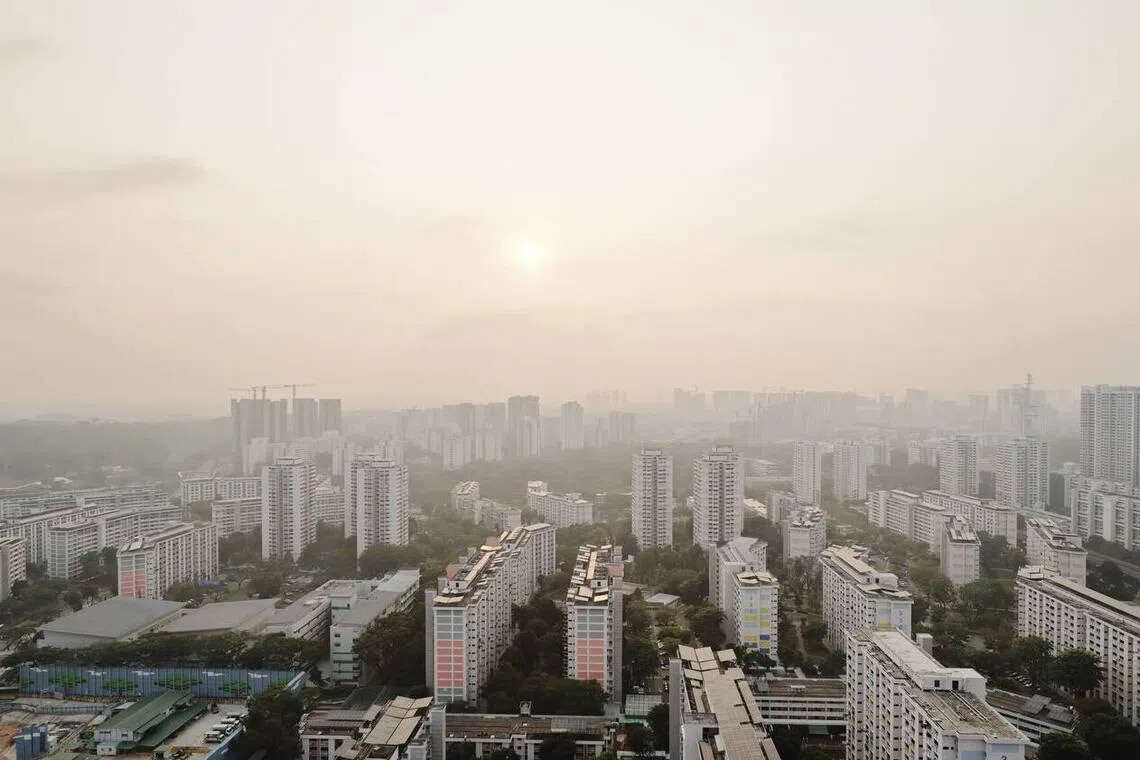
Hazy conditions seen from Sin Ming at 8.05am on Sept 4. ST PHOTO: GIN TAY
Hazy conditions seen from Sin Ming at 8.05am on Sept 4.
Haze and air quality are shown through two readings on NEA’s website: the 24-hour PSI and the one-hour PM2.5 readings. Both measures serve different functions .
During periods of haze, the 24-hour PSI forecast and corresponding health advisories should be used to plan outdoor activities for the next day, said the NEA website.
The one-hour PM2.5 should be referred to when deciding on immediate outdoor activities, for example, going for a jog.
The 24-hour PSI is computed based on the daily average concentration of six pollutants, including PM2.5, sulphur dioxide, carbon monoxide and ozone.
The calculations are done based on readings from the past 24 hours.
PM2.5 refers to micro-pollutants found in smoke haze from forest fires. These particles – 30 times smaller than the width of a strand of hair – can get lodged deep in the lungs and enter the bloodstream.
Air quality is considered good for PSI values of between 0 and 50, and moderate for PSI values of between 51 and 100.
For PM2.5, air quality is considered normal for readings between zero and 55 micrograms (mcg) per cubic m.
Check the NEA website , haze microsite and myENV app for real-time information on air quality.
Lim Ruey Yan is with ST Now, the desk that covers breaking and trending news for The Straits Times.
发布于 2026 年 9 月 4 日上午 7:12
更新于2026年9月4日上午8:42
新加坡——这里的24小时污染物标准指数(PSI)已超过101,空气质量已进入不健康范围。
根据新加坡国家环境局 (NEA) 网站的数据,9 月 4 日上午 8 点,新加坡中部地区的 24 小时 PSI 为 103。
9月4日早上7点,新加坡中部地区的24小时PSI指数为101。
当空气污染指数(PSI)在 101 至 200 之间时,空气质量被认为是不健康的。在此期间,国家环境局建议公众减少户外活动。
上一次因雾霾导致空气污染指数(PSI)达到不健康水平是在 2023 年 10 月。
这一次,24 小时 PSI 值从 9 月 4 日清晨就开始缓慢向不健康范围靠拢。
凌晨1点,新加坡空气污染指数(PSI)在70到90之间,处于中等水平,其中新加坡中部地区录得最高读数90。该地区的PSI在早上6点达到99。
新加坡气象局在9月1日发布的天气预报中表示,由于周边地区干燥天气将持续到9月上半月,新加坡未来两周可能会出现雾霾天气,尽管预计第二周会有零星阵雨。
报告补充说,由于持续干旱,热点地区及周边地区的烟霾情况有所加剧。自8月21日左右起,苏门答腊南部和中部以及加里曼丹岛部分地区大部分时间都观测到浓烟。
此前,受超级厄尔尼诺现象的影响,印度尼西亚苏门答腊岛和加里曼丹岛已连续数周发生森林和土地火灾。
新加坡受灾程度取决于风向。
马来西亚已受到雾霾的严重影响,多个州属的空气质量达到不健康水平,导致哮喘病例激增。在受影响最严重的州属之一砂拉越,西连市9月3日晚8点的空气污染指数高达408,属于“非常危险”级别,该州其他四个地区的空气质量也达到了“非常不健康”的水平。
新加坡雾霾工作组于 8 月 24 日告诉《海峡时报》,新加坡已加大力度提高公众对雾霾风险增加的认识,并指导公众采取措施保护自身健康。
医生们已被提醒要建议弱势群体(包括老年人、孕妇、儿童以及患有肺部或心脏疾病的人)采取预防措施。
学校里,教师将对学生的健康状况进行目视检查,并且已经向工作场所发出雾霾预警。
9月4日上午8点05分,新民山出现雾霾天气。(海峡时报照片:金泰)
9月4日上午8点05分,新民山观测到雾霾天气。
尼泊尔国家环境局(NEA)网站通过两项指标显示雾霾和空气质量:24小时PSI值和1小时PM2.5值。这两项指标的功能各不相同。
国家环境局网站表示,在雾霾期间,应参考 24 小时 PSI 预报和相应的健康建议来计划第二天的户外活动。
在决定立即进行户外活动(例如跑步)时,应参考一小时 PM2.5 值。
24 小时 PSI 是根据六种污染物的日均浓度计算得出的,包括 PM2.5、二氧化硫、一氧化碳和臭氧。
计算依据是过去 24 小时的读数。
PM2.5指的是森林火灾产生的烟雾中存在的微小污染物。这些颗粒比头发丝的宽度还要小30倍,可以深入肺部并进入血液。
当 PSI 值介于 0 到 50 之间时,空气质量被认为是良好的;当 PSI 值介于 51 到 100 之间时,空气质量被认为是中等的。
对于 PM2.5,当读数在每立方米 0 到 55 微克 (mcg) 之间时,空气质量被认为是正常的。
请查看国家环境局网站、雾霾专题网站和myENV应用程序,获取实时空气质量信息。
林瑞燕 (Lim Ruey Yan) 是《海峡时报》新闻报道部门 ST Now 的成员,该部门负责报道突发新闻和热点新闻。