Ukraine’s drone strikes reveal Russian planning failures, expert says专家称,乌克兰无人机袭击暴露了俄罗斯的计划失误。
Nearly a week into the war between Ukraine and Russia, a small fleet of Ukrainian drones is causing headaches and inspiring defenders.
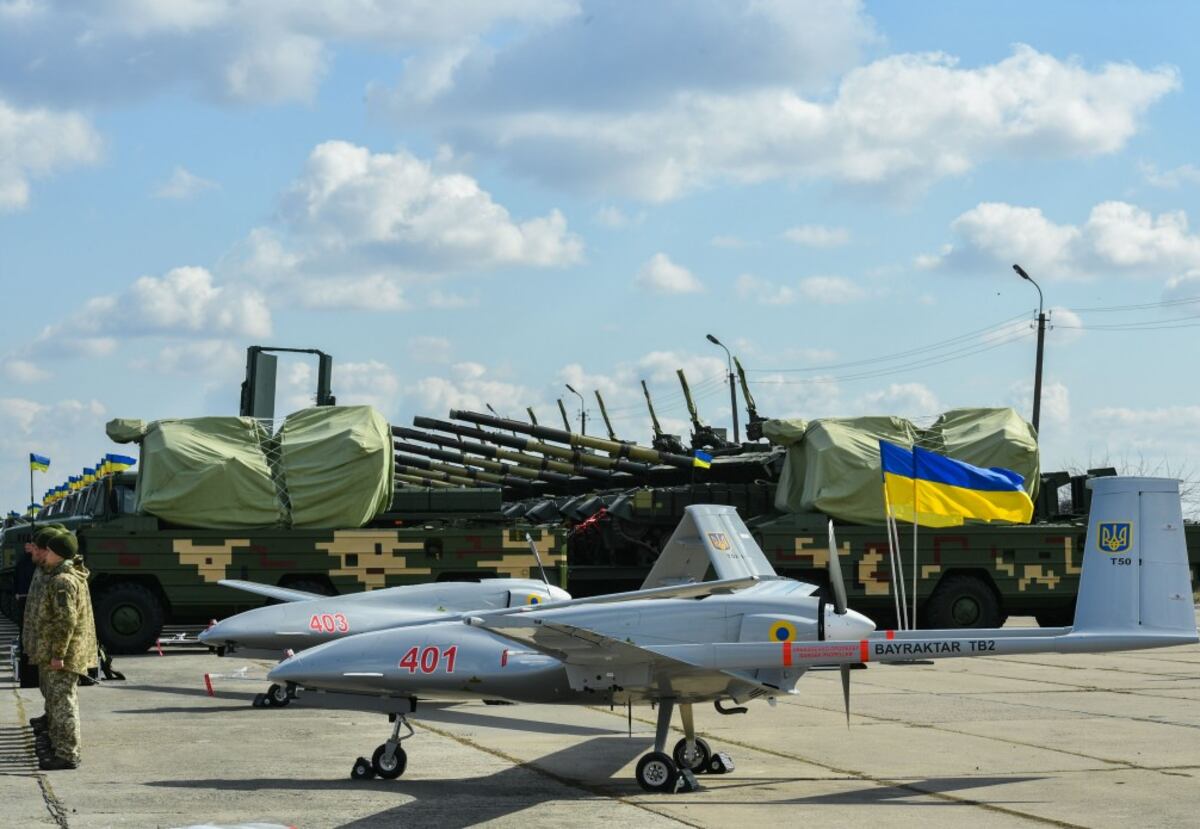
Amid the Russian invasion of Ukraine, a small portion of the defenders’ arsenal has had a disproportionate effect — Ukraine’s handful of Bayraktar TB2 armed drones .
Videos of their exploits have millions of views . They’ve destroyed surface-to-air missile launchers and logistics trains. They’ve inspired songs and are a common refrain in videos taunting the Russian invaders .
Despite their small number — around 20, according to pre-war comments made to Al-Monitor — the drones have been heavily utilized, according to Ukrainian officials. Russia, on the other hand, claims it has shot down some of the drones.
According to Stijin Mitzer , an open-source intelligence analyst, the small Turkish-made drones have destroyed at least 32 Russian vehicles since war broke out last week, though it’s impossible to independently confirm the total number of vehicles they’ve destroyed.
An expert on Russian drone warfare, Samuel Bendett of the CNA think tank, explained to Military Times that even the drones’ limited successes show that Russia is failing to implement its own air defense strategies. He added that Russia studied the lessons learned by Armenia in last year’s war with Azerbaijan, which saw the latter nation decimate Armenian positions and vehicles with Bayraktar drones and loitering munitions.
Perhaps the “biggest lesson” of that conflict, Bendett said, was that slow, low flying drones like the Bayraktar are effective against outdated air defense systems. Russian planners were confident that their force structure, which prioritizes modernized, layered air defense, would be able to prevent such a massacre — but “we’re not seeing...what Russians have advertised,” Bendett said.
Russian units are usually arrayed in battalion tactical groups, BTGs, with layered air defense and anti-drone capacity, said Bendett. But the forward elements of Russian forces have failed to operate as BTGs in Ukraine, frequently leaving behind their air defense assets “in inexplicable fashion,” he added.
“[In Ukraine], Russia doesn’t seem to display the very tactics, techniques and procedures that it’s practiced for years and sought to perfect in Syria...[to provide] adequate cover to its ground forces,” he said.
Bendett also pointed towards “the mythology of the Bayraktar” and how “Ukraine is winning the information war.”
“For all the Russian military talk about winning information war, they seem to be losing, and the videos of Bayraktars striking what appears to be Russian targets is feeding into that [Ukrainian] information campaign,” he said.
Bendett believes that the days of Bayraktar strikes are limited, though, should Russia reorganize its advance.
“If the Russian military reorganizes — if it sends in the BTGs, if it sends in adequate air defense capability, if it sends in its [electronic warfare] forces...it would become increasingly more difficult for Bayraktars to operate in an uncontested fashion,” said the drone expert. “They were definitely aware of the threat. They definitely practiced against the threat.”
And even should the Russians recover and counter the drone threat, he noted, “they were supposed to eliminate a lot of Ukrainian air defense capability from the...first hours of the campaign.” That includes the air bases where the drones are stored, fueled and equipped.
A portion of that responsibility, according to other experts and U.S. officials who spoke with Reuters , lies with the conspicuous absence of the Russian Air Force over the skies of Ukraine.
“The fact that there may be surviving [Bayraktars] somewhere is an embarrassment [to Russia],” said Bendett. “Clearly.”
Davis Winkie covers the Army for Military Times. He studied history at Vanderbilt and UNC-Chapel Hill, and served five years in the Army Guard. His investigations earned the Society of Professional Journalists' 2023 Sunshine Award and consecutive Military Reporters and Editors honors, among others. Davis was also a 2022 Livingston Awards finalist.
在俄罗斯入侵乌克兰期间,乌克兰防御者的一小部分武器产生了不成比例的影响——乌克兰的少量 Bayraktar TB2 武装无人机。
他们的英勇事迹视频获得了数百万的点击量。他们摧毁了地对空导弹发射装置和后勤列车。他们的事迹被谱写成歌曲,并在嘲讽俄罗斯入侵者的视频中频繁出现。
据乌克兰官员称,尽管数量不多——根据战前乌克兰方面向Al-Monitor透露的信息,大约只有20架——但这些无人机已被大量使用。而俄罗斯方面则声称击落了一些无人机。
据开源情报分析师斯蒂金·米泽尔称,自上周战争爆发以来,土耳其制造的小型无人机已摧毁至少 32 辆俄罗斯车辆,但目前尚无法独立确认它们摧毁的车辆总数。
俄罗斯无人机战专家、CNA智库的塞缪尔·本德特向《军事时报》解释说,即使无人机取得了有限的成功,也表明俄罗斯未能有效实施其自身的防空战略。他还补充说,俄罗斯研究了亚美尼亚在去年与阿塞拜疆的战争中吸取的教训。在那场战争中,阿塞拜疆使用“拜拉克塔尔”无人机和巡飞弹摧毁了亚美尼亚的阵地和车辆。
本德特表示,那场冲突或许“最大的教训”在于,像拜拉克塔尔这样的低速低空无人机能够有效对抗老旧的防空系统。俄罗斯的策划者们自信地认为,他们以现代化、多层次防空为核心的部队结构能够阻止此类屠杀——但本德特说,“我们并没有看到……俄罗斯人所宣称的那样。”
本德特表示,俄军部队通常以营级战术群(BTG)的形式部署,具备多层防空和反无人机能力。但他补充说,俄军前线部队在乌克兰未能按照营级战术群的形式作战,经常“以莫名其妙的方式”遗弃防空装备。
他说:“(在乌克兰),俄罗斯似乎并没有展现出它在叙利亚多年来一直在实践和完善的战术、技术和程序……(为)其地面部队提供充分的掩护。”
本德特还指出了“拜拉克塔尔神话”以及“乌克兰是如何赢得信息战的”。
他说:“尽管俄罗斯军方一直在谈论赢得信息战,但他们似乎正在输掉这场战争,而Bayraktar导弹袭击疑似俄罗斯目标的视频,正中(乌克兰)的下怀,助长了这场信息战。”
不过,本德特认为,如果俄罗斯重新组织进攻,拜拉克塔尔导弹的打击行动也将难以为继。
“如果俄罗斯军方进行重组——如果他们部署轰炸机群,如果他们部署足够的防空力量,如果他们部署电子战部队……那么拜拉克塔尔无人机就越来越难以不受阻碍地行动,”这位无人机专家说。“他们肯定意识到了这种威胁。他们肯定针对这种威胁进行了演练。”
他指出,即便俄罗斯能够恢复并应对无人机威胁,“他们也应该在战役开始的最初几个小时内就摧毁乌克兰的大部分防空能力。”这其中就包括存放、加油和装备无人机的空军基地。
据路透社采访的其他专家和美国官员称,部分责任在于俄罗斯空军在乌克兰上空明显缺席。
“某些地方可能还存有拜拉克塔尔导弹,这(对俄罗斯而言)是一件丢脸的事,”本德特说。“显而易见。”
戴维斯·温基是《军事时报》的陆军记者。他曾在范德比尔特大学和北卡罗来纳大学教堂山分校学习历史,并在陆军国民警卫队服役五年。他的调查报道曾荣获2023年专业记者协会阳光奖,并连续多年获得军事记者与编辑协会的表彰。戴维斯还曾入围2022年利文斯顿奖的最终候选名单。