How Europe’s next-generation combat jet aims to catch the AI wave欧洲下一代战斗机如何力图搭上人工智能浪潮的顺风车
The signature air-power program aims to be first such effort with artificial intelligence fully baked into every aspect.
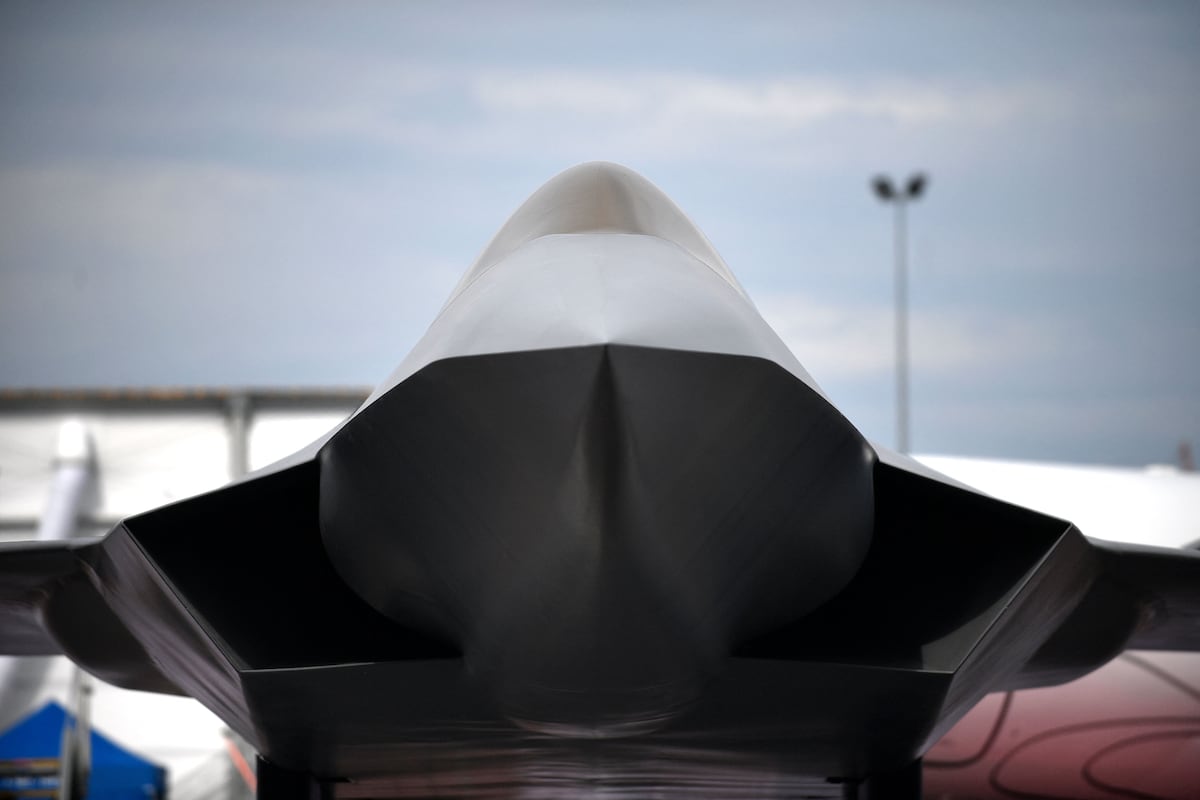
BERLIN — Mainland Europe’s Future Combat Air System, an ambitious effort to field a suite of warplanes and drones in the 2040s, could become the first large-scale defense program with artificial intelligence fully baked in.
A consortium of Germany, France and Spain – with Belgium joining as an observer last year – promises to have the first airworthy demonstrators of the futuristic idea flying by this decade’s end. Artificial intelligence will play a key role in practically all aspects of the system, engineers and experts told Defense News in a series of interviews, influencing everything from the platform’s development to kill-chain decisions and even the very things that pilots see.
The key novelty of FCAS, compared to existing platforms, is its use of so-called loyal wingmen. These drones are to travel alongside the main, manned aircraft and act to enhance the mission – collecting more data, allowing for more firepower or simply overwhelming enemy defenses by sheer numbers.
“Because you don’t want to have to control these out of a cockpit with a stick and throttle,” these drones will require a certain level of automation or autonomy, said Thomas Grohs, Airbus’ head of future capabilities and chief engineer of the FCAS project.
Building this type of intelligence, which entails finding the optimal degree of pilot involvement in different situations, will be crucial to the success of the program as a whole.
Onur Deniz’s company, NeuralAgent, is tasked with ensuring that data flows where it needs to go, enabling each of the system’s components to be in constant contact. The Munich-based startup is taking what it called an “AI agent approach”: Instead of a centralized, cloud-based decision-making algorithm, each of the wingmen drones will use smaller, locally-run models to operate autonomously and will exchange information with their peers using communication channels such as optical, narrowband radio or even infrared. While doing so, they will continuously construct redundant and ever-changing data links providing permanent connectivity.
“This gives you a very fast ability to build your own networks in blackout regions or conflict regions,” Deniz said. In computer simulations testing the concept based on real-world scenarios, this approach maintained connectivity in adverse electronic warfare environments for over 95% of the time. By comparison, centrally administered and cloud-based models saw a less than 0.5% success rate in NeuralAgent’s tests, he said.
By the end of 2025, the software will be ready for integration into existing hardware – legacy systems, at first – said Deniz, describing it as a “plug-in that you can put anywhere you want.”
The company claims that its models are extremely resource-efficient. “You could run them on a Raspberry Pi and they take less than a gigabyte of space,” Deniz said, referring to the small, single-board computers popular with schools and hobbyists, priced at around $50. “All we need is a Linux environment.” Access to the communications stack of the platform is really the only other prerequisite, he explained. “Because of containerization, installation will be as simple as if you were installing a library to code.”
While the current focus in NeuralAgent’s FCAS development is on networking, Deniz anticipates that the next step will be to use the technology for more complex mission-planning. This would include making decisions based on the combat environment and moving assets around to optimize communications and achieve objectives.
What is a pilot, anyway?
The constellation of manned and unmanned aircraft working together will require a radical redefinition of what a pilot’s role is, said Grohs, the Airbus chief engineer. Sitting in the cockpit of Europe’s next fighter will not only be about flying the aircraft but “really about becoming a mission operator,” he said, “elevating yourself above your own asset and operating the mission together with your p e ers that may be manned or unmanned.”
In fact, flying the aircraft may only take a secondary role altogether; the plan is to give even the manned aircraft the option of flying entirely on their own to allow the pilots to focus on mission management, the chief engineer said.
The project’s goal “is definitely to go for autonomy,” he added. “The loyal wingmen are given a high-level task and within set boundaries, the assets can work autonomously.”
Compared to automation – which Grohs defined as a system automatically fulfilling a predefined sequence of events – autonomy includes decision-making.
He described the envisioned implementation as a pilot choosing what action they want to have taken while not needing to issue “a specific trigger press.” A capability like this would be quick to implement, he said, pointing to the fact that similar AI pilots have already flown in the U.S. and that “we are testing things out.”
Organizing principle
At least initially, the AI models in FCAS will all be “frozen,” said Grohs, meaning that no machine learning will take place during missions. The algorithms, whether for processing sensor data or for making decisions about striking enemies, will be pre-developed and retrained off-board. At some point, however, machine learning may be integrated into the airborne platforms themselves, he said.
Even so, AI will touch every element of the observe, orient, decide, and act loop, Grohs said, referring to the “OODA Loop” framework popularized in U.S. military command textbooks. He said the algorithms would be paired with sensors in order to improve the quality of images, for example, but also play a role in developing courses of action.
The extent to which artificial intelligence will make targeting decisions on its own is still up for discussion, he added.
While details on the appearance and specific capabilities of FCAS are still sparse, the resources being invested are considerable. At Airbus alone, over 1,400 people are currently working on Europe’s next-generation air combat platform, said Christian Doerr, a company spokesperson. The European aerospace giant plays a key coordinating role in making the project come to life along with Dassault Aviation in France.
Many of the applications of the AI-based algorithms already exist in some form, though in isolation, said Grohs. The process of integrating them, with countless companies and thousands of engineers working on the project, runs the risk of becoming unmanageable, said Simon Pfeiffer, associate director of programs at the Munich-based AI company Helsing. Because AI models have dependencies on one another and the data they ingest, the company, along with partners, is working on creating a “digital assembly hall” to put it all together.
Through a cloud environment for developers, workflows can be improved, data can be exchanged and interoperability can be ensured, all while adhering to the particularly sensitive constraints of working in the defense sector, company representatives told Defense News. The online platform is already being used by over 50 contributors working on the FCAS project and was developed specially for it, according to Helsing.
In that sense, engineers already are using AI to breathe AI into the next-gen weapon, said Grohs. There is even the idea of developing an FCAS-specific Chat GPT-equivalent to help engineers with their jobs.
Meanwhile, nongovernmental organizations and autonomous-weapons experts have warned about delegating too much power to machines . Concerns include the unreliability of machine vision, the often-opaque nature of machines’ decision making and the danger of autonomy applying a tactical mindset to questions with strategic implications.
In interviews with Defense News, some analysts expressed concern that even if a weapon system might not by default be allowed to kill autonomously, changing this may only entail a simple software switch – and incentives to flip that switch would be strong. Grohs was not able to rule out that FCAS might have this ability to switch between such modes, depending on the “rules of engagement that may apply for the respective conflict,” said the Airbus chief engineer.
“I don’t see a major difference between autonomous and human decisions,” Grohs said. “You shouldn’t assume that either an AI decision or a human decision is always 100% correct.”
Linus Höller is Defense News' Europe correspondent and OSINT investigator. He reports on the arms deals, sanctions, and geopolitics shaping Europe and the world. He holds master’s degrees in WMD nonproliferation, terrorism studies, and international relations, and works in four languages: English, German, Russian, and Spanish.
柏林——欧洲大陆未来作战空中系统是一项雄心勃勃的计划,旨在 2040 年代部署一系列战机和无人机,它可能成为第一个将人工智能完全融入其中的大规模国防计划。
由德国、法国和西班牙组成的联合体(比利时去年以观察员身份加入)承诺,将在本十年末之前让首批适航的验证机进行试飞,验证这一未来主义构想。工程师和专家在接受《防务新闻》的一系列采访时表示,人工智能将在该系统的几乎所有方面都发挥关键作用,影响从平台开发到杀伤链决策,甚至飞行员所看到的景象等方方面面。
与现有平台相比,FCAS 的主要创新之处在于其使用了所谓的“忠诚僚机”。这些无人机将与主力有人驾驶飞机并肩飞行,以增强任务执行能力——收集更多数据、增强火力,或凭借数量优势压倒敌方防御。
“因为你不想在驾驶舱内用操纵杆和油门来控制这些无人机,”空客未来能力负责人兼FCAS项目总工程师托马斯·格罗斯表示,这些无人机将需要一定程度的自动化或自主性。
构建这种类型的智能,即在不同情况下找到飞行员参与的最佳程度,对于整个计划的成功至关重要。
奥努尔·德尼兹 (Onur Deniz) 的公司 NeuralAgent 的任务是确保数据流向所需之处,使系统的每个组件都能保持持续通信。这家位于慕尼黑的初创公司采用了一种名为“人工智能代理方法”的方案:与集中式的云端决策算法不同,每架僚机无人机都将使用更小的本地运行模型进行自主操作,并通过光纤、窄带无线电甚至红外线等通信信道与其他无人机交换信息。在此过程中,它们将持续构建冗余且不断变化的数据链路,从而提供永久连接。
“这使您能够在断电地区或冲突地区快速构建自己的网络,”德尼兹说道。在基于真实场景的计算机模拟测试中,这种方法在恶劣的电子战环境下保持了超过95%的连接率。相比之下,集中管理和基于云的模型在NeuralAgent的测试中成功率不到0.5%,他表示。
Deniz 表示,到 2025 年底,该软件将准备好集成到现有硬件中——最初是传统系统——他将其描述为“可以放置在任何你想要的地方的插件”。
该公司声称其产品模型资源利用率极高。“你可以在树莓派上运行它们,它们占用的空间不到1GB,”Deniz说道,他指的是树莓派这种小型单板计算机,这种计算机在学校和业余爱好者中很受欢迎,售价约为50美元。“我们只需要一个Linux环境。”他解释说,访问平台的通信协议栈是唯一的其他先决条件。“由于采用了容器化技术,安装过程将就像安装代码库一样简单。”
虽然NeuralAgent的FCAS目前研发重点在于网络化,但Deniz预计下一步将把这项技术应用于更复杂的任务规划。这将包括根据作战环境做出决策,并调动资源以优化通信并达成目标。
飞行员究竟是做什么的?
空客首席工程师格罗斯表示,有人驾驶和无人驾驶飞机协同作战将需要彻底重新定义飞行员的角色。他指出,驾驶欧洲下一代战斗机不仅仅是驾驶飞机,而是“真正成为一名任务操作员”,“超越自身所驾驶的飞机,与你的同伴(无论是有人驾驶还是无人驾驶)共同执行任务”。
事实上,驾驶飞机可能完全成为次要角色;总工程师表示,该计划是让有人驾驶飞机也能完全自主飞行,以便飞行员能够专注于任务管理。
他补充说,该项目的目标“绝对是实现自主运行”。“忠诚的僚机被赋予高级别的任务,并在设定的范围内自主运行。”
与自动化(格罗斯将其定义为自动完成预定义事件序列的系统)相比,自主性包括决策。
他描述了设想中的实现方式:飞行员可以选择想要采取的行动,而无需发出“特定的触发信号”。他表示,这样的功能可以很快实现,并指出类似的AI飞行员已经在美国飞行过,“我们正在进行测试”。
组织原则
格罗斯表示,至少在初期,FCAS中的人工智能模型都将处于“冻结”状态,这意味着任务执行过程中不会进行任何机器学习。无论是用于处理传感器数据还是用于制定打击敌方决策的算法,都将预先开发并在机外进行重新训练。但他同时指出,在某个阶段,机器学习可能会被集成到机载平台本身。
即便如此,格罗斯表示,人工智能将渗透到观察、判断、决策和行动循环的每一个环节,他指的是美国军事指挥教科书中推广的“OODA循环”框架。他指出,这些算法将与传感器配合使用,例如,以提高图像质量,同时也将在制定行动方案方面发挥作用。
他补充说,人工智能在多大程度上能够自主做出目标选择,仍有待商榷。
尽管关于未来空中作战系统(FCAS)的外观和具体功能细节仍不多,但投入的资源却相当可观。空客公司发言人克里斯蒂安·多尔表示,仅在空客公司,目前就有超过1400人正在参与研发欧洲下一代空中作战平台。这家欧洲航空航天巨头与法国达索航空公司共同发挥着关键的协调作用,推动该项目落地。
格罗斯表示,许多基于人工智能算法的应用已经以某种形式存在,尽管它们各自独立运行。慕尼黑人工智能公司Helsing的项目副总监西蒙·普费弗指出,将这些算法整合起来,涉及无数公司和数千名工程师,存在着难以管理的风险。由于人工智能模型彼此之间以及与它们所接收的数据之间存在依赖关系,该公司正与合作伙伴共同努力,创建一个“数字装配车间”,将所有模型整合在一起。
公司代表告诉《防务新闻》,通过面向开发人员的云环境,可以改进工作流程、交换数据并确保互操作性,同时还能遵守国防领域特有的敏感限制。据赫尔辛公司称,该在线平台已被超过50名参与未来空中作战系统(FCAS)项目的贡献者使用,并且是专门为该项目开发的。
格罗斯表示,从这个意义上讲,工程师们已经在利用人工智能将人工智能融入下一代武器的设计中。甚至还有人设想开发一种专门用于未来作战航空系统(FCAS)的聊天GPT算法,以辅助工程师的工作。
与此同时,非政府组织和自主武器专家警告称,不应赋予机器过多的权力。他们的担忧包括机器视觉的不可靠性、机器决策过程往往不透明,以及自主系统可能将战术思维应用于具有战略意义的问题。
在接受《防务新闻》采访时,一些分析人士表达了担忧,即即便武器系统默认情况下不允许自主杀伤,但改变这一设定可能只需要一个简单的软件开关——而切换该开关的动机将十分强烈。空客首席工程师格罗斯表示,他无法排除未来空中作战系统(FCAS)可能具备这种在不同模式间切换的能力,这取决于“适用于特定冲突的交战规则”。
格罗斯表示:“我不认为自主决策和人类决策之间存在重大区别。你不应该假设人工智能的决策或人类的决策总是百分之百正确的。”
林努斯·霍勒是《防务新闻》的欧洲记者和开源情报调查员。他报道影响欧洲乃至全球的军火交易、制裁和地缘政治。他拥有大规模杀伤性武器不扩散、恐怖主义研究和国际关系三个硕士学位,并精通英语、德语、俄语和西班牙语四种语言。