Firms should be more transparent about AI’s impact on workers: Jasmin Lau刘嘉敏:企业应提高人工智能对员工影响的透明度
Companies adopting AI in Singapore should be transparent about its impact on workers, sharing plans for automation, retraining, and business outlooks to foster trust. Read more at straitstimes.com.
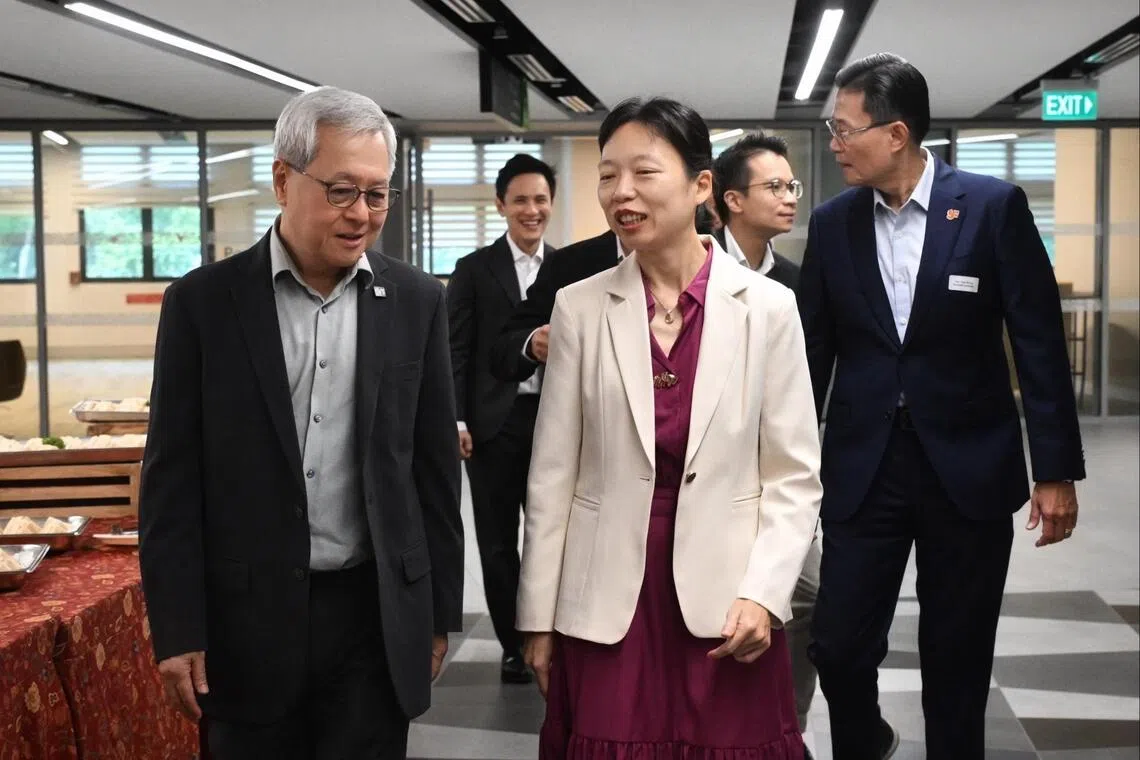
From left: Singapore Institute of Technology president Chua Kee Chaing, Acting Manpower Minister Jasmin Lau and GlobalFoundries Singapore senior vice-president and general manager Tan Yew Kong at the SG AI Xchange on Sept 17, 2026.
Published Sep 17, 2026, 05:36 PM
Updated Sep 17, 2026, 05:36 PM
Acting Minister Jasmin Lau urges companies adopting AI to be transparent about its impact on employees, including plans for automation, retraining, and business outlooks to maintain trust.
The inaugural SG AI Xchange highlighted the growth of AI Centres of Excellence in Singapore, promoting knowledge sharing to accelerate AI adoption, especially in advanced manufacturing.
Speakers emphasised building AI capabilities in the workforce and involving workers in AI transformation to prevent resistance and ensure successful organisational change.
SINGAPORE - Companies here adopting artificial intelligence should be more transparent about what the use of the technology means for their employees, said Acting Minister for Manpower Jasmin Lau.
While workers may not be pushing back, this does not mean they are necessarily happy, she said to an audience of about 150 business leaders at the inaugural SG AI Xchange, held at the Singapore Institute of Technology on Sept 17.
“They want to know what their business leaders are really thinking, whether you are already planning retrenchments and slowdown in hiring,” said Lau, who is also Senior Minister of State for Digital Development and Information.
“Don’t take a quiet workforce for an agreeable workforce.”
For example, plans for increased automation should be shared with workers, including any retraining they would have to go through, Lau said.
Such companies which are facing poor business outlooks should also share that information with staff, she said, noting workers may blame AI for the hard decisions made even if they are unrelated to the technology.
“We think that a lot more communication and transparency will help keep our workers and our companies together, and we hope that you play a part in it,” she said.
Lau also noted a groundswell of workers and younger students who are "somewhat anti-AI”, over concerns about the technology’s impact on jobs and the environment.
These are real sentiments and emotions that should not be ignored, she said.
“I spend a lot of time assuring workers and students that we are not blind in our pursuit for AI – that we want to use the technology for good, and at the end of the day, it is not about chasing the use of AI in itself,” she said.
“We will do so if it means giving our workers better jobs, and we will do so if it means providing better services for our people.”
She noted this comes even as more AI companies set up shop here, pointing to examples such as Claude developer Anthropic’s announcement that it would open an office here in October .
Held at the Singapore Institute of Technology (SIT), the SG AI Xchange is a new series of forums that aim to facilitate the exchange of knowledge between established AI Centres of Excellence and emerging builders to accelerate AI transformation here.
Such centres – which span research labs and innovation hubs – drive AI innovation and adoption, such as by creating custom AI solutions integrated into a company’s workflows and products, said the Economic Development Board (EDB) in a statement.
Since 2024, almost 100 AI centres of excellence have been established here across industries ranging from finance to manufacturing, said Lau.
“Within manufacturing alone, we see companies in semiconductors, medtech, mobility, energy and chemicals building up their AI capabilities,” she said.
Organised by EDB, SIT and chipmaker GlobalFoundries, the first SG AI Xchange was focused on advanced manufacturing, one of Singapore's four national AI missions.
Such a forum gives firms adopting AI a platform to share their experiences on issues such as data infrastructure as well as cybersecurity, as well as how they can get their workers onboard, said Lau.
This however only works if companies also share what they have not done well, she said, while noting how people in Singapore tend to be more reserved about such matters.
Acknowledging that companies may not be willing to openly share everything, Lau said there is still “a lot of value” in identifying the problems that they needed to solve and the challenges faced along the way.
“I ask that you share that, so that others will share back, sometimes with a connection or a solution you did not expect,” she said.
Speaking at the event, SIT president Chua Kee Chaing said the university sees AI not as a technology to be adopted, but as a capability to be built.
“How do we build a workforce fluent and confident in using AI, while knowing when and how to use it? These are not purely technology questions; they are questions of talent and organisational transformation,” he said.
GlobalFoundries Singapore senior vice president and general manager Tan Yew Kong said the AI revolution is one that cannot be reversed, comparing it to how paper maps had largely been supplanted by GPS alternatives.
Companies undergoing AI transformation should bring their workers on the journey, such as by informing them on matters such as how their jobs will be affected and what sort of reskilling is required.
“Otherwise they will just push back,” he said.
Zhaki Abdullah is a correspondent at The Straits Times. He is on the health beat, in addition to occasionally covering science, environmental, tech and Muslim affairs issues.
AI/artificial intelligence
2026年9月17日,新加坡理工学院院长蔡启昌、人力部代部长刘嘉敏和GlobalFoundries新加坡高级副总裁兼总经理陈耀光出席了SG AI Xchange活动。
发布于 2026 年 9 月 17 日下午 5:36
更新于2026年9月17日下午5:36
代理部长刘嘉敏敦促采用人工智能的公司公开其对员工的影响,包括自动化计划、再培训计划和业务前景,以维护信任。
首届新加坡人工智能交流会 (SG AI Xchange) 重点介绍了新加坡人工智能卓越中心的增长情况,促进了知识共享,以加速人工智能的采用,尤其是在先进制造业领域。
发言者强调要在员工队伍中培养人工智能能力,并让员工参与人工智能转型,以防止抵制并确保组织变革的成功。
新加坡——人力部代理部长刘嘉敏表示,新加坡采用人工智能的公司应该更加透明地说明这项技术的使用对员工意味着什么。
她于 9 月 17 日在新加坡理工学院举行的首届 SG AI Xchange 大会上对约 150 位商界领袖表示,虽然员工可能没有反抗,但这并不意味着他们一定感到满意。
“他们想知道企业领导者们的真实想法,是否已经在计划裁员和放缓招聘,”刘先生说道,他同时也是数码发展及新闻部高级政务部长。
“不要把沉默寡言的员工队伍当作温顺的员工队伍。”
刘先生表示,例如,应该与工人分享提高自动化程度的计划,包括他们需要接受的任何再培训。
她表示,面临糟糕经营前景的公司也应该与员工分享这些信息,并指出,即使艰难的决定与人工智能无关,员工也可能会将责任归咎于人工智能。
“我们认为,加强沟通和提高透明度将有助于维系员工和公司的团结,我们希望你们也能为此出一份力,”她说。
刘还注意到,由于担心人工智能技术对就业和环境的影响,许多工人和年轻学生“有些反对人工智能”。
她说,这些都是真实的情感,不应该被忽视。
“我花了很多时间向员工和学生保证,我们追求人工智能并非盲目——我们希望利用这项技术造福人类,归根结底,我们追求的不是人工智能本身的应用,”她说。
“如果这意味着给我们的工人提供更好的工作,我们就会这样做;如果这意味着为我们的人民提供更好的服务,我们也会这样做。”
她指出,即便越来越多的 AI 公司在这里设立办事处,这种情况依然存在,例如 Claude 的开发商 Anthropic 宣布将于 10 月在这里开设办事处。
SG AI Xchange 是在新加坡理工大学 (SIT) 举办的一系列新论坛,旨在促进成熟的人工智能卓越中心与新兴建设者之间的知识交流,以加速新加坡的人工智能转型。
经济发展局 (EDB) 在一份声明中表示,此类中心(涵盖研究实验室和创新中心)推动人工智能的创新和应用,例如创建集成到公司工作流程和产品中的定制人工智能解决方案。
刘先生表示,自 2024 年以来,这里已在金融、制造业等各个行业建立了近 100 个人工智能卓越中心。
“仅在制造业领域,我们就看到半导体、医疗技术、移动出行、能源和化工等行业的公司都在增强其人工智能能力,”她说道。
由新加坡经济发展局 (EDB)、新加坡科技学院 (SIT) 和芯片制造商 GlobalFoundries 联合举办的首届 SG AI Xchange 聚焦于先进制造业,这是新加坡四大国家人工智能任务之一。
刘先生表示,这样的论坛为采用人工智能的公司提供了一个平台,让他们可以分享在数据基础设施、网络安全以及如何让员工接受人工智能等方面的经验。
她表示,但这只有在公司也分享自己做得不好的地方时才有效,同时她也指出,新加坡人往往对这类事情比较保守。
刘先生承认,企业可能不愿意公开分享所有信息,但他表示,找出企业需要解决的问题以及在此过程中面临的挑战仍然“很有价值”。
“我希望你们分享这些信息,这样其他人也会分享,有时可能会带来意想不到的联系或解决方案,”她说。
新加坡理工大学校长蔡启昌在活动上表示,该大学认为人工智能不是一种需要采用的技术,而是一种需要培养的能力。
“我们如何才能培养一支能够熟练自信地使用人工智能,并且知道何时以及如何使用人工智能的员工队伍?这些不仅仅是技术问题,更是人才和组织转型的问题,”他说道。
GlobalFoundries 新加坡高级副总裁兼总经理 Tan Yew Kong 表示,人工智能革命是不可逆转的,并将其比作纸质地图在很大程度上被 GPS 替代。
正在进行人工智能转型的公司应该让员工参与到转型过程中来,例如告知他们工作将受到哪些影响以及需要进行哪些类型的技能再培训。
“否则他们就会反抗,”他说。
扎基·阿卜杜拉是《海峡时报》的记者。他主要负责健康新闻报道,偶尔也报道科学、环境、科技和穆斯林事务等议题。
人工智能