Inter-agency task force proposes fee caps for all disability services, more families to receive subsidies跨部门工作组提议对所有残疾人服务设定收费上限,更多家庭将获得补贴。
The disability task force also called for stronger support for persons with higher needs, who typically face higher costs.
新闻视频
The disability task force also called for stronger support for persons with higher needs, who typically face higher costs.
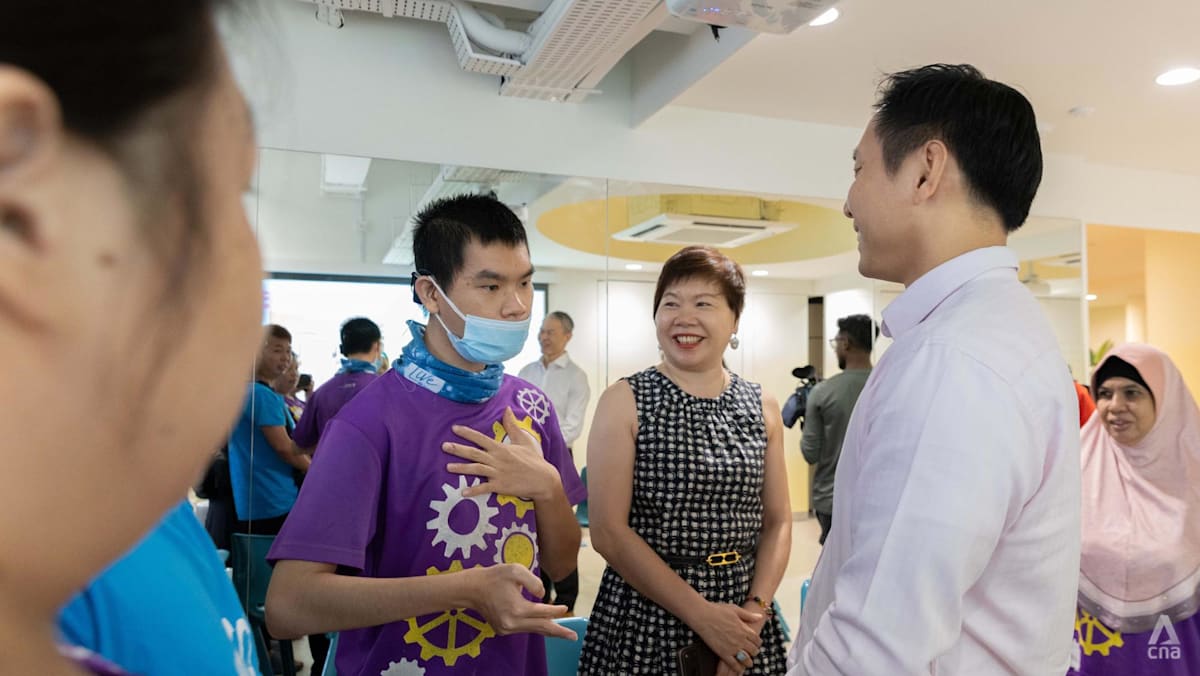
TOUCH client Jian Shouyi speaking to Senior Minister of State for Social and Family Development Goh Pei Ming at TOUCH Centre for Independent Living in Enabling Village on Sep 17, 2026. (Photo: CNA/Ili Mansor)
This audio is generated by an AI tool.
SINGAPORE: An inter-agency task force looking at measures to support families of people with disabilities has put forward its first set of recommendations, aimed at making services more affordable and accessible.
These include introducing fee caps for all disability services and raising means-tested subsidies for most families, the Ministry of Social and Family Development (MSF) said on Thursday (Sep 17).
The task force also recommended raising the eligibility threshold for means-tested subsidies to a monthly per capita household income of around S$6,000 (US$4,710), up from S$4,800.
It proposed stronger support for people with higher support needs, who typically face higher costs.
CNA Games Guess Word Crack the word, one row at a time Buzzword Create words using the given letters Mini Sudoku Tiny puzzle, mighty brain teaser Mini Crossword Small grid, big challenge Word Search Spot as many words as you can Show More Show Less Lower-income households will continue to receive the highest levels of support and would pay no more than S$10 for community-based services such as day activity centres and the Enabling Skills for Life Programme, down from the current S$20 to S$60. These changes are expected to be implemented by 2028, said MSF. By 2030, around 5,000 persons with disabilities accessing community and residential disability services are expected to benefit from these enhancements, it added. MSF said that the task force’s first recommendations take a “two-pronged approach”. “First, they seek to make disability services more affordable for families, including broader access to subsidies. Second, they aim to expand service capacity so that more persons with disabilities can access appropriate support," it added. "Together, these measures will strengthen assurance for families and support long-term care planning." Speaking to the media at the TOUCH Centre for Independent Living at the Enabling Village, Senior Minister of State for Social and Family Development Goh Pei Ming said caring for a person with a disability is a "lifelong journey", with affordability being one of the biggest concerns raised by families of people with disabilities. "Over time, care costs can add up. Families hope to get assurances that support will continue to be affordable," Mr Goh added.
Lower-income households will continue to receive the highest levels of support and would pay no more than S$10 for community-based services such as day activity centres and the Enabling Skills for Life Programme, down from the current S$20 to S$60.
These changes are expected to be implemented by 2028, said MSF. By 2030, around 5,000 persons with disabilities accessing community and residential disability services are expected to benefit from these enhancements, it added.
MSF said that the task force’s first recommendations take a “two-pronged approach”.
“First, they seek to make disability services more affordable for families, including broader access to subsidies. Second, they aim to expand service capacity so that more persons with disabilities can access appropriate support," it added.
"Together, these measures will strengthen assurance for families and support long-term care planning."
Speaking to the media at the TOUCH Centre for Independent Living at the Enabling Village, Senior Minister of State for Social and Family Development Goh Pei Ming said caring for a person with a disability is a "lifelong journey", with affordability being one of the biggest concerns raised by families of people with disabilities.
"Over time, care costs can add up. Families hope to get assurances that support will continue to be affordable," Mr Goh added.
Senior Minister of State for Social and Family Development Goh Pei Ming and TOUCH client Loh Soon Gek participate in an activity at TOUCH Centre for Independent Living in Enabling Village on Sep 17, 2026. (Photo: CNA/Ili Mansor)
Under the recommendations, MSF would introduce fee caps for all disability services before subsidies, limiting the amount families have to pay after subsidies.
Means-tested subsidy rates will also be increased by at least 10 percentage points for most families.
The enhanced subsidies would apply across a range of disability services, including day activity centres, the Enabling Skills for Life Programme, adult disability hostels, adult disability homes, children disability homes, the Enabling Transport subsidy and taxi subsidy scheme.
“Together, the fee caps and higher subsidies will help families better manage the long-term cost of disability care and support, while providing greater certainty as they plan for their loved ones’ future needs,” MSF said.
The task force also proposed raising the eligibility threshold for means-tested subsidies to extend support to more middle-income families.
This increase in the per capita monthly household income threshold to about S$6,000 would mean about 80 per cent of households of people with disabilities would be covered.
"More families who do not qualify for subsidies today will therefore be able to receive support for disability services, recognising the significant and long-term care costs that many families may face while supporting a loved one with disabilities," MSF said.
As people with higher support needs and their families often require more intensive and sustained assistance over the long term, the task force recommended stronger funding support for selected services for this group.
The enhanced support will apply to the Enabling Skills for Life Programme and adult disability homes.
"These measures will help ensure that persons with higher support needs can continue to access quality care and support, while easing the financial burden on families," said MSF.
Families of people with higher support needs can expect monthly fees after government subsidies for selected services to fall by about 25 per cent to 80 per cent compared with current levels.
For example, a family of four living in an HDB flat and caring for a person with higher support needs, with a monthly household income of S$6,000 – or S$1,500 per person – would pay S$40 a month for a day activity centre, down from S$210. For adult disability homes, the fee would fall from S$3,500 to S$700.
For a family of four with an income of S$13,000 a month – or S$3,250 per person – day activity centre fees would fall to S$400 from S$710, while adult disability home fees would fall to S$1,600 from S$7,000.
DAY ACTIVITY CENTRES, SHELTERED WORKSHOPS
To ensure families can access the support they need, the task force proposed increasing the number of spaces in day activity centres and sheltered workshops.
"Affordability enhancements must be accompanied by sufficient service capacity so that families can access the support they need," said MSF.
The task force proposed to add another 1,300 spaces at day activity centres and sheltered workshops by 2030, beyond the 1,000 additional places announced in 2024.
This brings the total number of additional spaces to 2,300 by 2030, on top of the current capacity of 3,600.
In 2026, close to 440 day activity centre and sheltered workshop spaces have been set up in areas such as Queenstown, Bukit Merah and Ang Mo Kio. Another 440 spaces are expected to be operational in 2027.
“The additional places will enable more persons with disabilities to access appropriate support closer to their communities, while giving families greater assurance that their loved ones can continue to receive more care, support and opportunities for meaningful engagement over the long term,” MSF said.
The ministry added that the government will work closely with social service agencies over the next few years to ensure that services are available to those who need them, as well as to implement the affordability enhancements by 2028.
"T hrough the first set of recommendations, we want families to know that disability services will remain accessible and affordable, and that the government will be with them every step of the way across different stages of life," Mr Goh said.
CNA has asked MSF for more information on the recommendations announced on Thursday.
"These affordability and capacity enhancements represent the first set of recommendations from the task force," said MSF.
"They are an important step towards strengthening assurance for families with persons with disabilities across different stages of life, while recognising that support needs may evolve over time."
The full set of recommendations will be announced by early October.
The Taskforce on Assurance for Families with Persons with Disabilities was announced by Prime Minister Lawrence Wong in December 2025.
It is looking at three key areas – affordability, employment and community living.
Since January, the task force has been engaging with people with disabilities, caregivers, employers, community partners and key stakeholders on issues including employment, community living and affordability.
Including Mr Goh, the five-member inter-ministry task force appointed by Minister for Social and Family Development Masagos Zulkifli are:
Minister of State for Health and Digital Development and Information Rahayu Mahzam
Senior Parliamentary Secretary for Social and Family Development and Law Eric Chua
Senior Parliamentary Secretary for Manpower and Finance Shawn Huang
Senior Parliamentary Secretary for Education and National Development Syed Harun Alhabsyi
Get our pick of top stories and thought-provoking articles in your inbox
Stay updated with notifications for breaking news and our best stories
Join our channel for the top reads for the day on your preferred chat app
残疾人工作组还呼吁加大对有较高需求人群的支持力度,因为他们通常面临更高的费用。
2026年9月17日,TOUCH客户简守义在位于Enabling Village的TOUCH独立生活中心与社会及家庭发展部高级政务部长吴佩明交谈。(图片:CNA/Ili Mansor)
这段音频由人工智能工具生成。
新加坡:一个跨部门工作组正在研究支持残疾人家庭的措施,并提出了第一批建议,旨在使服务更加经济实惠且易于获得。
社会及家庭发展部(MSF)周四(9月17日)表示,这些措施包括对所有残疾人服务引入收费上限,并提高大多数家庭的收入调查补贴。
工作组还建议将收入调查补贴的资格门槛从每月每户人均收入 4,800 新元提高到 6,000 新元左右(4,710 美元)。
它建议为有较高支持需求的人群提供更有力的支持,因为他们通常面临更高的成本。
CNA游戏 猜词游戏 逐行破解单词 流行词游戏 用给定的字母组成单词 迷你数独 小谜题,脑力挑战 迷你填字游戏 小方格,大挑战 单词搜索 尽可能多地找出单词 显示更多 显示更少 低收入家庭将继续获得最高级别的支持,社区服务(例如日间活动中心和“生活技能赋能计划”)的费用将不超过10新元,低于目前的20至60新元。社会及家庭发展部(MSF)表示,这些调整预计将于2028年实施。该部门补充说,到2030年,预计将有约5000名残疾人士受益于这些改进措施,他们将获得社区和住宿式残疾人服务。MSF表示,工作组的首批建议采取“双管齐下”的方法。“首先,他们力求降低家庭获得残疾人服务的费用,包括扩大补贴的范围。其次,他们旨在扩大服务能力,以便更多残疾人士能够获得适当的支持。” “这些措施将共同增强对家庭的保障,并支持长期照护规划。”社会及家庭发展部高级政务部长吴佩铭在“赋能村”的TOUCH独立生活中心接受媒体采访时表示,照顾残障人士是一项“终身事业”,而费用问题是残障人士家庭最关心的问题之一。“随着时间的推移,照护费用会不断累积。家庭希望得到保证,确保他们能够继续负担得起这些支持,”吴先生补充道。
低收入家庭将继续获得最高水平的支持,他们只需支付不超过 10 新元即可享受社区服务,例如日间活动中心和生活技能提升计划,而目前的收费标准为 20 新元至 60 新元。
无国界医生组织表示,这些改革预计将于2028年实施。该组织还补充说,到2030年,预计将有约5000名残疾人士在使用社区和住宿式残疾人服务时受益于这些改进措施。
无国界医生组织表示,工作组的首批建议采取“双管齐下的方法”。
“首先,他们力求降低残疾人服务的费用,让更多家庭能够负担得起,包括扩大补贴范围。其次,他们的目标是扩大服务能力,以便更多残疾人能够获得适当的支持,”声明补充道。
“这些措施将共同增强家庭的保障,并支持长期护理规划。”
社会及家庭发展部高级政务部长吴佩明在“赋能村”的TOUCH独立生活中心接受媒体采访时表示,照顾残疾人士是“一生的旅程”,而经济承受能力是残疾人士家庭最关心的问题之一。
“随着时间的推移,护理费用会不断累积。家属们希望得到保证,这些支持服务将继续保持在他们能够负担得起的范围内,”吴先生补充道。
社会及家庭发展部高级政务部长吴佩铭与TOUCH服务对象罗顺玉于2026年9月17日在位于Enabling Village的TOUCH独立生活中心参加活动。(图片:CNA/Ili Mansor)
根据这些建议,无国界医生组织将在补贴前对所有残疾人服务引入费用上限,从而限制家庭在补贴后需要支付的金额。
对于大多数家庭来说,收入调查补贴率也将至少提高 10 个百分点。
加强补贴将适用于一系列残疾人服务,包括日间活动中心、生活技能提升计划、成人残疾人旅舍、成人残疾人住宅、儿童残疾人住宅、交通补贴和出租车补贴计划。
无国界医生组织表示:“费用上限和更高的补贴将共同帮助家庭更好地管理残疾护理和支持的长期费用,同时为他们规划亲人的未来需求提供更大的确定性。”
工作组还提议提高收入调查补贴的资格门槛,以扩大对更多中等收入家庭的支持。
将人均家庭月收入门槛提高到约 6000 新元,意味着约 80% 的残疾人家庭将获得保障。
“因此,更多目前不符合补贴条件的家庭将能够获得残疾人服务方面的支持,这体现了社会及家庭发展部(MSF)对许多家庭在照顾残疾亲人时可能面临的巨大且长期的护理费用的重视。”
由于有较高支持需求的人及其家庭通常需要长期更密集、更持续的援助,工作组建议为该群体的特定服务提供更强有力的资金支持。
加强支持将适用于“生活技能提升计划”和成人残疾人之家。
无国界医生组织表示:“这些措施将有助于确保有较高支持需求的人能够继续获得高质量的护理和支持,同时减轻家庭的经济负担。”
对于有较高支持需求的家庭来说,在政府补贴部分服务后,每月费用预计会比目前水平下降约 25% 至 80%。
例如,一个居住在组屋的四口之家,需要照顾一位有较高照护需求的老人,家庭月收入为6000新元(即每人1500新元),那么他们每月只需支付40新元的日间活动中心费用,低于之前的210新元。对于成人残疾人之家,费用将从3500新元降至700新元。
对于一个月收入为 13,000 新元(或每人 3,250 新元)的四口之家来说,日间活动中心的费用将从 710 新元降至 400 新元,而成人残疾人之家的费用将从 7,000 新元降至 1,600 新元。
日间活动中心、庇护工场
为了确保家庭能够获得他们需要的支持,工作组提议增加日间活动中心和庇护工场的床位数量。
无国界医生组织表示:“提高可负担性的同时,必须有足够的服务能力,以便家庭能够获得他们需要的支持。”
工作组提议,到 2030 年,在日间活动中心和庇护工场再增加 1300 个名额,这还不包括 2024 年宣布的 1000 个新增名额。
到 2030 年,新增空间总数将达到 2300 个,而目前的容量为 3600 个。
2026年,在女皇镇、红山和宏茂桥等地区已设立近440个日间活动中心和庇护工场。预计2027年还将有440个场所投入运营。
无国界医生组织表示:“新增的名额将使更多残疾人士能够在离家更近的地方获得适当的支持,同时也能让家属更加放心,他们的亲人能够长期获得更多的照护、支持和有意义的参与机会。”
该部补充说,政府将在未来几年与社会服务机构密切合作,以确保有需要的人能够获得服务,并在 2028 年前落实提高服务可负担性的措施。
“通过第一批建议,我们希望让家庭知道残疾人服务将保持可及性和可负担性,政府将在他们人生的不同阶段始终陪伴在他们身边,”吴先生说。
CNA已向无国界医生组织询问有关周四公布的建议的更多信息。
无国界医生组织表示:“这些提高可负担性和容量的措施代表了工作组提出的第一批建议。”
“这是加强对不同人生阶段残疾人家庭保障的重要一步,同时也认识到支持需求可能会随着时间的推移而变化。”
全部建议将于10月初公布。
2025年12月,总理黄循财宣布成立残疾人家庭保障工作组。
它着眼于三个关键领域——经济适用性、就业和社区生活。
自 1 月以来,该工作组一直在与残疾人、护理人员、雇主、社区合作伙伴和主要利益相关者就就业、社区生活和负担能力等问题进行沟通。
包括吴先生在内,由社会及家庭发展部长马善高任命的五人跨部门特别工作组成员有:
卫生、数字发展和信息国务部长拉哈尤·马赫扎姆
社会及家庭发展及法律部高级政务次长蔡志强
人力及财政部高级政务次长黄晓明
教育和国家发展高级政务次长赛义德·哈伦·阿尔哈布西 (Syed Harun Alhabsyi)
订阅我们的邮件,即可获取精选热点新闻和引人深思的文章。
订阅通知,第一时间获取突发新闻和精彩报道。
加入我们的频道,即可在您常用的聊天应用上获取当日热门文章。