Food, ties between people and an Indian international school that helped Siglap with a park食物、人与人之间的联系,以及一所帮助锡格拉普建设公园的印度国际学校
Global Schools Group celebrates its 25th anniversary with milestones along the way to show how it contributes to communities in Singapore. Read more at straitstimes.com.
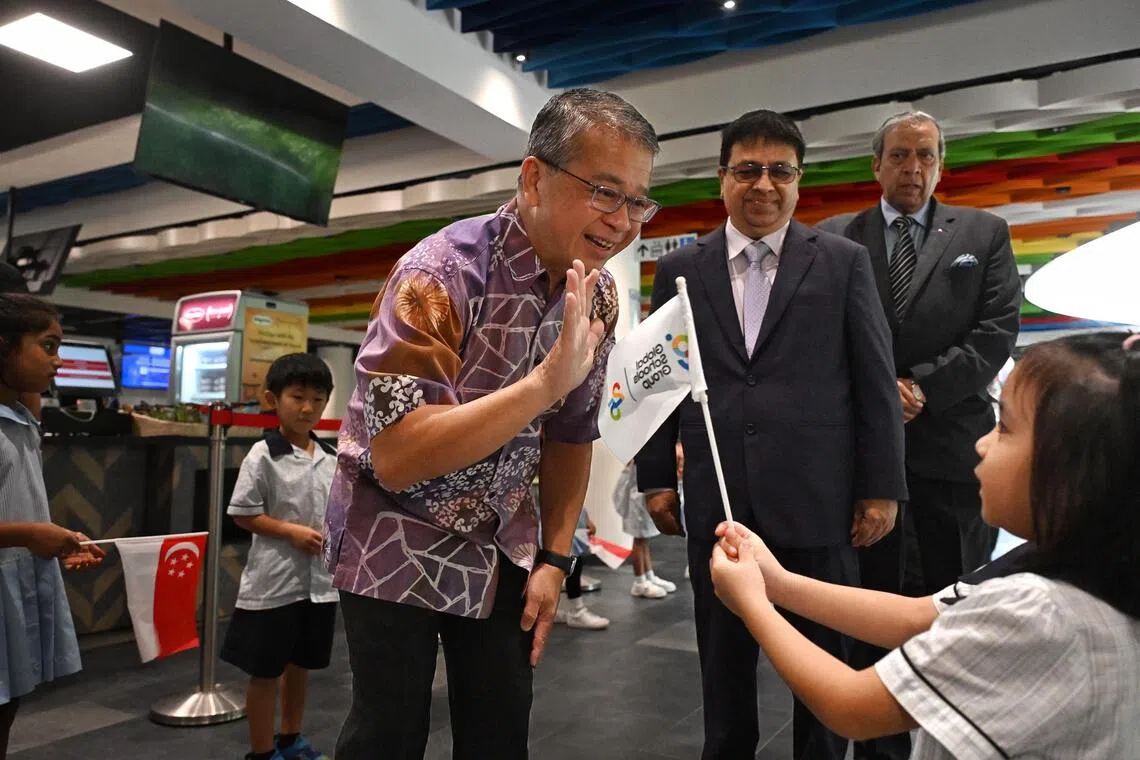
From left: Law Minister Edwin Tong and Atul Temurnikar, Chairman and Co-Founder of Global Schools Group greeting children at the One World International School on Sept 18, 2026.
Zaihan Mohamed Yusof
Published Sep 18, 2026, 05:35 PM
Updated Sep 18, 2026, 05:35 PM
Global Indian International School (GIIS) gave up space in Siglap for Yarrow Park, benefiting local residents with much-needed public space.
Law Minister Edwin Tong praised Global Schools Group (GSG) for community spirit and highlighted deep, people-focused Singapore-India ties.
GSG fosters diversity with 40+ nationalities, promotes innovation like the AI-powered LumaBand to assist the elderly, and is expanding globally under Global Schools Group.
SINGAPORE – Residents in Siglap have the Global Indian International School (GIIS) to thank for after waiting years for a park near their homes.
Revealing this on Sept 18, Law Minister Edwin Tong said Yarrow Park, which is in his Joo Chiat ward in the East Coast GRC, was carved from a cluster of five basketball courts which sat on premises previously leased by GIIS at Cheviot Hill.
The school, which is one of 12 under the Global Schools Group (GSG) banner, moved to its present location in Punggol in 2026.
Speaking at the campus, at an event to mark GSG’s 25th anniversary, Tong lauded GIIS for its contribution to the Joo Chiat community.
He told the audience, which included the High Commissioner of India to Singapore Shilpak Ambule and GSG chairman and co-founder Atul Temurnikar, that the school was quick to agree when asked to give up part of its premises for the park.
Tong, who is Second Minister for Home Affairs, said: “Siglap is a very tight estate with small roads built many years ago. There weren’t many public spaces.
“I moved the idea of a public space to Atul, and I said sheepishly, ‘Can we take a little bit of your school premises and turn it into a park for the community? Almost without hesitation, Atul said ‘Yes. How do we make this work?’”
The school then worked with NParks and the Singapore Land Authority in contributing to the park, which was officially opened in 2022.
Tong said: “You saw yourself as being part of Joo Chiat, part of the fabric of our community, and you were prepared to share what you had, so that a wider community could benefit, and indeed they have.
“In many ways, this story reflects the larger relationship between Singapore and India as well.”
He said close ties between the two nations go back more than 200 years. Singapore was once administered from Calcutta (now Kolkata) after Sir Stamford Raffles’ arrival in 1819.
Tong added: “After independence in 1965, India was one of the first to recognise the status of Singapore, which is why we celebrated 60 years of our diplomatic relations last year.
“It’s a very deep relationship that we have, bound by history and across many areas, from trade and investment to technology, skills, sustainability, connectivity, and defense.
“But to me, the relationship has been less about agreements between governments or numbers on a balance sheet or trading surplus or deficit. The relationship ultimately rests on people. It’s the most valuable commodity.”
In his speech, Tong praised the school’s academic achievements, noting that the students have done exceptionally well.
He said the classrooms in GIIS today bring together young people from more than 40 nationalities, a mix which mirrors what Singapore looks like.
“We share that same quality: to be outward looking, cosmopolitan, and welcoming of the world.
“Singapore has always drawn strength from people of different backgrounds coming together. We say multiculturalism, multi-ethnicity, diversity.
“There’s a strong quality about that,” he said, adding that while each group group brings something unique about themselves to the table, they still share a common identity.
Tong said he was in India in July, where he enjoyed the warmth of the people, the buzz and energy, and the deep history and culture.
“And of course, there’s the food. I’m a typical Singaporean. People often ask whether I prefer North or South cuisine, and I say actually both because I’m Singaporean. As long as it’s food.”
He added: “Beyond the food, what makes the Singapore-India relationship special are the human connections.
“The Indian families who have made Singapore their home, the Singaporeans who live, work and do business in India, the students and professionals as well as entrepreneurs who move freely between our two countries, the friendships that have been built and nurtured over generations, and of course institutions like GSG.
“GSG has remained proud of its Indian heritage, but at the same time, you have become very much a part of Singapore.”
The group now operates 64 campuses across 11 countries. It has about 45,000 students in its schools.
In his speech, Temurnikar said that GSG started 25 years ago by planting a small seed in Mount Sophia.
“Today, we have grown a tree. Now this tree will shape the lives and will shape our future.
“It is our responsibility to ensure the branches reach even further and that its shade benefits generations of children who are yet to come,” he added.
At the event, Tong was given a tour of exhibits at the school -- from achievements by students and alumni, to special projects being championed by the students.
They include a project by 15 students called LumaBand, an AI-powered wristband for the elderly that will alert five contacts via SMS when it detects a fall by the wearer.
Student Iraj Gupta, 17, said the idea was developed when his 70-year-old female relative suffered a fall.
Teammate Anuraag Vombatkere, 17, said the idea is for the elderly person to receive timely assistance.
Anuraag said: “Given Singapore’s growing elderly population, we thought it would be great for an elderly to receive immediate help in any emergency.”
左起:律政部长唐振辉和环球学校集团主席兼联合创始人阿图尔·特穆尼卡于2026年9月18日在世界国际学校与孩子们打招呼。
扎伊汉·穆罕默德·优素福
发布于 2026 年 9 月 18 日下午 5:35
更新于2026年9月18日下午5:35
全球印度国际学校 (GIIS) 让出了位于锡格拉普的一块土地,用于建设亚罗公园,为当地居民提供了急需的公共空间。
律政部长唐振辉赞扬环球学校集团(GSG)的社区精神,并强调新加坡与印度之间以人为本的深厚关系。
GSG 拥有 40 多个国家的员工,营造了多元化的氛围;它还推动了创新,例如利用人工智能技术为老年人提供帮助的 LumaBand;并且在全球学校集团的领导下,GSG 正在向全球扩张。
新加坡——锡格拉普的居民们多年来一直盼望着家附近能有一个公园,现在他们应该感谢全球印度国际学校(GIIS)。
9月18日,律政部长唐振辉透露,位于他所在的东海岸集选区如切选区的亚罗公园,是由位于雪维奥山的GIIS之前租用的五个篮球场改造而成。
该校是环球学校集团 (GSG) 旗下 12 所学校之一,于 2026 年迁至榜鹅现址。
在校园举办的纪念GSG成立25周年的活动上,Tong发表讲话,赞扬GIIS对如切社区的贡献。
他告诉听众,包括印度驻新加坡高级专员 Shilpak Ambule 和 GSG 董事长兼联合创始人 Atul Temurnikar,当被要求让出部分校舍用于建设公园时,学校很快就同意了。
内政部第二部长唐先生表示:“实乞纳是一个非常紧凑的住宅区,道路狭窄,而且是多年前修建的。当时公共空间并不多。”
“我向阿图尔提出了公共空间的想法,我不好意思地说:‘我们能不能借用你们学校的一小部分场地,把它改造成一个社区公园?’阿图尔几乎毫不犹豫地说:‘可以。我们该怎么做呢?’”
随后,学校与国家公园局和新加坡土地管理局合作,为公园的建设做出了贡献,该公园于 2022 年正式开放。
Tong说:“你把自己视为如切的一份子,是我们社区结构的一部分,你愿意分享你所拥有的,以便更广泛的社区能够受益,而事实上他们也确实受益了。”
“从很多方面来看,这个故事也反映了新加坡和印度之间更广泛的关系。”
他表示,两国之间的紧密联系可以追溯到200多年前。1819年斯坦福·莱佛士爵士抵达新加坡后,新加坡曾一度由加尔各答(现为加尔各答)管辖。
唐补充道:“1965年新加坡独立后,印度是最早承认新加坡地位的国家之一,这也是我们去年庆祝建交60周年的原因。”
“我们之间有着非常深厚的关系,这种关系由历史紧密相连,涵盖贸易、投资、技术、技能、可持续性、互联互通和国防等诸多领域。
“但对我而言,这种关系与其说是政府间的协议,不如说是资产负债表上的数字,或是贸易顺差或逆差。这种关系最终建立在人的基础上。人才是最宝贵的财富。”
童在讲话中赞扬了学校的学术成就,并指出学生们表现非常出色。
他表示,如今GIIS的教室里汇聚了来自40多个国家的年轻人,这种多元化的构成反映了新加坡的现状。
“我们都拥有同样的品质:目光远大、具有国际视野、欢迎世界。”
“新加坡一直以来都从不同背景的人们团结在一起中汲取力量。我们称之为多元文化主义、多种族、多样性。”
“这其中蕴含着一种强大的特质,”他说道,并补充说,虽然每个团体都带来了一些独特的东西,但他们仍然拥有共同的身份认同。
童先生说他7月份去了印度,在那里他感受到了印度人民的热情、活力和热情,以及深厚的历史文化。
“当然,还有美食。我是个典型的新加坡人。人们经常问我更喜欢北方菜还是南方菜,我的回答是两者都喜欢,因为我是新加坡人。只要是美食,我都爱。”
他补充道:“除了美食之外,新加坡和印度关系的特殊之处在于人与人之间的联系。”
“在新加坡安家落户的印度家庭,在印度生活、工作和经商的新加坡人,在两国之间自由流动的学生、专业人士和企业家,几代人建立和培育的友谊,当然还有像新加坡政府这样的机构。
“GSG一直为其印度传统感到自豪,但与此同时,你们也已成为新加坡不可分割的一部分。”
该集团目前在11个国家运营着64个校区,旗下学校约有45000名学生。
特穆尔尼卡尔在讲话中说,GSG 25 年前在索菲亚山上播下了一颗小小的种子。
“今天,我们种下了一棵树。现在,这棵树将塑造我们的生活,也将塑造我们的未来。”
“我们有责任确保树枝伸得更远,让树荫惠及子孙后代,”他补充道。
活动中,童同学参观了学校的展览——从学生和校友的成就,到学生们正在大力推进的特殊项目。
其中包括 15 名学生参与的名为 LumaBand 的项目,这是一款面向老年人的 AI 腕带,当检测到佩戴者跌倒时,它会通过短信提醒五个联系人。
17 岁的学生伊拉杰·古普塔表示,这个想法源于他 70 岁的女性亲戚摔倒的一次经历。
队友阿努拉格·沃姆巴特克雷(Anuraag Vombatkere,17岁)表示,这样做的目的是为了让老年人得到及时的帮助。
阿努拉格说:“鉴于新加坡老年人口不断增长,我们认为,如果老年人在任何紧急情况下都能立即获得帮助,那将是一件非常好的事情。”