After over 10 years of racing, Shanti Pereira still gets ‘very nervous’参加比赛超过10年后,珊蒂·佩雷拉仍然会“非常紧张”。
Singapore’s sprint queen and her coach speak about pressure, precision and dips at the finish ahead of the Asian Games. Read more at straitstimes.com.
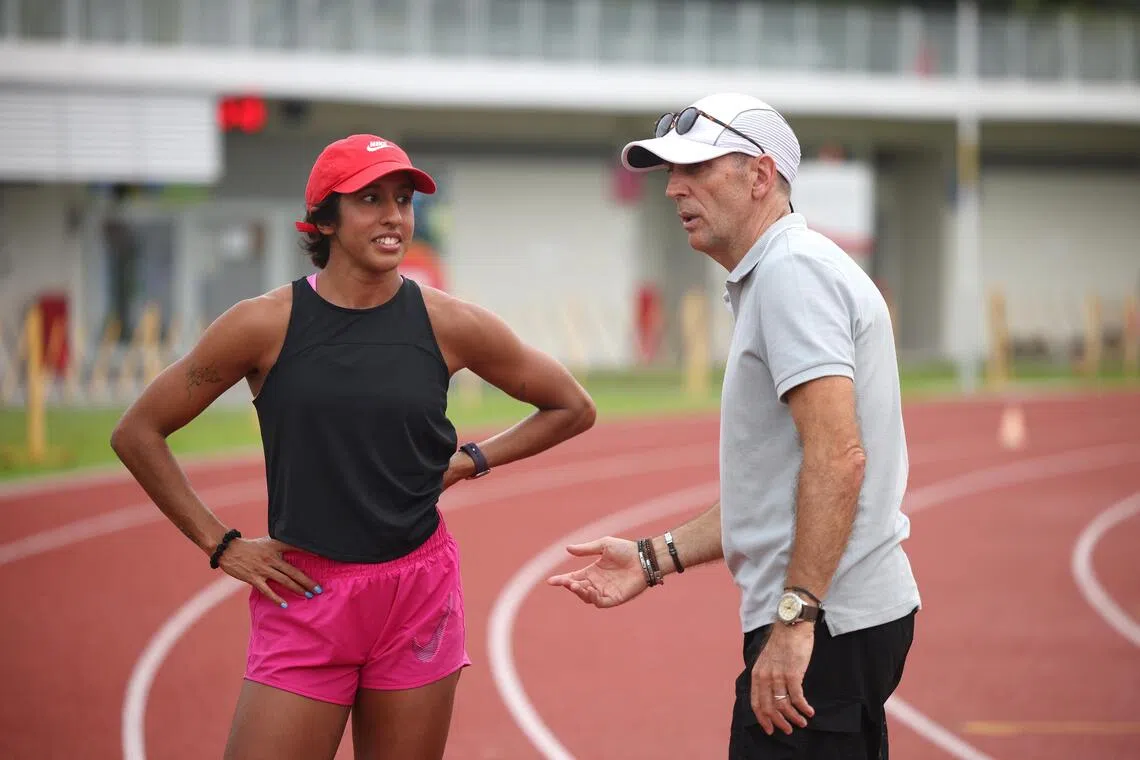
Singapore’s fastest woman and her coach, Luis Cunha, speak to assistant sports editor Rohit Brijnath about pressure, precision and dips at the finish as she readies to defend her 200m title at the Asian Games.
Shanti Pereira and coach Luis Cunha have had a very successful working relationship.
ST PHOTO: JASON QUAH
Published Sep 18, 2026, 03:52 PM
Updated Sep 18, 2026, 05:07 PM
A grim-faced herd of runners clatter round the track, a lone hammer thrower whirls in a cage, a gaggle of high jumpers gather to defy gravity. As a light wind rustles through the Home of Athletics (HOA) on the evening of Sept 8, most of the attention is reserved for a woman connected profoundly to the earth.
Shanti Pereira is breezing barefoot across the grass.
Singapore’s fastest woman is like a race car warming up in the pits. Right now, her engine is only at a low growl. But on Sept 27, her afterburners will light as she attempts to go where no Singaporean track athlete ever has. To a second Asian Games gold in the 200m.
After all she’s done, Asian Championships won, the Olympics reached, the World Championships qualified for, the Commonwealth Games final raced in, anxiety still chews at her insides.
“I still get very nervous,” she says, “but I think it’s about being okay with that, I guess, and realising that it’s normal. It means I care about what I’m doing and I’m excited, I’m pumped. Yeah, there’s a little bit of fear in there, but where is there no fear?
“I’ve been in so many packed stadiums and big moments, but those big moments never get easier. They perhaps get even harder, just because the more you achieve, the more pressure there is.”
Pereira’s athletic life has an exploration of persistence, about building belief even while doubt, expectation and injury have stalked her. Pressure never dims, yet athletes fight it with effort. Sweat eventually dilutes stress. If running is her religion, practice is her faith. It is the only way to gold.
As Pereira stretches, coach Luis Cunha shows me videos on his phone as he walks me around the 200m track. It’s a privilege, like a boxing trainer showing you his fighter’s dance steps in a ring.
The race starts on a curve, so the starting blocks are on an angle. When the gun goes off, Cunha starts counting. Time from Pereira’s hands moving to back foot exiting the blocks: ideally 0.10 of a second. Time to first foot touching the track: ideally 0.30sec. The ideal is elusive in sport, for the wind interferes and so does a wet track and a tired body, yet the ideal must be chased.
Cunha doesn’t view the 200m track as one, vast curved runway. Instead, he sees a race in bits and pieces. A jigsaw of speed. A puzzle of precision. At the eighth step, he points out, Pereira should ideally be just over the 10m mark. Time: 1.9sec. By the 13th step, she should be at the 20m mark. Time: 3sec.
As we chat, a hurdler steams by in the next lane but Cunha is focused. A scientist bent on creating an artist. The first 50m, he says, should take roughly 26.5 steps (time: 6.2sec or 6.3sec), the second 50m 23 steps, the last 100m 45 to 46 steps.
This precision is pursued in training because once the gun goes off, it’s too late. “The goal,” Pereira says, “is to be able to not think at all during the entire race.
Where she wants to think, she says, is here, on evenings like this at the HOA, where she refines her technique. “Going on the track is supposed to feel effortless... because I do all the hard work here.
“It’s like studying for an exam. I’m supposed to be able to do it flawlessly because of all the training that I’ve done. And so, it’s just full trust and full confidence. Just execute. All I’m thinking about is just getting out and letting my body flow.”
Everything has been polished – her starts, first steps, knee action, even composure. I ask if panic ever triggers and she says, “for sure”.
“ It could happen when you feel someone close to you. And if you don’t practise that composure in training, then it could lead to panic. Like suddenly your technique just goes all over the place. Essentially, for sprinting, the more relaxed you are, the faster you go.”
By the time Sept 27 arrives, Pereira will have long visualised her race. In the past 13 years, she’s done over 120 races. Yet it still requires a sort of advance dreaming where she sees herself coming out of the curve. “That’s about it. I don’t really feel the need to zoom in and visualise every single step. Because to me, coming out of the curve is like, it’s okay, home straight.”
Shanti Pereira’s athletic life has an exploration of persistence, about building belief even while doubt, expectation and injury have stalked her. ST PHOTO: GIN TAY
Shanti Pereira’s athletic life has an exploration of persistence, about building belief even while doubt, expectation and injury have stalked her.
As race time approaches, her body will feel the moment. Her heartbeat may gallop. Sometimes a toilet calls. She’ll recite private words to herself which she tells no one. Not even Cunha. Then she’ll bend into the blocks, place her fingers on the track, and extend her legs when “set” is called. When the gun fires, she will imitate a human stone launched from catapult.
Pereira prefers lanes 6 to 8 because the curve is gentler, yet by the straight, the runners are often a bunched blur, all of them decelerating, fighting fatigue, trying to keep technique pure till the end.
In 2025, Pereira lost the 200m at the Asian Championships to China’s Chen Yujie by 0.01sec. Death by dip is the worst end. And this is the last piece of immaculate timing Cunha wants from her, the dip, which she’s practised till it’s burned into her instinct. If you dip too early, he says, “you lose time”.
He spreads his arms and dips to show me how it’s done.
“Voom,” he says, using sound to imitate how he wants her to finish.
He’ll be studying her during the 200m final at the Nagoya City Mizuho Park Athletic Stadium, trying to enjoy this moment of intense emotion. We’ll be at home in Singapore, watching her and wanting from her. Our affection for her eventually transforms into expectation and she can feel this pressure. But she must forget it, must just run freely, her legs like wings, her body taking flight, while in front of our TVs we’ll just hold our breath for 23 tense seconds.
Rohit Brijnath is assistant sports editor at The Straits Times. He writes columns on a wide range of subjects.
新加坡速度最快的女子和她的教练路易斯·库尼亚与体育助理编辑罗希特·布里杰纳特谈论了压力、精准度和冲刺阶段的波动,因为她正准备在亚运会上卫冕200米冠军。
Shanti Pereira 和教练 Luis Cunha 一直保持着非常成功的合作关系。
《海峡时报》摄影:JASON QUAH
发布于 2026 年 9 月 18 日下午 3:52
更新于2026年9月18日下午5:07
一群面容严肃的跑者在跑道上疾驰,一名链球运动员在投掷笼中独自旋转,一群跳高运动员聚集在一起,试图挑战地心引力。9月8日傍晚,微风拂过田径之家(HOA),大多数人的目光都集中在一位与大地有着深厚联系的女性身上。
珊蒂·佩雷拉赤着脚在草地上轻快地走着。
新加坡最快的女选手就像一辆在维修站热身的赛车。此刻,她的引擎只是低沉地咆哮着。但9月27日,她的引擎将火力全开,她将力争创造新加坡田径运动员从未企及的成就——在200米比赛中夺得第二枚亚运会金牌。
尽管她取得了如此多的成就,赢得了亚洲锦标赛冠军,进入了奥运会,获得了世界锦标赛的参赛资格,并在英联邦运动会决赛中冲刺,但焦虑仍然在她内心深处啃噬着她。
“我仍然会非常紧张,”她说,“但我认为关键在于接受这种紧张,意识到这是正常的。这说明我关心我正在做的事情,我很兴奋,我很激动。是的,其中确实有一点恐惧,但哪里没有恐惧呢?”
“我经历过无数座座无虚席的体育场,也见证过无数重要时刻,但那些重要时刻从来不会变得更容易。它们或许会变得更加艰难,因为你取得的成就越多,压力也就越大。”
佩雷拉的运动生涯是对坚持不懈的探索,是对即便怀疑、期望和伤病如影随形,依然坚守信念的诠释。压力从未消减,但运动员们用努力与之抗争。汗水最终会冲淡压力。如果说跑步是她的信仰,那么训练就是她的信念。这是通往金牌的唯一途径。
佩雷拉做拉伸运动时,教练路易斯·库尼亚一边带我绕着200米跑道走,一边用手机给我播放视频。这是一种荣幸,就像拳击教练向你展示他拳手在拳台上的舞步一样。
比赛从弯道开始,所以起跑器呈一定角度。发令枪响后,库尼亚开始计时。从佩雷拉双手离开起跑器到后脚离地,理想时间为0.10秒。从佩雷拉双手离开起跑器到第一只脚触地,理想时间为0.30秒。在体育运动中,理想状态难以企及,因为风力、湿滑的跑道和疲惫的身体都会影响成绩,但理想状态必须不断追求。
库尼亚并不把200米跑道看作一条宽阔的弧形跑道。相反,他认为比赛是由一个个片段组成的,就像速度的拼图,精准的谜题。他指出,佩雷拉在第八步时,理想情况下应该刚好超过10米标记。用时:1.9秒。到第十三步时,她应该到达20米标记。用时:3秒。
我们聊天的时候,隔壁跑道上一个跨栏运动员飞奔而过,但库尼亚却全神贯注。他就像一位科学家,一心想把运动员培养成艺术家。他说,前50米大约需要26.5步(用时6.2秒或6.3秒),第二个50米需要23步,最后的100米需要45到46步。
这种精准度在训练中至关重要,因为一旦发令枪响,就为时已晚。“我们的目标,”佩雷拉说,“就是在整个比赛过程中完全不去思考。”
她说,她想思考的地方就是这里,就是像今晚这样的HOA(业主协会)的夜晚,在这里她可以精进自己的技术。“上赛道应该感觉毫不费力……因为我在这里付出了所有的努力。”
“这就像准备考试一样。因为我接受过大量的训练,所以我应该能够完美地完成。所以,我完全信任自己,充满信心。只需执行即可。我满脑子想的都是如何出去,让我的身体自由发挥。”
她的一切都经过精心打磨——起跑、迈出第一步、膝盖动作,甚至连镇定都一丝不苟。我问她是否会感到恐慌,她回答说:“当然会。”
“当你身边有亲近的人时,这种情况可能会发生。如果你在训练中没有练习保持这种沉着冷静,就可能导致恐慌。比如,你的技术会突然完全失控。本质上来说,对于短跑而言,你越放松,跑得就越快。”
到9月27日比赛那天,佩雷拉早已在脑海中预演过比赛的场景。过去13年里,她参加过120多场比赛。即便如此,她仍然需要提前进行一些“梦境式”的想象,想象自己冲出弯道的画面。“差不多就是这样。我并不觉得需要放大画面,想象每一步。因为对我来说,冲出弯道就意味着,一切都结束了,进入直道了。”
珊蒂·佩雷拉的运动生涯是对坚持不懈的探索,讲述了她在怀疑、期望和伤病如影随形的情况下,如何建立起自己的信念。ST 摄影:金泰
Shanti Pereira 的运动生涯是对坚持不懈的探索,讲述了即使怀疑、期望和伤病一直困扰着她,她仍然如何建立信念。
随着比赛时间的临近,她的身体会感受到那一刻的到来。她的心跳可能会加速。有时,她会突然想上厕所。她会默念一些只有自己知道的咒语,不会告诉任何人,甚至连库尼亚也不会。然后,她会弯腰进入起跑器,手指放在跑道上,听到“预备”的口令后,双腿伸直。发令枪响时,她会像弹弓发射出去的人体石块一样飞驰而去。
佩雷拉更喜欢第 6 至 8 道,因为弯道比较缓和,但到了直道上,跑者们常常挤成一团,模糊不清,所有人都在减速,与疲劳作斗争,努力保持技术的完美发挥直到终点。
2025年,佩雷拉在亚锦赛女子200米比赛中以0.01秒之差惜败于中国选手陈宇洁。因下潜过早而失利是最令人痛心的结局。而这正是库尼亚教练希望她做到的最后一个完美时机——下潜过早,她为此练习已久,几乎成了本能反应。库尼亚教练说,如果下潜过早,“就会损失时间”。
他张开双臂,弯腰向我示范。
“呜呜,”他用声音模仿他希望她结束的方式。
在名古屋市瑞穗公园田径场举行的200米决赛上,他会全神贯注地观察她,努力享受这激动人心的时刻。而我们则会在新加坡的家中,观看比赛,为她加油鼓劲。我们对她的喜爱最终会转化为期待,她也能感受到这份压力。但她必须忘却一切,必须自由奔跑,双腿如翼,身姿矫健,而我们则会在电视机前屏住呼吸,紧张地等待这23秒。
罗希特·布里杰纳特是《海峡时报》的助理体育编辑,他撰写专栏文章,内容涵盖广泛。