Public service can better bridge understanding between groups for collective action: Chan Chun Sing陈振声:公共服务能够更好地促进不同群体间的相互理解,从而推动集体行动。
It does not need to possess every answer or capability, but needs to bring everyone toward a common outcome, he said. Read more at straitstimes.com.
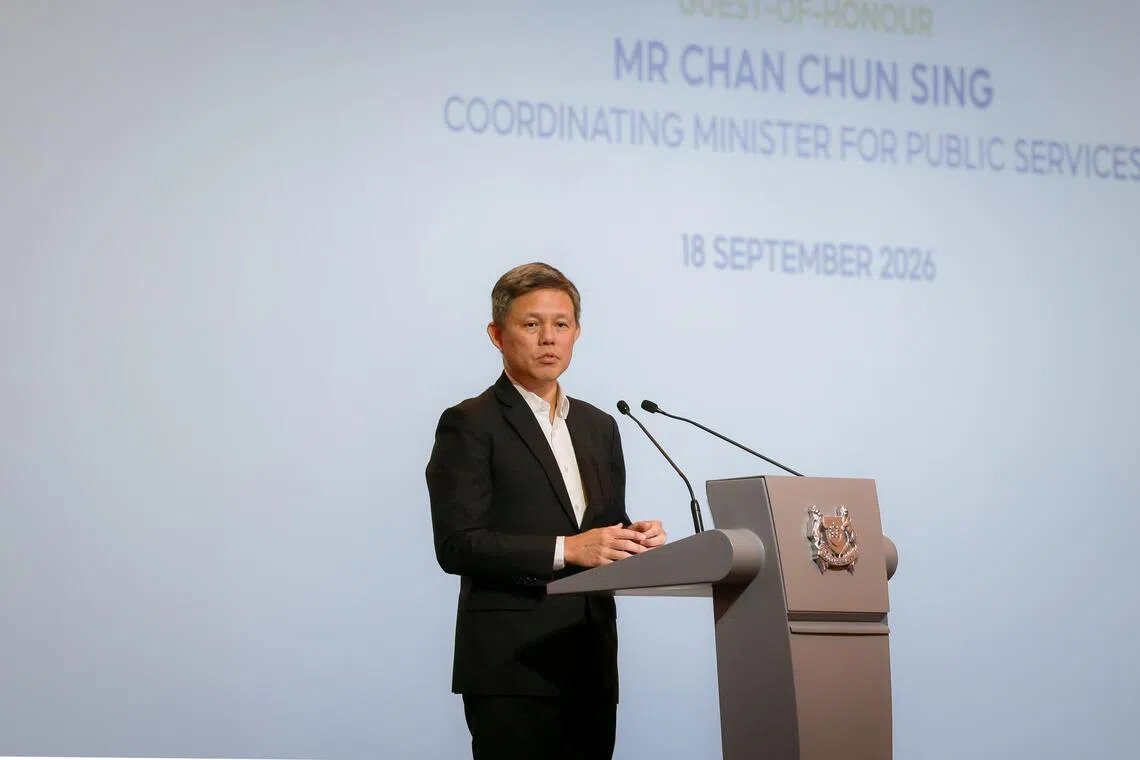
Coordinating Minister for Public Services Chan Chun Sing speaks at the Annual Public Service Leadership Ceremony on Sept 18.
Published Sep 18, 2026, 06:55 PM
Updated Sep 18, 2026, 06:55 PM
SINGAPORE - The public service can do better at bridging understanding between different groups of people towards a common outcome, said Coordinating Minister for Public Services Chan Chun Sing on Sept 18.
Officers must listen genuinely to understand different interests and articulate trade-offs honestly, he said to a roomful of newly-appointed leaders in the public service.
Doing so will also help them to find new ways to shift from doing things for people to doing things with them, said Chan.
Referencing recent debates on redevelopment plans for Maju Forest and Gilman Barracks , Chan said everyone has their preferred outcomes and personal convictions about the issue, which they hold strongly.
“But there is a need to align on the bigger picture, the trade-offs and the range of considerations - housing needs, land use, energy, transport, and even sewage planning.”
Proposed public housing developments in the Maju Forest and Gilman Barracks areas have in recent months sparked discussions among residents, nature groups and the wider public about their potential impact on the environment and Singapore’s approach to redevelopment. The authorities later announced that they would retain more greenery .
Chan said public servants must go beyond brokering agreements on individual issues to bringing different groups of people together to understand what purpose unites them to create a shared picture of success.
Turning different perspectives and capabilities into collective action was one of three ways Chan said the public service must respond to an increasingly complex and contested world.
Addressing about 800 public servants at the Annual Public Service Leadership Ceremony held at the Sands Expo and Convention Centre, the minister said that demands on leadership are changing.
“We must be clear-eyed about what the public service can do. We do not need to possess every answer or capability ourselves,” he said.
“We need to know what we must be good at and have a responsibility to decide what others are better placed to do, and how to bring citizens, communities, businesses and Government towards a common outcome.”
Another area Chan urged public servants to focus on was forging new bilateral and multilateral partnerships to carve out a “strategic space” for Singapore.
They should also stay alert to what is happening regionally and globally and pursue development opportunities abroad, he added.
Chan, who is also Defence Minister, said the world has grown more contested as rules and norms that have governed the international system are increasingly under strain, and competition between global powers has spilled into trade, technology, supply chains and the information space.
Domestic challenges have also become more complex, said Chan. For instance, workforce transformation must now navigate the disruption from and opportunities presented by artificial intelligence, against the backdrop of Singapore’s ageing population and the need to sustain economic growth.
Where existing frameworks no longer work, the public service has to reimagine new ones, added Chan.
He cited Singapore’s participation in new frameworks like the Digital Economy Partnership Agreement, a trade agreement that Singapore co-founded in 2020 during the Covid-19 pandemic and the recent upgrading of bilateral relationships with like-minded partners such as Australia and New Zealand .
He added: “These are not partnerships of convenience. They are deliberate efforts to create space for cooperation and advance our shared interests.”
Chan said Singapore’s chairmanship of ASEAN in 2027 will also present another chance for Singapore to bring its partners together and strengthen the organisation’s relevance.
Public service leaders must hence deliberately deepen external and international exposure across the service, he added.
Chan also urged public servants to develop solutions and capabilities that will be “distinctive value propositions” which ensure Singapore remains relevant not just to its citizens but also its partners.
“Every capability we build, every niche we carve out, they only buy us time to develop the next better one before they are obsolete, and this is the nature of the world that we are in.”
Chan referenced capabilities Singapore has built in its semiconductor ecosystem, ranging from chip design to wafer fabrication, advanced packaging and other parts of the value chain, to become a “trusted and indispensable node”.
These have helped the city-state account for one in 10 chips and a fifth of global semiconductor equipment produced annually, an “outsized contribution” for a country of its size, said Chan.
Beyond the economy, Chan stressed, the public service must also innovate in how it governs, such as in the way public services are delivered.
He noted that many public services worldwide are wrestling with fragmented systems and siloed processes that make it difficult for citizens to navigate government services.
While Singapore’s public service has come up with new successful initiatives such as ServiceSG, it needs to proactively challenge itself to reimagine solutions with courage and creativity, he said.
ServiceSG, launched in 2021, acts as a concierge for nearly 600 public services from more than 25 agencies.
He added: “When we do this well, good governance is not just good public administration. It becomes a form of strategic relevance.”
At the ceremony, Chan also thanked four retired permanent secretaries - Leo Yip, Pang Kin Keong, Ng Chee Khern and Professor Tan Chorh Chuan - and 21 other senior leaders who had relinquished their appointments in the past year for their contributions to the public service.
A new cohort of 33 public service leaders and 79 Public Service Leadership Programme (PSLP) officers were also appointed at the event.
The PSLP is a programme to develop talented public service officers for key leadership roles within the public service.
Wong Yang is a journalist who covers politics and policy.
Public Service Division
公共服务统筹部长陈振声于9月18日在年度公共服务领导班子仪式上发表讲话。
发布于 2026 年 9 月 18 日下午 6:55
更新于2026年9月18日下午6:55
新加坡——公共服务统筹部长陈振声9月18日表示,公共服务部门在促进不同群体之间的相互理解,以实现共同目标方面可以做得更好。
他对满屋子新上任的公务员领导说,官员们必须认真倾听,了解不同的利益,并诚实地阐明权衡取舍。
陈表示,这样做也有助于他们找到新的方法,从为人们做事转变为与人们一起做事。
陈先生在谈到最近关于马朱森林和吉尔曼军营重建计划的辩论时表示,每个人都有自己偏好的结果和对这个问题的个人信念,并且他们对此深信不疑。
“但是,我们需要在大局上达成一致,权衡各种利弊,并考虑一系列因素——住房需求、土地利用、能源、交通,甚至污水处理规划。”
近几个月来,拟在马朱森林和吉尔曼军营地区开发的公共住房项目引发了居民、自然保护团体和广大公众的讨论,他们关注这些项目对环境的潜在影响以及新加坡的重建方式。当局随后宣布,他们将保留更多绿地。
陈表示,公务员必须超越就个别问题达成协议,将不同群体的人们聚集在一起,了解将他们团结在一起的目标,从而创造共同的成功愿景。
将不同的观点和能力转化为集体行动,是陈表示公共服务部门必须应对日益复杂和充满争议的世界的三种方式之一。
部长在金沙会展中心举行的年度公共服务领导力仪式上向约 800 名公务员发表讲话时表示,对领导力的要求正在发生变化。
“我们必须清醒地认识到公共服务部门能够做什么。我们并不需要自己掌握所有的答案或能力,”他说。
“我们需要知道自己擅长什么,并有责任决定哪些事情其他人更适合做,以及如何让公民、社区、企业和政府朝着共同的目标前进。”
陈敦促公务员重点关注的另一个领域是建立新的双边和多边伙伴关系,为新加坡开辟“战略空间”。
他还补充说,他们也应该密切关注区域和全球形势,并寻求海外发展机会。
兼任国防部长的陈先生表示,随着国际体系的规则和规范日益受到压力,世界竞争日趋激烈,全球大国之间的竞争已经蔓延到贸易、技术、供应链和信息领域。
陈先生表示,国内挑战也变得更加复杂。例如,劳动力转型如今必须在新加坡人口老龄化和维持经济增长的背景下,应对人工智能带来的冲击和机遇。
陈补充说,当现有框架不再奏效时,公共服务部门必须重新构想新的框架。
他列举了新加坡参与《数字经济伙伴关系协定》等新框架,该协定是新加坡在 2020 年新冠疫情期间共同发起的一项贸易协定,以及近期与澳大利亚和新西兰等志同道合的伙伴提升双边关系的例子。
他补充道:“这些并非权宜之计的伙伴关系,而是为了创造合作空间、增进共同利益而做出的深思熟虑的努力。”
陈先生表示,新加坡在2027年担任东盟轮值主席国也将为新加坡提供另一个机会,使其能够团结合作伙伴,并加强该组织的影响力。
他补充说,因此,公共服务领导者必须有意识地加深整个公共服务部门的外部和国际视野。
陈还敦促公务员开发具有“独特价值主张”的解决方案和能力,以确保新加坡不仅对其公民,而且对其合作伙伴都保持相关性。
“我们开发的每一项能力,我们开辟的每一个市场空白,都只是为我们争取时间,让我们在它们过时之前开发出下一个更好的能力,这就是我们所处世界的本质。”
陈先生提到了新加坡在其半导体生态系统中建立的能力,涵盖芯片设计、晶圆制造、先进封装以及价值链的其他环节,使其成为“值得信赖且不可或缺的节点”。
陈先生表示,这些成就帮助这个城邦国家占据了全球每年生产的芯片的十分之一和半导体设备的五分之一,对于一个如此小的国家来说,这是一个“巨大的贡献”。
陈强调,除了经济之外,公共服务部门还必须在治理方式上进行创新,例如公共服务的提供方式。
他指出,世界各地许多公共服务部门都面临着系统碎片化和流程孤立的问题,这使得公民难以使用政府服务。
他表示,虽然新加坡公共服务部门已经推出了 ServiceSG 等新的成功举措,但它需要积极主动地挑战自我,以勇气和创造力重新构想解决方案。
ServiceSG 于 2021 年推出,为来自 25 个以上机构的近 600 项公共服务提供礼宾服务。
他补充道:“如果我们能做好这一点,良好的治理就不仅仅是良好的公共管理,它更是一种战略意义。”
在仪式上,陈先生还感谢了四位退休的常任秘书——叶良、彭建强、吴志坚和陈楚泉教授——以及过去一年中放弃职务的其他 21 位高级领导人,感谢他们对公共服务的贡献。
活动中还任命了新一批 33 名公共服务领导人和 79 名公共服务领导力计划 (PSLP) 官员。
PSLP计划旨在培养有才华的公务员,担任公务员队伍中的关键领导职务。
黄阳是一位报道政治和政策的记者。
公共服务部