‘Totally new’: Nammo pursues rocket motor engine for latest IRIS-T air defense“全新”:Nammo公司为最新型IRIS-T防空导弹系统研发火箭发动机
The push comes as German defense firm Diehl targets a first Safety Integrity Level (SIL) firing test of the surface-launched IRIS-T SLX in 2027.
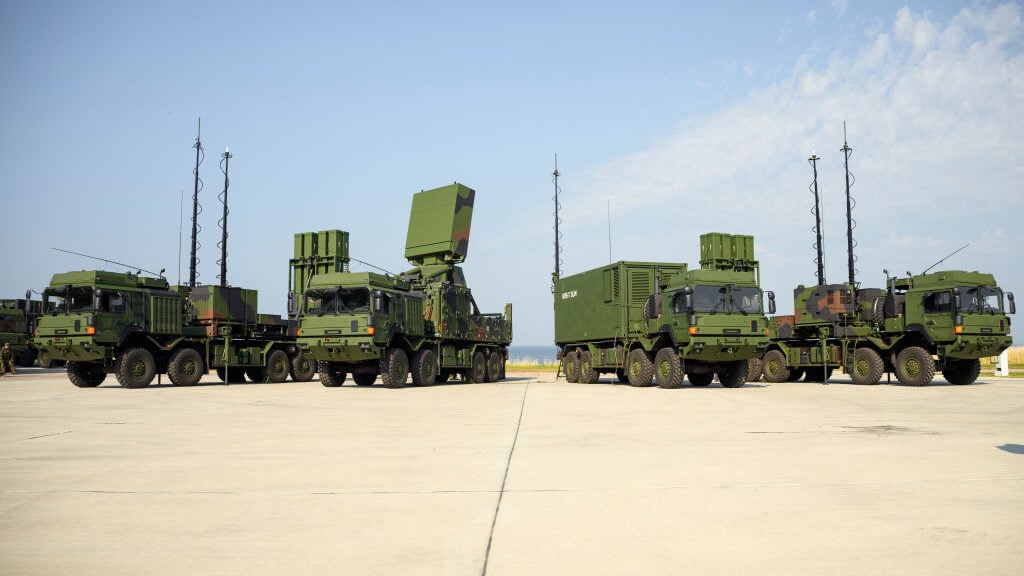
KIEL, GERMANY - SEPTEMBER 4: The IRIS-T SLM air defence system is seen in operation mode and fully set up during the operative launch of the Bundeswehr's first IRIS-T SLM air defence system at the Todendorf military base on September 4, 2024 in Panker, Germany. (Photo by Gregor Fischer/Getty Images)
RAUFOSS, Norway — Norwegian defense firm Nammo is taking its first steps in developing a new prototype rocket motor engine, envisioned as powering a long-range variant of the German-made IRIS-T air defense system, a company official told Breaking Defense .
Nammo produces rocket motor engines for other munitions, but “this is a totally new development project for us … [without] that much piggybacking on different things or from previous kinds” of programs, a Nammo program manager said Thursday on the sidelines of the company’s multipurpose symposium. “We will start building [a prototype] as soon as we can.”
At the company’s production site in Raufoss, more than 100 kilometers (62 miles) north of Oslo, Nammo expects to conduct early prototype activities for the so-called “dual pulse” concept, including static firings to validate engineering analysis and simulated modelling, with “adjustments” to be made if necessary, according to the program manager, who spoke on the condition of anonymity. “We design the propellant with a certain thrust profile, but also we divide [the rocket motor engine] into two different sections,” as part of the dual pulse concept.
The push comes as German defense firm Diehl targets a first development or Safety Integrity Level (SIL) firing test of the surface-launched IRIS-T SLX in 2027, according to Alexander Linss, GBAD business unit executive at Diehl. Serial production of the longer range missile is reportedly slated for 2029.
The company said the SLX variant can intercept targets at a range of 80 kilometers (50 miles), doubling the capability of the SLM model, while opening the way for the targeting of enemy fighter jets, bombers, long endurance drones and support aircraft. The extended range interceptor was first unveiled by Diehl at the 2024 Berlin Air Show.
Linss said that Ukrainian forces have used both the IRIS-T SLS and SLM to destroy over 1,000 Russian targets since the outbreak of the war in 2022. He said that the pair of short- and medium-range interceptors have registered a hit rate of 95 percent during the conflict, with key targets covering Russian Kh101, 3M14 Kalibr cruise missiles and Shahed 136 drones.
In July, Diehl CEO Helmut Rauch said that the SLX could lessen reliance on US-produced Patriot missiles, amid a shortage that has caused Ukraine to plead with Western allies to urgently donate their stocks.
Three exercises that pushed counter–UAS from prototype to proven
Architecture that linked sensors, C2, RF effects, and lasers into a distributed c-UAS kill chain.
“We are ramping up our volumes a lot” for the IRIS-T SLS and IRIS-T SLM rocket motor engine programs, added the Nammo program manager, as “they are very important” for Ukraine’s ground based air defense.
Outlining why the SLX represents a “big step up” in capability terms, Linss said a number of the missiles can be added to a common launcher that can also carry SLM missiles and thereby deliver a “mixed” load.
He added that the SLX will rely on a host of supporting equipment elements that serve the SLM, including the system’s radar, common tactical operations center and software. European nations that have acquired the SLM variant include Germany, Estonia, Latvia, Bulgaria, Sweden, Denmark and Switzerland. The missile is also a core part of the European Sky Shield Initiative (ESSI), which is intended to boost the region’s air and missile defense capabilities.
德国基尔——2024年9月4日:在德国潘克尔的托登多夫军事基地,德国联邦国防军首套IRIS-T SLM防空系统正式投入使用,图中可见该系统处于运行模式并已完全部署完毕。(图片来源:Gregor Fischer/Getty Images)
挪威劳福斯——挪威国防公司Nammo的一位官员告诉Breaking Defense,该公司正在迈出开发新型火箭发动机原型的第一步,该发动机预计将为德国制造的IRIS-T防空系统的远程版本提供动力。
Nammo公司为其他弹药生产火箭发动机,但“这对我们来说是一个全新的研发项目……[没有]太多借鉴其他项目或以往项目的经验”,Nammo公司的一位项目经理周四在公司举办的多用途研讨会间隙表示。“我们将尽快开始制造[原型机]。”
据一位不愿透露姓名的项目经理称,Nammo公司位于奥斯陆以北100多公里(62英里)的劳福斯生产基地将开展所谓“双脉冲”概念的早期原型测试活动,包括静态点火以验证工程分析和模拟建模,并根据需要进行“调整”。这位经理表示:“我们设计推进剂时会考虑特定的推力曲线,同时,作为双脉冲概念的一部分,我们将火箭发动机分为两个不同的部分。”
据德国迪尔公司(Diehl)全球防务与防务(GBAD)业务部门主管亚历山大·林斯(Alexander Linss)透露,该公司计划于2027年进行IRIS-T SLX地对地导弹的首次研发或安全完整性等级(SIL)试射,而这款远程导弹的批量生产预计将于2029年启动。
该公司表示,SLX型拦截器可在80公里(50英里)的范围内拦截目标,拦截能力是SLM型的两倍,并可用于拦截敌方战斗机、轰炸机、长航时无人机和支援飞机。这款远程拦截器由迪尔公司在2024年柏林航展上首次亮相。
林斯表示,自2022年战争爆发以来,乌克兰军队已使用IRIS-T SLS和SLM摧毁了1000多个俄罗斯目标。他说,这两种短程和中程拦截导弹在冲突期间的命中率高达95%,主要目标包括俄罗斯的Kh-101、3M14“口径”巡航导弹和“沙赫德136”无人机。
7 月,迪尔公司首席执行官赫尔穆特·劳赫表示,SLX 可以减少对美国生产的爱国者导弹的依赖,而由于导弹短缺,乌克兰已恳求西方盟友紧急捐赠其库存。
三个演习推动反无人机系统从原型发展成为成熟技术
将传感器、C2、射频效应和激光连接成分布式 c-UAS 杀伤链的架构。
Nammo 项目经理补充说:“我们正在大幅提高 IRIS-T SLS 和 IRIS-T SLM 火箭发动机项目的产量”,因为“它们对乌克兰的地面防空非常重要”。
林斯概述了为什么 SLX 在能力方面代表着“一大进步”,他说,许多导弹可以添加到通用发射器中,该发射器还可以携带 SLM 导弹,从而实现“混合”载荷。
他补充说,SLX将依赖于一系列为SLM提供服务的配套设备,包括该系统的雷达、通用战术作战中心和软件。已采购SLM改进型导弹的欧洲国家包括德国、爱沙尼亚、拉脱维亚、保加利亚、瑞典、丹麦和瑞士。该导弹也是欧洲天空之盾计划(ESSI)的核心组成部分,该计划旨在提升该地区的防空和导弹防御能力。