France’s 2035 national security plan warns of increased conflict in sea, outer space法国2035年国家安全计划警告称,海上和外太空冲突将会增加
"An increasing share of power — and also vulnerabilities — will be concentrated in these spaces, which are largely invisible to citizens.” the document says.
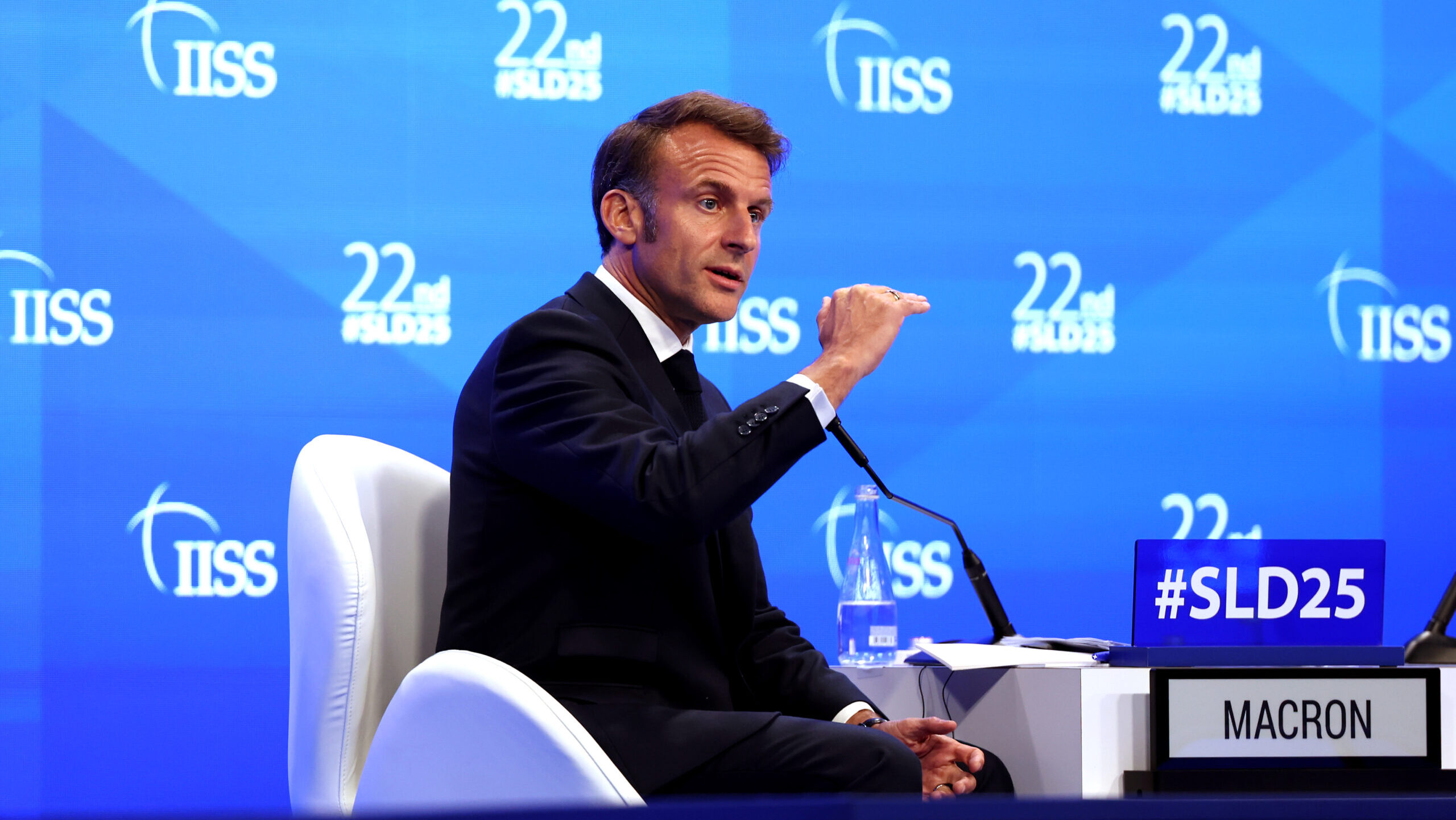
SINGAPORE, SINGAPORE - MAY 30: French President Emmanuel Macron answers questions from the audience following a keynote address during the 22nd IISS Shangri-La Dialogue at the Shangri-La Hotel on May 30, 2025 in Singapore. Organized by the International Institute for Strategic Studies, the annual conference brings together senior defense officials to debate and discuss current and pressing global and regional security challenges. (Photo by Yong Teck Lim/Getty Images)
MILAN — French President Emmanuel Macron said today that France, among other European countries, has been the target of Russian hybrid threats over the last few weeks.
“In recent weeks, the threat — particularly the Russian hybrid threat — facing Europeans and France has intensified,” Macron told reporters after a meeting at the Élysée, which was attended by presidential candidates and senior military, intelligence, and energy officials. (France will hold presidential elections on Sept. 28, and Macron will not be able to run for reelection, having served two mandates.)
According to an AFP report , the gathering was expected to address, in part, the rapid decline in global relations, including the wars in Ukraine and the Middle East, and their implications for French security and energy prices.
Only days before, France’s strategic planning body warned that Europe must increase military capabilities, reserves and societal resilience in preparation for more hybrid warfare attempts and major, prolonged conflicts.
The Haut-Commissariat à la Stratégie et au Plan (HCSP) on Tuesday published a 40-page document outlining Paris’ 2035 national security objective, highlighting that it anticipates an increase in confrontations on the seabed and in outer space by 2035.
“Critical digital infrastructure, the seabed and outer space will increasingly become areas of strategic confrontation between states, as well as between private and state actors,” the report says. “An increasing share of power — and also vulnerabilities — will be concentrated in these spaces, which are largely invisible to citizens.”
The HCSP report further highlighted the areas that would become points of tension between different actors. It noted that between 2022 and 2024, Russia-attributed hybrid warfare operations in Europe increased from fewer than 10 instances to nearly 50. Based on the increase, the report states that these actions are bound to multiply across different sectors, including cyber, economic and information.
Europe’s military advantage depends on sovereign command of the ground truth
As NATO and European governments accelerate investment in space-based intelligence, decision advantage will depend on how quickly sovereign and commercial capabilities can be fused into a trusted operational picture.
Hybrid warfare refers to a combination of methods used by adversarial actors that fall below the threshold of open military conflict, ultimately making it harder to prove who is behind these attacks or attempts.
Looking toward 2035, the authors made several key recommendations for both Paris and Europe as a whole to be ready to operate in and face a “durably degraded” security landscape. First, they recommended fast-tracking the transformation of the military model to avert the threat of a major war in Europe. French military officials have urged the country to shift away from smaller, international counter-terrorism forces toward large-scale, high-intensity combat readiness, and to prioritize adopting a war-economy approach.
“The budgetary effort required of the nation must align with a clear European objective for 2035: the ability — acting among Europeans if necessary — to prevent any attack aimed at testing Europe’s unity and credibility,” it said.
A second recommendation is to end the continent’s technological dependency, including on US and Chinese suppliers, to favor European-made systems. The country has made greater efforts this year to make this a reality, particularly in digital and artificial intelligence. For instance, in January, it laid out plans to create a Digital Sovereignty Observatory to map the government and associated businesses’ reliance on non-European technology.
By 2035, the report says, the aim should not be “to build full European military integration,” but rather to bolster forms of collaboration with other like-minded actors that can deliver results quickly.
Finally, the plan recommends that France preserve national unity as a priority in the context of heightened hybrid warfare, highlighting that a key capability will be to identify and counter information-based attacks aimed at destabilizing societies. The report did not outline specific methods for how it plans to do this.
新加坡,新加坡——2025年5月30日:法国总统埃马纽埃尔·马克龙在新加坡香格里拉酒店举行的第22届国际战略研究所香格里拉对话会上发表主旨演讲后,回答了听众的提问。该年度会议由国际战略研究所主办,汇聚高级国防官员,共同探讨当前紧迫的全球和地区安全挑战。(图片来源:Yong Teck Lim/Getty Images)
米兰——法国总统埃马纽埃尔·马克龙今天表示,在过去几周里,法国和其他欧洲国家一样,一直是俄罗斯混合威胁的目标。
“近几周来,欧洲人和法国面临的威胁——特别是俄罗斯的混合威胁——有所加剧,”马克龙在爱丽舍宫会见记者后表示。此次会见有总统候选人以及高级军事、情报和能源官员出席。(法国将于9月28日举行总统选举,马克龙已连任两届,将无法竞选连任。)
据法新社报道,此次会议预计将部分讨论全球关系迅速恶化的问题,包括乌克兰和中东战争,以及这些战争对法国安全和能源价格的影响。
就在几天前,法国战略规划机构警告说,欧洲必须提高军事能力、储备和社会韧性,以应对更多混合战争企图和大规模、持久的冲突。
巴黎战略与计划高级专员公署(HCSP)周二发布了一份 40 页的文件,概述了巴黎 2035 年的国家安全目标,并强调预计到 2035 年,海底和外太空的对抗将会增加。
报告指出:“关键数字基础设施、海底和外层空间将日益成为国家间以及私人行为体与国家行为体之间战略对抗的领域。越来越多的权力——以及脆弱性——将集中在这些对公民而言大多不可见的空间。”
HCSP报告进一步强调了不同行为体之间可能出现紧张局势的领域。报告指出,2022年至2024年间,俄罗斯在欧洲发起的混合战争行动从不足10起增加到近50起。基于这一增长趋势,报告认为,此类行动势必会在网络、经济和信息等不同领域呈倍增趋势。
欧洲的军事优势取决于其对实际情况的主权掌控。
随着北约和欧洲各国政府加快对天基情报的投资,决策优势将取决于主权能力和商业能力能够多快地融合到一个可信的作战图景中。
混合战争是指敌对双方使用多种手段,这些手段未达到公开军事冲突的程度,最终导致更难证明这些袭击或企图的幕后黑手是谁。
展望2035年,作者们为巴黎乃至整个欧洲应对“持续恶化”的安全形势提出了几项关键建议。首先,他们建议加快军事模式转型,以避免欧洲爆发大规模战争。法国军方官员敦促法国放弃规模较小的国际反恐部队,转而建立大规模、高强度的作战准备体系,并优先采取战时经济模式。
“国家所需的预算努力必须与欧洲2035年的明确目标保持一致:即有能力——如有必要,在欧洲各国之间采取行动——阻止任何旨在考验欧洲团结和信誉的攻击,”声明中写道。
第二项建议是结束欧洲大陆对包括美国和中国供应商在内的技术的依赖,转而优先选择欧洲制造的系统。今年,该国加大了实现这一目标的力度,尤其是在数字和人工智能领域。例如,今年1月,该国制定了建立“数字主权观察站”的计划,旨在摸清政府及相关企业对非欧洲技术的依赖程度。
报告称,到 2035 年,目标不应该是“建立全面的欧洲军事一体化”,而是加强与其他志同道合的行动者之间的合作形式,以便快速取得成果。
最后,该计划建议法国在混合战争日益加剧的背景下,将维护国家统一作为优先事项,并强调一项关键能力是识别和反制旨在破坏社会稳定的信息攻击。报告并未概述具体实施方案。