Pete Hegseth is rebuilding the military's ‘brass ceiling’皮特·赫格塞斯正在重建军队的“铜天花板”。
The SecDef says his ideological approach to promotion is helping recruiting. Surveys don't back that up.
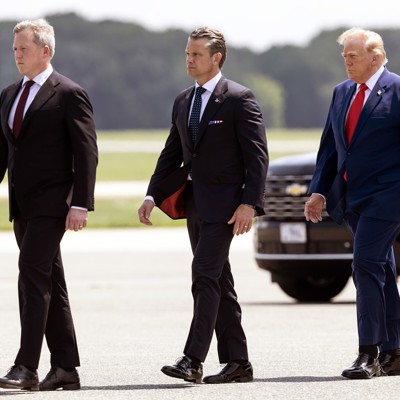
Army Secretary of the Army Dan Driscoll, Defense Secretary Pete Hegseth, and President Donald Trump met an airlifter carrying military casualties of the war with Iran on July 22, 2026, in Dover, Delaware. Kevin Dietsch/Getty Images
The SecDef says his ideological approach to promotion is helping recruiting. Surveys don't back that up.
Jeremiah Favara , The Conversation
Dan Driscoll resigned as secretary of the Army on Aug. 31, 2026. His departure leaves the Army without a Senate-confirmed civilian leader six months into the war with Iran, its busiest period since the wars in Iraq and Afghanistan.
Driscoll’s resignation was reportedly motivated, at least in part, by his frustration with Defense Secretary Pete Hegseth . Earlier in August, Hegseth had blocked the promotions of four Army officers.
Since his appointment in January 2025, Hegseth has fired or blocked the promotions of more than 80 admirals and generals . Often, Hegseth has referenced “woke” diversity efforts in his reasoning. One officer who was blocked had written a paper while in graduate school about the impact of political polarization on recruiting . Another officer had his name pulled from the promotion list after officials incorrectly believed that he had allowed a mentorship group for female paratroopers to exist in his unit.
More than half of the officers removed have been women or Black in an officer corps that is 79% male and 74% white .
Hegseth’s blocking of promotions and apparent targeting of women and Black people appear to violate military rules meant to protect against the politicization of the military’s officer corps and have undermined faith in the military’s promotion system , which is supposed to be merit-based.
I’ve spent years studying the U.S. military and have written a book on diversity and military recruiting . In my assessment, Hegseth is building a military that fits a narrow ideological view at the cost of its service members’ safety and well-being.
Recruiting isn’t ideological
The Army exceeded its recruiting goal of 60,500 new enlistees in fiscal year 2025 and has already hit its targets for the 2026 fiscal year.
In fact, 2026 marks the third straight year that every active duty military service has met its recruiting goals . That the Army and other branches have been able to do this – despite the fact that they rely on women and people of color – would, at first glance, seem to indicate that the politicization of the military has not hurt recruiting.
Hegseth has attributed the success to “the belief [recruits] have in civilian leadership and military leadership.” According to a Pentagon spokesperson , “Americans everywhere are prouder than ever to serve.”
What Hegseth and others fail to acknowledge, however, is that recruitment is driven not by ideology but by market factors and need.
Since the end of the draft in 1973, according to my research, the success of military recruiting has largely hinged on young people’s perceptions of their chances for upward mobility. Many young people join the military because they are in need of the opportunities military service provides. This past year’s recruitment numbers are likely more a result of young Americans seeking steady pay, job training and educational benefits than agreement with Hegseth’s vision of the military.
Market research studies conducted in the past year have found that making money, paying for education, travel, work experience and medical benefits are the top motivators guiding young people toward military service. Recruits are guided by what military sociologist Charles C. Moskos called occupational appeals that frame enlisting as a smart economic decision rather than by patriotism or nationalism. These kinds of appeals have historically been successful in attracting the diverse recruits – women and people of color – who have been critical to the military’s ability to meet its personnel needs .
Recruiting data shows that Hegseth and other members of the Trump administration have little control over the composition of the enlisted ranks. However, Hegseth’s anti-woke campaign is changing what the military is like for those who serve.
Historically, women, Black service members and service members of color have faced discrimination and violence within the ranks .
Recent firings and blocked promotions have further shaped a military leadership that has historically been almost exclusively white and male. All five service chiefs and 9 in 10 combatant commanders are white men . This year the lowest percentage of women in 25 years have been nominated to the rank of general and admiral.
This targeting of women and people of color has solidified the “brass ceiling” – a term used to describe the limited opportunities for promotion for women and Black service members – and is creating a military leadership that doesn’t reflect the service members they command or the nation they represent. The overwhelmingly white and male leadership commands an enlisted force in which 34% identify with a racial minority group and 17% are women .
By purging military leadership of women, Black service members and those who have supported opportunities for service members other than white men, Hegseth is creating a culture ripe for racial, sexual and gender discrimination and harassment.
Hegseth has also sought to restore tributes to Confederate soldiers and has attacked military diversity. These actions further erase and invalidate the contributions of women, Black service members and other service members of color.
Lessons from Vietnam
The military’s need for more equitable representation was born of the demands and costs of combat.
During the Vietnam War, disproportionate numbers of Black and Latino service members served in combat and were killed while under the command of a largely white officer corps.
The Defense Race Relations Institute – now known as the Defense Equal Opportunity Management Institute – was formed in 1971 to provide race relations education to every member of the armed forces to quell rampant racial unrest, including racial violence and fragging incidents. Fragging incidents – the killing of a fellow service member, often using fragmentation grenades – were rampant in Vietnam.
Army Reserve Officers’ Training Corps programs were instituted at historically Black colleges and universities to increase the numbers of Black officers. The Department of Defense pushed for increased ROTC programs at HBCUs during the Vietnam war as a way to increase the size of the officer corps.
While HBCUs provided large numbers of Black officers during Vietnam , the success of diversifying the officer corps has been limited. Scholars have attributed this limited success, despite consistent efforts to recruit Black Americans, to educational inequalities and the conservative culture of the officer corps.
These efforts were based on the military adopting the idea that an efficient and lethal military should look like the nation it serves and that its leaders should look like the soldiers they command.
Hegseth’s purging of the officer ranks means the Americans who serve in the military won’t see themselves reflected in leadership or see a path to the top ranks. But they will continue to bear the costs of war: About half of the 18 service members killed in the Iran war between February and August were women and people of color.
NEXT STORY: How a MAGA influencer with ties to Russia became Trump’s Arctic adviser
2026年7月22日,在特拉华州多佛市,陆军部长丹·德里斯科尔、国防部长皮特·赫格塞斯和总统唐纳德·特朗普会见了一架运送在伊朗战争中受伤军人的运输机。图片来源:Kevin Dietsch/Getty Images
国防部长声称他推行的意识形态化的晋升方式有助于招募新兵。但调查结果并不支持这一说法。
杰里迈亚·法瓦拉,《对话》
丹·德里斯科尔于 2026 年 8 月 31 日辞去陆军部长一职。他的离任使得陆军在与伊朗开战六个月后,失去了一位经参议院确认的文职领导人。这是自伊拉克战争和阿富汗战争以来,陆军最繁忙的时期。
据报道,德里斯科尔辞职的部分原因是他对国防部长皮特·赫格塞斯感到不满。8月初,赫格塞斯曾阻止了四名陆军军官的晋升。
自2025年1月上任以来,赫格塞斯已解雇或阻止了80多名海军上将和陆军上将的晋升。赫格塞斯经常以“觉醒”式的多元化举措作为其理由。一位被阻止晋升的军官曾在研究生阶段撰写过一篇关于政治极化对征兵影响的论文。另一位军官的名字被从晋升名单中移除,原因是官员们错误地认为他允许在其部队中设立一个女伞兵指导小组。
在被撤职的军官中,超过一半是女性或黑人,而军官队伍中男性占 79%,白人占 74%。
赫格塞斯阻挠晋升,并明显针对女性和黑人,这似乎违反了旨在防止军队军官团政治化的军事规则,并破坏了人们对军队晋升制度的信心,而该制度本应以功绩为基础。
我多年来一直研究美国军队,并撰写了一本关于多元化和军队招募的书。在我看来,赫格塞斯正在打造一支符合狭隘意识形态的军队,却牺牲了军人的安全和福祉。
招募与意识形态无关。
陆军在 2025 财年超额完成了 60,500 名新兵的征兵目标,并且已经达到了 2026 财年的目标。
事实上,2026年是所有现役军种连续第三年完成征兵目标。陆军和其他军种能够做到这一点——尽管他们主要依靠女性和有色人种——乍一看似乎表明,军队的政治化并没有损害征兵工作。
赫格塞斯将成功归功于“新兵们对文职领导和军事领导的信任”。五角大楼发言人表示,“世界各地的美国人比以往任何时候都更以服役为荣。”
然而,赫格塞斯和其他人没有意识到的是,招聘的驱动力不是意识形态,而是市场因素和需求。
根据我的研究,自1973年征兵制结束以来,军队征兵的成功与否很大程度上取决于年轻人对自身向上流动机会的认知。许多年轻人参军是因为他们需要军队提供的机会。去年的征兵人数很可能更多地反映了美国年轻人寻求稳定的收入、职业培训和教育福利,而非认同赫格塞斯对军队的愿景。
过去一年的市场调查发现,赚钱、支付教育费用、旅行、工作经验和医疗福利是促使年轻人参军的主要动机。正如军事社会学家查尔斯·C·莫斯科斯所言,新兵的动机更多地是出于职业诉求,而非爱国主义或民族主义。这类诉求历来都能成功吸引到多元化的新兵——包括女性和有色人种——而这些人对于军队满足人员需求至关重要。
征兵数据显示,赫格塞斯和特朗普政府的其他成员对士兵队伍的构成几乎没有控制权。然而,赫格塞斯的反觉醒运动正在改变军队对现役军人来说的现状。
从历史上看,女性、黑人军人和有色人种军人在军队中都面临着歧视和暴力。
近期的解雇和晋升受阻进一步强化了军队领导层的构成,该领导层历来几乎完全由白人男性组成。五大军种司令以及十分之九的作战司令都是白人男性。今年,女性被提名为将军和海军上将的比例创下25年来的最低水平。
这种针对女性和有色人种的做法巩固了“铜天花板”(指女性和黑人军人晋升机会有限的现象),并导致军队领导层无法反映其所指挥的士兵或他们所代表的国家。这支由白人男性主导的军队,其士兵中只有34%属于少数族裔,17%是女性。
通过清除军队领导层中的女性、黑人军人和那些支持为白人男性以外的军人提供机会的人,赫格塞斯正在营造一种容易滋生种族、性取向和性别歧视及骚扰的文化。
赫格塞斯还试图恢复对南方邦联士兵的纪念,并攻击军队的多样性。这些行为进一步抹杀和否定了女性、黑人军人和其他有色人种军人的贡献。
越南战争的教训
军队对更公平的代表权的需求源于战争的需求和成本。
在越南战争期间,黑人和拉丁裔军人在战斗中服役和阵亡的人数不成比例地多,而他们的指挥者主要是白人军官。
国防部种族关系研究所(现更名为国防部平等机会管理研究所)成立于1971年,旨在为所有军人提供种族关系教育,以平息猖獗的种族骚乱,包括种族暴力和杀害战友事件。杀害战友事件——通常使用碎片手榴弹——在越南战争中十分猖獗。
陆军预备役军官训练团(ROTC)项目最初设立在传统黑人学院和大学(HBCU),旨在增加黑人军官的数量。越战期间,国防部大力推动HBCU增加ROTC项目,以此扩大军官队伍规模。
尽管在越南战争期间,传统黑人学院(HBCU)输送了大量黑人军官,但军官队伍多元化的成效却十分有限。学者们认为,尽管招募黑人军官的努力持续不断,但这种成效有限的原因在于教育不平等和军官队伍的保守文化。
这些努力是基于军方所秉持的理念,即一支高效而致命的军队应该与它所服务的国家相像,其领导人应该与他们指挥的士兵相像。
赫格塞斯对军官队伍的清洗意味着,在美国军队服役的美军将无法在领导层中看到自己的身影,也看不到晋升到高层的途径。但他们仍将继续承受战争的代价:在2月至8月的伊朗战争中阵亡的18名军人中,约有一半是女性和有色人种。
下一篇报道:一位与俄罗斯关系密切的“让美国再次伟大”(MAGA)运动人士如何成为特朗普的北极顾问