German Forces Surge Onto Baltic Island In First-Of-Its-Kind NATO Drill德国军队在北约首次演习中登陆波罗的海岛屿
Exercise Silver Wotan tests how quickly allied troops, ships, aircraft, and weapons can reach the strategically vital island of Gotland. Silver Wotan tests how quickly allied troops, ships, aircraft, and weapons can reach the strategically vital island of Gotland.
Published Sep 18, 2026 3:12 PM EDT
Bundeswehr/Marc Tessensohn
Swedish and German forces are conducting what appears to be the first joint rehearsal of their rapid-reinforcement plans for the Baltic island of Gotland . The exercise is another step in Sweden’s defense planning for an island whose position in the middle of the Baltic gives it an outsized strategic importance for controlling access, protecting the Baltic states, and maintaining NATO’s freedom of movement in a region where Russian military activity remains a persistent concern .
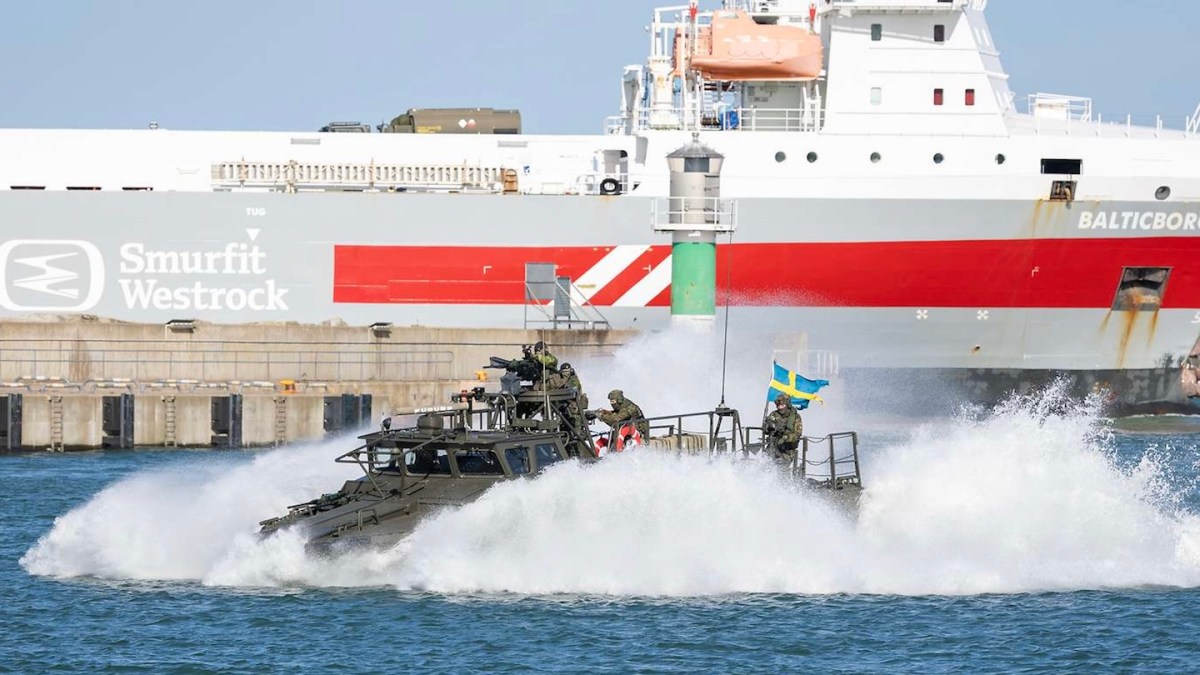
German and Swedish warships stand offshore while a Swedish CB90 fast assault craft operates in the harbor at Visby. Bundeswehr/Marc Tessensohn
The exercise, Silver Wotan 2026 , running between September 14-23, brings together Swedish and German forces across the land, maritime, and air domains. The scenario is built around a Swedish request for allied assistance, with German forces moving personnel and equipment across the Baltic before integrating with Swedish units already defending the island. The operation is testing the entire process of getting allied combat power to Gotland, protecting it during the movement to Visby, and rapidly incorporating it into the island’s existing defensive network.
A video shows troops coming ashore on Swedish CB90 fast assault craft, a type that German soldiers are also trained to operate:
A rapid deployment of German and Swedish forces to Gotland island is being carried out today. Units from 🇸🇪 and 🇩🇪 are rehearsing the swift reinforcement of the strategic island in order to ensure the security of the Baltic Sea. #SilverWotan #NATO pic.twitter.com/A0r3LF8XUP — Försvarsmakten (@Forsvarsmakten) September 18, 2026
A rapid deployment of German and Swedish forces to Gotland island is being carried out today. Units from 🇸🇪 and 🇩🇪 are rehearsing the swift reinforcement of the strategic island in order to ensure the security of the Baltic Sea. #SilverWotan #NATO pic.twitter.com/A0r3LF8XUP
The strategic importance of Gotland has grown considerably following Sweden’s accession to NATO in March 2024, which was a direct response to the full-sclae Russian invasion of Ukraine.
Located approximately halfway between mainland Sweden and the Baltic states, the island occupies a central position in the Baltic Sea, close to the maritime approaches to the Gulf of Finland and within reach of the Russian exclave of Kaliningrad . Its location gives forces operating from Gotland a potentially significant position from which to conduct surveillance, air defense, and maritime operations, while also making the island an important part of the wider network connecting NATO’s northern and eastern members.
The location of Gotland within the Baltic region. Google Earth
At the same time, Gotland sits within an extremely complex littoral environment, where shallow waters, islands, narrow maritime approaches, and the proximity of multiple states can make both offensive operations and defensive planning more difficult. The region has also been shaped by longstanding Swedish concerns about Russian clandestine activity, including intelligence gathering and other forms of covert or deniable activity . The complexity of the Baltic operating environment can make such activities harder to detect and attribute, adding another layer of uncertainty alongside the more conventional military challenges facing the region.
The unloading operation in Visby. The vehicles seen here were transported by sea from he rapid deployment from Karlskrona ton the Swedish mainland. Bundeswehr/Marc Tessensohn
Geography has long made Gotland important to Swedish defense planning, but its significance has taken on a broader dimension since Sweden joined the alliance. NATO has described the island as strategically important to its freedom of maneuver in the Baltic, while Swedish officials have highlighted its potential role as a hub for military operations and logistics in the region.
The current exercise is designed around the practical difficulties of reinforcing such a position.
Military equipment is being transported by sea to Visby, Gotland’s principal port , including by commerical ferry. In Visby, Swedish and German personnel are securing the harbor and conducting the reception of the arriving force. Among the equipment being moved are air defense systems, while Swedish forces are also operating coastal defense systems armed with anti-ship missiles.
German Army vehicles roll into Visby during Silver Wotan. Bundeswehr/Marc Tessensohn
Meanwhile, publicly available flight-tracking data showed German Luftwaffe transport aircraft, including at least one Airbus A400M airlifter, apparently involved in the effort. The commercial airport at Visby has long also been used for military activities related to Gotland and the wider Baltic region.
”A rapid deployment of German and Swedish forces to Gotland island is being carried out today” https://t.co/z6oLs1LCT4 pic.twitter.com/n18MdST6r1 — Jamming (@balticjam) September 18, 2026
”A rapid deployment of German and Swedish forces to Gotland island is being carried out today” https://t.co/z6oLs1LCT4 pic.twitter.com/n18MdST6r1
The movement is supported by Swedish and German naval forces and other aircraft, creating a scenario in which the maritime transit, protection of the port, air operations, and subsequent movement of troops and equipment ashore all form part of the same military problem. Once ashore, the arriving forces have to be moved into position and integrated with Swedish units already responsible for defending the island.
The Swedish Gotland Regiment , P 18, provides the core of the island’s permanent military presence. The regiment, Sweden’s youngest and smallest, has been rebuilding its capabilities since Sweden began expanding its military presence on Gotland. Its forces form the basis of the ground-defense structure into which allied reinforcements would be incorporated.
Soldiers of the Gotland Regiment of the Swedish Army camouflage an armoured vehicle during an earlier field exercise near Visby. Photo by Jonathan NACKSTRAND / AFP
Swedish coastal defense capabilities are another important element of the drill. Land-based anti-ship missiles provide the island with a means of threatening hostile surface vessels operating in the surrounding waters, giving the defense of Gotland a direct connection to the wider maritime battle for the Baltic. During Silver Wotan, Swedish and German forces are also conducting anti-surface warfare activities alongside the broader reinforcement operation.
Germany is contributing more than 500 troops to the exercise, part of approximately 2,000 Bundeswehr personnel involved , including elements from the army, navy, and air force. The German Luftwaffe has deployed Panavia Tornado aircraft for surveillance, while German naval forces are participating in the maritime component, and German ground personnel are involved in the reinforcement and security activities on Gotland.
Stock photo of a Luftwaffe Tornado ECR equipped for a reconaissance mission. Bundeswehr
The exercise scenario is particularly relevant against the backdrop of Russia’s continuing military presence in the Baltic region.
Russia maintains major military infrastructure in Kaliningrad, including naval , air , missile , and air defense capabilities, while the Russian Baltic Fleet operates from bases in the region. Kaliningrad’s position between Poland and Lithuania gives Moscow a significant military foothold inside the NATO area, while Russian forces and military infrastructure elsewhere along the Baltic add to the complexity of operating and reinforcing allied territory in the region.
The security environment around the Baltic has also deteriorated considerably since Russia’s full-scale invasion of Ukraine. NATO has increased its surveillance and military activity in the region, including the launch of Baltic Sentry in January 2025 following a series of incidents involving critical undersea infrastructure . The alliance has subsequently expanded efforts to monitor maritime activity and protect infrastructure and sea lines of communication.
A Swedish Navy Helicopter 15 on the flight deck of patrol ship HMS Carlskrona as part of the NATO Baltic Sea patrol mission, Baltic Sentry, aimed to secure critical underwater infrastructure. Photo by Johan NILSSON / TT NEWS AGENCY / AFP
Swedish authorities have stressed that Silver Wotan was planned in advance and is not being conducted in response to a specific imminent Russian threat. The exercise nonetheless reflects the operational environment in which Swedish and NATO planners now have to consider the possibility that maritime and air movements across the Baltic could be monitored, disrupted, or contested.
The exercise also builds on a series of increasingly large Swedish-led activities designed to test the reception of allied forces on Swedish territory. During Aurora 26 earlier this year, more than 18,000 troops from 13 countries participated in operations across Sweden, including the deployment of allied forces to Gotland alongside the Gotland Regiment and Swedish Home Guard. NATO described that activity as an emergency deployment intended to test the reinforcement of the island.
A Dutch AH-64 Apache attack helicopter takes part in Exercise Aurora 26 in southern Sweden on April 29, 2026. Photo by Johan NILSSON / various sources / AFP
Silver Wotan places a more concentrated emphasis on the Swedish-German relationship and on the movement of an allied force into the island’s existing defensive structure.
Germany’s participation is also consistent with its growing military role in the Baltic and along NATO’s northeastern flank. Berlin is already providing forces for NATO’s forward defense in Lithuania and has increasingly emphasized the ability to move German forces rapidly across northern Europe in support of allied operations.
For Sweden, meanwhile, Gotland has become one of the clearest examples of how NATO membership has changed the country’s defense planning. The island remains a Swedish responsibility, but its location means that what happens there has consequences well beyond Sweden’s territorial defense.
German and Swedish troops on a Swedish CB90 fast assault craft. Bundeswehr/Marc Tessensohn
A defended and adequately supplied Gotland provides NATO with a strategically positioned base for surveillance and defensive operations in the Baltic, while the ability to reinforce it demonstrates that the alliance can maintain access to the island even as the surrounding maritime and air environment becomes more contested.
The exercise comes as European allies are being forced to plan for a NATO in which the United States may provide less of the conventional military weight it has supplied for decades. The Pentagon is reviewing the size and posture of U.S. forces in Europe, including the forces and capabilities Washington would make available in a European crisis, while NATO’s top commander has said further U.S. troop withdrawals should be expected as European allies build up their own conventional capabilities.
A German and a Swedish soldier involved in securing Visby during Silver Wotan 2026. Bundeswehr/Marc Tessensohn
At the same time, the alliance now describes Russia as its most significant and direct security threat , citing military activity alongside airspace violations, sabotage, cyber operations, and other forms of hybrid pressure. There are also growing concerns that Russia could try something in the Baltics, while it continues to step up its gray-zone activities regardless. NATO officials have warned that Russia could rebuild enough military capacity to pose a more serious conventional challenge to the alliance before the end of the decade .
For Sweden and Germany, the Silver Wotan exercise is a practical test of how quickly European forces can reinforce and defend one of the Baltic’s most strategically important positions. As the security environment grows more contested and Europe prepares for a future in which U.S. forces may not be as readily available, the ability to move allied combat power across the region and integrate it into existing defenses is becoming an increasingly important part of NATO’s deterrence.
Contact the author: thomas@thewarzone.com
Comments couldn’t be loaded. Please refresh the page.
发布于美国东部时间2026年9月18日下午3:12
德国联邦国防军/马克·泰森松
瑞典和德国军队似乎正在进行首次联合演练,以检验其在波罗的海哥特兰岛的快速增援计划。此次演习是瑞典防御计划的又一举措。哥特兰岛位于波罗的海中心,地理位置极其重要,对控制通道、保护波罗的海三国以及维护北约在该地区(俄罗斯军事活动持续令人担忧)的行动自由具有举足轻重的战略意义。
德国和瑞典军舰停泊在近海,一艘瑞典CB90快速突击艇在维斯比港内作业。(德国联邦国防军/马克·泰森松摄)
代号为“银色沃坦2026”的联合演习于9月14日至23日举行,汇集了瑞典和德国在陆地、海上和空中领域的部队。演习场景设定为瑞典请求盟军援助,德军将人员和装备运过波罗的海,与已在岛上部署的瑞典部队整合。此次行动旨在检验盟军向哥特兰岛部署作战力量、在向维斯比转移过程中保护部队安全以及迅速将其融入岛上现有防御体系的整个流程。
视频显示,部队乘坐瑞典CB90型快速突击艇登陆,德国士兵也接受过操作这种艇型的训练:
今天,德国和瑞典军队正在向哥特兰岛进行快速部署。来自德国和瑞典的部队正在演练迅速增援这座战略要地,以确保波罗的海的安全。#SilverWotan #NATO pic.twitter.com/A0r3LF8XUP — Försvarsmakten (@Forsvarsmakten) September 18, 2026
今天,德国和瑞典军队正在向哥特兰岛进行快速部署。来自德国和瑞典的部队正在演练迅速增援这座战略要地,以确保波罗的海的安全。#SilverWotan #NATO pic.twitter.com/A0r3LF8XUP
自瑞典于 2024 年 3 月加入北约以来,哥特兰岛的战略重要性显著提高,这是对俄罗斯全面入侵乌克兰的直接回应。
该岛位于瑞典大陆和波罗的海三国之间,大致处于波罗的海的中心位置,靠近芬兰湾的海上通道,并且与俄罗斯飞地加里宁格勒有一定距离。其地理位置使驻扎在哥特兰岛的部队拥有开展监视、防空和海上行动的潜在重要优势,同时也使该岛成为连接北约北部和东部成员国的更广泛网络的重要组成部分。
哥特兰岛在波罗的海地区的位置。谷歌地球
与此同时,哥特兰岛地处极其复杂的沿海环境,浅水区、岛屿、狭窄的航道以及多国毗邻,都使得进攻行动和防御计划的制定更加困难。此外,瑞典长期以来对俄罗斯秘密活动的担忧,包括情报收集和其他形式的隐蔽或可否认活动,也影响了该地区的局势。波罗的海作战环境的复杂性使得此类活动更难被发现和归因,这在该地区面临的传统军事挑战之外,又增添了一层不确定性。
在维斯比的卸货作业。图中所示的车辆是从卡尔斯克鲁纳快速部署基地经海路运往瑞典大陆的。德国联邦国防军/马克·泰森松
哥特兰岛的地理位置使其长期以来对瑞典国防规划至关重要,但自瑞典加入北约以来,其重要性更上一层楼。北约称该岛对其在波罗的海的行动自由具有重要的战略意义,而瑞典官员则强调了其作为该地区军事行动和后勤枢纽的潜在作用。
本次练习旨在解决巩固这种立场所面临的实际困难。
军事装备正通过海运运往哥特兰岛的主要港口维斯比,其中也包括商业渡轮。在维斯比,瑞典和德国人员正在确保港口安全并迎接抵达的部队。运送的装备包括防空系统,同时瑞典军队也在操作配备反舰导弹的海岸防御系统。
在银色沃坦节期间,德国陆军车辆驶入维斯比。德国联邦国防军/马克·泰森松
与此同时,公开的航班追踪数据显示,德国空军的运输机,包括至少一架空客A400M运输机,显然参与了此次行动。维斯比的商业机场长期以来也被用于与哥特兰岛和更广泛的波罗的海地区相关的军事活动。
“今天,德国和瑞典军队正在向哥特兰岛快速部署兵力。” https://t.co/z6oLs1LCT4 pic.twitter.com/n18MdST6r1 — Jamming (@balticjam) September 18, 2026
“今天,德国和瑞典军队正在向哥特兰岛快速部署兵力。” https://t.co/z6oLs1LCT4 pic.twitter.com/n18MdST6r1
此次行动得到了瑞典和德国海军以及其他飞机的支持,使得海上运输、港口保护、空中作战以及随后部队和装备的登陆都成为同一个军事问题的一部分。登陆后,抵达的部队必须迅速就位,并与已负责岛屿防御的瑞典部队整合。
瑞典哥特兰岛第18步兵团是该岛常驻军事力量的核心。该团是瑞典最年轻、规模最小的部队,自瑞典开始在哥特兰岛扩大军事存在以来,一直在重建其作战能力。该团的兵力构成了地面防御体系的基础,盟军增援部队将融入其中。
在维斯比附近的一次野外演习中,瑞典陆军哥特兰团的士兵正在对一辆装甲车进行伪装。照片由乔纳森·纳克斯特兰德/法新社提供。
瑞典海岸防御能力是此次演习的另一重要组成部分。陆基反舰导弹为该岛提供了威胁周边水域敌方水面舰艇的手段,使哥特兰岛的防御与波罗的海更广泛的海上战斗直接联系起来。在“银色沃坦”演习期间,瑞典和德国军队除了进行大规模增援行动外,还开展了反水面作战演练。
德国将派出500多名士兵参加此次演习,这是德国联邦国防军约2000名参演人员的一部分,其中包括来自陆军、海军和空军的兵力。德国空军部署了帕纳维亚“旋风”战斗机进行侦察,德国海军参与了海上演习,德国地面人员则参与了哥特兰岛的增援和安保工作。
一张德国空军“旋风”ECR战斗机执行侦察任务的库存照片。德国联邦国防军
鉴于俄罗斯在波罗的海地区持续的军事存在,此次演习场景具有特别重要的意义。
俄罗斯在加里宁格勒拥有重要的军事基础设施,包括海军、空军、导弹和防空能力,俄罗斯波罗的海舰队也从该地区的基地开展行动。加里宁格勒位于波兰和立陶宛之间,这使得莫斯科在北约区域内拥有重要的军事立足点。此外,俄罗斯在波罗的海沿岸其他地区的军队和军事基础设施也增加了盟军在该地区作战和加强防御的复杂性。
自俄罗斯全面入侵乌克兰以来,波罗的海周边地区的安全环境也显著恶化。北约加强了在该地区的监视和军事活动,包括在发生一系列涉及关键海底基础设施的事件后,于2025年1月启动了“波罗的海哨兵”计划。此后,北约进一步扩大了对海上活动的监控力度,并加强了对基础设施和海上交通线的保护。
一架瑞典海军15型直升机停在卡尔斯克鲁纳号巡逻舰的飞行甲板上,这是北约波罗的海巡逻任务“波罗的海哨兵”的一部分,旨在保护重要的水下基础设施。照片由Johan NILSSON/TT新闻社/法新社提供。
瑞典当局强调,“银色沃坦”演习是事先计划好的,并非针对俄罗斯迫在眉睫的具体威胁而进行。尽管如此,此次演习也反映了瑞典和北约规划人员目前必须考虑的作战环境,即波罗的海海空交通活动可能受到监控、干扰或阻碍。
此次演习也建立在一系列规模日益扩大的瑞典主导行动之上,旨在检验盟军在瑞典领土上的部署情况。今年早些时候的“曙光26”演习中,来自13个国家的18000多名士兵参与了在瑞典境内的行动,其中包括盟军与哥特兰军团和瑞典国民警卫队一同部署到哥特兰岛。北约将此次行动描述为一次紧急部署,旨在检验该岛的增援能力。
2026年4月29日,一架荷兰AH-64“阿帕奇”武装直升机在瑞典南部参加“极光26”联合军演。照片由Johan NILSSON拍摄/来源:多家媒体/法新社
《银色沃坦》更加着重描写了瑞典与德国的关系,以及盟军向该岛现有防御体系的进驻。
德国的参与也与其在波罗的海地区和北约东北翼日益增长的军事作用相符。柏林已向北约在立陶宛的前沿防御部署兵力,并日益强调德国军队能够迅速调动至北欧各地,以支援盟军行动。
与此同时,对瑞典而言,哥特兰岛已成为北约成员国身份如何改变其国防规划的最鲜明例证之一。该岛仍是瑞典的责任范围,但其地理位置意味着岛上发生的一切都会产生远超瑞典领土防御范围的影响。
德国和瑞典士兵乘坐瑞典CB90快速突击艇。德国联邦国防军/马克·泰森松
一个防御稳固且补给充足的哥特兰岛为北约在波罗的海的监视和防御行动提供了一个战略位置优越的基地,而加强该岛的能力表明,即使周围的海空环境竞争日益激烈,北约也能保持对该岛的访问。
此次演习正值欧洲盟国被迫为未来北约做准备之际,美国可能不再像过去几十年那样提供常规军事力量。五角大楼正在重新评估美国在欧洲的兵力规模和部署,包括华盛顿在欧洲危机中可提供的兵力和能力。与此同时,北约最高指挥官表示,随着欧洲盟国增强自身的常规军事能力,预计美国将进一步撤军。
一名德国士兵和一名瑞典士兵参与了2026年“银色沃坦”行动期间维斯比的安全保障工作。(德国联邦国防军/马克·泰森松摄)
与此同时,北约将俄罗斯列为其最重大、最直接的安全威胁,并列举了俄罗斯的军事活动、侵犯领空、破坏、网络行动以及其他形式的混合施压等行为。人们日益担忧俄罗斯可能在波罗的海地区有所作为,尽管如此,俄罗斯仍在不断加强其灰色地带的活动。北约官员警告称,俄罗斯可能在本十年结束前重建足够的军事能力,从而对北约构成更严重的常规挑战。
对瑞典和德国而言,“银色沃坦”演习是对欧洲军队能否迅速加强和防御波罗的海地区最具战略意义的地点之一的一次实战检验。随着安全环境日益复杂,欧洲也在为未来美军可能无法像现在这样随时出动做准备,盟军在整个地区调动作战力量并将其融入现有防御体系的能力,正成为北约威慑力量中日益重要的组成部分。
联系作者:thomas@thewarzone.com
评论加载失败,请刷新页面。